Uncategorized

What Are We Fighting For?

For as long as we have been able to record history, we’ve been fighting for or against something. In America, it is embedded in our DNA, the very fabric of the foundation of our country.

Every essence of who we are weaves a tapestry of rebellion, big and small. Our government, our clothes, our music are all based on the simple notion that how it is or was or might be is just not what we want. This is us and this is the U.S.: many individuals coming together, despite differences, to create a We.

And I will be among the first to agree that a voice of dissension in any discussion is a good way to bring balance and hopefully, better judgment.

But are we out of ideas on what we’re so riled up about? Or just completely misguided on what should matter? Because, when I digest the current events, those are the only two possible outcomes I can come up with.

Ice Bucket ChallengeMy social media timelines are filled with basically one thing: the ALS Ice Bucket Challenge.

Either people are doing it, or posting reasons why they aren’t doing it.

Is the Ice Bucket Challenge self-congratulatory? Yes, it is.

And that’s sort of the genius of it, tapping into the social narcissism of our current society and flipping it on its head to create something good out of it.

Sorry if this is breaking news, but social media in general is self-congratulatory. So before you scoff at it, think of every time you’ve posted a selfie, a picture of your awesome kids, your awesome life, the latest concert you attended or how great of time you are having on your vacation.

The entire point of social media is a page dedicated to you, ran by you and about you for others to learn and hear more about you, your life and how your world is going.

So yes, the Ice Bucket Challenge used that simple fact and twisted it to the advantage of a good cause for a terrible disease.

Some groups have targeted the use of animals or embryos used in some forms of ALS research, other groups targeted the “misuse” of water.

And this is what our rebellions have come to? Fight the power! Go against the grain! Let’s do a quick search on all those against the forms of ALS research using human embryos and animals. I hope they are staunchly, devoutly pro-life and no other support is offered for the systematic use of human embryos. Additionally, let us hope no one has a pair of leather shoes, sofa or fur coat lying around.

As for the water, I hope those all those water conservationists out there upset that people using bowls and buckets of water they pay for don’t take a dip in the pool, fill a water balloon or turn on the hose to let their kids use a Slip N Slide. Come to think of it, I just feel bad for their children.

The numbers do not lie: a record breaking amount of money raised and new donors brought in since this challenge began. Last year, during the same time period, the ALS Association raised $2 million. This year it’s $42 million and counting.

And it’s not enough. They need this every year, as certainly countless other organizations do.

By 2025, 1 in every 25 American adults will be diagnosed with ALS, Parkinson’s or Alzheimer’s. These are the horrible diseases that no one wants to see up close or personal, ripping the mind and the body of its functional uses.

And yet, some still take the angle of complaining or rebellion over the Ice Bucket Challenge.

Is there literally nothing left that we aren’t willing to condemn and complain about anymore?

If you are frustrated with your social media timeline’s contents, fret not, there are a few options:

  • Wait it out, Candy Crush scores, cat videos and selfies will be back soon
  • Don’t go on Facebook
  • De-friend everyone who is posting about it or simply delete your account

I have to believe that dumping ice over your head and challenging others to do the same is one of the least offensive things that 90 percent of the social media community has published. If your venom comes from people dumping and not donating, then I would agree. ALS needs the money.

But the folks that are mad that people aren’t just donating and forgetting the ice? Again, you’re in the wrong medium then. Look at your feed, for crying out loud. We’ll post funny inside jokes and inappropriate pictures, share and re-tweet videos of cars, cats and bloopers, but we get offended when Joan asked Jane to donate $100 to ALS or dump a bucket of ice water and donate $10?

Well, look at us! All of the children from the 70s, 80s and 90s, so rebellious despite being all grown up. In truth, we’re running out of things to really rebel against – or we just stopped paying attention to what matters.

It would seem that there are much larger and more complex problems going on in the world.

We just cannot get out of our own way. A vicious cycle of “me, me, me”, who betrayed whom, who’s failing us, why are we not where we want to be and who is to blame for it.

So yes, my family and I dumped buckets of ice on our heads and donated some money for a small fraction of the needed research for a wretched disease that most of us associate to a legendary former Yankee baseball player. Yes, we took the time to talk to our children about why people were dumping ice on their heads and what ALS is and what a terrible disease it was.

None of this should reveal anything about me remotely controversial.

It does not mean that we are anymore self-involved that anyone else on social media. It does not mean that I am no longer a staunch defender of life and that my devotion to my faith should be in question. It does not mean that by taking the challenge we did not donate or waste away a precious natural resource.

It was just a thing. And sometimes, that’s all it is.

Don’t ruin a good thing.

After all, it could be you or someone you love in 2025 in need of research findings the money raised in 2014 funded.

Now, remind me: what are we fighting for?

To make a donation to the ALS Association, click here

To learn more about ALS, click here

Standard
Uncategorized

Culpable to our Capabilities

A bogus urban legend or not, the theory that we only use 10 percent of our brain’s capacity is gaining some personal traction with me.

And let this second sentence serve as a warning, fair reader, that yes, I am about to embark on the underlying theme found within all my writing over the past few years: we need to change or risk becoming the worst generation in humanity’s history.

It’s a bold statement, to be sure. And it is merely conjecture, but still, humor me and take a look around you.

What do you see?

I see a world utterly obsessed with filth and stirring the pot; I see an era in which we are more self-involved than at any point in human history. Mix those together and you get one helluva hangover when the party’s over.

In “Noah”, the biblical epic starring Russell Crowe, humanity is depicted as having reached a breaking point with its creator. By killing, stealing, destroying the world of its natural order as the creator intended, Crowe’s Noah is convinced that the world is meant to be washed clean of its filth.

So if Tabul-Cain was bad for putting his needs before others and eating the flesh of creatures placed on Earth by the creator to serve a certain purpose, where does that rank us?

justin-bieber-just-launched-a-new-social-network-dedicated-to-selfiesWe, of our selfies, nuclear war and material obsessions. We, of our indulgence, greed and corruption. We, of our sick and twisted ability to manipulate, judge and condemn.

It seems as though we are simply out to get one another, to catch someone and make them twist in the wind. We forward e-mails, directly quote them and use people’s words out of context and to our advantage, all in an attempt to make them feel pain, regret, agony or remorse.

Our emotions are out of control and we plaster them for the world to see.

What do you feel?

See, no matter if you believe in evolution or creation, both parties should be worried. We are either angering the creator or we are destroying the ecological systems which hold nature together.

We verbally abuse family, friends and random strangers through social media – as if it is our place, our right. We share space, but we don’t share a willingness to make this world any better for the future.

Are the best days of the United States behind us? Will we become a historical footnote like the Roman Empire?

These questions cannot be answered in the present, only at some unknown future point and with a proper evaluation period – though it should be noted that currently, more than 52 percent of Americans think our best days are behind us. This pessimism, shockingly, has happened very few times since Rasmussen Reports began taking the poll.

Nonetheless, these questions remain the backbone of a larger proposition: what are we doing with what we’ve been given? How are we handling the world after those that came before us worked so hard to get us to this point?

The misconception comes from believing the world was a better place in the past. It was not – but it was filled with generally better people, who nominally shared a wholly different mindset than we do.

The point was to progress, to advance, and to set the table for the future generations. We advance in terms of technology, but there seems to be a correlation that with more technology, the more introverted, self-serving and self-seeking we become.

In “Lucy” they discuss this specifically, albeit as a general theory in the context of the film’s plot. We either adapt to our likable surroundings in search of immortality, or we reproduce in hopes of passing on what we have learned to future generations.

What are we passing down?

Cell phones? Text messages? Candy Crush?

We went to the moon a few times and we’re so busy with this stuff we cannot afford the time, energy or investment to go back? For the past 40 years? What about Mars, or other places in the galaxy? We can pump out $100 million prequel and sequel movie budgets but we can’t work on the stuff that matters a bit more?

When Alexander saw the breadth of his domain he wept, for there were no more worlds to conquer.  

We’ve got lawmakers wasting taxpayer time and money on the NCAA and the Washington, D.C. football team nickname? As valid and rational as the conversations about those topics may be, I’d prefer to wait until we’ve got world peace or eradicated hunger before delving into those matters.

We cannot prioritize because we do not know what our priorities are – and we think we should care about things, so we act like we do as long as we need to in order to convince others we find it important as well.

nasaCase in point, let’s look at NASA and the Apollo program again. We didn’t go back for the simple reason that we could figure out a way to get there, but never knew what to do next. We talked of colonization and moving on to other exploration, but public sentiment waned from shortly after our giant leap for mankind.

We now write the history of the importance of this event. The rhetoric of the importance of math and science rings true in our current educational state, yet misrepresents that period of time completely. After our awe-inspiring accomplishments in both landing on the moon and bringing back Apollo 13, nothing really changed.

As others have argued, including this article, the age of Apollo ended due to a number of factors – money, the Cold War, shifting interests, war and social issues – but there was more to it: we just didn’t care as a society about what the program symbolized.

Science, technology, the future, progress, where man could go and where it might need to mattered little compared to other things we’d deemed more important by the 1970s.

This has not really changed. There is a reason we don’t have Walt Disney’s actual Experimental Prototype Community of Tomorrow in Florida, or flying cars or a colony on the moon.

We stopped dreaming, stopped caring and stopped doing the things that facilitated progress. Our math and science scores are not good – perhaps because all we do is sit around and argue about what a waste of time NASA was and devalue the jobs that require those subjects the most. But by all means, let’s talk about Sharknado some more.

Our vocabulary and grammar are poor because we’re producing novels about BDSM and vampires. We are texting emojis instead of actual words. The era of “The Great Gatsby” this is not.

Ever heard the phrase “they don’t make ‘em like they used to?” and dismissed it as nostalgia? Well, it is not, in so many ways. We do not do us like we used to. We do not make cars like we used to, or books, or buildings or people. We do not do family meals like we used to, Sundays, schedules and vacations. We do not do life as we used to.

We work too much, party too much and wonder why our lives fill devoid of purpose and meaning. We complain about how people do not work together for the betterment of society and then spy on them. Why would we want our best and brightest working for or with the government? The government doesn’t trust the government – and maybe it never has, but know we can track e-mails and phone records to prove it with our own surveillance.

We only have ourselves to blame because we constantly and consistently self-promote that which matters to us.

If you find music reflective of society, for example, fine. Do me a favor and look at your playlist. Listen to the lyrics. Kei$ha? Pit Bull? Moping, weeping alt songs? Another drunken country tune? Miley Cryus? Death Metal?

Eric Clapton could make you feel it – from Layla to Bell Bottom Blues to Tears in Heaven to Wonderful Tonight – emotive, sweeping, real. And he wasn’t the only one. Now, I mean…just…wow. There is taste in music and then there is understanding what should be a song and what is drivel filled jibberish.

What do you hear? What do you see? What do you feel?

How about what you believe?

A story yesterday indicated that perhaps Coach Herman Boone from “Remember the Titans” is not quite as his character is depicted. Not a huge deal, seeing as how movies about true stories just embellished or changed to fit a Hollywood narrative. Until you find out that Boone himself is helping to pass along this propaganda and is somewhat rewriting his own history – and profiting wildly from it.

Whether this is all true or not is not as important as what we have permitted to influence and shape us as a culture and as a society.

In 2011, Terrelle Pryor received a five game ban from Roger Goodell and the NFL for his role at Ohio State of a scandal involving memorabilia for free tattoos. Last week, Ray Rice received a two game suspension for knocking out his fiancée.

Many bemoaned this, mostly Raven’s fans and fantasy football aficionados.  Others were angry over the apparent lack of empathy for the situation by the NFL – domestic violence is a very serious problem; this suspension does not necessarily imply that it is being treated as such.

You may not, but I care what this says about America, what it says about our culture and society. And I certainly care more about how misplaced the entire conversation is – which mainly revolves around Ray Rice and the NFL and Stephen A. Smith’s reaction – over what truly matters.

Moral judgments are fine, so long as we have a general baseline of morals to work from. We clearly do not.

After reading 1,600 words, the four of you left may be asking yourselves what NASA, Eric Clapton, Ray Rice, Herman Boone, Candy Crush, “Noah”, “Lucy” and the Washington Redskins nickname have to do with each other and how on earth they could serve as examples for our potential downfall.

And that’s just it: nothing and everything. It’s the tiny cuts and cracks that eventually lead to the rubble.

If this is the stuff that fills our minds and signifies our purpose here, then it does not matter if we are using 10 percent or 100 percent of our brain’s capacity.

Our true and maximum capabilities are shown all around us, all the time.

What we think.

What we see.

What we do.

What we hear.

What we believe.

We are the only ones culpable for maximizing our capabilities.

Now, what do you care?

Standard
American culture, Derek Jeter, LeBron James, Uncategorized

A Life of Lazy Fastballs

For an examination of all that ails our decaying American culture and society, look no further than Derek Jeter’s first at-bat in the 2014 Major League Baseball All-Star Game.

Jeter got the unbelievably kind gesture of a couple fastballs, right down the middle. These courtesy pitches, from Adam Wainwright, were meant allow the great Jeter a chance to get a hit in his final All-Star game before retiring at season’s end.

jeterNever mind that this game is supposed to be important because it decides home-field advantage for the World Series.

“I was going to give him a couple pipe shots,” St. Louis Cardinals pitcher Adam Wainwright said. “He deserved it.”

Frankly, aside from the free pass to be publicly idolized, Jeter didn’t deserve to be there based simply on merit. He ranks as one of the worst shortstops in the majors this season. But the fans determine who goes to the All-Star game, and they wanted their hero in the game.

But while America paid #re2pect to Derek Jeter, I #cringed.

The Nike ad that went viral this week on Jeter was touching, very cool and well done, but this embarrassing display of over-honoring our sports heroes serves as yet another reminder that we have got societal shortcomings that must be addressed.

For starters, there is the humility of Derek Jeter during the 2014 Fare Thee Well tour. For example, to put that ad together, Nike needed Jeter’s cooperation. They needed him to film it.

Can it be a touching, poignant tribute if you played a part in filming scenes for it? Can you be humble and do the “awe, shucks, you shouldn’t have” routine if you are participating in the shine? Following the All-Star game, after being named MVP, Jeter spoke at the press conference about how a night about him wasn’t a night about him.

The paradoxes are endless here. But this is not Derek Jeter’s fault.

No, his hubris aside, these grandiose gestures are bypassing the unspoken rules we have been ignoring for a long time, anyway. We decided to bid a long farewell before they actually are gone, all to appreciate what they have given us.

What they’ve given us is something to latch on to and distract ourselves from. That’s all sports are – entertainment. They can teach us about heart, effort, teamwork and dedication, but more often than not, they serve as a distraction from the day-to-day simplicity of life.

Jeter and the Yankees are the best representative of this. There was something about the mid-to-late 1990s. New York seemed to be on resurgence in cool. Part Seinfeld and Friends, part Yankees, part Rudy Guiliani. And we looked to the Yankees following 9/11, looked to follow their lead with American pride literally bursting with emotion.

Maybe that’s why we’re so wrapped up in honoring these guys, even though our gratitude has been paid (literally – and in millions) for years.

We are attached to our professional athletes, dangerously so. We ask far too much of them to support our emotional imbalance from our own lives feeling unfulfilled.

It can engulf us, our families, our friends, and in the case of Cleveland, an entire region.

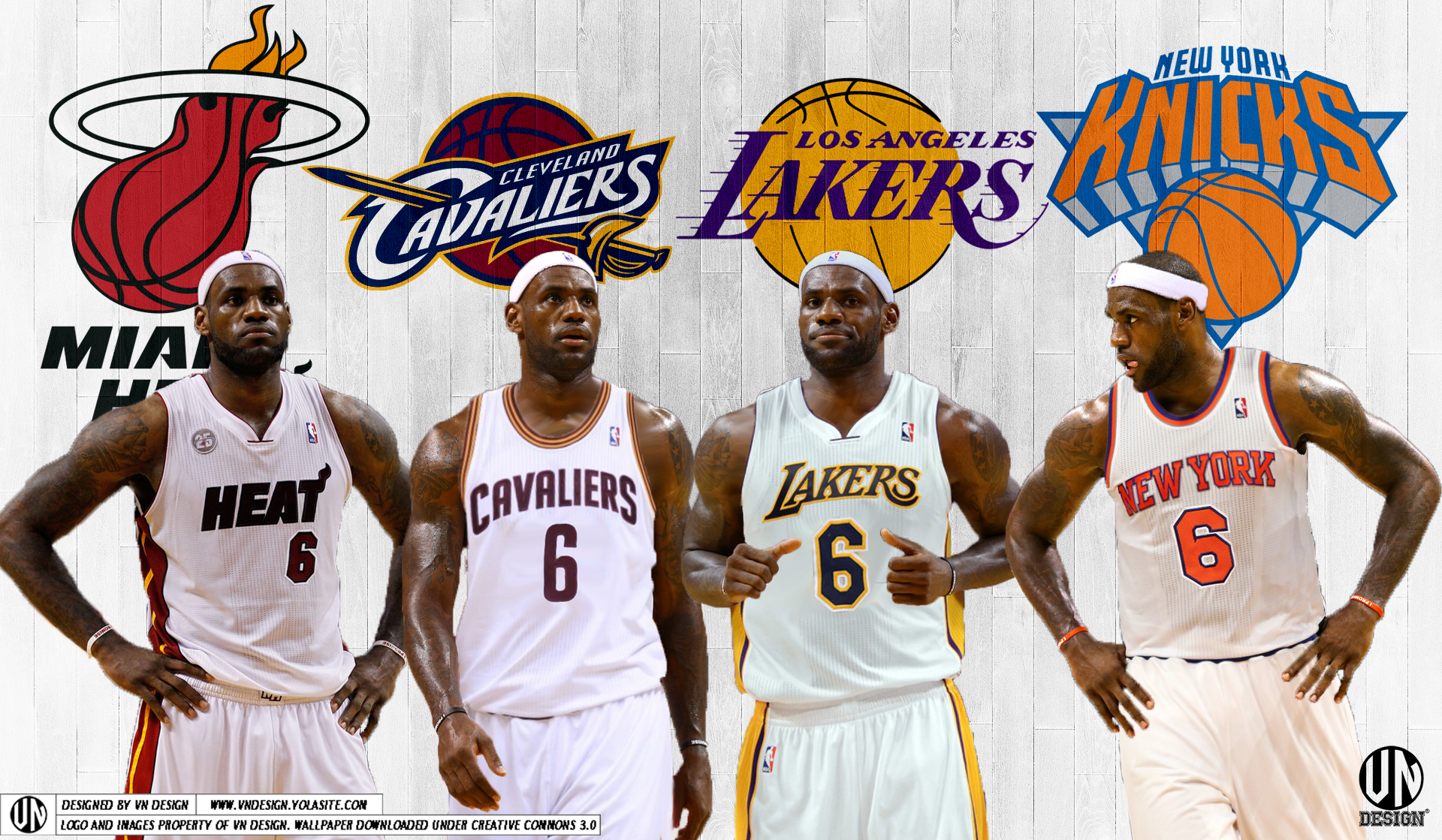
We were so quick to jump on the fairy tale bandwagon of LeBron James return to Cleveland and the Cavs, that we overlooked everything prior to it. The unbiased media was biased in rooting for LeBron’s return home.

They ignored all the prior theories about why and how he left the Cavs in the first place to gush about a love story. It was and remains fun to pick on the Heat now, easy to forget that LeBron picked them and then did nearly exactly what he did to the Cavs four years ago. There may not be a “Welcome Party” or a televised special, but we’re still enthralled with it. His website crashed on Thursday due to constant refreshes.

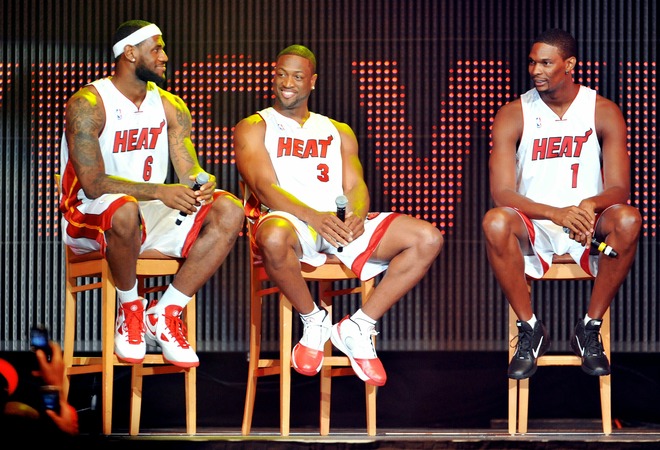
Miami Heat Introduce LeBron James, Chris Bosh and Dwyane WadeJames misled Pat Riley and the Heat front office, as well as his supposed brothers Chris Bosh and Dwyane Wade, for a few weeks, trying to let his PR folks figure out how to handle it better this time around, knowing full well that most likely, the vast majority would be delighted he’d come to his senses and returned to Cleveland.

Should it – does it – matter that James did both the Cavs and Heat dirty, or can we even acknowledge this time around he did? See, we’re fine with certain things, a bending of the rules and the moral code, as long as we like the end result or the person.

We are fine with this decision because Cleveland needs him, he’s from there, Miami has more sunshine in a day that majority of us see in a week, Riley’s legendary status was not enough for once, the Heat had their success and you shouldn’t be able to win with your friends at a discount.

Above all, it’s just a heartwarming story. And man, are we a sucker for those.

You can be an egocentric individual and a great athlete – believe it or not, many before have. So LeBron James can be a great basketball player. He can want to be in Cleveland. He can be a good husband, a great role model and father, as well as tremendous at a number of other things. But can also be a disingenuous businessman.

It’s OK for us to admit these things, still want these athletes to succeed and win our favorite team’s championships. But we just can’t bring ourselves to admit anything like that.

We need them too badly.

We do the same thing with actors. We want to believe they are the characters we see in the movies. We’re stunned at the rumors and the arrests, disappointed they failed our expectations. And then we go right back to watching their films, because we need them way more than they need us.

We need heroes to distract us from our schedule-oriented, consumer-driven lives. We need them to wear the championship shirts, to have some seminal event to share half-drunk with friends, to bond with our children.

This is both understandable and remarkably sad at the same time.

We value the real heroes, the ones who died, sacrificed themselves for us and gave all to protect our freedoms. But we only do this on holidays where we are reminded of it. Our society, our culture, demands that our heroes forever be in our face, in our minds, lest we forget who we truly idolize.

We’ll always want and need Jeter, Jordan and James because they are someone to follow from a distance. And following at a distance allows us to not get hurt, to feign emotion and allows for easy backlash, if ever required. Our disappointment, while directed at them, is really with ourselves.

No wonder Twitter is such a big hit.

You may be asking yourself why this is a problem? Who cares and what does it matter?

Simple: our hero worship is so out of control that it is controlling us. We want our kids to be heroes, so we push them too hard, scream at their coaches and yell at their teachers. At the same time, ironically, we don’t want them embarrassed, so we shield them from possible pain and rejection. This is why everyone gets a trophy. This is why cuts are no longer publicly announced – even for a high school play.

In our own bitterness, resentment and disdain, we’re erasing the very things that balance us out and make us real for future generations: pain

Rejection and pain were meant to serve as a catalyst to something more. Once upon a time, they did. In fact, these very heroes we worship all have their stories of pushing beyond someone else’s no.

Now, we’re all too happy to use them as an excuse. This leads to a life of feeling sorry for ourselves, passing the days remaining in our lives by hoping for our hero’s successes or failures, all while buying their music, their movies, their jerseys.

Love or hate LeBron James or Derek Jeter over these past few weeks, we made them. We empowered them.

If we are even remotely interested in solving some of our bigger issues, it would serve us good to spend more time reflecting on what we can do to make ourselves less emotionally dependent on the success of others.

If we poured even 25-percent of what we give them into ourselves, I bet it would be amazing what could be accomplished, both as individuals and as a collective society.

The only problem is, those days seem long passed us now. We bypass challenges these days. We don’t pay even pay tribute in the right way.

We just throw lazy fastballs.

Right down the middle.

Standard
LeBron James, Media, NBA Free Agency, Society & Culture

Searching for Sources

Roughly four years ago, I wrote this piece about unconfirmed stories, rumors and the growing use of “sources” as a complete cop-out.

Oddly enough, four years ago we had the absolute circus known as “The Decision” when we all collectively freaked out because a young man we (fans and media) gave a ton of fame and attention to at a young age chose a new basketball team.

LeBron-James-DecisionFunny how much and how little changes over time.

We didn’t like the bombastic manner in which LeBron James joined Chris Bosh and Dwayne Wade in Miami – though in hindsight, the televised event raised over $6 million for charity.

No, we had a problem with the “Welcome Party” the following day – you know, “Not one, not two…

And who wouldn’t, really? The brash, bold, self-aggrandizing manner in which they presented their new union was more than a touch overboard.

Still, did we take the time, in the moment, to analyze what was happening? No, not really. And we rarely do, because we are human. We need and want instant reaction, gratification and resolve. We were all busy burning jerseys, bashing, mocking, and defending.

I was among the masses, proclaiming that the “King” was a bit out of his element, that he hadn’t won anything, that, at 25-years old, he had severely overplayed his hand.

But over time, I accepted this narrative: his handlers had blown the whole TV thing, Jim Gray made it all seem a bit cheesy and most importantly, I thought that James was still in many ways a child-like person, just trying to break out and do something bold.

He never went to college, therefore wasn’t recruited, so it seems logical that he liked the recruiting process of free agency in 2010 – something that after many years in Cleveland, he’d earned the right to do. The Cavs never got him the help he needed. Jordan would not have won titles with that scurvy crew of misfits.

Feeling under-appreciated, feeling boxed-in, James went to Florida, to beaches and Pat Riley’s legendary figure, to Mickey Arison, a hipster dude who owns cruise ships and a basketball team. He went with buddies he made on the Olympic team, guys he knew didn’t suck at the sport of basketball, as it seemed his fellow teammates on the Cavs kind of did.

What was the truth in 2010? Probably a little bit of both.

And now? Well, I’m not sure any of what’s going on with James reasoning matters as much as how much stock we’re putting into reading tea leaves.

We think way too much of our athletes and role models in the public sphere, and yet at the same time, we dehumanize them. They have emotions, they have biases. They have their reasons. We just don’t care about that.

All this is to say, I can see how and why James would want to return to Cleveland now, four years later. A bit more accomplished to say the least, a bit more mature, perhaps even better equipped to handle the ridiculous amount of pressure applied by the greater Cleveland fan base.

I can also see how and why James would stay in Miami, even if for only a year or two.

Does James play into the power trip? Of course. And if you’re waiting for him to not, you are simply in the wrong era of athlete.

What about all of us? What about the fans in Cleveland who burned his jersey, now pleading for his return? What of the owner who comically, sans-ily wrote the most vicious and disgraceful e-mail in the history of people who got picked last? What about the Heat fans who walked out and booed in the Finals? What about our collective reaction to the cramps?

For better or worse, this man cannot win. And we like it that way, for whatever reason. So no matter what this decision yields, we’re ready to lose our minds.

And that is the entire crux of the problem. It feels as though nothing has happened, yet everything is happening.

James himself has done and said little to perpetuate the absolute ridiculous and scary uproar through the media over a possible return to Cleveland.

LeBron James The decision 2014This brings us back to sources.

You’d think we’d have learned something from 2010, from attaching legitimacy to rumors, to giving full credence and exposure to “sources.”

But we haven’t learned a damn thing. If anything, we’re doing it all worse than before. From New York to Miami to Cleveland to Los Angeles, we’re all preparing for way too much joy and way too much anger.

Have you ever seen so many formerly reputable people get so much wrong? And someone reputable will be proven wrong, for sure. There are so many journalists and media types on both sides of the fence that there is no gray area. Reputations will be damaged.

And why? Because they are rushing to get anything out in an effort to provide the smallest morsel of information, to satisfy us. We crave it. We say we don’t, we act annoyed and we pretend like we don’t want it, but we do.

This is our drug. It’s speculation, gossip and the need to know what we don’t really need to. And the addicts need fed. Which is why we’re hearing anything and everything.

Cupcake shop owners claiming it’s a done deal. Moms who say LeBron’s wife’s pregnancy is enough to push him back to Cleveland. Someone who talked to someone in James’ group in Vegas who told a friend that Pat Riley exposed the pregnancy to the media before James had a chance to tell all his family and friends, so now they are mad and hurt.

Web programmers who have found hidden code on his website that shows the color scheme could change to Cavs base colors. People tracking Dan Gilbert’s plane, people watching and staking LeBron’s homes in Miami and Cleveland.

Look at us? Are we not entertained? We asked for it. And we can’t deny it any longer. SportsCenter, talk radio and Twitter are breaking records for viewers, listeners and refreshes per minute. James’ website crashed today. All because we’re seeking another hit, another piece of dubious intel.

And the media, addicted to our clicks because it brings pay raises and job promotions (see Broussard, Chris, 2010), are more than happy to find something, anything to be our dealer.

Is this a harsh or unfair analogy? Maybe, maybe not.

We want the media to check its sources? We should be checking ours.

Our sources, after all, are what permits this whole charade to begin with. A culture obsessed with the dirt and greed produces just that. We’re angry either way with James, then and now, because we’re jealous.

We’re outraged by his greed and the greed of athletes everywhere, but we’d do the same thing. We blast them for taking max deals and the money and playing for owners with less-than high morals, then blast them even more for collaborating with each other to take less and play with their friends and win championships.

We won’t be happy, no matter what. Social media is certainly intensifying the issue. It didn’t exist for Jordan’s playing days, or we would have destroyed him, too.

We’re easily bored, ready to tear down our idols just as fast as we build them up.

And why? Because it makes us feel better about us. Our lives are relatively empty, so it would seem by the way we follow celebrities and blow things completely out of proportion.

We have few true sources of joy and purpose as a society at large, so we do this. We ignore the news and stories that really matter, really make a difference, and throw all our emotions and interest to following adults who play kids games for large amounts of money switch companies to do the same job. We cut people down, and cut people off before we flip them off.

We jump jobs for money, then ask how they have the nerve. We cheat on our spouses, lie to our friends and cut corners, then put them on blast for doing the same. We scream at youth sporting events, officials and blame coaches, then call the pros cowards for doing the same in an interview where they’re goaded into the same. We’re hypocrites and we’ve created this.

‘Merica, right?

So here we are, four years later, having learned really nothing. We still wait with baited breath to find out where LeBron James will spend the next year, two or four, putting a basketball through a metal circle. Until we find what our collective culture is looking for, we’ll just keep on doing in this, in truly mind-numbing ways.

We’re in full-blown instant gratification mode now, seeking resolution merely for the sake of being able to move on with our judgments, our condemnation, our praise and dissection.

Feed the beast, LeBron. We’re hungry.

It’s just what we do now.

Before we blame anyone for this mess, perhaps we are the ones who should check our sources. Because I’m nearly 63.2 percent sure that according to reports, our intentions are dubious at best.

And we are all witnesses.

Standard
American culture, Donald Sterling, NBA, Uncategorized

A Wrong to Write

Over the past week, as Donald Sterling’s disturbing remarks came to light and the world reacted, I watched it unfold. From the statements to the ban to the talk of boycotts, I just listened, read and absorbed.

But for the first time, I wrote nothing.

It was not for lack of something to say, an angle or an opinion. Anyone who has read what I write about knows that I have no problem diving into a topic, sensitive or not, and navigating through it with thoughtful intent.

Donald SterlingOn Thursday, I finally had a complete, nuanced outline in my head of what I wanted to say on Sterling and the entire situation. About halfway through putting it from brain to laptop, a dear friend texted me and asked me what I thought and why I had not posted something about it.

I bounced my draft his way. It was a thought-provoking piece about race, racism, and the new social media justice that has evolved into a speedy, mob mentality that we should be fearful of should the topic not be something we could universally agree on (you know, like Donald Sterling being a slumlord scumbag who should certainly not own a basketball team.)  I asked if there was anything in it that could somehow be misconstrued or viewed as insensitive – certainly the last thing anyone wants, but especially on this topic.

His response was probably more thought-provoking than my piece.

It’s good, and you certainly spent a good enough amount of time making sure it was crystal clear that you didn’t agree with Sterling while making an entirely valid point. Freedom of speech and this social media component are an important distinction from this particular topic, but some might not make that distinction. You have to ask is it worth it for you? The sad part to me is that you even have to think about it.”

It wasn’t the response I was expecting, and it affected me. Why was I struggling to post it? Why did I wait so long? Was it because of the topic?

That’s not me – or at least it used to not be. More frequently than ever, I pass on stories that I feel I have a well-informed, researched and thought provoking opinion on. The mental war over what the fallout of negativity might be is just not worth it. This makes me slightly sad.

Are there more out there like me? Writers and journalists and bloggers afraid to post about certain topics because of the mob mentality of social media and the speed of judgment made now in America? I re-read my draft on the Sterling situation and found at least eight different instances where I used multiple adjectives to describe how disgusting I personally found the man to be – whilst trying to make a broader point about being careful how quickly we react. I was so concerned to make one thing clear (I’m not racist) that it was interfering with my other points (social media has changed how we react, is this a good thing?, etc.).

Do I really need to guard myself that much?

This is my passion. I admired and devoured the work of Frank Deford, Tony Kornheiser, Gary Smith, Ralph Wiley, Malcolm Gladwell, Chuck Klosterman and Bill Simmons growing up. I favorite author is probably George Orwell. Kornheiser’s piece on Nolan Ryan from the 1980 Sporting News is perhaps one of the finest pieces of long-form I’ve ever read. And Deford’s “The Deer Hunter” piece on Bob Knight in the fall of 1980 for Sports Illustrated rivals it.

Wiley’s catalog stands next to most as some of the best, thought-provoking and ingenious writing I’ve ever come across. I was deeply saddened when he passed away too young. Simmons was the first to use the internet, pop-culture and sports and wrap it up into a massive piece that left you laughing for hours.

Writing is an art. It is powerful. It has always inspired me because I believe words can inspire others, sway them, inform them and move them. Which is why I was perplexed by my hesitation to post what I knew would be a good take on this mess with Donald Sterling, the NBA, race and social media.

But I didn’t feel safe enough to post it because frankly – regardless if it was this topic or not – free speech is dying, if not dead. There are too many topics that immediately spark a response – no matter what the take or angle, no matter how thoughtful and sincere. You’re better off making fun of PED users, bad calls and questioning the NCAA than you are to actually discuss the nuanced issues facing both sports and society.

The reason free speech is dying is because of the very place that would seem to promote its use the most: the Internet.

Twitter and Facebook have caused a rapid shift in society and our culture. You can share whatever you want, but whatever you share is spread more rapidly than ever before. And it is not only shared, but dissected and rapidly responded to.

On the surface, this seems good. We tend to associate speed with progress – like the swift speed of booting Sterling from the NBA in 72 hours. In 1914, this would have taken months, if not years. In 2014, we do it in a matter of hours.

And as I said in the Sterling piece I will not be posting, that’s just fine in this instance. But is it fine because we all agree on who it was and what was said? What happens if the topic is more ambiguous next time? Will we still move so rapidly towards the decision?

How many times do you write something snarky on someone’s Facebook post or reply to a Tweet without truly thinking about what you are saying? What implications there might be in 10 minutes, 10 hours or 10 days? You don’t think, because you are reacting. And reacting is 100 percent emotional and spontaneous.

Social media has increased the speed and the volume of reaction and therefore emotion. We have a lot of emotion in the social media world today. This emotion, this anger over your opinion, mine and theirs is what leads to the reduction of use of free speech.

Free speech is a principle. You may not agree with it in its various forms, but the point it supposed to be that it is allowed. Like so many, I cannot fathom how Donald Sterling thinks the way he does in 2014. It is beyond insensitive, beyond embarrassing and beyond rational.

Free speech is also not something to hide behind. You cannot run from your words, or avoid a fallout. There can and will be consequences for the things we say – as there were and should be for Sterling. But if the person still wants to say something, under the Bill of Rights, it is allowed.

The absolute key, however, is that to check and balance this, we must make sure we do not lump in allowance with tolerance or permanence. They are each separate entities.

A principle has to be defended because it is a principle, not because we all happen to agree in this instance it was violated was for a perfectly good reason. The Sterling situation is obvious; what do we do and how do we react if this happens again, but it’s not about race? Are religious comments OK? How about sexual orientation? What happens when there are other shades of gray and moral ambiguity involved?

Why we must practice some patience is because of that very thing: next time. Here, the punishment and the reaction were befitting and deserving in this instance because we all agree it was offensive and there is no place for racism in this country.

But we must be aware it will now serve as a reference point to any and all future situations that may not be so unifying.  Better still, how do we feel about social media being able to so quickly affect decisions in this country, in our society?

This is a real thing, and it’s a reason that someone like me, who loves writing more than most and has been doing it for years, is left wondering whether I should or can freely express my opinions anymore.

Then again, I guess I just did.

Sigh.

I should have just scraped this whole thing and wrote jokes about quarterbacks and crab legs.

Twitter loves that sort of thing.

Standard