American culture, NFL

The Social Media Mob

On Tuesday morning, I was driving to work listening to “Mike & Mike” on ESPN radio, as I do most morning commutes. For 15 minutes, Greeny and Golic allowed Jim Turner, the former offensive line coach for the Miami Dolphins, to share details and his point of view on what exactly happened last year between Richie Incognito and Jonathan Martin that led to a social outcry over locker room ethics and behavior.

For the first few minutes, all I could think was:

  1. Why are they rehashing all this? That was last year!
  2. Why are they giving this man so much air time to talk about something that happened last year and has been over for so long?

After all, there was much more to talk about – sports for one. But if the show was heading down that path (again) of discussing the larger issues that are taking over sports, then why not at least cover something from 2014?

And then it hit me.

We never really figured out what happened.

I didn’t even know this guy’s name. We moved through that story, that news cycle, so fast and with such condemnation that we made grandiose assumptions about what happened, but never really found out the truth, then came to a conclusion well in advance and moved on to the next thing.

social mediaIf it seems like the NFL is in a dark place right now, it is because it does seem that way. But seeming to be is not the same as it actually happening. To be fair, the NFL, NBA and the world in general are not any darker or different than it was 25 or 30 years ago.

We just find out about everything now – in near real time – and often react within the same beat.

We have a mob mentality on Social Media. We have shifted into an era of guilty until proven innocent. This is no longer about defending one person, their actions or even trying to determine what actually happened.

This is about the part that precedes that part.

While there is clearly a lack of leadership in the NFL – and perhaps more importantly, it’s player’s union – the NFL and other professional sports leagues should not be held to a standard that we do not hold ourselves or the justice system to.

In other words, while the NFL can and should do better, it is not their responsibility to go above and beyond the punishment, or lack thereof, handed down by the law.

We’ve been dipping our toes in some very troubling waters lately. Social media has pushed the public outcry to a place that is placing a great deal of pressure on different groups and people to act correctly – and with extreme speed. This creates two important problems that we seem to be ignoring with consequential long term damage.

Problem No. 1: In an attempt to get things right, speed matters. But not rapid speed. Rushing leads to mistakes, to not hitting all the angles just right. Think of pretty much every time you have rushed to get something done. Now how did that work out? Fail a test? Miss a deadline? Burn the casserole? Care for any do-overs? Ever think back on that situation a month, six months or a year later? While our decision making process should not take a long time, it also shouldn’t play out in 36 hours.

Problem No. 2: We cannot agree on what is “right” – and we probably never will. This is a simple fact of humanity. You will not find everyone in complete agreement on any issue, which is a good thing.

Look, we do not need to like the same things. The world would be a pretty boring place if we did. But we also do not have to agree on everything, or be right all the time. Better still, until we have all the information we need to process something, we don’t even need to be first or fast. We should want to do what is right, not just be right.

Debate, whether reasonable or not, at the very least helps with Problem No. 1 because it forces a slowdown. Making a decision alone, without consult, and it tends to cause collateral problems.

There is no doubt a wide array of opinions on the Adrian Peterson situation. From every corner, we hear from people with various and diverse backgrounds who have all been disciplined in a numerous ways. Some might have been whipped and hated it. Some might have hated it, but understood it and employ it with their kids. Others were never whipped and have run amok in life, while still even more were never spanked and have turned out to be fine, upstanding citizens.

But we want to be right, we want everyone to agree that we are right and we want to move on to the next thing we can find to stand up on a soapbox and shout about, be right about and move on from.

It does not – or should not matter – what our opinions are in regard to these situations, frankly. We can and should feel free to share them, so long as it does not sway the process due to them. And there is a difference between defending someone and defending the rights of anyone.

For example, Donald Sterling is clearly a sick, twisted and evil man. The NBA used his incredibly disgusting track record and a surging public outcry to take his business and sell it to someone else. And while the NBA – and the world in general – are better for it, while we all applaud the fact he’s out and gone, it doesn’t make us any less culpable for beating up the bully and taking what didn’t belong to us.

And now, it’s over. It feels like a long time ago.

It was July.

adrian-petersonWe’ll move on – and quickly – from Adrian Peterson, too. Just like we did with Ray Rice and Roger Goodell a whole week ago.

It is strange to think how collectively, through social media, we make up one of the most influential groups in the modern world. It’s an instant poll in many ways – like performing in front of a live audience, except with each line, you stop, gather the reaction and then move on to the next scene.

Truth be told, no one knows what to do right now –almost entirely because of what we will say. We have frozen the market on public relations, almost across the board.

Beer companies are threatening to pull sponsorship money because the NFL’s problems are not matching their “value” system (slightly ironic, right?). Hotels are gasping when their sponsorship banner hangs behind a team official as he makes an announcement because of the content and topic of said announcement.

Major sports companies and sponsors are suspending or pulling their deals with athletes and teams and leagues because they are afraid of us. They are afraid we’ll boycott, that we won’t buy their goods or services. Further, these actions are met with approval from celebrities and dignitaries outside the world of sports, simply because it feels like something that needs to be stated: “[Insert whatever situation, e.g. Child Abuse/Domestic Abuse] is wrong and I’m glad to see them doing something about it.”

Except nobody really did anything. “They” stopped selling jerseys or action figures or posters. They suspended someone with pay. They booted someone from the league. But nothing of real value has actually been done to prevent future child or domestic abuse.

This is not just limited to sports. Last week, Apple haphazardly forced all iTunes accounts to download the new album from U2 – which was met with swift and shameful scorn by social media. In about three days’ time, Apple released a program that would remove the album from user accounts. Good, right? Except how many even knew Apple possessed the power to put that on our devices to begin with? And if they can do it with Bono’s overly produced music, what could they do it with in the future?

We have yet to understand the breadth and depth of the power we now hold in our hands – both the technology and the medium.

Look at what we’ve done in just the past 10 days: Roger Goodell, the most powerful sports commissioner in history – has been shamed into hiding for the past week. Perhaps he should be fired – for a variety of reasons that include incredibly poor decision making – but a gone Goodell does not solve the problem. It only satisfies the social media mob.

The NFL did not just get a domestic abuse problem – as detailed here, it’s had one for years. Whether or not Goodell goes away or Ray Rice ever is allowed to return does little to address the issue. Further, we don’t seem to actually care about Janay Rice, just about using her as visual evidence for our cries of NFL violence and players out of control.

Donald Sterling did not just become a bigot overnight after a weird conversation with a woman not his wife; it had been documented for years as the lawsuits piled up. Being ousted as owner of the Clippers changes none of the living situations and irreparable damage Sterling did to others as their landlord.

The same as the NFL locker room has probably always been a strange place to you and me, the details of this foreign area escaped last fall in a situation that has been reported on largely by one side. But we don’t care about Richie Incognito or Jonathan Martin anymore.

We’ve long since moved on.

Last week, we had the whole NFL, the Baltimore Ravens and Ray Rice to be the judge, jury and pass verdict on. This week, we’ve got Adrian Peterson and the Minnesota Vikings. Next week, or the week after, it will be something else.

We’re using social media to collectively engage in our own little drama filled soap opera. And now, as our social media world turns, so does the actual world. We engage and trade barbs and opinions with people we know and we don’t know, saying things we’d never say out loud and/or in person, making the world at large believe we’re actually invested in the issue of the day – making our collective voices the loudest voting poll in human history.

You have to wonder if our cyber selves are creating a kind of future where social media swiftly – and with great feigned outrage – decides even more. What about the policies and the politics that govern us? Will we continue to not wait for all the information and provide a presumption of guilt until proven innocence as standard operating procedures?

Just remember that it is not so much about who you are, but what you will become.

I feel compelled to ask, what are we becoming?

And, are we really OK with it?
Standard
Uncategorized

Rog: The Great & Powerful

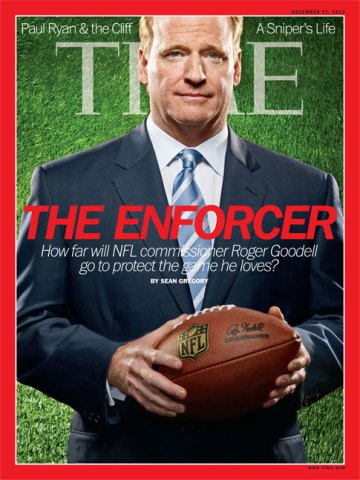
“I don’t do things for public relations. I do things because they’re the right thing to do, because I love the game. If you want to do the popular thing, be a cheerleader.” – Roger Goodell, in 2012, to TIME

Maybe Goodell, who didn’t make a misogynistic comment at all with that line, should be a cheerleader, because he does not make a very good NFL commissioner.

Oh, certainly, Goodell fits the profile and looks the part: a strapping lawyer with blonde hair and blue eyes, well versed and tenured as an NFL employee, saying all the right things in interviews.

However, behind those steely eyes lies the mind of a egocentric, greed fueled and power hungry man who’s blinded by the bright lights and the cash cow that is his league.

It seems as though the league has gotten worse off the field since Goodell took over the reins from Paul Tagliabue in 2006. From his random, inconsistent suspensions to how naïve he pretends to be on concussion related issues, Goodell plays the brilliant fool so well, you can see how he got the job.

Goodell’s lagoodelltest bungled act was the two-game suspension of Ray Rice for his assault of his then-fiancée (now wife) last February.

After waiting for months to let it play out in the courts, Rog suspended Rice for two whole games – or two games less than recent drug violations netted other players.

Now that TMZ has done a very TMZ-like thing and leaked the elevator video for the world to see what Ray did, Goodell hides behind technicalities like not actually seeing the video himself and apologizing for misunderstanding the egregious act by Rice.

On one hand, he tells you that the NFL has been working to better understand domestic violence over the years, but apparently did not learn that you don’t interview the victim with the violator in the room, as they did with Ray and Janay Rice.

Goodell spins yarns about how the NFL just couldn’t seem to get their hands on the video from the hotel or the police, then hear from well-regarded ESPN legal analyst Lester Munson that the NFL security team is full of people with “former” titles that spent entire careers getting exactly what they want.

Goodell and the NFL did not see the video because they did not want to see the video.

The tragedy of Roger Goodell is he feigns his emotion, his pain and his condolences and then turns around and cashes the checks of millions who gobble up his league every single day.

In that same issue of TIME – the one that deemed Goodell “The Enforcer” – Goodell said that when Jovan Belcher killed his girlfriend, then himself, it was a human tragedy. But days later Belcher’s team, the Kansas City Chiefs, played their game. Goodell explained the players wanted to play, that it would be good for them.

What again about doing the right thing?

Keep cashing those checks, Roger. Or posing for those authoritative magazine covers.

The checks that go into the massive Scrooge McDuck money bank, the ones that fill your over $40 million dollar salary.

Goodell says he isn’t worried about his job. Says that he’d used to the criticism.

“Every day, I have to earn my stripes,” he says.

I just hope he doesn’t break his arm patting himself on the back for all his hard work in the areas of player safety and making the league’s players better citizens of society.

goodell-si-cover“People expect a lot from the NFL,” Goodell said this week. “We accept that. We embrace that. That’s our opportunity to make a difference, not just in the NFL but in society in general. We have that ability. We have that influence. And we have to do that. And every day, that’s what we’re going to strive to do.”

Whatever. It’s all noise now.

The simple fact is, the NFL wants your money. Nothing more, nothing less. And they know they’ll get it.

They care about the product on the field only as it pertains to enhancing the enjoyment of the event you’ve paid to see, either in person or on television.

And they could care less about the players who produce the product, unless it is a brand name like Manning or Brady, because the NFL knows that players don’t last forever and the league itself is bigger than any one player or team.

The NFL is not alone in its objective, mind you. Restaurants, hotels, car dealerships – before you get home, you’re getting buttered up in advance for your next meal, your next trip, your next new car. They liked your sweet paper and they want some more of it in the future.

If it takes a voucher to ensure you return, so be it. If it takes a measly two game suspension for beating up a woman in an elevator, fine. Goodell did what he figured would bring a little heat, but blow over long before that kickoff game in September.

This one backfired, but the next one might not. Sure, the media is clamoring for his resignation, but those billion-dollar owners, the ones he works for? They want more of that sweet paper, too. So long as it doesn’t destroy the gate receipts and TV revenues, Goodell’s job is safe.

Goodell could have and should have done more to send a larger message about domestic violence. He is right, the NFL does owe it to society at large to set an example. They have the influence to do that.

But that is not the world we live in. It sounds great in a memos to teams, but it does little to change anything. In the real world we live in, a subject of real importance that deals with how we treat one another, how we treat each gender in the roles of relationships is cut up and distributed to the masses on blogs, social media, Sports Center and talk radio.

Even when the NFL is wrong, or in a bad news cycle, it still gets the ratings and coverage it wants – lining that money bin with more paper.

Our addiction is the distraction Goodell and the NFL count on, each and every time.

Goodell has the ball, always has. He’s just been running trick plays for years, distracting us with his charm, his wits and his quotable lines of empathy.

Don’t forget: The Enforcer will protect the game, not the people.

Not even the cheerleaders.

Standard
Uncategorized

Culpable to our Capabilities

A bogus urban legend or not, the theory that we only use 10 percent of our brain’s capacity is gaining some personal traction with me.

And let this second sentence serve as a warning, fair reader, that yes, I am about to embark on the underlying theme found within all my writing over the past few years: we need to change or risk becoming the worst generation in humanity’s history.

It’s a bold statement, to be sure. And it is merely conjecture, but still, humor me and take a look around you.

What do you see?

I see a world utterly obsessed with filth and stirring the pot; I see an era in which we are more self-involved than at any point in human history. Mix those together and you get one helluva hangover when the party’s over.

In “Noah”, the biblical epic starring Russell Crowe, humanity is depicted as having reached a breaking point with its creator. By killing, stealing, destroying the world of its natural order as the creator intended, Crowe’s Noah is convinced that the world is meant to be washed clean of its filth.

So if Tabul-Cain was bad for putting his needs before others and eating the flesh of creatures placed on Earth by the creator to serve a certain purpose, where does that rank us?

justin-bieber-just-launched-a-new-social-network-dedicated-to-selfiesWe, of our selfies, nuclear war and material obsessions. We, of our indulgence, greed and corruption. We, of our sick and twisted ability to manipulate, judge and condemn.

It seems as though we are simply out to get one another, to catch someone and make them twist in the wind. We forward e-mails, directly quote them and use people’s words out of context and to our advantage, all in an attempt to make them feel pain, regret, agony or remorse.

Our emotions are out of control and we plaster them for the world to see.

What do you feel?

See, no matter if you believe in evolution or creation, both parties should be worried. We are either angering the creator or we are destroying the ecological systems which hold nature together.

We verbally abuse family, friends and random strangers through social media – as if it is our place, our right. We share space, but we don’t share a willingness to make this world any better for the future.

Are the best days of the United States behind us? Will we become a historical footnote like the Roman Empire?

These questions cannot be answered in the present, only at some unknown future point and with a proper evaluation period – though it should be noted that currently, more than 52 percent of Americans think our best days are behind us. This pessimism, shockingly, has happened very few times since Rasmussen Reports began taking the poll.

Nonetheless, these questions remain the backbone of a larger proposition: what are we doing with what we’ve been given? How are we handling the world after those that came before us worked so hard to get us to this point?

The misconception comes from believing the world was a better place in the past. It was not – but it was filled with generally better people, who nominally shared a wholly different mindset than we do.

The point was to progress, to advance, and to set the table for the future generations. We advance in terms of technology, but there seems to be a correlation that with more technology, the more introverted, self-serving and self-seeking we become.

In “Lucy” they discuss this specifically, albeit as a general theory in the context of the film’s plot. We either adapt to our likable surroundings in search of immortality, or we reproduce in hopes of passing on what we have learned to future generations.

What are we passing down?

Cell phones? Text messages? Candy Crush?

We went to the moon a few times and we’re so busy with this stuff we cannot afford the time, energy or investment to go back? For the past 40 years? What about Mars, or other places in the galaxy? We can pump out $100 million prequel and sequel movie budgets but we can’t work on the stuff that matters a bit more?

When Alexander saw the breadth of his domain he wept, for there were no more worlds to conquer.  

We’ve got lawmakers wasting taxpayer time and money on the NCAA and the Washington, D.C. football team nickname? As valid and rational as the conversations about those topics may be, I’d prefer to wait until we’ve got world peace or eradicated hunger before delving into those matters.

We cannot prioritize because we do not know what our priorities are – and we think we should care about things, so we act like we do as long as we need to in order to convince others we find it important as well.

nasaCase in point, let’s look at NASA and the Apollo program again. We didn’t go back for the simple reason that we could figure out a way to get there, but never knew what to do next. We talked of colonization and moving on to other exploration, but public sentiment waned from shortly after our giant leap for mankind.

We now write the history of the importance of this event. The rhetoric of the importance of math and science rings true in our current educational state, yet misrepresents that period of time completely. After our awe-inspiring accomplishments in both landing on the moon and bringing back Apollo 13, nothing really changed.

As others have argued, including this article, the age of Apollo ended due to a number of factors – money, the Cold War, shifting interests, war and social issues – but there was more to it: we just didn’t care as a society about what the program symbolized.

Science, technology, the future, progress, where man could go and where it might need to mattered little compared to other things we’d deemed more important by the 1970s.

This has not really changed. There is a reason we don’t have Walt Disney’s actual Experimental Prototype Community of Tomorrow in Florida, or flying cars or a colony on the moon.

We stopped dreaming, stopped caring and stopped doing the things that facilitated progress. Our math and science scores are not good – perhaps because all we do is sit around and argue about what a waste of time NASA was and devalue the jobs that require those subjects the most. But by all means, let’s talk about Sharknado some more.

Our vocabulary and grammar are poor because we’re producing novels about BDSM and vampires. We are texting emojis instead of actual words. The era of “The Great Gatsby” this is not.

Ever heard the phrase “they don’t make ‘em like they used to?” and dismissed it as nostalgia? Well, it is not, in so many ways. We do not do us like we used to. We do not make cars like we used to, or books, or buildings or people. We do not do family meals like we used to, Sundays, schedules and vacations. We do not do life as we used to.

We work too much, party too much and wonder why our lives fill devoid of purpose and meaning. We complain about how people do not work together for the betterment of society and then spy on them. Why would we want our best and brightest working for or with the government? The government doesn’t trust the government – and maybe it never has, but know we can track e-mails and phone records to prove it with our own surveillance.

We only have ourselves to blame because we constantly and consistently self-promote that which matters to us.

If you find music reflective of society, for example, fine. Do me a favor and look at your playlist. Listen to the lyrics. Kei$ha? Pit Bull? Moping, weeping alt songs? Another drunken country tune? Miley Cryus? Death Metal?

Eric Clapton could make you feel it – from Layla to Bell Bottom Blues to Tears in Heaven to Wonderful Tonight – emotive, sweeping, real. And he wasn’t the only one. Now, I mean…just…wow. There is taste in music and then there is understanding what should be a song and what is drivel filled jibberish.

What do you hear? What do you see? What do you feel?

How about what you believe?

A story yesterday indicated that perhaps Coach Herman Boone from “Remember the Titans” is not quite as his character is depicted. Not a huge deal, seeing as how movies about true stories just embellished or changed to fit a Hollywood narrative. Until you find out that Boone himself is helping to pass along this propaganda and is somewhat rewriting his own history – and profiting wildly from it.

Whether this is all true or not is not as important as what we have permitted to influence and shape us as a culture and as a society.

In 2011, Terrelle Pryor received a five game ban from Roger Goodell and the NFL for his role at Ohio State of a scandal involving memorabilia for free tattoos. Last week, Ray Rice received a two game suspension for knocking out his fiancée.

Many bemoaned this, mostly Raven’s fans and fantasy football aficionados.  Others were angry over the apparent lack of empathy for the situation by the NFL – domestic violence is a very serious problem; this suspension does not necessarily imply that it is being treated as such.

You may not, but I care what this says about America, what it says about our culture and society. And I certainly care more about how misplaced the entire conversation is – which mainly revolves around Ray Rice and the NFL and Stephen A. Smith’s reaction – over what truly matters.

Moral judgments are fine, so long as we have a general baseline of morals to work from. We clearly do not.

After reading 1,600 words, the four of you left may be asking yourselves what NASA, Eric Clapton, Ray Rice, Herman Boone, Candy Crush, “Noah”, “Lucy” and the Washington Redskins nickname have to do with each other and how on earth they could serve as examples for our potential downfall.

And that’s just it: nothing and everything. It’s the tiny cuts and cracks that eventually lead to the rubble.

If this is the stuff that fills our minds and signifies our purpose here, then it does not matter if we are using 10 percent or 100 percent of our brain’s capacity.

Our true and maximum capabilities are shown all around us, all the time.

What we think.

What we see.

What we do.

What we hear.

What we believe.

We are the only ones culpable for maximizing our capabilities.

Now, what do you care?

Standard