American culture, Culture, culture war, Politics, pop culture, psychology, race relations, Society & Culture

As The World Burns

It’s beginning to look a lot like Christmas.

That is not such a good thing.

Here we sit, as the world burns around us, and lament the trivial, the inconsequential, the minutia. We fight over saving an extra 20 percent in the Target parking lot. black friday

I have come to the conclusion that we must secretly want it this way. Or we are lazy. Or we do not care. Or it is just easier to ignore it and focus on our first world problems, holiday plans, on the gifts we must buy. We do not really want to talk about it or do anything about it. We just want to complain about it for a hot minute and move on to the next thing.

We put a proverbial Band-Aid over it and hope it goes away?

Oh, you are probably wondering what “it” is. You want to define “it”? Fine, I suppose that is fair.  “It” is undefinable. “It” is everything, anything and nothing at the same time.

“It” is the topic of the day. “It” is immigration, race relations, religion, poverty, politics, international affairs and the economy. “It” is gun control, Hollywood celebrity culture, concussion protocols, domestic violence, locker room language and bullying.

“It” is how families communicate, nuclear and extended. “It” is marriage, divorce, parenting and children. “It” is our increasing reliance on technology. “It” is our jobs, our anxiety, and our fears, our obsessions with the material and immaterial of the world.

“It” is every little thing we deal with on a day-to-day basis.

Perhaps most of all, “it” is you.

Yes, you – the one who thinks I am writing to everyone else and doesn’t think that these (hopefully) thought provoking pieces of less than literary prowess over the past few years are directed at them.

It is directed at you.

It is also meant for me.

When my writing changed a few years ago, it was because the way I think changed and evolved. A funny thing happens as you age, you start paying attention to more than just box scores. You marry, have children and find yourself watching less SportsCenter. Why? Because in the grand scheme of things, it just doesn’t matter as much, while what we are doing to ourselves does as a society matters all that much more.

But a key realization occurred along the way: talking does little. Writing seems to do less. People do not want to hear about the ills of the world, much less so what they can do to improve it. We do quite a bit of talking in our public and private lives. Actually addressing “it” and finding real solutions is a much more difficult proposition.

And this is because we simply do not listen.

We hear, but we don’t listen. We can’t talk about anything that leads to a civilized, give-and-take discussion and solution, because mostly, we’re unwilling to budge on our positions, to meet others halfway. We react, we get angry, we get hostile. To most, an idea of a solution to any problem is agreeing that we are right. It is part ego, part vanity.

Devaluing the ideas, thoughts, and concerns of others while simultaneously self-promoting our own as fact and truth is as dangerous as it is foolish.

To most of us, we might recognize this, so we back-off. It is not worth the argument, the fight. We Band-Aid our lives for the sake of doing the dance. We won’t talk about “it” – whatever “it” happens to be, because all it will end in is hurt feelings, angry words and emotional outbursts.

So we bottle it all up inside, allowing it to take residence in our proverbial mental garbage bin of all the things we’ve ignored, swallowed and tried to forget over the years. These situations become like sticks of unlit dynamite.

And then, at some unknown point in the future, the most meaningless thing sets off the wick and we explode, looking like we need a straight-jacket and some prescription drugs.

We’re all a little crazy.

But that is because we allow ourselves to be. We think we’re saving face. We’re not. Clear and honest communication is a central part, but actually listening and being willing to bend, to meet in the middle on whatever “it” is would most likely serve us all well.

This much is true: if we agreed to disagree from the beginning and worked to a solution that neither feels entirely great about, but comfortable with, we might actually get somewhere in this world.

Our world view is significantly altered by the fact that I am me and you are you. We’re a country and world full of people with specifically engineered lives, with experiences vastly independent from one another.

We share the same period of time and space in this universe, but we experience that time and space in very different ways, which means we do not – and cannot – see the world the same way.

So why are we so surprised when people of opposing viewpoints and political parties, living in different cities, towns and regions, with entirely different life experiences disagree with us?

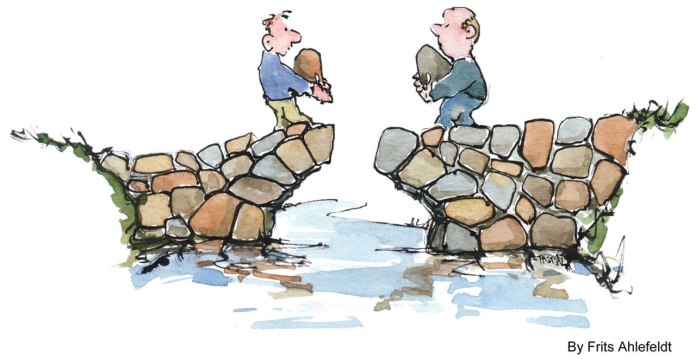
We will never agree on anything because not one of us looks at everything the same way. It is not about forcing someone else to see why they are wrong and you are right.On the contrary, it is an attempt to build a bridge toward the middle where you see where they are coming from.
bridge


That is problem solving. That is relationship management. That is how we were designed to interact. We are not all geniuses in all aspects of life and its infinite mysteries, nor are we complete morons, either. We’re a melting pot of races, religions, ethnicities, social, cultural and economic backgrounds.

We – READ: you and I – would be better off if this were not just a pipe dream, but something we actually exercised ourselves and taught to our children. You – yes, you – will be wrong sometimes. You will be right sometimes.

Sometimes, you might be either, neither or both.

The same goes for me, your parents, in-laws, children, their friends, teachers, your co-workers, the guy working construction and the lawyer on 5th Avenue, the President, Congress, Roger Goodell, Chris Rock and the waiter at your restaurant.

Be in the world, not above it. People are people, their problems are real because they experience them. Don’t shut them down. When we refuse to grow, we refuse to change – and change is largely inevitable. Growth is good. Sticking to your old habits, beliefs and traditions is not necessarily something to be proud of.

So this holiday season, start a new tradition.

Try.

Try to be honest. Try to be kind.

Try to avoid the Social Media tar pits that cannot be one. Try not to take the bait. Try to understand there are people who do not have food, shelter or friends.

Try to not be too swayed – or angry – with those seeking your vote, your money, your donations and your time. Try to give back a little more than you take.

Try to understand the other side, someone else’s perspective as best you can. Try not to shut down or shut out. Try open minded. Try accepting what you can.

I don’t think you should necessarily succumb to the world, give in to all opposing views and beliefs and acknowledge they are somehow right. But the world is not going to fully come your direction, either.

Try to build a bridge.

At least your half of “it,” anyway.

Standard
Bill Simmons, ESPN, Media, Uncategorized

Bye, Bye Byline

You know that old saying about opinions and a certain body part that ends with the punch line “everybody has ‘em?” Well, if the mega media conglomerates continue to silence the voices in writing, pretty soon, only one of those will still be true.

Media has gotten so big, so interconnected, columnists are a dying breed. Perhaps this is just the natural progression of things. First, it was technology impacting media and the death of the traditional newspaper. Next, the 24-hour news cycle and social media have reduced it to a sound bite.

And now, here we are toeing in dangerous, muddied waters were media, journalism, columnists and brands are all hanging out together around the water cooler.

For those who follow sports, writing and media, perhaps you are well aware of the recent events surrounding ESPN’s suspension of popular sports columnist Bill Simmons. If you are not, well, you can catch up by reading this or simply doing a Google search.

The short of it is that Simmons, who founded Grantland.com, and has been one of ESPN’s most popular writers for the past dozen years, was suspended in late September following a podcast where he called NFL Commissioner Roger Goodell a liar in regard to details and facts that led to the Ray Rice suspension.

Simmons taunted ESPN to reprimand him and got three weeks of what he was looking for.

No matter what you think of Simmons, as a writer or as a media figure, what is clearly evident is that this is his “Custer” moment. He’s taking a stand against something he feels is extremely out of sync in the world of media. It got worse on Thursday, when ESPN Radio’s popular morning show, Mike & Mike, played a snippet of a sound bite where Simmons critiqued LeBron James – to which one of the hosts of the show blasted Simmons for, and took a personal shot at Simmons over perceived headline grabbing.

Naturally, Simmons responded by going nuclear on Mike & Mike via Twitter.

Simmons Tweets

This is not the first catfight between “talent” at ESPN – nor will it be the last. But the last six weeks have brought into clear focus what is not only a growing issue in all forms of media, but especially in sports.

ESPN has serious issues to confront behind the scenes right now, and they have very little to do with Bill Simmons. The crossfire happening across platforms and brands happens all the time – and is wildly disconcerting. If you continually mock and belittle your co-workers, you both lose. The audience doesn’t know who to trust and become uncomfortable with the situation and will turn elsewhere for less hysterics.

The Worldwide Leader in Sports cannot cover sports as they should, in large part due to the behemoth brand that is “ESPN” – and perhaps most concerning – due to its massive TV rights contracts with the NBA, NFL and Major League Baseball.

For a long time, these moments have been coming: How do you completely cover a news story or an event if the entity you are covering in said story is also your meal ticket – sorry, “corporate partner”? ESPN pays for the rights to cover these games and find it difficult to dive too deep into sensitive issues and topics for fear they will lose that right down the road.

This is not just an ESPN problem – but as the biggest sports industry media conglomerate, it is the most easily detectable. Whether or not Simmons has the right to say Roger Goodell is a liar should never be in question, but it is because the ESPN brand is in bed with the NFL and the NFL just cannot be questioned like that from its partners.

And this is the same reason why no one can take the NFL Network seriously – it is merely a mouthpiece for the league to package the product and show highlights and retain some money by keeping viewers on their league channel.

The second component of this issue is how poorly we label journalism, reporting and writing in the current age.

Writing is a creative art form, and most other writers I know treat it as such. Opinion based columns are just that – based on someone’s opinion. While there are obligations to writing factual evidence in support of your opinion – an argument, really – it is not to be taken as journalistic reporting of events. And most people know the difference.

The ESPN Ombudsman wrote about this earlier this week, and frankly, I’m not convinced this person understands it either.

(Note: The Ombudsman is an appointed official who investigates complaints against maladministration, in this case, media and journalism.)

Agreeing that Simmons had not met “journalistic obligations” in providing sufficient proof that Goodell was a liar, the ESPN Ombudsman counters those like me who put Simmons in a different category by claiming that “Simmons sometimes acts like a journalist, or at the least seems to want to be taken seriously.”

Is that itself not a potshot from an unbiased appointed official? And further, am I right in taking this to mean that you cannot be an opinion columnist, a jokester or a podcast host and be taken seriously? What about that kind of writing and media means you are a farce in the eyes of the journalism world? Reporting the facts and only the facts would leave many others at ESPN – in print, radio and television – suspended to the point they might not have enough talent to do a show some days.

How do you prove someone a liar, anyway? It is the ultimate he said/she said. People struggle with this in a court of law, let alone a court of public opinion. Many would argue we still do not know all the facts on the Ray Rice situation and subsequent suspension scandal – partly because the NFL has contradicted itself, as well as having other entities in the situation dispute their side of the story.

Would the Ombudsman – or anyone else – have had a problem with the NFL calling the security officials in charge of the tape who claimed they sent it to the NFL liars? They essentially did. But the now-closed Casino didn’t have a television contract with ESPN or the NFL, so who cares about their integrity and side of the story, right? Has anyone come out and vigorously defended Goodell or shown proof that he’s not lying? If so, I must have missed it.

House rules do apply, except that the mansion of ESPN is not the journalistic beacon of integrity to begin with, so their house rules are painted with a heavy coat of bias as well. Should I not take them seriously because they market themselves so heavily?

Better still: how many “Rules of Journalism” were broken during the NBA Free Agency period? Do these sacred rules include quoting unnamed sources which turn out to be completely wrong? No one knew anything, but everyone knew something when it came to where LeBron James was going to choose to play basketball. ESPN printed many of these “rumors” on their website, discussed them at length on the airwaves. No one was suspended or reprimanded or blasted cross-brand for that. No one issued an apology weeks later when it was clear that half of what we heard the first 10 days of July was a mixture of gossip, rumor and lies.

The expectation that Simmons should show journalistic integrity is a farce for that reason and an even more important one: Simmons is not a reporter or a journalist. Just read anything he has written since 2000 – a conglomeration of jokes, analogies, pop culture references and random opinions. It is not journalism, nor was it ever intended to be. He’s no different than Rush Limbaugh or anyone else in that sub-category of media. He’s also not Walter Cronkite.

As the Ombudsman himself writes, “Simmons is a columnist paid for opinions, not a reporter paid to dig up facts.” Well, Simmons opinion was that Roger Goodell is a liar and that LeBron James is not looking like himself early this NBA season. While I personally wouldn’t put up quite the fight Simmons is – there is a bit of grandstanding taking place on his part – how can anyone determine his opinion is right or wrong, since by definition, it’s an opinion?

Some – like the Ombudsman – refer to this as accusatory or slander. That’s stretching those definitions for effect just a bit. There’s at the very least minor pause that can be given to the notion that Goodell was lying about seeing the tape based on what we’ve heard and read up to this point.

It is tough to condone the manner and irreverence of Simmons in these situations, but that was never the point.

We’re confusing what reporting, journalism and writing are. There are subgenres and shades of gray within the media world – and we’re forced to deal with most of them. But you cannot stop people or forbid them from sharing what they are being paid to do.

If this makes your brain hurt, welcome to the club, but more importantly, welcome to the future.

We’ve entered a mysterious world where something is essentially owned by a group that owns four other things that are not all that connected, but treading lightly is required all the same. Sticking with ESPN here: Disney owns Marvel, ABC, ESPN and Grantland – and must identify it as being so.

We chuckle when we think of Big Brother, but this is happening, in chunks and pieces, in different areas of our society. This is just one component, and anyone – like the ESPN Ombudsman – who suggests we simply all need to evolve is one of those already lost to the media machine.

Evolving would be recognizing the various and diverse kinds of writing and journalism that make up the media now, not ordering all good soldiers to fall into line with what the company  – or its partners want.

If that is truly the way we are headed, I fear for our creative writing genre in media.

Soon, even the byline will fade to the mind-numbing “Wire Report,” as if some lifeless droid concocted the cold, hard facts and presented them as such, sans opinion.

And that will truly be a sad day.

If you disagree, call me a liar.

I, for one, will not demand your evidence to the contrary.


[Writer/Editor/Blogger/Site Manager Note: For clarification purposes, this was an opinion piece and in no way, despite fancy links and evidence, should be considered journalism.]

Standard
American culture, money, Uncategorized

The Power of Paper

In America, we are defined by action in virtually everything we do. From how we produce at work to how much we do in our spare time, we attempt to let our actions speak louder than our words.

So what does it say about us that a record number of people are choosing to not get married? Further, what does it say about us that the primary reason for this action – or inaction – is due to financial concerns?

It says that while seeking financial windfalls, we have become morally bankrupt in America.

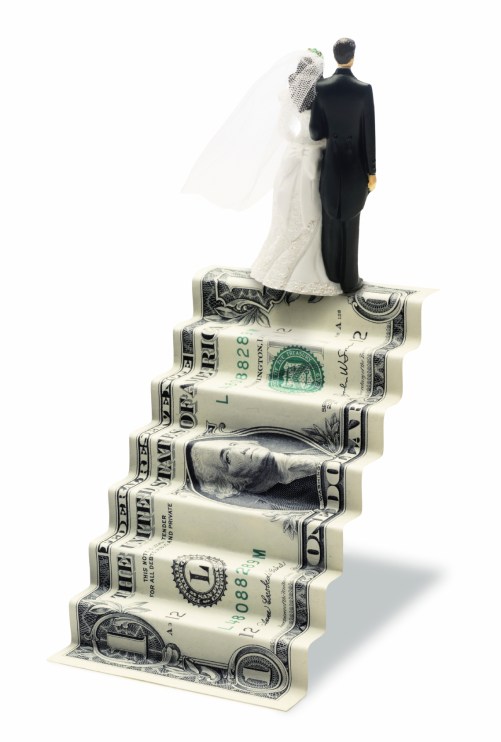
dollar-steps-money-marriage-wedding-bride-groom-bill

This is not a religious soapbox, nor one about the sanctity of marriage. And this certainly is not a statement on who can or should get married.Earlier this week, The Pew Research Center released a report on the decline of marriage in the United States. A record 1 in 5 Americans, aged 25 or older, have never been married – up from 1 in 10 in 1960.

The numbers are further connected by race and gender: men are less likely than women to get married, African-Americans less likely than Hispanics. Education plays in, too, as does employment. A recent survey showed that 78 percent of women polled said it would be “very important” for their prospective spouse to have a steady job.

By 2030, researchers estimate that a 25 percent of 45-t0 54-year olds will never have been married, up from 14 percent right now.

Some may write this off to a weak economy or a recession. Others may reason that because divorce rates are high – and have been for decades – a smarter generation of Americans is emerging that logically wants to make sure all their ducks are in a row and they are safe before they wed. They wish to not make the same mistakes as their ancestors and live a life free of financial stress. In fact, most reports suggest the decision to not marry is in one way or another often tied back to finances.

This fear of financial worry is another ticking time bomb in our current societal and culture implosion.

Our obsession with these numbers, of retirement, of financial freedom, our houses, cars and vacations: do we not understand they are meaningless without someone – or someones – to share it all with?

Humans have written books and produced art for centuries portraying that companionship and love are the true meaning of life. And we are slowly eradicating that by narrowing the human existence down to gross total sums of that sweet paper.

Do we not understand that individually and collectively, we determine all forms of value?

In high school, I had an awesome history teacher who gave an incredible example one day. In explaining how fragile the global economy is, he pulled out a $20 bill.

“All you need to do to completely collapse the infrastructure of any economy is get enough people to agree that this paper in my hand does not actually hold any real value,” he explained. “You see, we’ve all accepted that this is worth twenty dollars, but the paper itself is worthless. It only holds value because we accept the idea that it does. It’s merely a method of exchanging goods and services.”

The teacher went on to explain how we begin this process at a young age, trading a turkey on rye for a PB&J on wheat in the school cafeteria. Each party accepted that the trade was fair and held equal value. Long ago, this trader mentality is how we survived. Furs were traded for grains and so on.

He then ripped the $20 bill up into little pieces, letting it fall like confetti to the ground.

“The moment that any society decides the paper holds no value to them anymore, then the value agreement is broken.”

It could be argued, somewhere along the way, we got lazy and invented a system that would allow others to do the work and we would pay them for services in a standardized, official form.

We perfected this system by then equating time to money, which is really like equating apples to oranges. In essence, we are paid for our time to do and make things others do not in order to purchase things from others that we either don’t do or do not make. One could argue that it is a time saver. But if we’re trading our time anyway, what’s the difference?

While I’m not suggesting ripping up all of your money and proclaiming it has no value (I’m not a barbarian), I am urging us to stop equating apples to oranges. Is money a factor in the world we live in? Of course. Should it be the only one? Never.

We set the market on everything in this world, everything is supply and demand. The minute we stop caring about something, its value drops. We have the power on value, and we’ve had it all along.

We are the ones that buy the gas, the milk, the bread. We’ve deemed these essential to our survival. On the other side of that action, we buy the gossip, the music and movies, the drama of the NFL, the crisis of Apple iPhones bending, politics and the like. Our message is that these things are also essential to us because our actions tell us as much.

The message now, it appears, is that value rules over valuable. Money is more essential than people and relationships, that working together with someone to create a shared profit in the future, one that includes money, but is not of it is just not worth it.

sunset handsMaybe it is just me. From practically the moment I met my wife, I felt a pull that was nearly divine. In a short amount of time, I knew that I needed this woman in my life. I didn’t know exactly what that meant – I couldn’t. I didn’t know how we’d support each other, or a family, in six months, let alone six years – or 60 years.

And that was entirely the point.

I didn’t need to know, because I wanted to try; because all I really needed, was her.

To this writer, at least, marriage isn’t about a solid, well-planned, financial future. It is simply about two people who choose to take on the randomness of the world, its roller coaster ride, as a team – and the emotional, spiritual and physical connection you get from the journey. No amount of monetary value can be placed on that, nor would I accept it if someone tried.

Some do not want to get married, others who do or are already married may not make it ‘til death do them part. It is naïve in America to think that other factors are not at play. It may not always work. I had a conversation with a close, single friend about this very thing, asking him if money would be the primary factor in him choosing to marry someone or not.

“It wouldn’t be the factor, but it would be a factor,” he said.

Fair enough. Money – or lack thereof – can certainly ruin a marriage. But this piece is about the fact we’re increasingly unwilling to even risk getting to the part where we argue with our spouse over money, spending and bills, become bitter and lose the love. This is about the supposedly sweet, gooey part at the beginning. We’re putting the money before that part all together, which means financial planning has replaced the exciting butterflies of falling in love.

It’s a personal decision, but I cannot help but wonder if all that planning for the future will be a future alone, one where we might sacrifice an emotional and physical connection with someone in order to have a larger figure in our bank account. It is a false sense of security in a world where you can never really be financially secure.  The money will come and go. And when you leave, you leave with nothing except what you gave and experienced with others.

Will people remember your bank account figures or how much you paid off in student loans before getting married when your time to go comes? Do we remember that bill from four years ago that had us stressed out? Or who the bill was even from?

It is amazing how much power we’ve given that sweet paper.

I only caution us to find a balance, to be careful. This collective cultural decision to wait for marriage until financially stable means we’re willing to be alone, which ties in closely with the rise of social media.

We’re alone, but we’re pretending to be connected with people. We’re virtually social, we’re virtually getting married. One could argue we’re virtually human. Shakespeare would get laughed out of the room now; Ralph Waldo Emerson, Yeats, Frost, all deemed foolish. Our new poets are Warren Buffett, Suzy Orman and Dave Ramsey.

We have “progressed” to a point in time where we would apparently rather not take the risk of an unhappy, poor future, thus sacrificing the risk of a truly happy, rich future.

I suppose it is all in how a person defines rich and the value equated to that term.

Just try to remember, after all, it’s just paper.

It only holds the value you allow it to.

Standard
Uncategorized

Rog: The Great & Powerful

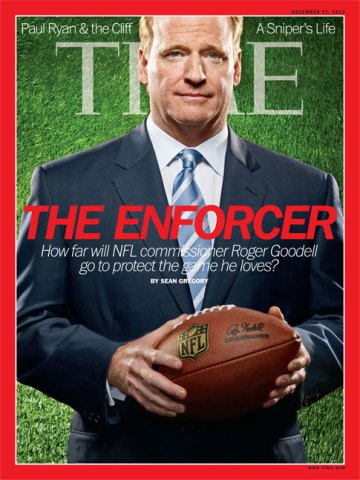
“I don’t do things for public relations. I do things because they’re the right thing to do, because I love the game. If you want to do the popular thing, be a cheerleader.” – Roger Goodell, in 2012, to TIME

Maybe Goodell, who didn’t make a misogynistic comment at all with that line, should be a cheerleader, because he does not make a very good NFL commissioner.

Oh, certainly, Goodell fits the profile and looks the part: a strapping lawyer with blonde hair and blue eyes, well versed and tenured as an NFL employee, saying all the right things in interviews.

However, behind those steely eyes lies the mind of a egocentric, greed fueled and power hungry man who’s blinded by the bright lights and the cash cow that is his league.

It seems as though the league has gotten worse off the field since Goodell took over the reins from Paul Tagliabue in 2006. From his random, inconsistent suspensions to how naïve he pretends to be on concussion related issues, Goodell plays the brilliant fool so well, you can see how he got the job.

Goodell’s lagoodelltest bungled act was the two-game suspension of Ray Rice for his assault of his then-fiancée (now wife) last February.

After waiting for months to let it play out in the courts, Rog suspended Rice for two whole games – or two games less than recent drug violations netted other players.

Now that TMZ has done a very TMZ-like thing and leaked the elevator video for the world to see what Ray did, Goodell hides behind technicalities like not actually seeing the video himself and apologizing for misunderstanding the egregious act by Rice.

On one hand, he tells you that the NFL has been working to better understand domestic violence over the years, but apparently did not learn that you don’t interview the victim with the violator in the room, as they did with Ray and Janay Rice.

Goodell spins yarns about how the NFL just couldn’t seem to get their hands on the video from the hotel or the police, then hear from well-regarded ESPN legal analyst Lester Munson that the NFL security team is full of people with “former” titles that spent entire careers getting exactly what they want.

Goodell and the NFL did not see the video because they did not want to see the video.

The tragedy of Roger Goodell is he feigns his emotion, his pain and his condolences and then turns around and cashes the checks of millions who gobble up his league every single day.

In that same issue of TIME – the one that deemed Goodell “The Enforcer” – Goodell said that when Jovan Belcher killed his girlfriend, then himself, it was a human tragedy. But days later Belcher’s team, the Kansas City Chiefs, played their game. Goodell explained the players wanted to play, that it would be good for them.

What again about doing the right thing?

Keep cashing those checks, Roger. Or posing for those authoritative magazine covers.

The checks that go into the massive Scrooge McDuck money bank, the ones that fill your over $40 million dollar salary.

Goodell says he isn’t worried about his job. Says that he’d used to the criticism.

“Every day, I have to earn my stripes,” he says.

I just hope he doesn’t break his arm patting himself on the back for all his hard work in the areas of player safety and making the league’s players better citizens of society.

goodell-si-cover“People expect a lot from the NFL,” Goodell said this week. “We accept that. We embrace that. That’s our opportunity to make a difference, not just in the NFL but in society in general. We have that ability. We have that influence. And we have to do that. And every day, that’s what we’re going to strive to do.”

Whatever. It’s all noise now.

The simple fact is, the NFL wants your money. Nothing more, nothing less. And they know they’ll get it.

They care about the product on the field only as it pertains to enhancing the enjoyment of the event you’ve paid to see, either in person or on television.

And they could care less about the players who produce the product, unless it is a brand name like Manning or Brady, because the NFL knows that players don’t last forever and the league itself is bigger than any one player or team.

The NFL is not alone in its objective, mind you. Restaurants, hotels, car dealerships – before you get home, you’re getting buttered up in advance for your next meal, your next trip, your next new car. They liked your sweet paper and they want some more of it in the future.

If it takes a voucher to ensure you return, so be it. If it takes a measly two game suspension for beating up a woman in an elevator, fine. Goodell did what he figured would bring a little heat, but blow over long before that kickoff game in September.

This one backfired, but the next one might not. Sure, the media is clamoring for his resignation, but those billion-dollar owners, the ones he works for? They want more of that sweet paper, too. So long as it doesn’t destroy the gate receipts and TV revenues, Goodell’s job is safe.

Goodell could have and should have done more to send a larger message about domestic violence. He is right, the NFL does owe it to society at large to set an example. They have the influence to do that.

But that is not the world we live in. It sounds great in a memos to teams, but it does little to change anything. In the real world we live in, a subject of real importance that deals with how we treat one another, how we treat each gender in the roles of relationships is cut up and distributed to the masses on blogs, social media, Sports Center and talk radio.

Even when the NFL is wrong, or in a bad news cycle, it still gets the ratings and coverage it wants – lining that money bin with more paper.

Our addiction is the distraction Goodell and the NFL count on, each and every time.

Goodell has the ball, always has. He’s just been running trick plays for years, distracting us with his charm, his wits and his quotable lines of empathy.

Don’t forget: The Enforcer will protect the game, not the people.

Not even the cheerleaders.

Standard
Uncategorized

What Are We Fighting For?

For as long as we have been able to record history, we’ve been fighting for or against something. In America, it is embedded in our DNA, the very fabric of the foundation of our country.

Every essence of who we are weaves a tapestry of rebellion, big and small. Our government, our clothes, our music are all based on the simple notion that how it is or was or might be is just not what we want. This is us and this is the U.S.: many individuals coming together, despite differences, to create a We.

And I will be among the first to agree that a voice of dissension in any discussion is a good way to bring balance and hopefully, better judgment.

But are we out of ideas on what we’re so riled up about? Or just completely misguided on what should matter? Because, when I digest the current events, those are the only two possible outcomes I can come up with.

Ice Bucket ChallengeMy social media timelines are filled with basically one thing: the ALS Ice Bucket Challenge.

Either people are doing it, or posting reasons why they aren’t doing it.

Is the Ice Bucket Challenge self-congratulatory? Yes, it is.

And that’s sort of the genius of it, tapping into the social narcissism of our current society and flipping it on its head to create something good out of it.

Sorry if this is breaking news, but social media in general is self-congratulatory. So before you scoff at it, think of every time you’ve posted a selfie, a picture of your awesome kids, your awesome life, the latest concert you attended or how great of time you are having on your vacation.

The entire point of social media is a page dedicated to you, ran by you and about you for others to learn and hear more about you, your life and how your world is going.

So yes, the Ice Bucket Challenge used that simple fact and twisted it to the advantage of a good cause for a terrible disease.

Some groups have targeted the use of animals or embryos used in some forms of ALS research, other groups targeted the “misuse” of water.

And this is what our rebellions have come to? Fight the power! Go against the grain! Let’s do a quick search on all those against the forms of ALS research using human embryos and animals. I hope they are staunchly, devoutly pro-life and no other support is offered for the systematic use of human embryos. Additionally, let us hope no one has a pair of leather shoes, sofa or fur coat lying around.

As for the water, I hope those all those water conservationists out there upset that people using bowls and buckets of water they pay for don’t take a dip in the pool, fill a water balloon or turn on the hose to let their kids use a Slip N Slide. Come to think of it, I just feel bad for their children.

The numbers do not lie: a record breaking amount of money raised and new donors brought in since this challenge began. Last year, during the same time period, the ALS Association raised $2 million. This year it’s $42 million and counting.

And it’s not enough. They need this every year, as certainly countless other organizations do.

By 2025, 1 in every 25 American adults will be diagnosed with ALS, Parkinson’s or Alzheimer’s. These are the horrible diseases that no one wants to see up close or personal, ripping the mind and the body of its functional uses.

And yet, some still take the angle of complaining or rebellion over the Ice Bucket Challenge.

Is there literally nothing left that we aren’t willing to condemn and complain about anymore?

If you are frustrated with your social media timeline’s contents, fret not, there are a few options:

  • Wait it out, Candy Crush scores, cat videos and selfies will be back soon
  • Don’t go on Facebook
  • De-friend everyone who is posting about it or simply delete your account

I have to believe that dumping ice over your head and challenging others to do the same is one of the least offensive things that 90 percent of the social media community has published. If your venom comes from people dumping and not donating, then I would agree. ALS needs the money.

But the folks that are mad that people aren’t just donating and forgetting the ice? Again, you’re in the wrong medium then. Look at your feed, for crying out loud. We’ll post funny inside jokes and inappropriate pictures, share and re-tweet videos of cars, cats and bloopers, but we get offended when Joan asked Jane to donate $100 to ALS or dump a bucket of ice water and donate $10?

Well, look at us! All of the children from the 70s, 80s and 90s, so rebellious despite being all grown up. In truth, we’re running out of things to really rebel against – or we just stopped paying attention to what matters.

It would seem that there are much larger and more complex problems going on in the world.

We just cannot get out of our own way. A vicious cycle of “me, me, me”, who betrayed whom, who’s failing us, why are we not where we want to be and who is to blame for it.

So yes, my family and I dumped buckets of ice on our heads and donated some money for a small fraction of the needed research for a wretched disease that most of us associate to a legendary former Yankee baseball player. Yes, we took the time to talk to our children about why people were dumping ice on their heads and what ALS is and what a terrible disease it was.

None of this should reveal anything about me remotely controversial.

It does not mean that we are anymore self-involved that anyone else on social media. It does not mean that I am no longer a staunch defender of life and that my devotion to my faith should be in question. It does not mean that by taking the challenge we did not donate or waste away a precious natural resource.

It was just a thing. And sometimes, that’s all it is.

Don’t ruin a good thing.

After all, it could be you or someone you love in 2025 in need of research findings the money raised in 2014 funded.

Now, remind me: what are we fighting for?

To make a donation to the ALS Association, click here

To learn more about ALS, click here

Standard