Marcus Smart, NCAA College Basketball

The Smart Move

By now, you have seen it, right?

OK, well, so you didn’t “see” it per se, but you had a reaction to it nonetheless after hearing about it from friends and family, or seeing a .gif about it or one of the other thousands of ways that “news” is circulated in America in 2014.
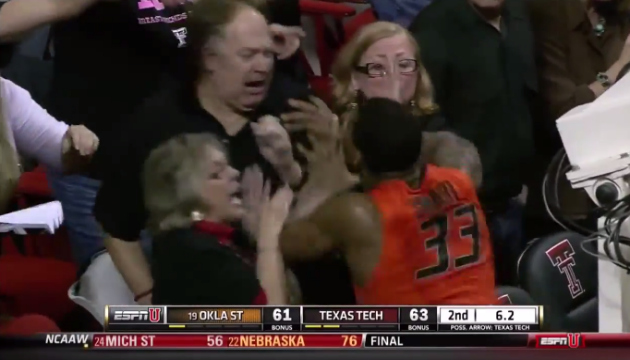
marcus-smart-shoveJust know that whatever your reaction to Oklahoma State guard Marcus Smart shoving a Texas Tech fan in the waning moments of Saturday’s game, it’s probably wrong.

But by all means, tag your thoughts with #shovegate. It will give them credibility, for sure.

Once again, what happened this weekend highlighted – for what appears to be the one trillionth time – everything that is wrong with America.

Yeah, I know, I know. This is my MO, to tell you just how messed up our society is and can be and why we need to change.

What is funny is that America may be the world’s leader in secondary education. After all, it has eight of the world’s Top 10 universities. But we do not learn very well.

It seems each week we over and under react to something, blowing it out of proportion or sweeping it under the rug. We overanalyze, under analyze and reach a conclusion, a verdict, a judgment. Then, it’s over and we’re on to the terrible conditions of Sochi restrooms or something else.

And we do this in about six hours.

Was Marcus Smart justified in shoving the Tech fan? Of course not.

Look, any athlete – former has been or never was – can tell you that should you choose to pursue a path in competitive sports, you will undoubtedly hear things from fans that will not sit very well with you mentally.

Between the ages of 15-18, I heard everything you might possibly hear from opposing fans. Racial slurs, comments about parents, comments about hairstyles, dress, mannerisms, sexual preferences I didn’t even know existed and really, everything in between.

Now might be a good time to mention I grew up in a relatively tame, relatively small and relatively white (read: predominately white) community.

It didn’t matter. I have had friends, frenemies and random people that shared the floor or field with me look around with the same expression: people are crazy.

The sooner you understand that, the sooner that you make peace with the fact that as an athlete, you are the target of one motive: to get in your head and take your mind off the task at hand. Is it hard? Of course.

Should mentally unstable people, say Ron Artest, be even more mindful of blocking out literally everything they hear, feel or see? Let’s hope so. Because I am certain that for anyone over the age of about 20, there was a flashback to 2004 and the Pacers-Pistons brawl.

Many opinions – including some from my own hand – argued then and now that there was an invisible line that cannot be crossed between performer and spectator.

And Marcus Smart must understand that no matter what they say to you, you just cannot respond. He’s 19, though, so he must be allowed to repent, learn and move on.

But what about those in the stands? That same line exists for all of us spectators. How sad are we? How pathetic is this Tech fan, Mr. Orr, for saying something, anything to a college student. You are a 50-year-old man. Act like it. Why are you calling a successful college athlete with all his hair and defined muscles who has undoubtedly far succeeded what you did on a basketball floor a piece of crap?
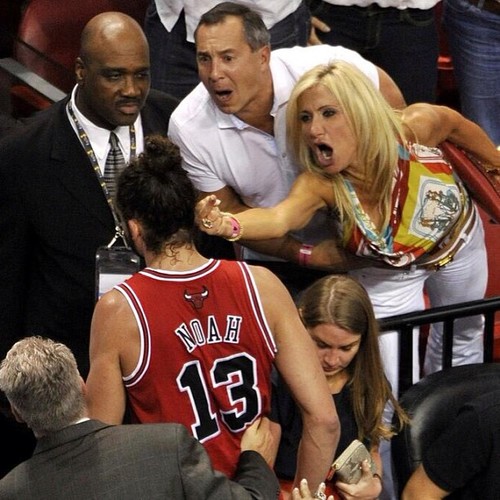
noahIf the former has been/never was athlete in me has reared its ugly head, then I apologize. It has always been a difficult proposition to listen to those who don’t, haven’t and never will throw down a cascade of spoken abuse that most would be enraged to hear if it were being spoken to them or someone they love. Fans are short for fanatical, but that does not have to mean flat out insane and crazy, shouting, cursing and throwing up middle fingers as they calmly pass by.

So was Mr. Orr wrong? Absolutely.

Yet there remains the rest of us. And what are we do to from the sidelines? Well, by all means, let’s get involved.

Notice that we are over 600 words into this piece before race was even mentioned? Well, aside from the physical act of the shove, that became the de facto topic of #shovegate.

We are quick to turn nearly everything into a commentary on race, when in reality, this has much more to do with how we interact with each other.

Again, this problem – this dangerous line between the fans in the stands getting to unleash a torrent of verbal abuse on athletes and the inevitable, split-second reaction from someone who’s just heard enough has become razor thin in recent years.

Every situation is different. In this one, a 19-year-old who turned away the NBA to come back to college and mature more found himself in the middle of a crummy month in the middle of a crummy season that has scouts wondering whether or not he can make it in the NBA.

Add to it all the media attention to what is perceived as Smart flopping on defense to get calls and a game against Texas Tech that was slipping away and you find yourself with the 19-year-old breaking down with a superbooster screaming at him after tumbling into the crowd.

Should he have shown restraint? Should the fan?

Of course.

But were would either of them learn their lesson?

Certainly not from the melodramatic, breaking news style SportsCenter updates and the millions of people on social media who turned those five seconds into a 4-hour racial debate.

But we don’t take the time to rationalize any of this. We just react. Suspend Smart, ban the fan, belly moan the spoiled athletes and joke that the fans have it coming.

Maybe next time, before we once again belittle someone else for not thinking clearly, questioning their character or jumping to 1,000 different conclusions, we could just make the smart move and just not.  The smart move is to just shut up.

That’s the smart move, though.

And we just don’t do shutting up very well.

Do we?
Standard
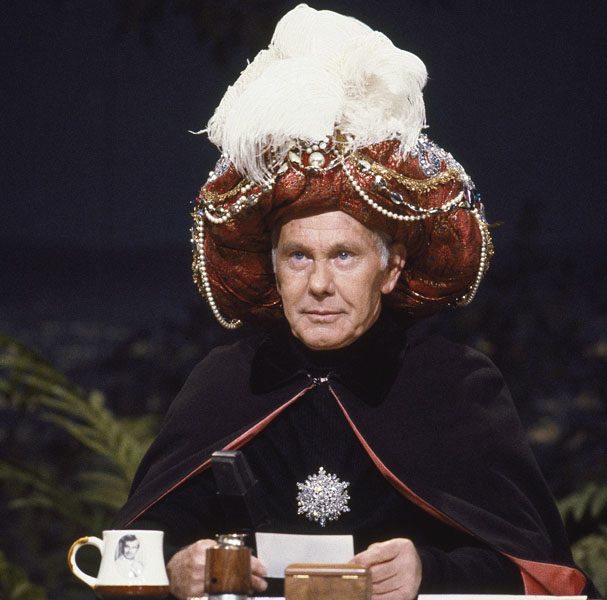
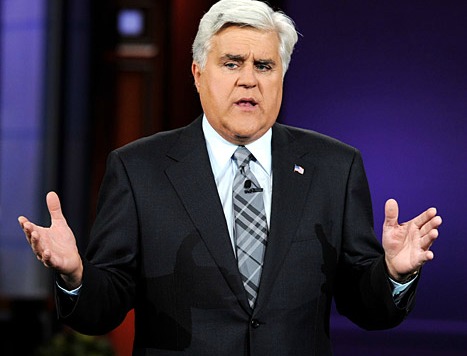
Jay Leno, Jimmy Fallon, The Tonight Show

Tonight & Tomorrow

Turning over the books of The Tonight Show cannot be an easy thing.

Just ask Jay Leno, he’s doing it for the second time tomorrow night.

At least, so we think. (I kid, Jay!…But seriously, this is it, right?)

If we can be serious about comedy for a moment, giving up the chair, the curtain and the monologue of the most widely-known television brand in history must be difficult.

It should be even more challenging for a guy like Leno, who if he cared about such things, might realize what an awful waste of his time and ours the past 22 years have been.

Leno I cannot help but wonder if that will be what runs through Leno’s mind when Jimmy Fallon takes the keys to the show from him tomorrow night. Maybe that thought has been crisscrossing Leno’s brain for some time, dating back to when he butchered Conan O’Brien’s takeover of the show several years ago.

Regardless, it’s happening again: Leno, the current king of late night ratings, is leaving The Tonight Show and is being replaced by Fallon, who is quite possibly the most compelling choice for the role since Johnny Carson.

And quite possibly, you could care less.

We have Jay Leno to thank and blame for that.

Oh sure, that does not fall just at Jay’s feet. There is a whole list of factors – like the fact that since Carson left in May of 1992, only roughly 9 million more options exist for your viewing pleasure between 11:30-12:30 each night. And even if there isn’t anything good to watch that particular night, your DVR has most likely been piling up and you have better things to catch up on than watching Jay make roughly 4,600 Bill Clinton jokes over the past 20-plus years.

So we can write off some of the fall of The Tonight Show – and late night in general – to the expanding options, shifting demographics and generational shifts of the past decade.

The only problem with that is Leno would have you think that is the full story, or that he is being pushed aside (again) for a younger, hipper model.

It’s just that Jay was never that hip to begin with – not even for our parents. So this logic that some seminal passing of the torch has a hint of melancholy to it is slightly overblown and distracts from the greater narrative thread.

I get the point of the well-done piece on Grantland, which angles in on Jay and the Baby Boomer generation being pushed aside, just as their parents’ generation was before them, and how careful my generation must be to readily take the reins in all things that matter: sports, politics and of course, late night TV. After all, our heads will be the next to roll for positions of power, prestige and authority by our own kids in 20-25 years.

But that’s doing a massive disservice to the analysis of just how badly Jay Leno did in this job.

For those who pay attention to such things, there was a slow build-up of comedians and performers who wanted to be “The One” to succeed Carson. Leno beat out Letterman, for reasons that mostly had to do with network preference, not because he was necessarily hand-picked by Carson.

And Leno proceeded to stick to the format – monologue, guests, house band, music act, good night – for 22 years.

He tried little new, which essentially means two things:

  1. His contemporaries in age watched because it was familiar, comfortable and the least bit surprising or shocking. It was part of the routine, something they remembered to do, but largely forgot what happened.
  2. This means anyone outside of the Boomer demographic did not really watch. Which works well enough and keeps you at the top of Neilsen charts – until all those youngsters start staying up late enough to take a look and find out you are not very funny.

Though Leno constantly points to his place at the top of the ratings, it is indeed misleading, the same way a 60 Minutes report of Leno ranking as one of the five most popular people on television is misleading. Baby Boomers watch more network television, one would suppose, than say 18-34 year olds, who, one can assume, will find the content they want from any number of sources or stations. As for recognition, well, Carson had to be perhaps one of the most recognizable people, period.

It cannot be easy to follow that, just reinforcing you never want to be the guy to follow the legend, but the guy who replaces the guy who followed the legend.

But Leno did not really help himself out with his act, which became outdated because he would not – and perhaps could not – change with the times. You could argue Leno missed his real window, based on his humor, and would have fared much better in a different time period, say the 1950s or 1960s. Leno’s routine is like your uncle’s or your grandpa’s – the jokes are low-hanging fruit found in everyday life. This is neither overly creative or created. It’s just kind of there.

And that’s just it. We don’t want to consume comedy because it is there. We want to laugh. We laugh with our friends, not at them. We have a whole generation or two hell-bent on making memories, capturing them and talking about it later. This is why Instagram exists, #tbt and a host of other social “things”.

But really, it comes down to this: You have to give us a reason to watch.

While Carson certainly had the blessing of only facing opposition from major networks, as opposed to hundreds of cable channels, 24-hour news and technology that have us on social networks and playing games about angry and flippy birds in our beds, well, he also gave us memories by creating them.

Fallon can do that, which is something Leno must not grasp. Or maybe he does not stay up to watch Late Night

If he did, he should be able to see what the rest of us do. Jimmy Fallon was made to host The Tonight Show. His bits are simply spectacular. He incorporates technology, You Tube and Twitter into the show on a consistent and regular basis. Fallon’s house band is The Roots, not the guy who played trumpet for The Stones on one album in 1975.

The Tonight Show Starring Johnny CarsonFallon’s creative partnership with Justin Timberlake is equally parts amazing, fun and very, very creative. I mean, have you watched the History of Rap? They have formed some kind of on-air chemistry that allows you to believe they are best friends – whether that assumption is correct or not really does not matter. In a way, it reminds us of the ease and casual nature of Carson with Ed McMahon. The laughs from co-workers and house band members are not forced with Jimmy. With Jay, well, let’s just say you were never quite sure if there was a bonus check for boisterous laughing.

It is a truly magical thing to feel a connection with a TV talk show host, even more so if they come off as genuine and natural. You have to connect with people in their most private of moments – in their beds at 11:30pm, after who knows what went on during their day. We are tired and stressed and you need to now entertain us.

Fallon has you talking about his bits in the office the next day, re-Tweeting links to his You Tube clips, like when he did a rendition of “Blurred Lines” with Robin Thicke using school-room instruments. Or when he had Miley Cyrus on during the peak of her crazy last fall to sing a likeable a cappella rendition of her unlikeable song, “We Can’t Stop.” Both have had over 16 million views. A piece.

One of Leno’s biggest YouTube hits? Well, he got 2 million views for the replay of Michael Jordan asking if he was stupid in response to Leno asking Jordan if he could still dunk. So there’s that.

In a way, that itself is metaphorical for Jay Leno. He was kind of the butt of the joke – the one we were laughing at and not with. Popularity can be judged in a variety of ways – namely recognition – but we have had a lot of popular things in America that just were not very good.

You do not become celebrated simply because you are there. Leno’s biggest problem was and is that he is constantly seeking approval. He spends so much time making sure you know he’s funny and entertaining you that he does not actually do it. Fallon just seems to want to have fun. He enjoys his job, the creative process and if something bombs, he’ll probably laugh at it before you do. And he’ll try something different again with the same pure intention.

Do you see the difference yet?

justin-timberlake-brings-sexyback-on-late-night-with-jimmy-fallonLeno lives to hear your laugh as a sign of approval for him. Fallon just wants to laugh with you because it feels good for everyone. It is why his constant breaking on SNL skits isn’t annoying; Jimmy actually cannot keep his stuff together because it is funny to him, not just to you. He hasn’t rehearsed the punch line, because he’s not quite sure if there is one. He wants to be a part of the moment with you. 

Leno would prefer to keep his distance and point at highlighted sections of the newspaper. It’s what he planned to do and therefore, it will work. Hence, how he actually has made over 4,600 Clinton jokes since 1992. No really, someone counted and everything.

Sticking to the pre-determined act leaves little room for improv – a.k.a. life. You can tell Fallon does not plan on how Blake Shelton will react when he tries to get him to sing a Rupert Holmes song on the couch in the middle of an interview. He’s making it up as he goes along.

This is why Fallon works so well with us: we’re making it up too. We do things that just don’t work sometimes and all we can do is laugh at the fact we thought it would.

When Leno passive-aggressively cries wolf about age discrimination – and he has been, and he rest assured, he will again – just know that while true, that is not the entire story. He is just not very good at this particular job.

That is why, despite leading the ratings, Leno’s lease on The Tonight Show is up.

Every generation has the moment when they just won’t let go of the baton. It is more than understandable.

It is just that Jay Leno took that baton from the king 22 years ago, stood still and hoped you’d just keep laughing.

Some of us did.

But most of us are still waiting to start, waiting for a new act.

Waiting for a reason to come back tomorrow night.

Standard
Martin Luther King Jr., Richard Sherman, Society

Lessons from a King

mlk604233On Monday, it was Martin Luther King, Jr. Day.

I might have used “celebrated”, but that would be a stretch. We were far too focused on Richard Sherman’s WWE style promo cut on Erin Andrews following the NFC Championship to celebrate the life and work of Dr. King.

The vast majority of us sits and hides from the Polar Vortex, hitting the snooze button – or not even setting an alarm on this typically cold January Monday each year. Turns out, that makes quite the metaphor for our lives.

We have hit the snooze button one too many times.

The reasons are many, but mostly are due to the false sense of security we have about progress. Too many of us are oblivious to the problems we face, as a nation, as a society. The collective majority of us believe we are simply better than those generations before us.

While it may be true that we do not have many of the problems of the 1960s, we have the issues of today. And we are flat out ignoring them. In yet another call to arms and minds, this wonderful nation that could is quickly becoming a nation that can’t.

We can’t sustain this beast.

We can’t survive in political gridlock.

We can’t keep shooting each other with machine guns in schools.

We can’t keep striping away the fabric of our morality and rights by either vague posturing or blind ignorance.

We can’t live beyond our means for much longer.

But we can do so much more to improve our personal situations and those we call neighbors.

As I read some of the fantastic pieces commemorating Dr. King this week, I wondered: what would he think of the world now? Had he not been assassinated in 1968, Martin Luther King, Jr. would be 85, no doubt an even bigger social, political and cultural icon for all that he would have accomplished in the 40-plus years since.

And it’s difficult to think about him without thinking of Bobby Kennedy, who was also assassinated in 1968. What might he have done had he lived? What would he think of the world now?

If we are honest, as interesting as it may be to speculate on such things, it really does not matter.

What matters is what we think of the world today.

What are we going to do to make it better?

If you actually study their measured words, Dr. King, and his contemporaries, truly transcended time and place. Their words are still relevant and important today. We just fail to heed them, listen to them, and implement them is all.

richard-sherman-elite-daily-600x300For example, let us return to Mr. Sherman, Seattle Seahawks cornerback and perhaps the best player at his position in the NFL. From the moment his amazing athletic feat occurred through today, we could run about a million different case studies of what still plagues us as a society.

We are a bit too obsessed with inconsequential things, like football and the famous. Far too many people cared about two teams from the West coast in the middle and eastern parts of this country. Sherman gained nearly 225,000 followers between the end of the game and Monday evening. My social media feeds were flooded with comments – mostly negative – about Sherman scaring Erin Andrews half to death.

We’re more prone to comment on something like Sherman’s outrage than we are on things like abortion, crime, or helping find homeless men, women and children shelter from freezing temperatures.

Why? Because if we ignore it long enough, we can pretend it is not there.

Everything is a personal choice or belief, therefore private, and in modern America, the private decisions and stances we have trump humility, human dignity and the betterment of our society. This is because most people do not want to have some other liberty infringed upon, so we willfully ignore others to save the ones we personally identify with.

But in the end, we all lose.

How does that relate to pro football? Simple – we can easily find common ground on the surface of any topic – like the fact Sherman seemed like a selfish, boastful jerk during the interview. But most will fall silent when we discuss a more substantive topic outside a sporting event or reality TV.

As Dr. King said, “Our lives begin to end the day we become silent about things that matter.”

King also said: “There comes a time when one must take a position that is neither safe, nor politic, nor popular, but he must take it because conscience tells him it is right.”

It might help if we knew what was right.

We seem to have forgotten grace, sportsmanship and humility. Sherman mocked the receiver he tipped the ball from, Michael Crabtree, who had, apparently, disrespected him. So, by all means, disrespect right back.

I cannot remember the last time I saw a tremendous play that the athlete who made it did not find it imperative to let the entire world (that just watched it) know what happened.

Why can we not let our actions speak for themselves? Maybe it has something to do with our lust for attention. Then again, it might be worth looking at what we do with the attention once we have it. Ask for the grand stage, and you must put on a grand show, right?

Dr. King’s thoughts: “The ultimate measure of a man is not where he stands in moments of comfort and convenience, but where he stands at times of challenge and controversy.”

And where do we stand during others times of challenge and controversy? We distance ourselves as quickly as possible.

A player caught cheating in sports: “I never liked the guy, always suspected he was a cheater.” Really? Interesting you never came out and said as much.

I’ll admit to liking Lance Armstrong during his years on top and being duped by Mark McGwire. It was believable, yet not. It was borderline heroic. And it was a lie. Now we know. But I cannot re-write history – and neither can you.

It probably says more about who you would stand next to during a controversy of theirs than what you would do during one of your own.

We give a pass for emotion in the moment. After the initial backlash on Sherman, there was a backlash to the backlash. I read far too many “don’t stick a mic in an athlete’s face in that environment” and “the media begs for crazy moments and then freaks when they get one” type comments.

Far too often and far too easily we give a pass to people for their reactions “in the heat of the moment.” We should hold people accountable for their actions, reactions and emotions. It is indeed the measure of a man. As it is the measure of our society. We all reacted in the same manner as Sherman did. Neither was appropriate or befitting.

Until we can get a grip on ourselves and acknowledge how far we still have to go – that the journey of personal and societal growth never ends, only evolves – then we will continue to struggle with the reality that we are losing everything we say we value.

WE must stop hitting snooze.

WE must stop wasting our collective time and societies time by passively participating and only engaging in the stuff that does not matter.

Maybe WE could do something to transcend time and place, where memories are not just words, but live in action.

“People fail to get along because they fear each other; they fear each other because they don’t know each other; they don’t know each other because they have not communicated with each other.” – Dr. Martin Luther King, Jr.

Standard
2014 AFC Championship Game, Peyton Manning, Tom Brady

The Great Debate

After four long months, we have come away with a familiar match-up in the AFC Championship.

Brady vs. Manning.

ImageThis Sunday, it will be nearly 10 years to the day since two of the greatest professional quarterbacks in any lifetime met in the playoffs. It feels like this could realistically be the last time they meet with the stakes so high.

They are intrinsically linked, despite their football narratives taking entirely opposite paths, they remain relatively the same.

Peyton Manning could never quite get over the hump in the playoffs, despite stellar numbers and regular season records that nearly every QB would trade for. Then, he broke through the New England and Super Bowl barrier in 2006.

All seemed settled, the monkey removed from his back. Yet as time has passed from that magical day in Miami, when the Colts beat the Bears in an ugly, wet game, Manning’s place among the elite of the elite remains a question for some, due largely – if not entirely – to his continuing poor performance in the playoffs.

Tom Brady had it pretty good the first half of his career. With a masterful coach, a tremendous defense and a clutch kicker, the Patriots won three Super Bowls in four years. But he never had the stats or regular season records to match the Mannings, Marinos and Elways. Then 2007 happened. Finally armed with two receivers not found at a Dollar General store, Brady shattered records and the Patriots had the first undefeated regular season since Nixon was in office.

But Brady had found life to be a bit tougher in recent years – with two Super Bowl losses at the hands of Tom Coughlin, Peyton’s little brother Eli and the New York Giants. As Gisele said so eloquently, Tom can’t catch the ball or play defense, too. He’s just a man. A man in Uggs.

As we often find, there’s more to it than just that. The Patriots have had the better organization, which means their team is often well-rounded, while Manning’s days with the Colts were often marked by a defense that never materialized into anything more than subpar.

Though not necessarily by choice, Manning has moved on to Denver in his NFL golden years and found a team chalked with talent on both sides of the ball, leading to a superior team in each of the past two regular seasons. As the numbers and MVPs pile it, it is safe to assume that he really should not need anything else to stake claim to the label of greatest quarterback ever.

But a second Super Bowl ring sure would put it to rest.

Brady has survived and thrived long enough that the Patriots have been forced to basically overhaul their team in chunks over the past two or three seasons. While that has not stopped New England from piling up more division titles and first round byes and AFC Championship or Super Bowl appearances, the fact remains Brady and Belichick have not won a Super Bowl since February 2005 – remember, when Terrell Owens actually mattered and Donovan McNabb was throwing up in the fourth quarter? If it seems so long ago – it is.

Even without the gaudy, long term stats, Brady will always have a logical claim to the label of greatest quarterback ever.

But a fourth Super Bowl ring sure would help drive the point home.

ImageHowever, it should be obvious: this debate will not end come Sunday. For those who actually pay attention, there is far too much else that happens on and off the field to allow this conversation to be settled. It might never be – and maybe it should not.

They have taken turns breaking each other’s records. Each has probably been at their very best not when breaking those marks, but in the seasons where they excelled when they probably should not have.

Like the years Manning and the Colts offense was actually their defense, used to keep other teams – and the porous Colts defense – off the field. Or this season, when Brady has guided the Patriots to another double-digit win total with huge injuries and lack of experience on both sides of the ball.

Plainly stated, both are in many minds, the best of all time. No other quarterbacks have done it in so many different ways and for so long.

Their stories have a different arc, but a similar tone. Manning was perhaps relied on more (at least up ‘til now) than Brady. As a friend stated, it must be nice to have a running game like the Patriots did on Saturday against the Colts, or to play against a young Andrew Luck, who threw four interceptions.

Perhaps, but just the same as I am sure Brady would trade his receiving core for Manning’s at any point in their careers except for possibly 2007. Just the same as Manning would probably take the Patriots defense over any the Colts had in every year but the 2006 playoffs.

You see, they are at the same time very similar, yet very different. They have defined their teams and the NFL for the past decade-plus.

And really, all this comes down to are a bunch of largely superfluous factors that really are more telling of us than they are them.

For example, where you live, what your favorite team is, what you appreciate in football, what you value in a quarterback. Do you enjoy winning consistently and your team having a chance, or do you value championship trophies more? Do you like a cerebral quarterback with a master command or a quarterback so precise between 15-35 yards he could hit Lincoln’s nose on a penny?

So what are we arguing about? The simple fact we like one guy or another. That’s it.

Manning and Brady do not think of this the same way we do. They like and respect each other. In fact, they are better friends than most people know, often talking and texting about life – and football; like sharing game plans on how to beat other teams. Of course they want to win, but I doubt if they sit around comparing resumes and arguing about who is better.

We’ve been wasting so much time pointing out all the things we don’t like, or what we think is the reason one is better than the other. It is just what we do. We need to know. We need people to agree with us. We want a clear-cut winner in this.

But no matter the outcome, we won’t know any more after this game than we did before it. Perhaps it is time to stop finding so much strength or fault in either man and appreciate them both at the same time.

Let us just enjoy the show before the final credits.

This great debate is nothing more than a distraction to the show.

In the words of T.O., grab your popcorn.

Standard
Baseball Hall of Fame, Baseball Writers of America, Major League Baseball, Morals

Voter Frauds

We might want to remember yesterday, January 8, 2014, as a date we will not remember. We can forget that this was the date that everyone left stopped caring about the Baseball Hall of Fame.

Just look at this mess.

From who got in to who did not, from who voted and whom they voted for to who gave their vote away, this has become one of the single dumbest topics in all of sports.

Oh, I used to care – even when my friends who had long since cared were forced to reckon with my soapbox about steroids and Pete Rose and why baseball still mattered.

But this nonsense is stripping away the final remaining people who actually cared.

The last thing most of us want to do is listen to these smug little men take their 15 minutes every year and give superfluous reasons as to why they put Craig Biggio 11th on their ballot.

Greg MadduxOr why Greg Maddux – GREG MADDUX (that’s right, all CAPS) – didn’t deserve their vote due to some preposterous unwritten rule that says because Babe Ruth wasn’t a unanimous Hall of Fame choice in 1936, no one can be.

If 11 voters left Ruth off their ballot nearly 80 years ago, then by Zeus, Greg Maddux should be left off dozens more, right? Is this an SNL sketch about Bill Bradsky? What are we doing?

Has any of these voters taken a moment to think about how comical this is? They are taking themselves and this process so serious that it is scaring people away from the topic at all.

There was a time that the debate on what to do with the players who admitted or allegedly used steroids was a decent conversation worth having. Leave them out? Create a separate wing? Change their plaques? And if we ever actually addressed that issue, Rose would have to be allowed in, too.

Now? Well, like a growing legion of baseball fans, I’m of the opinion it just doesn’t matter. We’re so caught up in the minutia; the whole thing comes off as childish as the game’s very nature.

We’re looking at you, writer guy who says he will not vote for anyone from the steroid era, then defined it with beginning and end dates and goofed when admitting you voted for a player within those dates.

Oy.

And we’re glaring at you, indigent, self-righteous hypocrites obsessed with slamming Dan LeBatard for allowing Deadpsin.com readers to vote on his ballot and proclaiming LeBatard unqualified to vote anyway – but left Maddux off your ballot entirely.

Yikes.

Who said these writers are “worthy” of casting a vote, anyway? Because they write the “beat”? Because they “cover” baseball? Thank goodness our American government doesn’t allow the same voting process. Only talk show hosts and political pundits would be allowed to choose the president, based on the fact they “cover” it for media outlets.

That coverage, as outlined in a fantastic piece on Grantland yesterday, including ignoring steroids in baseball, forgetting to cover it like Sammy Sosa forgot the English language during his suspicion period, or just not covering it at all until enough people started covering it they switched sides and picked up a pitchfork and started finally talking about what they’d seen and heard for 15 years.

It’s easy to be honest after the truth has come out.

You cannot pretend these players did not play. You cannot ignore an era. You just have to deal with it. Just like all the collegiate banners brought down, we still know who played and what year they went to the Final Four or won the National Championship. It cannot be erased from our memories. There are pictures and everything!

hall of fameIf this stance of ignoring players from the steroid era because the playing field was unequal, then why did the sportswriter forefathers allow in players prior to African Americans involvement in the league? Was that a level playing field? How about the cleats those guys wore versus today?

But the absolute worst offense is throwing stones inside a house of glass. Baseball is trying to do the impossible: create a perfect center of worship to compare all players from all generations equally.

It cannot be done. It should not be done. And until we can get over that, the process will be as convoluted, unintelligible and comedic as it was during yesterday’s afternoon of shouting.

Major League Baseball ought to just have a voting day where every fan – informed or not, just like the rest of our voting systems – can cast one vote for one player. Top three make the Hall of Fame, with a minimum number of votes or a certain percentage of the vote.

Is that a good idea? Probably not. In fact, I am certain it could be a terrible one, with many flaws and loopholes. But it can be no worse than listening to this nauseating yearly dissertation from sports writers who take themselves far too seriously.

And the worthless exercise where we try to convince them all how flawed their logic is has not made bit of difference. Trying to convince someone with flawed logic is an ironic oxymoron. It is a noble exercise in futility.

So I do not care if someone gave away their Hall of Fame vote to a poll on Deadspin.com any more than I do to listen or read another rationalization on why a handful of guys do not belong in the Hall based on reasons that have nothing to do with numbers and statistics, yet everything to do with morality, honesty and various shades of gray.

Until there is less lack of intelligence in this entire, much broader conversation about the process in general, there is probably going to be fewer and fewer people paying attention and caring to this sideshow.

Kind of like politics, with its sniping, arguing over points of emphasis that are not really points at all, backroom deals, dark corners, suspicion and biased, media driven stories.

Baseball really has become as absurd and obscure as our political system.

And, if you are looking to continue to push that whole America’s game status, well, that’s about as American as you can get these days.

Standard