Here we are again, in the season of graduations and weddings, with a fresh new crop of young people who find themselves embarking on a whole new foreign world.
While I am certainly no expert, allow me the chance to impart a single suggestion on what you are about to face: take out your trash.
Certain studies are showing that we’re not quite as prepared and ready as we think we are for these important life steps of college, jobs and marriages.
And it is not for the reason – or reasons – you may think, like the standard preparation for classes or a job. No, on the contrary, we’re fairly well educated and well trained.
The problem is, we just don’t communicate very well.
But how can we be problem solvers in our jobs if we can’t solve the problems in our personal lives? It is there where our problem solving skills are fortified, or in most cases, not.
We all seem to have a cluster of friendships and relationships that sit awkwardly unresolved because we don’t address the problems that put them in that state.
It is a choice to be passive in this regard. Lack of action is still an action. We cannot do well until we do better.
This increasingly unsocial society, where we freely state in text – whether typed in e-mail, text or on a social media screen – what we are not willing to say, or would never say, in person is the single biggest societal issue we face. And it is clearly one that permeates all aspects of our lives.
Communication is the backbone to everything we can hope to do in our lives. It is what makes us human, what makes us emote. If we pull back from those things, the only thing we’re left with is the direction we’re taking now: a society of people who cannot communicate with each other in more than 140 characters and emoji’s.
Humanity needs a better human relations plan.
So try this: picture your life as a series of trash cans of varying sizes. Each trash can represents something in your life: relationships, friendships, work, fitness, health, and so on. In each situation, you are willing to put up with so much in order to keep it going.
With friends, you will swallow a certain level of perceived “wrongdoing” on the other side’s behalf. An unreturned phone call is forgivable, yet you still feel slighted, so it goes into the metaphorical trash can. A dis from the same friend, a betrayal, not being invited to something, a missed birthday, those all pile up until one day, they throw something somewhat meaningless onto the pile – a banana peel let’s say – and now, well, you’ve had it.
We do this with virtually everything in life. We’ll put up with so much at work and stay until the trash can is full. The trash cans might vary in size, as we’re more willing to forgive our spouse than say, a co-worker. But in relative terms, we’ll keep plugging away to maintain whatever is left of that particular relationship until that final banana peel causes the trash can to spill over and cause our crazy to come streaming out, raw, emotional and unfiltered.
The difference, of course, with relationships and friendships is that there is a real person on the other side, probably with their own can of “trash” you don’t even realize you threw away on them.
And it is never really about that last banana peel. It was about the collection of items that filled up the can before it.
It was about the fact that neither of you really ever emptied the trash. You didn’t talk through it.
Why? Because you were just too busy? Because life got in the way? Because it just didn’t matter?
Perhaps it is because you didn’t think it mattered much to you at the time. Well, clearly you never fully pulled an Elsa and just “let it go.” Or maybe it is because you thought that saying something at the time about it might hurt their feelings.
But that all that unspoken, undiscussed, unresolved trash does build up until one of you – or both – determines the damage done, the trash is full and now it truly just isn’t worth carrying around all those heaping, stinky bags.
Look, this human interaction stuff isn’t easy – that’s why so many friendships, marriages and relationships fail.
We are all individuals with different backgrounds, upbringing, history, emotions, experiences and interests. More often than not, we forget to respect those awesome nuances that make us unique.
Maybe we just need to quit trying to force everyone to see our side or agree with us.
Too much time is wasted spinning our wheels trying to convince cyber friends that we are perfect. Our hair isn’t perfect, our clothes are not perfect. Our bodies are not perfect. Our families and homes and cars, they are not perfect. And they do not make us, us. They do not accurately represent who we are. On the contrary, how we treat each other does best represent who we are.
I tend to believe that not everyone is meant to stay in your life forever. Some come and go and are a mere footnote in the index of your Book of Life. Not every relationship and friendship is worth saving or meant to be saved.
Then again, you’ll go through life pretty lonely without investing in others, because I’ve found it means a whole lot more to share it with those who matter, the ones that care, that root for you to win, that will share your sorrow.
If you’ve found someone or someones that somehow or another chose to interact with you and your own brand of weirdness, try a little harder to keep that proverbial trash can less than full.
The question is simple, then. Is it worth it? Whether you’ve been friends for 40 years or 4 months, it meant something to both of you at some point no matter when or how you met.
Maybe it was on a school playground in kindergarten.
Maybe it was because of a shared interest or activity.
Maybe it was an attraction or a dance or a song or by proximity.
But we all managed to make some friends. The trick is keeping them. And the best way to do it is simple.
There is a hilarious recurring character on Saturday Night Live called “Drunk Uncle” that shows up from time to time on Weekend Update. Bobby Moynihan delightfully portrays the classic embodiment of every family member we distance ourselves from at holiday gatherings, who might be slightly drunk, slightly racially biased or worse, both.
At least, that was the starting point for the concept of the character. In more recent years and appearances, really Drunk Uncle has become the curmudgeon everyman, sarcastically and unapologetically pointing out how different the world has become through technology. His sweater and jacket combo are the same as his plight: the world kind of sucks right now.
As funny as these skits are, it is even funnier that most people laugh at the jokes, then turn around and find themselves doing many of the same things Drunk Uncle is condemning. Whether it is the off-handed slurs or the over-use of technology to promote oneself, we should be laughing at ourselves.
The problem is, we are so narcissistic, we don’t get that we are the punchline.
America is running afoul and we, as citizens, are too concerned with our own image and personal public relations campaign to notice. A misstep and we simply say we’re being individuals. We write off most things by throwing out catchy phrases, as pointed out in this New York Times piece.
“You do you”? “It is what it is”? “Keeping in real”? What the heck does any of that even mean, anyway? Of course you are doing you, who else would you be doing? Wouldn’t you doing someone else just be an imposter? It certainly is not what it is not. And why is there a strong need to keep things real? When did things become fake that we had to tell people we are keeping our feet on the ground?
We are always doing us. Sometimes it’s angry you, depressed you, happy you, volatile you, sarcastic you, hurt you, compassionate you, betrayed you, joyful you, religious you, feisty you, helpful you or spiteful you, but it’s always you.
Oh, but we like to pretend. We enjoy putting on the show of who we want the world to think we are. From trolling comment sections, Facebook posts and Twitter feeds, we’re all about that face.
Being insensitive, being narcissistic, being flat-out self-centered is not a license to write off your actions with “h8trs gonna h8!” This has wormed its way into society like a catchy pop song – oh, wait, it was a catchy pop song.
No, we’re not gonna hate.
We’re not allowed to even remotely look like we’re the eighth cousin, twice removed from hate. Then again, should you slightly, distantly look like you’re heading toward a path of hate, Haterade will rain down in buckets like you just won the national championship of hate.
Just please don’t look at the skeletons in our closet, right? Nothing to see here, move along! You do you, right?
(I did learn, it’s OK, however, to talk about hate in the past tense, as long as it involves Christian Laettner.)
Americans always seem ready and willing to stand and fight injustice – right after we’ve been shown just how bad it is by someone else, all the while ignoring our own issues and faults.
Anyone who tries to take away equality, or slightly resembles to treat different groups without equality is going to see a whole lot of what Indiana saw this past week (and what it will continue to see if something isn’t changed).
It makes very little difference any more what is real or true about the bill that was passed, all that matters now is the fallout. The state is in the midst of a PR nightmare, one that has already been lost. The window has closed, the verdict sealed.
The world of social media has tried Indiana, it’s legislators, it’s governor, it’s people and passed down its verdict – there is no stopping the court of public opinion. Forget arguing that you can inform the uninformed, or “convince” anyone anything different than what they’ve already heard and believed.
The media dominates, writes the story, and controls the narrative. It is completely naïve to think otherwise. And the power of the medium allows for quick dissemination of a whole truckload of judgement, condemnation and reaction – and reaction to the reaction of a reaction.
Supporters say the bill is to defend religious freedom, opponents claim the law discriminates. We’ll never truly know.
It’s possibly safest to assume that both sides are correct. It’s always somewhere in the middle – a place we refuse to go or even visit. Compromise is one of the hardest places to find and it’s not labeled on any map. Siri can’t help you. Compromise does not allow it’s picture to be taken. It has too much humility to pose for a selfie, too much dignity to be reduced to a hashtag.
And this is why it eludes us.
We all have a sphere of influence; we just greatly misconstrue what to do with it. Social media allows you to build and sell your brand. Every post you make, every favorite, like, share and retweet.
Now, this may or may not be who you actually are – but that does not really matter. It is what you show the world you are. You are marketing you, and you build your brand.
If you want to change the world, hate won’t beat out hate. Shaming others won’t do it either. You cannot change the world, you can really only change your world – and by doing so, through your sphere of influence, the world around slowly changes over time.
So many people tell us of the ills of society (just check your news feed). They will complain (check your news feed). They will condemn others who do not think and act as they do (maybe you should check your news feed). They will tell you that you are, in fact, wrong (you might find examples in your news feed). Now how many times when someone told you that you were wrong did it actually change your mind? (Bet it’s not in your news feed.)
I’ll venture a guess: Zero.
The message is half as important as the messenger.
Throughout history, powerful orators – great messengers who would no doubt come up with far better handles and hashtags – have influenced mass amounts of people to do really great things.
They have also persuaded entire populations to do really dumb things, terrible or horrific things.
The difference between disagreeing and intolerance is a thin line, and we are unaware that we have crossed it until it is too late. The same holds true then in how we conduct ourselves with others in person.
Life cannot be done as it is on social media. It is not a hashtag. Some of this stuff is real and important and needs to be treated as such.
Earlier this week, after finishing a family dinner, my wife and I randomly started listening to songs from our younger days while cleaning up.
Acting goofy at first, we probably looked like Ferris Bueller belting out some tunes in his shower at the start of a big day off. We picked a lot of fast paced songs, knowing it would draw some attention from the audience (OK, so it was our kids) if we kept up with the lyrics.
“You know a lot of words to a lot of songs, guys,” said our sweet-hearted 8-year-old daughter.
This comment sparked a conversation about how the words and lyrics to these old songs (weird to say, since most of them were late 90s and early 00s country songs) meant something different to both my wife and I.
As we sang in harmony (well, kinda), our daughter sat and stared for a little while. I could read her mind, and briefly, she seemed impressed that we had remembered and memorized the subtle voice inflections of each song.
Soon enough, her fascination ended and she went back to playing with her younger brothers, who were apparently caught in a game of home many pairs of underwear and ball shorts they could wear at once. They nicknamed themselves Capty Underwears and Capty Shorts, so clearly they weren’t listening to the songs to begin with. (And yes, this what 6-year-old and 3-year-old boys tend to do.) Our eldest son, turning 13 this Sunday, however, listened to the songs, but his eyes never came up from his iPad.
There was one song in particular that we listened to that made me realize how much our society has changed due to the technology advancements of just the past 10-15 years.
As my wife selected The Dixie Chicks “Travelin’ Soldier,” the overall themes found in the tragically sad love story of a young man sent off to Vietnam and the young girl he’d wrote letters to strike a different kind of chord with me.
It is painfully obvious that we’re drifting apart in our communications with each other. I have tackled this topic before, but I must admit, there is a hint of sadness within me that envelopes each advancement in technology and communications.
We don’t write love letters anymore.
We text emoji’s and short, grammatically incorrect phrases. And then we wonder why people don’t “get us” or wonder why we have a hard time communicating in serious relationships.
We don’t visit or call as much, we text and send Facebook messages and post on digital “walls.” And then we wonder why we don’t see our friends anymore.
Never has there been a more appropriate term than a Facebook “wall,” because in essence, I’ve come to realize that is truly what social media does: it builds walls.
We may be more “connected” than ever before in human history, but emotionally and spiritually, we are more disconnected than we can possibly imagine.
Last week, I read this story in the New York Times on the world of Middle School Instagram. Both fascinated and terrified, I couldn’t believe the emotional turmoil that takes place in the world of 7th grade girls and boys over who follows whom, their follower to followed ratios and who is tagged in each delicately planned post.
Look, I remember 7th grade. It’s no picnic. Hormones raging, self-doubt waging a war on perception versus reality. I cannot imagine having to do it in this social media driven world.
When we examine our exposure to and on these channels of communication, we come to find that we’ve often revealed too much for public consumption. I’ve heard many friends say this, and I agree: Had Facebook and Twitter been around in the 90s, I’m not sure I could get a job or be very well regarded today.
It’s not that I did anything illegal or terribly bad, it’s just that the whole world didn’t know about me and my buddies toilet papering a house in the fall of 1997, or the Spring Breaks in Florida, or…you know, I think I’ve proved my point.
It’s not that everything can be shared now so much as it is that not everything should be shared now.
Those private moments between you and some friends, you and a date, you and your wife or loved ones, those are yours. They build bonds and form deep friendship and companionship because you and they were the only ones to experience it, to know what it was like to be in that moment in time.
If you share every moment, trivial or significant, what is left to stand out? Why should the person who sat next to you in freshman algebra, but you haven’t spoken to since, well, freshman algebra, get to share that?
All I know is that I used to have deep, meaningful, philosophical conversations with several people who once meant a great deal to me – and still do. Mentors, family friends, buddies. For quite some time now, that has given way to text messages and birthday posts on a wall, joined by hundreds of other “friends” doing the same.
Time, distance, whatever the case may be, I miss those conversations. I miss those friends and mentors. My fear is that too much time has passed, too much left unspoken. Now, those relationships have been forever changed and altered. All because we stopped talking and started taking the time to take the time.
One of the strongest points of my relationship with my best friend, who happens to be my wife, is our commitment to talking. We started out talking in a college history class in the fall of 2003 and really haven’t shut up since.
I wrote her poems, she left notes on my truck windshield. I keep the first one she ever wrote in my wallet to this day.
For generations over, the world has communicated through talking face-to-face or with pen and paper. We had the time to thoughtfully prepare a letter, or a note.
Now, we can barely text 10 words with our thumbs without losing interest. We’re lazy in our friendships and relationships and the cracks are showing.
In the spaces in between TTYL and C YA SOON, lies what is unspoken, what is implied, what is missing. We’re connected, but we’re not connecting. I have fewer new memories with these family friends, buddies and mentors. While no doubt brought on by the busyness of life, we are fractured by what has not been said, what has not been mended or fixed, what lack of time has wrought.
As smiley face cannot replace a face with a smile. LOL cannot replace an a friend actually laughing out loud. These things are just meant to be placeholders until we can meet or talk again. Except for the part where we aren’t really getting together again.
Tonight, and for many more days and nights in the years ahead, my wife and I will try to combat the technological grip on societal interactions through our children. We’ll play music and listen to the words.
We will gather at dinner and talk about our days, our experiences, our frustrations and our successes.
We’ll try to get them to put the phones down and turn the TV off. We will encourage them to write notes and call their friends.
Emoji’s don’t equal emotions.
I’ve got a letter in my wallet that reminds me of that.
Thirty years ago this week, former Indiana University basketball coach Bob Knight threw a plastic red chair across the free-throw lane early in the first half of a 72-63 home loss to rival Purdue.
It was classic Knight, which is neither meant as a compliment, nor is it meant as a completely negative thing. It was just, well, another landmark Bob Knight moment during the height of the Bob Knight era.
The anniversary of this event provides an excuse to try to make sense now of the strange relationship between Knight, the school and the fans who loved him – and loved to hate him.
Bob Knight remains an enigma in the hearts and minds of fans of a certain age, even nearly 15 years after he last coached in Bloomington. It is one thing to watch a YouTube clip of a chair toss, or to read “A Season on the Brink” – but it is quite another to have lived through it.
And really, to understand Knight, to understand why fans still love him, but from a distance, you probably need to know that Bob Knight would never exist in this way today.
Oh sure, “The Chair” might happen, but Knight would have been suspended, fined or fired.
Maybe all three.
And probably within 24 hours.
Between social media and our viral news society, the entire world would have viewed the toss 10 million times by the following morning. Sports talk shows would discuss it, Knight, his mental state, who was to blame, what should be done and how it affected the players, officials and fans in a matter of three hours.
Better stated: If we make a big deal about touchdown celebrations, deflated footballs and the smallest hints of impropriety, what would we do with Knight in 2015?
In 1985, the Big Ten suspended Knight one game, and probably only did that because they had to do something. The media favored him, especially in Bloomington, and there’s little doubt that story did not make the regional or national news, at least not the way it would have today, with big, bold font and a catchy headline.
Yet there remains another reason that Bob Knight could not and would not exist in the same manner or fashion he did back then: The world – not just the game of basketball – has changed, evolved and grown. Knight has not.
Indiana (the state) in the 1970s and 1980s was dominated by basketball, in a way that must have been experienced, not told. Between the high school state-wide, single class tournament, Notre Dame, Purdue, Indiana State, Butler and Indiana, the state had a plethora of future pros and all-time legendary players come through.
The coaching characters were just as bold: Digger Phelps, Gene Keady and of course, Knight. Loud, intimidating, charismatic, bold figures cut from a cloth of execution and perfection. To be fair, there are times I wonder if many of the coaches from basketball and football would survive, even at their primes, 30 years into the future.
Perhaps the biggest factor of all: Indiana was less developed in the 1980s than it is now. This means lots of rural towns, connected by state highways and county roads. It means less to do in a city like Indianapolis, in towns like Fishers, Carmel, Greenwood, Brownsburg, Avon and Greenfield. It means there were only four TV stations – and cartoons aired on Saturday mornings.
It means a lot of free time to practice, play and watch basketball.
The house I spent my early years in sat on three acres on State Road 252, about 40 minutes from Bloomington, built by my grandfather in the late 1970s. In the area between the detached garage and the house, was a gravel driveway where my first basketball goal went up. In the middle of the backboard, my father painted the interlocking IU logo.
“You hit the corners of the ‘U’, and the ball will go in every time,” Dad told me. My parents were huge Indiana fans. My father had Knight’s salt-and-pepper hair, and at a young age, I wanted to play for them both.
I learned to dribble a basketball on gravel. Saturdays were spent at the Boys Club in short shorts, weekdays were spent out shooting at the logo until the utility light flickered and the shadows prevented my eyes from reading the bounce of the gravel. (I learned early on, dribbling on rocks in the dark brings about a bloody nose for a six-year-old.)
Evenings were spent watching the Hoosiers and Bobby Knight, a.k.a. the General. My memories of youth are interwoven with Martha the Mop lady, Don Fisher, Chuck Marlowe and John “Laz” Lazkowski and Indiana games on WTTV-4. In fact, to this day, I can do a dead-on Don Fisher impersonation.
The rest of my free time was spent pretending to be a player on a Nerf goal in our rec room. Mainly, it was always the National Championship game and I methodically recreated “The Shot” – Keith Smart’s baseline jumper to win the 1987 National Championship – every single time I played. Sometimes, I’d redo the sequence until mine went through the basket. I’d celebrate. I’d conduct my own TV interview. My dad, and thousands of other fathers, had the red sweater and golf shirt combo Knight nailed down, like a uniform of his own.
I tell all this because there is no conceivable way I was the only child of the 80s in Indiana who did these things. Some loved Purdue and the Boilermakers, like my parents’ best friends and their boys, others loved Notre Dame or Butler. I tell this as an example of why everyone loved and obsessed over basketball. And all the boys believed they would play for their school. Much of this had to do with the character of The General.
Reading the stories, the books, you were convinced that there was a method to Knight’s madness, which everything he did was to make you better, as a person, as a player. There are countless former players that swear by him, fewer, but still numerous that swear at him.
What “The Chair” should have shown us, had our eyes not been so blinded, our discipleship so strong, was that there was far less method and much more madness.
Bob Knight did not throw a chair across the floor because the officials were just that bad (Knight actually respected one of the officials, Phil Bova, deeply and later worked a clinic for him for no charge).
Knight did not throw a chair across the floor because his team was having a bad season by his standards (which was true, considering IU was a preseason top-5 team after an Elite 8 run in ’84 and upset of North Carolina).
And Knight certainly did not throw the chair to help out an elderly lady he said was asking for his seat, should he not be using it, as he told David Letterman in ’87.
No, Knight threw the chair because he could not stop himself from throwing the chair. Knight lacked control, probably always did. The method really got lost in his madness. And as time went by, that remained Bob Knight’s biggest obstacle. He couldn’t control himself and demanded from everyone else what he himself was incapable of – what all are incapable of: perfection.
Knight demanded maximum effort and precision. He demanded focus in the classroom. He demanded the most of his players, every day, all day. This makes him not at all different from thousands of other coaches.
What made him different was he simply could not tolerate when these things did not occur all the time, in the manner in which he wanted them. Someone who sought control was inevitably brought down by his own lack of it. It is one thing to strive for perfection, to push your players to reach for it, but it is quite another to deem them failures or to punish them emotionally, physically for the slightest mistakes.
There was no margin of error with Bob Knight, and his true method was in recent years as something he calls “The Power of Negative Thinking.” He has said that the worst word in the English language is hope. Perhaps that is because he lost hope in others before they ever did themselves. A self-fulfilling prophecy in many ways.
There is irony in the fact that Knight was the last to coach an undefeated college basketball team with Indiana in 1976. Perhaps obtaining that perfection changed him, hardened him in a search for duplication over the next 10-15 years. As Kentucky chases that immortal status this college basketball season, as UNLV nearly did in 1991 when they reached the Final Four before falling to Duke, it is known that chasing perfection is draining, demanding and most of all, unsustainable.
Perfection cannot be maintained because you begin losing it the moment you achieve it. In sports, someone will find a way to defeat you after long enough. Or you’ll just have an off day. But Knight dug his feet in a little more each year. Like any general, he would make everyone else change, but he’d stay the same.
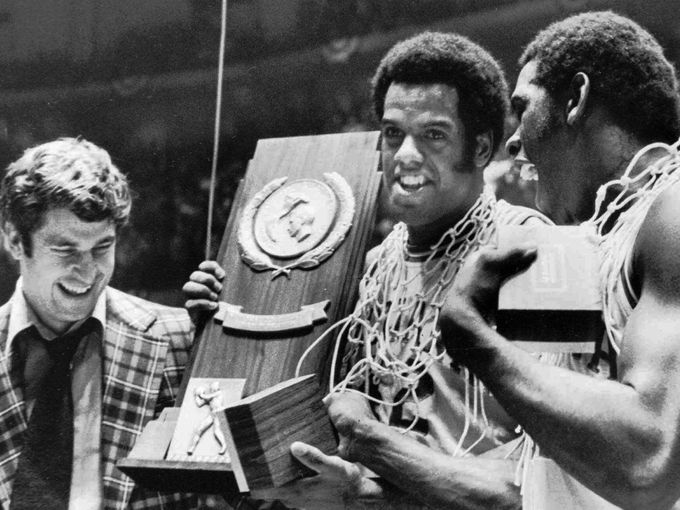
Truth be told, Knight did in fact change in the mid-1980s and into the 1990s. He stopped wearing suits, switching to golf shirts and polos before arriving at a pullover (the modern day equivalent of Bill Belichick and his hoodie). He seemed to grow colder to his players, at least publicly. He lost more players to transfer, had more players in his doghouse for longer periods of time. Look at the picture above, he smiled in 1976. He didn’t smile much in 1996. Some of his better teams in the 1989-1993 range had some of the strangest blowout losses and even with those loaded teams, never won another national title.
And this is when he lost me, and most likely when he lost many, many others.
As I reached high school, I was still playing basketball and still had that dream of Indiana (even though I knew I was not good enough to get there). But the more I watched Knight through the eyes of a 14-year-old, the more I saw that this didn’t seem like something I wanted for myself, even if I would have been able to have it.
The head-butts, the jokes about whipping his players, the feces covered toilet paper. I read “A Season on the Brink” around this time – and it absolutely terrified me looking at it through a player’s eyes. For some reason, when reading Knight’s quotes in the book, the voice in my head immediately sounded like R. Lee Emery in “Full Metal Jacket.”
What 18 to 22-year-old kid is equipped to step into the mind games a 50-year-old coaching legend is playing with them? Knight should win those games. And that dominance over others is certainly a component of Knight’s demeanor as well.
Meanwhile, I began watching other basketball teams and their coaches in the mid-1990s. Dean Smith seemed kind, yet passionate and disciplined. Knight’s former protégé, Mike Krzyzewski, had built Duke into a national power and his players seemed to love him, too. The same for Lute Olson, and his Arizona teams moved up and down the floor, not stuck in a stagnant, set motion offense. Olson’s players were always smiling, seemed to be having fun. Indiana players looked depressed and scared.
All of these men – except for Knight – have a court named after them, a sign of the lasting effect, the impact and the accomplishments. Knight has nothing left in Assembly Hall but the fading banners dated 1976, 1981 and 1987.
Though my skill level, height and ability did not match major Division I recruits, my mindset certainly did, meaning I wasn’t the only one who looked at Knight and knew that it would be a daily judgment and sentence handed down in Knight Court by Judge “General” Robert Montgomery Knight.
He couldn’t keep the best players in state and rarely got the better out-of-state players, either. Fewer and fewer star players wanted to play for him, which is what leads to not topping 23 wins in a season for his last seven seasons at IU and first round NCAA Tournament exits in five of the seven years. By the end of his tenure at Indiana, it was little surprise it ended the way it did. A crusty, curmudgeon bitter over a freshmen’s perceived lack of manners and a lingering tape of him choking Neil Reed, a non-descript player who seemed to give everything for Knight on the floor, but never could gain his approval.
The world changed, but Knight would not. Values, respect, seeking perfection and discipline will never go out of style. Demanding, demeaning, degrading, embarrassing? Those do go out of style, like a plaid jacket.
Which brings us back to present day, when Indiana fans awkwardly interact with the memories of Knight and his fantastic teams – the guts of the school’s illustrious basketball history and tradition. They talk about the tradition, the candy cane warm-ups, the floor design on Assembly Hall, the banners. They rarely mention Knight. It’s like trying to remember the presidency of Roosevelt, Eisenhower or Reagan without saying their names or conceding they were the President.
This is because there is no closure, even now, nearly 15 years after his departure. We embraced Knight for nearly 30 years in Indiana – even fans of other teams miss him – but we cannot bring ourselves to patch it all up without acknowledging our role in accepting and allowing it.
Truth be told, as wild and manic as Knight was, it is hard not to miss that era a bit now. I watch less college basketball than I ever have before. The games are not as exciting as they once were. Or perhaps I’m more distracted, or have more options to spend my time doing a litany of other things. The world developed and evolved. We kind of, you know, left the Indiana of the 1980s behind. Our little towns are small cities now, Indianapolis does anything but “nap.”
We left a lot of that time period behind in sports, too. Conference re-alignment changed so much of the landscape, as did the plethora of players leaving school after a year or two. Indiana went to multi-class basketball before Knight was fired (1998). Lots of other sports and activities are available, as is cable TV, technology and loads of other time distractions. The investment is not as deep as it once was. That is also neither good, nor bad. Just the way it is. Times change, but something about the fact that Knight never did is oddly comforting, yet disconcerting all the same.
Now, and perhaps finally, in a proper way, with enough time and distance to handle such things, we can begin to figure this all out. Indiana, the school and the state, has to determine how to admit that it loved Bobby Knight, while also yielding that his methods expired and that he was a megalomaniac.
They have to accept that his ego probably won’t ever allow him to step foot back in Assembly Hall, that the same ego is expecting a grand apology. You must understand that Knight does not believe – probably never believed – he did anything wrong. He once said he wanted to be buried upside down so the world could kiss his backside. If he does return while still alive, there will be some serious backside smooching that must occur by Indiana. Not because it is due or warranted to Knight, but because it is the only way he’ll come back. He just won’t change. Then again, maybe Indiana won’t change, either. And maybe they shouldn’t.
But if it ever happens, if Knight can come back and time can ease the pain of the anger gone awry, it can be both a celebration and a little sad.
If it ever happens, it will no doubt be clunky and awkward and strange.
Basically, it will be a little bit more like life. A little less than perfect, not entirely ideal, but still getting the job done.
A little bit like a chair, clumsily bouncing across a basketball court. It’s not supposed to be there, but it is there all the same.
And here, in Indiana, the crowd will ultimately cheer either way.
For many, Super Bowl XLIX will always be about the game, the way in which it ended and the enduring legacies of the key participants on both sides.
For me, it will always be about the moment I understood the complexities of being a parent. With four children and a fifth on the way, perhaps that moment should have come sooner. Alas, maybe it is only now that I fully understand it.
In many ways, especially as someone who was rooting for the villainous New England Patriots, I wish the game would remain tucked away in the recesses of my memories as one that solidified Tom Brady as the NFL’s greatest quarterback (purely an opinion). I’d like to remember his nearly perfect fourth quarter, bringing the Patriots back from 10 points down and collecting a record-tying fourth Super Bowl ring.
I’d like to vaguely recall in 20 years the look of horror on Richard Sherman and Pete Carroll when that pass was intercepted – but only because it serves as a reminder of how sports can change on a dime, how cruel they can be and how nothing is guaranteed in life (pretty much fact).
And perhaps I will remember all of these things. But I also know that I will remember more about the commercials than anything else. The ads themselves might not be that memorable, but I am certain to not forget the reactions in our house to them.
Especially those of my 8-year-old daughter.
Perhaps it was my fault. I had hyped the game to our precocious second-oldest – and only girl – for hours. The boys and my wife were easy, they were ready for four hours of football’s grandest theatrics and for what would ensue – their father hollering at the TV and cheering wildly for a team that no one else in our area liked.
And man, she was all in. Wearing a throwback Welker jersey from her brother’s closet, our daughter placed herself in a chair next to me and basically did not move – or wasn’t allowed to – for the duration of the game.
Dad’s superstitious nature kicked in just briefly after kickoff. Every Patriots first down, I ran the room and high-fived, in order, our oldest son (12), the youngest son (3), my wife and then returned to give the biggest, double high-five to our daughter before sitting the exact same way we had the play before. (Meanwhile, our 6-year-old son went back in for the between the iPad and the game and playing with toys. Sigh. I took what I could get.)
She squeezed my arm on big third downs, asked all kinds of questions about the rules and the game and cheered to please us at first, then later because she seemed to actually, briefly, kinda care.
Soon, this became as entertaining as the game. My daughter and I were enjoying a bonding moment within the bonding moment of our family.
As the game stayed tight and tension mounted, we were all glued to the TV.
Which included the commercials.
It began with the dead-child Nationwide commercial in the second quarter and ran right on through to the game’s end, specifically, Always #LikeAGirl, Victoria’s Secret and the 50 Shades of Grey trailer.
There is no one way to adequately describe the confusion on a child’s face in, what for a parent, is an awkward moment. There is also not a great way to address the confusion without convoluting it further and getting more questions.
“Why is the boy dead?”
“Why didn’t the parents stop the bath water?”
“I don’t run like that. That’s not funny.”
“Are they making fun of girls?”
“She’s not wearing very many clothes.”
“Those people are kissing a lot and kissing really weird.”
Thanks, guys. Really, just a bang-up job, advertisers. Why didn’t you just air a commercial debunking Santa Claus or an documentary on where babies come from?
And look, n the heels of a national discussion (again) on if athletes are role models and how they are not the parents, there’s Marshawn Lynch grabbing his crotch again. And if he wasn’t, people were talking about it.
Stating the obvious: My wife and I raise our children. No one else. Ultimately, how they turn out is a far greater reflection on us than it is society in general. Yet in being a parent, you’d like to shield them from certain topics and situations for as long as possible, because, as science has proven, their minds just are not ready for it yet.
And it is a simple fact that kids are influenced by their peers, other family members and yes, who they see in movies and on television. You know how I know this? Because I was a kid once. I wore the shoes, rolled the jeans. I acted like my favorite players on the court or diamond.
Back in the 1990s, we had a whole Gatorade campaign centered on “Being Like Mike” for goodness sakes. It was aimed at kids.
Advertising has not changed who it targets, but the topics and the boundaries of those messages have changed.
I have heard it described like this: we urge caution with young athletes lifting weights, noting how the body structure of a 14-year-old is not meant to handle too much lifting because the frame cannot handle the weight. The same is true for the brain. An 8-year-old is can comprehend more than a 6-year-old, but not as much as say a 12-year-old.
These ads, geared towards adults, are viewed by kids who simply cannot contextually understand them. From what the ads mean, to what they infer. They may contain a message, but the absorption of that message is varies widely based upon the receiver.
And we simply do not care.
As eyes begin to roll of readers who fear I’m just complaining or bemoaning something else in society, I’d venture to say you don’t have children. You’d suggest we turn it off, that we have a choice in the matter, that the media does not raise and influence my child.
Some may say that we’ve always had this (though, as noted above, there is a significant difference in “Being Like Mike” and talking about the ghost of a kid whose parents were either a) neglectful or b) neglectful and without Nationwide’s accidental home prevention training.)
My response to this is humble and contrite: it is the right of my wife and I to determine if and when we talk about these issues or topics. They normally don’t see these ads, because our children are not normally up past 8:45-9:00pm. But the Super Bowl is anything but normal.
I’d rather not be forced to address my daughter’s self-esteem during the Super Bowl because the ad #LikeAGirl – a positive message overall – was viewed incorrectly in the eyes of an 8-year-old simply because she was eight and thought they were making fun of her.
“I don’t run like that, Daddy.”
“I don’t throw like that, either.”
No amount of “I know you don’t” or “that’s not what they meant” could remove the furrowed brow of my little girl. She just didn’t understand the point. In her eyes, she didn’t even know there was a image issue to begin with. But hey, thanks Always for putting it out there.
Is it the advertiser’s responsibility to control the message? At the very least, perhaps a little?
The same as Marshawn Lynch grabbing his crotch with millions of young football players watching him, he controls the message. I can tell my kids that something is wrong or not right, but the follow-up is the same as it was 25 years ago when I was a kid: “But why does he get to do it?”
Explaining six figure fines doesn’t really address that question, either.
I can defend Lynch over not speaking to the media. It does little harm and makes a mockery of what the current sports media has become. Any reporter who can tell you with a straight face they need Marshawn Lynch to write a story about the NFL, Super Bowl XLIX or the Seattle Seahawks is a reporter who is not very good at their job. Write something else, don’t give him the attention and move on.
But I cannot defend or pretend to agree with lewd gestures as an alternate sign of rebellion to the league. Kids don’t know or get that. All they see is the action, not the message.
To Marshawn Lynch, Charles Barkley before him – and all the athletes in between who feel they are not role models, I remain disappointed. No, you are not the role model for my kids. Yes, my wife and I should be and hopefully are. But it is naïve and irresponsible to pretend you are not at minimum an influencer of children everywhere who watch you play and want to be like you. It comes with the millions of dollars, the fans and the fame. They may not know you, but they know you can play and play well.
Show some decency, respect yourself and others with your actions. Athletes demand respect all the time, then do little to earn it with actions such as these. Don’t ask us to embrace you and cheer for you, then pretend to poop out the football.
Similarly, these companies and ad agencies hold the power to do a delicate balance of creative marketing and societal responsibility.
Run your child death ad at 10pm on a Tuesday night, Nationwide. Otherwise, you are anything but on my side. If my kid is awake and watching, that one is on me.
But they knew the reaction the ad would draw, they knew it would spike Twitter trends, Google searches. They knew the value of the ad would increase significantly with that kind of ad, in that moment and the kind of reaction it would garner.
There is no great call to arms coming here. Not this time. I don’t have a solution for something the majority of us do not see as a problem.
I just have disappointment.
My only hope is my daughter remembers the high fives and not the commercials.




 worldbetweenlines.com