Dr. Seuss, Duke, Jim Valvano, Kentucky, March Madness, NC State, NCAA Tournament, The Meaning of Life

The Tournament of Life


And so begins perhaps the greatest 48 hours of our sports year. Sixty-four teams, 32 games. In the next two days, we’ll have basketball for 24 hours. It’s wild, it’s chaotic. Your bracket will be busted, but it matters little right now, because you think this is it: the year you pick ‘em all right.
(Um, I don’t know how to tell you this, but you won’t pick them all right – well, unless your bracket looks like mine, of course.)
To quote Seth Davis, “I love the smell of Madness in the morning!”
Let’s be honest, we’re all just swimming in giddiness right now. Like a kid on Christmas morning. I’ve got that Bill Cosby smile happening at the moment, the one where your head bounces from side to side, with a permanent smile plastered across your face.

I don’t know if it’s because of the pools, the actual filling out of the brackets, the madness, the sound of the buzzer, the anticipation, the fact that every team has a chance to have One Shining Moment or something else entirely, but there is always – always – something magical about this Thursday and Friday in March.
It’s a way of life, really.
As a kid, I’d sneak into school with a hand-held radio, run the headphones up through my sweatshirt and listen to the games all afternoon in class. Trick was to appear as though I was intently listening to whatever was being said by the teacher. He or she sounded like the teacher from Charlie Brown, but I nodded like I understood – and appreciated – the insight. In truth, I was in The Pit, or in Dayton or San Jose or wherever the game I was listening to was broadcasting from.
Oh yes, I’ve used the “Boss Button” – the button you would hit that would pull up a fake Excel spreadsheet at your desk in case someone walked by while you were watching the games. I’ve called in sick. I’ve gone to the games (when they were local).
I’m guessing many of you have done the same. There’s just a palpable hue in air, a feeling of great expectations and anticipation. What’s this year going to be like? Who’s going down? Who survives? Who advances?
Watching the ESPN “30 for 30” documentary Sunday on Jim Valvano’s 1983 NC State team was a reminder of this logic. Survive and Advance. The Wolfpack had to win the ACC Tournament just to get in – then went through a ridiculous stretch of overtime thrillers to keep surviving, keep advancing. They had to beat Ralph Sampson and Viriginia a second time, not to mention Houston and Phi Slamma Jamma, which was the 1989-90-91 UNLV of the early 80s.
There have been Cinderella’s, like NC State, and there have been years of total domination, too: UNLV in 1990, Duke seemingly every third year, Kentucky in ’96. Nearly every year memorable, every year magical. For the longest time, I could tell you every Final Four team in each season beginning with 1980.
The point is, people from all walks of life, from all over the country, young and old, get into this tournament. Maybe it’s the all-inclusive nature of the Big Dance. Maybe it’s the drama or the vulnerability of rooting for 18-22 year olds to be perfect for three weeks when they can barely keep themselves organized for three hours. Perhaps it’s the fact that really, every game is a Game 7 in the NCAA Tournament. There really is no tomorrow if you lose.
Today, my daughter’s school celebrates the life and writings of the great Dr. Seuss. And my favorite book is, has and perhaps might always be “Oh, The Places You’ll Go!” The very real message in the book still rings true. About life’s ups and downs, the fact that you control your own destiny, that sometimes you’ll be going so fast in life you are out of control, and other times, you’ll realize you’re going down a dark and dangerous path. Sometimes there will be negativity, others people will be essentially singing your praises and rooting for you to win.
The message: you can do it, you can accomplish it, because you control your fate due to your ability to steer and guide yourself anyway you choose.
And really, isn’t that just a microcosm of what the NCAA Tournament is? Isn’t that really what life is? It can be done. You can survive and advance.
We choose and chose the lives we lead, the families we have (or don’t), the significant others, the jobs, the cars, the clothes, the house, the city we live in and the friends we surround ourselves with. We chose our the college we went to, the classes and major, whether or not to study for an exam.
These are our picks. Life is our real bracket.  
Really, we fill out the bracket of life as we go along our own tournament. Sometimes there are upsets, sometimes the favorite wins by 30. And maybe that’s why March Madness resonates with us just a little bit more, because it’s comparable, relatable in ways we don’t even realize. The only difference is, we can change our picks as we go.
Some days we are the No. 1 seed, others the 16. One moment, we’re a mid-major, at times, we feel like we’re from a power conference. We’re tournament-tested and prepared, then suddenly, we don’t look like we should even be in the field. One day, we’re sponsored by Nike, the next, we look like we’re sporting homemade uniforms and our name is misspelled. We’ve hit game winners, we’ve been blown-out. We’ve accidently called a timeout with none left. We’ve hit a shot as the buzzer sounds.
And truthfully, we like it this way. It’s unpredictable, just like this tournament. We never know what’s going to happen. And the options are endless. Each day, we survive and advance. Sometimes, it’s a struggle, other times, we look like we’ll run the table.
We’re all really just playing our own Tournament of Life, looking for as many Shining Moments as we can create for our highlight reel. We just have to keep filling out our bracket each day.
Surviving. Advancing. Hoping. Dreaming. Competing. Playing the game.
Let’s just enjoy the madness of it all.
Standard
Bob Knight, Indiana Hoosiers, Indiana University, Jeff Meyer, John Beilein, Michigan Wolverines, NCAA College Basketball, Rick Pitino, Tom Crean

All Apologies


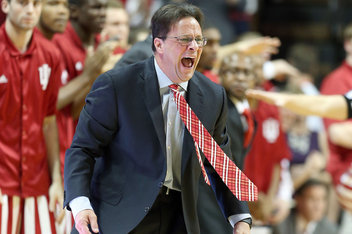
The head men’s basketball coach at Indiana University is, to put it mildly, unpredictable on the sidelines.
He stomps his feet. He shakes his fists. He berates officials. He screams. He teaches.
He’s not wearing a red sweater.
 
No, Tom Crean isn’t Bob Knight – but he’s closer than you think. In fact, that much was evident following Indiana’s intense-laden, 72-71 victory over Michigan in Ann Arbor on Sunday.
Moments after a hold-your-breath final 20 seconds, moments after Jordan Morgan’s tip bounced around and around – but not in, moments after IU captured their first outright B1G regular season championship since 1993, there was another moment: Crean confronting current Michigan assistant – and former Indiana assistant – Jeff Meyer.
And Crean couldn’t stop himself from saying something.
“You know what you did!” Crean shouted. “You helped wreck the program! You helped wreck our program!”
He ran away with a grin that can only be described as half Cheshire cat, half Grinch Who Stole Christmas.
It was rebellious, it wasn’t entirely classy, yet given the circumstances, it wasn’t entirely unforgivable.
As a member of Sampson’s Indiana staff, Meyer had made impermissible phone calls to recruits, calls that along with Sampson and fellow assistant Kevin Senderoff, would put the storied program on sanctions that would nearly break the Hoosiers. Crean was hired, as has been documented, not knowing the full content of the allegations and sanctions and went to work with what might resemble a JV roster in the B1G. There were two walk-ons who’d scored a combined 36 career points.
Crean’s first season, 2008-09, the Hoosiers were 6-25. Six and twenty-five. Worst in school history. The following season, 2009-10, IU went 10-21. In 2010-11, 12-20.
Forget last year’s 27-9 Sweet 16 team. Those three seasons in basketball purgatory don’t ever leave you. They stick and stay – a funk that’s not easily removed. And it’s the anger behind those 66 beatings in three seasons that built up and came up Sunday on the court at Crisler.
It didn’t just boil over – it was directed at a person who played a large part in helping facilitate those 66 losses in three seasons. Following the game, Michigan coach John Beilein commented on how Michigan would always conduct themselves with class and how Meyer helped build Michigan basketball “brick by brick” since arriving in 2008 – just months after leaving IU and being a part of a staff that destroyed it brick by brick.
Coaches can sometimes act like the kids they coach. Tom Crean is no different. This may surprise many outside of Hoosier Nation, but Tom Crean has become somewhat unpopular. He cut down the nets last week after a loss. He’s getting into people’s faces, smirking and possibly enjoying some of these wins a bit too much. He’s brash.
He’s also not changing a thing. And in the process, he’s prepping his team for the NCAA Tournament. Indiana won that game with three timeouts just sitting on the table. They played through the missed free throw, the Zeller lay-up and the frantic final seconds without calling for a huddle. Crean’s players know what to do – which is an unbelievably good quality come tournament time. You never know when you’ll be out of timeouts with 30 seconds to play and trailing by four.
Indiana won ugly Sunday, trailing most of the game. The Hoosiers looked poor in losing, at home, to Ohio State on Senior Night. As I said last week, these are college-age kids and you can’t predict how they will play. But Tom Crean is coaching really well. And Hoosier fans are hoping these last couple seasons are the rebirth of another era.
It’s not. It’s the start of a new one.
Crean is not Bob Knight. He’s not throwing chairs or attacking his players. You know who Tom Crean really is? He’s Rick Pitino circa 1992-96 at Kentucky.
After the nightmare Kentucky went through in the late 1980s, Pitino had to rebuild that storied program, same as Crean, from the ground up, without star recruits. The Wildcats went 14-14 in 1989-90. And when Kentucky started winning again, Pitino enjoyed it, relished in it and made sure you knew it.
He started dressing his players in crazy uniforms, they responded with crazy games – like the legendary 31-point second half comeback against LSU in 1994. The roster began to fill with NBA-quality players who wanted to play for a fiery, intense guy like that. After that Duke loss in the 1992 regionals, Kentucky went on to play in the Final Four in 1993, 1996, 1997 and 1998 (without Pitino, but with his players), winning national championships in 1996 and 1998.
Indiana could be primed for a run like that, and the Hoosiers could become insufferable to the rest of the nation. With another stellar recruiting class coming up, Indiana is back and isn’t going away again anytime soon.
And neither is Tom Crean.
Do we wish these coaches wouldn’t do embarrassing things? Certainly. Then again, coaches like Pitino and Crean are the only ones bold enough to take on challenges like Kentucky and Indiana have faced and deal with the humbling losses.
Crean defending the program, unleashing a mocking tirade on a former assistant who, in a way, put him and the school through hell for three seasons of beatings, is more defensible that so many other coaches actions – most notably the actions of the man who Crean will be measured against, Knight.
Knight and so many coaches get caught up in discussing and taking controversial stances on things outside of what they know, which is little besides college basketball.
This was different – and it’s not something Crean should apologize to Meyer for.
We’ve become a little overly PC on the apologies. We apologize – and demand apologies for – nearly everything. We’re offended by the action, but we can also become offended if the apology doesn’t suit our ridiculously high standards. Was it sincere? Did they mean it?
Why don’t we just stop and examine what exactly demands an apology? Why can’t we deal with letting conflict exist? So Crean doesn’t think much of Meyer and his recruiting practices. Who cares? It’s overshadowing so many other stories from this game, this weekend. Last Wednesday, people wanted Crean and IU to apologize for cutting down the nets in their own building.
Why do we care? And why do we care to the point that we need to hear “I’m sorry.”
All these apologies. Ugh. I like a stern handshake, a vigorous pat on the back, a deep, lingering look directly into someone’s soul through their eyes. It’s the Michael Corleone “Fredo, I knew it was you!” moment. And it’s OK. People are allowed to not like one another – it’s what makes something a rivalry, which is now sorely lacking in sports because, well, everyone likes everyone so dang much.
If Crean wants to apologize for representing Indiana University poorly in a public setting then fine. If Crean feels like he should set a better example for his players, then fine. Apologize all over yourself, Tom. But Crean shouldn’t apologize to Jeff Meyer. Jeff Meyer should be apologizing to Tom Crean, to Indiana University and it’s fans.
If Crean continues on this path, no doubt he’ll have other things to apologize for.
Like winning. A lot of winning. 
I guess, in a way, he could be a lot like Bob Knight. 
And it’s the one thing he won’t ever need to apologize for. 

NOTE: The blog has been updated to accurately reflect that Meyer was never found guilty of major violations, but was part of the coaching staff that did. Meyer was cleared by the NCAA having committed minor infractions relating to phone calls and the NCAA found at the time that they paled in comparison to Sampson and Senderoff.

Standard
Dr. Seuss, Eric Holder, John Brennan, motivation, Rand Paul, Society, Theodor Geisel, United States Senate

Unless


On Wednesday, John Brennan was all set to be confirmed as the new director of the Central Intelligence Agency (CIA) by the United States Senate.
Unless.
Unless someone did something.
And just before lunch, someone did, as Kentucky Senator Rand Paul took the floor and announced he was beginning a filibuster to bring light to recent comments by Attorney General Eric Holder regarding the dangers of drone strikes on U.S. citizens.
“I will speak until I can no longer speak”, he said. “I will speak as long as it takes…”
When Paul finally yielded the floor – over 12 hours later – realistically, he had not changed much. Delaying the inevitable, really. Brennan will still most likely be confirmed, possibly this weekend, and the discussion on drone strikes will fall back out of the public eye.
Unless.
Unless Paul did something just a little bit more than provide a speed bump to the legislative agenda of the Senate on a random Wednesday. Maybe he sparked an interest group to pick up the mantle and seek further dialogue with the White House on the matter. Maybe some journalist will write an expose on drones. Maybe he educated another 10 percent of the population on what the threat of a drone strike even was.
The point isn’t necessary what happens in the future, but that something happened in the now. Paul got attention – and then he used it for something. It doesn’t necessarily matter what the something was, or if you agree with it or like it. It doesn’t particularly matter if you like Paul or his politics or the filibuster tactic in general.
The world has changed so rapidly that time indeed feels like it moves faster to us, even though it doesn’t. We often remark how life moves at a faster pace than it once did. When I was a child, it seemed like the years were two or three times as long as they are now. Is it because my sample size was so small? Or is it because I actually remember so much? Naturally, we remember days and events when they are distinct and unique. It’s what, you know, makes them, well…memorable.
Early life is filled with firsts. First time you learned to read, first time a friend spent the night. A first game. The first time you saw your favorite movie or heard that song. Your first kiss. Your first heartbreak. The first time you saw your spouse. The first time a loved one died, the first time you held your child.
What I’ve realized is this world needs more firsts.
It’s the repetition that dulls the effect. We’re all just so busy now, with jobs, kids, appointments and soccer games, homework and functions. Pretty soon, we’ll look up and it will be Christmas season again and we’ll think to ourselves “where did this year go?”
Before we know it, a decade will have passed. And we often discuss doing something more, something different. Have you ever noticed it’s always in the future?
Oh, I’ll have time for the kids when my job slows down” or “We’ll pay down our debt once we get promotions at work.”
Notice how these statements contradict each other? You can’t earn more money and see your family and friends more in modern America. There just aren’t enough hours in the day, right?
Except there are. There are just as many hours in the day for us as there was for Socrates, Lincoln, Da Vinci, Einstein, Disney, Jobs, Jordan. It’s all in how we spend it. We get so lost thinking about what we could do that we have forgotten completely about what we are doing. We’re not in the present, we’re in the past and the future while in the present. Our bodies are here, our minds are in 1999 and 2021.
Which means, simply, we’re wasting our nows by thinking about what we didn’t do before and what will do tomorrow. Tomorrow will be yesterday soon enough. Be passionate, purposeful and provocative with your time. If everyday looks the same, it’s because it is, which kind of completely the opposite of the point. Life is constant motion and growth. If we’re not eliciting that feeling within ourselves that we had during our younger days, then we don’t have enough motion and growth.
There is no grand finale. Death is the opposite of birth; life itself really has no opposite. The point of it is not for me to say. I can’t tell you what to do. It’s not my place and I’m not qualified in the least bit. I don’t even want to look underneath my own hood sometimes and examine what goes on in this brain.
But I do know that if nothing changes, then nothing changes.
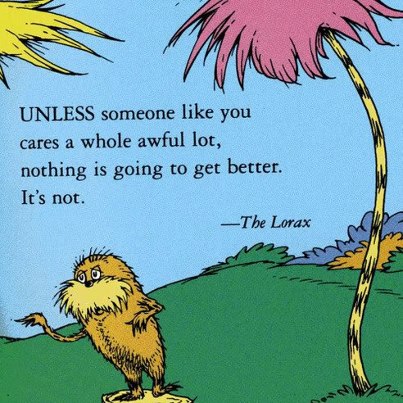
At least Rand Paul stood up and talked about something. Yesterday wasn’t just another day in the U.S. Senate. Paul got attention and he used it to passionately push for change. He did something with the moment and I immediately connected it with the famous line from Dr. Seuss’ “The Lorax”: “Unless someone like you cares a whole, awful lot, nothing is going to get better. It’s not.”
Dr. Seuss was the pen name of Theodor Geisel, and both were perfectionists. Geisel reportedly threw out 95 percent of the material he wrote until he had settled on a theme. He preferred to be paid when his material had been handed in – a rarity in writing, as most are paid in advance. His first book was rejected 27 times.
But Geisel wanted to make the world a better place and found that he could do it by infecting common ideals that we could all agree on in fun, easy to read ways. He ended up helping millions of young children learn to read with his strange vocabulary, colorful and unique drawings and deeply thought provoking messages, usually around humanity and how we treat one another.
In other words, a morality play – kind of like this.
Nevertheless, Seuss’ books were morality plays that you and I remember. A voice, a message that stands out. Unique.
But we cannot tell what the overall message is anymore because it’s all jumbled together. If no voice stands out, it’s just noise. That’s why our days and years are getting mangled and tangled. We’re not empowering ourselves, we’re just running out the clock. We haven’t made our voice heard. We haven’t delivered that message that resonates. Each day looks and feels the same because, well, it kind of is.
Unless.
Unless we change it. Unless we prioritize and maximize and stop talking about when. I want my days busting with so much activity, either mental or physical, that when I’m 95, I’m ready to go because I’ll having nothing left in the tank. I’ll be done. Live forever? How about live for now?
So individually we can’t solve it all, but we the journey has to start somewhere. Can’t solve world hunger by yourself, but you could donate to a food pantry. Can’t fix a broken relationship or friendship in one day, but it could start with an apology. Can’t fix stop the nomination of a new CIA Director, but can bring light to an issue of importance to the American people.
Speak until we can no longer speak.
Unless.
Unless we’re all OK with this life we’ve created for ourselves. Unless we’re OK with our income, our jobs, our family time, our government, our tax rate, our foreign policy, our society, our faith, our health. Unless we’re just OK with everything.
If nothing changes, then nothing changes.
Unless.
Unless we care a whole, awful lot.
Standard
1987, Assembly Hall, Bob Knight, Calbert Cheaney, Damon Bailey, Digger Phelps, Gene Keady, Indiana Hoosiers, NCAA College Basketball, Steve Alford, Tom Crean

This is (the new) Indiana


What I’ve learned in all my years watching college basketball is this: it is lacking all logic and rationale and cannot be explained.
So many inexplicable things happen, defeat snatched from the jaws of victory and vice-versa. Buzzer beaters, blown leads, comebacks, brain freezes. What makes sense, what looks good, depth, balance, defense, offense, can all change radically within a week, a road trip or even a game.
But we all know why. These are just kids.
They have classes on the History of Southern Cooking, bowling, Advanced Triple Trigonomics and the Economic Impact of the Sudan on Western Civilization. In one semester. They eat their weight in Cookie Crisp and don’t gain a pound. They stay up all night and sleep half the day. They may or may not shower regularly.
And they are going to be as perplexing to us, especially while playing a game, as they are to themselves all the time. In college basketball, perfection is rare, predictability even more so – that’s why it’s called March Madness, after all.
Indiana basketball cannot be rationally explained, either.
Why is it so important to fans that Indiana University basketball return to a place of actual relevance and championship contending status? Why is this night, Senior Night against Ohio State with the outright B1G title on the line special? Why is this important?
Does “it just is” suffice for those questions? No? OK, well, that’s a shame, because that’s kind of the best answer. We don’t even really know what a “Hoosier” is – and it’s a good time to mention it’s 2013.
But that’s the best answer because, really, it would simply take too long to explain Damon Bailey, 1976, Martha the Mop Lady, Calbert Cheaney, Brian Evans, Alan Henderson, Scott May, the Abernathy twins, Branch McCracken, candy-striped pants, The Shot, Alford, Darryl Thomas, The Rim Recker, Greg Graham and his brother from another mother Jeff, Evans arm sling, The Chair, The Sweater, The General, A Season on the Brink, 1987, 1981 and the missed opportunity in 1993, Haston, Guyton, Lyndon Jones and Jay Edwards, Uwe, Kent Benson, Steve Green, Mike Woodson, Keith Smart, Isiah, The McGlocklins, Laz, Chuck Marlowe, The Indiana Classic, The Hoosier Classic, “Socks, Shorts, 1-2-3”, Bracey Wright, Joby Wright, McGinnis, Buckner, Wittman and really, a hundred other moments, names and games.
What we have is a grassroots style of support for a game long entrenched in the fabric of the state. From high school to college to pros, we live and breathe this stuff. In 1998, the state’s high school athletic sanctioning body, the IHSAA, changed the format of the state tournament to multiple class basketball and it was nearly Armageddon. The backlash is still going on, somewhat. People still talk about it.
But you have to understand how deep the roots are. It’s tribal.
Counties of four, five and six schools, like the six or seven that surround Indianapolis, are deeply rooted in rivalries between schools of diverse enrollment and socio-economic class. It’s 1990 Duke-UNLV or 1992 Michigan-Duke, in a way. Then, there’s Marion County, home of Indianapolis and home to a hoops hotbed. The City and County championships are legendary.
Every game is March Madness in Indiana high school basketball. At least it was. I played in both the final single-class tournament and the first multi-class tournament. It felt like they were trying to find a way to make the small schools feel important, but we already did. A sectional championship might as well have been a state championship. It meant that much.
Now take that, let it age a few years. Let the lived and lost dreams of former players, coaches, cheerleaders and fans permeate.
In Bloomington, they have five national title banners swaying softly in an oddly shaped building that can get very, very loud. It’s loud because it’s filled to the brim with diehard fans of the game. A former high school star sits next to a former high school cheerleader next to their parents, who went to every game, drove every trip for AAU games in Fort Wayne and Evansville when they lived in Batesville, Rushville or Jasper.
Nature vs. nurture? How about both.
In Indiana, this basketball stuff goes deep and it’s like a cult. Nearly everyone did have a basketball goal and dreamed of taking the last second shot. Magnetic – and usual – personalities like Bob Knight, Gene Keady and Digger Phelps ran the state for nearly 30 years. They brought in the local boys, the hometown heroes we had watched through puberty and made them men – championship men. Some went on to the NBA, others just back to their hometown. But all basically legends.
Knight himself was a force of nature, and when he slipped and finally lost it, it was like a giant falling. The crash left collateral damage, bruising the school, the state, the game, our tribes. And as often happens when eras end, there is a hangover, a decay, a funk. Then, to make matters worse, Kelvin Sampson started using a cell phone. Those hometown heroes started leaving the state.
When you don’t have a deep connection to your high schools and your counties, when specialization in sports during this era means fewer kids participating as they get older, when your state divided by enrollment, when your legendary college coaches retire (or get removed) and some hotshot comes in from out of state, you lose your bearings a little bit.
The thread of the fabric unravels.
But just like with most things in life and in history, with proper attention and care, things can be repaired or made new again. These things just take time. It took the right guy – someone like Tom Crean – to fully submerge himself in the process of not just picking up the pieces, but building a new foundation from scratch.
It was good that Steve Alford knew all these years what many couldn’t see: IU didn’t really need him. Oh, they wanted him. What a story, right? The prodigal son returns. To do what exactly? Just winning would never have been enough. He would always be compared to Knight. He’d be living moment to moment, with no joy, dying with each loss, with each recruit he didn’t get. He’s better off building something new in New Mexico than trying to relive the past in Bloomington.
No, Indiana needed Tom Crean, someone without history here, but someone with passion for the history of the state and obsession for basketball, not the other way around.
Truthfully, honestly, full restoration may never occur – it’s just a different time, both in the state and the sport. We might never see the dominance of Indiana basketball again for an extended period of time, just like we might never see the level of obsession again.
Think of it as the new Hoosier Hysteria. It’s realistic, slightly tempered, built better for the modern age, with a nod to history. We like Tom Crean, but he hasn’t consumed us, blinded us as Bobby did. And yes, that’s a good thing. It shouldn’t matter if Knight wants to come back – for the first time since he left, the program is bigger than he is.
It’s the name on the jersey, not the coach on the bench.
Does Indiana, now after regaining credibility, being ranked No. 1 most of the regular season and capturing the school’s first B1G title in years need to win it outright tonight? Does it need to win the NCAA Tournament this year to fully return to glory?
Does it matter?
Sometimes to appreciate where you are, you just have to realize where you’ve been.
Standard
Dan Patrick, ESPN, Keith Olbermann, SportsCenter

Of Biscuits & Baskets


Well, well, well.
Looked what the cat dragged in. Why, it’s Keith Olbermann, looking for a job.
According to a story in the New York Times, Olbermann’s throwing rocks at the window of ESPN. I can visualize Olbermann with a boom box held over his head ala John Cusak.
If this seems strange to you…well, you’d be right. This oozes of desperation, the kind where self-loathing is only trumped by one’s willingness to have their voice heard, even if nobody listens anymore.
Olbermann has become the bigot in Henry Fonda’s “12 Angry Men”, where everyone just ignores him now.

His first time around, Olbermann spent five years at ESPN (1992-1997), pairing with Dan Patrick to create one of the greatest broadcast teams in sports. During an era when ESPN and SportsCenter were both simultaneously growing and peaking in popularity, everyone watched the 11pm SportsCenter. And for that hour, Patrick and Olbermann were your witty, snide and insightful co-hosts of sports highlights.

They were a fantastic team and SportsCenter became must watch viewing for males 14-450. Everyone watched. They were creating catch phrases and making athletes themselves watch “The Big Show.”
But then Olbermann lost his mind. He was suspended for going on a former colleague’s show and calling ESPN a “Godforsaken place”. He might as well have burned down the Bristol campus the way he left town. He spent the next decade either verbally eviscerating ESPN or half-heartedly apologizing.
Meanwhile, Olbermann continued his erratic professional behavior at Fox, MSNBC and CurrentTV have all parted ways with him, mainly because he just kept saying things that would cross the line. It’s hard in the current political landscape to actually say enough against another party to lose one’s job, but Olbermann keeps finding ways to do it.
Perhaps it’s because it’s so venomous, spiteful and angry. Or, it could be, as Rupert Murdoch once said, “I fired him…he’s crazy.” He even found a way to make Al Gore hate him and Gore is of similar political leanings. He’s a master of professional and journalistic arson
Either way, Olbermann’s reached a point where no one credible will hire him. He’s one step away from using his catchphrases in a fast-food drive thru.
Which is why, short of toying with him, I can’t imagine why ESPN would even entertain this. I picture ESPN as something akin to Henry F. Potter in “It’s a Wonderful Life”, when George Bailey comes to him for help after “misplacing” the money:
Look at you. You used to be so cocky. You were going to go out and conquer the world.”
But Keith Olbermann is no George Bailey.

He’s smarmy, arrogant, incendiary, rude, unyielding – a reckless force of nature now. He’s grown to think his importance and stature are above that of the topics he covers. It’s all background noise to the Keith Olbermann Show itself. His ego is bigger than the state of Connecticut.

And there’s just no way ESPN can put him back out there. First, ESPN isn’t big on big stars. Second, there’s the whole Keith Olbermann “I Hate ESPN” campaign that was only missing some bumper stickers and its own Super PAC.
Perhaps most importantly, nobody cares about what Keith Olbermann has to say anymore. When he has dipped his right holier-than-thou toes into the sports scene, it’s clear he considers it to be a somewhat silly attempt to lower himself to that level of commentary again.
In other words, Keith Olbermann thinks he’s too good for sports. And can you imagine how his 1990s catch-phrase style would come off now?
For the time being, ESPN is wisely staying away. Then again, they are doing just what I said they might, which is toy with him. Like an executive took Olbermann out to dinner and then made it known to other media outlets than Olbermann was looking for work, but that it’s ESPN and ESPN doesn’t need him.
On second thought, maybe they deserve each other. Because I can’t think of anyone outside of Olbermann who thinks higher of their own self-importance than ESPN does.
ESPN’s biggest problem is has all the angles covered: SportsCenter isn’t just highlights and brief analysis. Now it’s on all the time, with 10 minutes devoted to the Jets backup quarterback situation on a Tuesday in February.
There’s a blur between opinion, journalism and commentary. What’s factual isn’t always so clear, due to the instant analysis nature of the brand now. And maybe that’s where Olbermann fits, in this style of telling you, oh lowly viewer and impressionable mind, what to think about a topic. But instead of politics, it’s sports. We aren’t allowed to judge or develop our own narratives, it’s done for us now, by former coaches and ex-players and never-weres like Olbermann. ESPN News, when it’s actually on, is what SportsCenter used to be 10 years ago.
So this is what we’ve been reduced to: stories about two massive egos who value themselves as entities so highly that they deem this a news story. In fact, I wouldn’t be surprised if they didn’t cover this whole thing themselves, further blurring the line.
Come to think of it, we’d be better off if we just ignored them all together. Since that’s not going to happen with ESPN, we can at least all agree to ignore Olbermann.
Keith, just go away. Your 15 minutes is up. After all, it’s not 1997 anymore. 
Standard