American culture, American People., Culture, faith, family, Life, Logic, motivation, philosphy, pop culture, psychology, Society & Culture, Sports, Uncategorized

We Hope for Baseball

Image result for baseball

The collective emotional roller coaster our homes, communities, states, nations and world have experience over the past week cannot be quantified with words.

But damn if it’s not like me to try. Leave it to a pandemic for me to sit down and type my first entry in so long I cannot recall.

The world around us moved so fast last Wednesday that it seemed unreal. The NBA was suspending its season?

Huh.

Thursday saw universities shuttered, college basketball conference tournaments cancelled, high schools move to eLearning.

Um, what?

Friday felt like the bottom fell out, the cancellation of the NCAA Tournament, a new kind of March Madness. Spring sports cancelled – including the College World Series in June – throwing eligibility questions and team rosters for the 2020-21 season into a quagmire that didn’t feel so giggity giggity.

And we thought the news was all filled with doom and gloom before?

I told my wife Friday afternoon that my brain hurt. I couldn’t comprehend much more that day, think of any more angles to cover or next steps after the next steps. I needed wine tequila and a hoodie.

2020 will be forever remembered as when “Social Distancing” became apart of the American lexicon, when everyone from the age of two to 92 could recite proper hand washing protocols.

It will be remembered when we learned everything in our economy is connected, that an essential freeze halted us in our tracks. We quarantined, we worked from home. We overreacted, we under-reacted.

We hoarded toilet paper.

Everything has effectively been put on hold. Youth sports, book clubs. Going out to dinner, a family cookout with grandparents. Spring break. Every Disney Park closed for weeks, every zoo and museum closed. No choir concerts, no parades, no church in person, no events really of any kind.

Everything. Has. Stopped.

But have we learned?

Nothing we didn’t already know.

That faith, hope and love are some good things He gave us, and while the greatest is love, the most important might be hope.

We need to hope we can get back to normal before July. Before June.

We’re holding out hope for high school baseball in our home state. My son, a senior, is a part of a team that won a state championship last season. His friends from his travel teams, scattered across the state, all want the chance to play before college. Most won’t get a chance to play in college, but it is not about that specifically.

It’s about Senior Night. It’s about Prom. It’s about hearing your name called for the final time. Crossing the stage with a diploma at graduation and graduation parties of definitely more than 10 people.

It’s about all we’ve taken for granted. The commute to work filled with podcasts that have fresh content about sports, movies, politics, whatever. Seeing our co-workers, sitting face-to-face in meetings, teaching in a classroom filled with people.

It’s been merely a week, and even the introverts like me don’t think we really understood how significant social distancing could be to the fabric of what it is to be American.

Maybe this is a chance to re-learn, to re-think the daily life and throw our routines out of whack. Are we adaptable? Are we unbeatable? Can we turn a negative, a 100 negatives, into a positive? Are we just catch phrases, or can we rise to the challenge and endure?

We’re always taking about how busy we are (I’m looking at, well, all of us).

Well, how about now? Time to read. Time to listen. Time to think. To take a walk. To get to know our spouses and kids again. To find a way to serve a purpose greater than ourselves.

Maybe this is our wake-up call.

What is truly important, and what is not.

Sure, we’ve clung tight to family. Personally, we haven’t turned into The Shining family around here…yet. And we appreciate our home, our jobs, our friends and our freedoms.

But hope, man.

Hope might be the most fascinatingly human emotion there has ever been. And we need it more than ever.

No matter your beliefs, your political allegiances, whether you call this a hoax or are digging your doomsday bunker as I type, this is history happening for better of worse in real time.

It is a stark reminder we are not in control, not even a little bit, not even at all. But like any good book or movie (that we’ve all probably re-watched or re-read three times by now), hope is a good thing.

It could be the hope we’ll stop losing our ever-loving minds. Hope that those who aren’t taking it serious will wake up to the fact that COVID-19 is a bit more threatening than we thought a week ago, or even a day ago.

Hope is why Hallmark is running Christmas movies in March. It’s why Disney+ put Frozen II up months before they were supposed to. It is why classic sports re-runs are a welcome distraction. Why Tom Brady going to Tampa Bay and leaving New England was something else to talk about for a few hours.

Because we do not know where this going. We do not know the impact on the economy, on our jobs, on our daily lives yet. And we won’t fully for some time.

But we hope.

We hope for the sick, we hope for the cure, for strong leadership, for our friends, for our industries, for our kids.

We hope for an appreciation of the life we lived two weeks ago and for a future that might be close to it.

So, yes, we hope for baseball in this house. And we hold out that hope, because without it, well, it just makes the brain hurt.

Stay safe. Stay informed. Stay good to each other.

Stay hopeful.

Standard
American culture, Facebook, Uncategorized

The Book Without My Face

facebookwarriors1-640x380

In the end, it will not matter or make the least bit of difference to anyone but me.

Yet I believe it will vastly improve my life.

And that is why I’m leaving Facebook.

Starting now, my detox begins. And it is an addiction, no doubt about that. We pretend it is not, but it most certainly is. Whether it’s just deleting the app, or entirely deactivating my account, one way or another it needs to be out of my life for at least a good long while.

My life has not been enriched by Facebook. My faith has not been enriched by Facebook. My family has not been enriched by Facebook. My relationship with my spouse has not been enriched by Facebook. And I certainly interact with the platform far different than I do the other forms of social media I use.

But I finally reached the point where I am just tired. Tired of the correctness, or lack thereof, tired of watching what I say and how I say it because this friend is a liberal and that friend is a conservative, or that person in my feed hates this sports team and I don’t want to start World War III on anything. Tired of wondering if it’s my page and I can say what I want, or if because I post in the public sphere I’m fair game.

I am tired of pretending that most of the people in my feed are my friends to begin with. And I am tired of pretending that I am their friend, too.

That’s meant more wistfully than sarcastically or hurtfully.

At some point, we probably were friends. But there is a reason that before Facebook we didn’t remain close or that those friendships fell aside. For a while, it was fun to see from afar what people I used to know were up to. But reading a post or seeing a picture doesn’t really tell me who someone is now.

I truly wish I knew some of the people in my Friends list better, saw them more. Some of them, I forgot were there, honestly.

But regardless of status, in my mind, this is charade. We’re just pretending to know enough and care a little. My phone is a internet device, with fewer phone calls and texts to take or read than time spent app scrolling. But it brings out some of the worst reactions I have ever seen.

The name of the app itself is Book of Faces. Ever heard to not judge the book by its cover?

Because all Facebook seems to actually do is put even more labels on us, not knowing who the real person is behind the likes and shares and tagged photos.

It would take someone far greater and smarter than me to do the necessarily research and analysis on this, but is there a small chance that part of the apparent growing divide in this country – which at the moment feels like the Grand Canyon – could be caused by our use of social media?

Not only that, but I get tired of myself sometimes. I can’t imagine what other people thought when I mindlessly clicked like on about 25 posts about the New England Patriots winning the AFC Championship Sunday. (Yes, in case you didn’t know, I am a Pats fan – but let’s not open up that can of worms).

fb.jpg

Point being, I just clicked “Like” on every photo I saw. Over. And over. And over. Without even really thinking, “Hey, this is going to show up in everyone’s feed who hasn’t already hidden you.” And that only matters because others, almost with a carnal reaction as well, will inevitably judge you on your likes, your posts and shares.

Lately, it has gotten worse. Now I feel as though what I like, what I post, what I share – or more importantly, what I do not like, post or share – is somehow the only representation or part of me that people see.

And it’s not that that is unexpected or that I’m chiding anyone who’s been guilty of doing that. I have done it, too. We’re humans. We process what we see and react to it. We can’t help it.

But it’s incredibly dangerous for so many reasons. We are not who we always appear to be, for better or worse. And our reactions run the gamut – from idolizing people or couples who we think are “perfect” to despising those we find that do not align with our already rooted bias’.

Again, this somehow makes us feel like we know someone, when we don’t. Facebook has created a mini-celebrity culture, just like the one in Hollywood where the message is controlled and everyone appears a certain, packaged way.

As I’ve written before, I am incredibly guilty myself of not keeping up with my friendships the way I should have or wanted to. But it’s also a two-way street. All I know is that my friendships are worse because of Facebook and the lazy idea that it fills in the gaps.

If we want to truly fix what ails America, it starts with becoming more humble and kind. We treat strangers horribly, but possibly that is because we started treating our friends like strangers first.

I am not naïve. I do not believe my simple decision to leave Facebook will make even the slightest of ripples. The machine will keep turning come tomorrow morning. People will continue to start verbal wars with each other about some of the silliest and inconsequential things, typing things they would never say to someone’s face.

But now, it just won’t include me.

It isn’t necessarily Facebook or social media in general that is bad. It would be tough and certainly irresponsible to blame a program for all this (unless we’re talking about TRON, which we can do, by the way – just give me a call.)

But by and large, social media has given an easy out to the rise of cynicism and criticism. It has provided a megaphone to a platform for a whole different kind of bullying. We like to think and pretend this is teens pressuring classmates. However, we adults make them look boring.

I have watched how we’ve responded to elections, general news, social issues, marches, to statements of opinion and I’ve come to the conclusion that we are worse than our children simply because we cannot handle it if everyone does not agree with us. We cannot even pretend to objectively hear someone else’s opinion because if it disagrees with ours, then we come out with verbal pistols firing like it’s the climax scene in Young Guns II.

And I’m not afraid to admit all of this serves to negatively affect me. I realize that I have allowed someone’s comments or posts to impact my opinion of them. Whether it should or should not is both parts irrelevant and up to whatever values or morals I hold to be important. But the point is, I am letting this platform dictate my opinions without spending the time to hear more about why someone thinks that way. Which is just lazy.

If we can recall such a time without social media, we spent time talking in depth about something. The pictures we shared weren’t captioned, there was a story to them. And hearing the story, seeing the form of emotion on someone’s face telling the story made it a connection point, which built bonds.

We all have enough to worry about in life. It is too short of a ride. Why spend it dealing with the decorum and unwritten rules necessary to circumnavigate a simple post on social media? Why spend it knowing everything and nothing about someone at the same time?

I probably sound old. I probably sound nostalgic for something that perhaps never really was.

So be it.

I know who I am, but I fear we are not taking the time to be present and to build our friendships and relationships because we’re too busy scrolling our News Feeds and posting selfies.

I kind of want people to wonder what I’m doing, what I’m up to – and then if they are inclined – reach out to me for lunch or to hang out and find out for themselves. And I should be willing to do the same for them.

To do that, I think I need to take my Face out of the Book. It’s perhaps the only way for me to truly have friends that know who I am, and not just my latest profile picture.

In the end, it probably will not matter or make the least bit of difference to anyone but me.

So be it.

Standard
American Politics, Donald Trump, Hillary Clinton, Philosophy, Politics, Uncategorized, United States

Love in the Time of Trump

hith-white-house-attacks-e

Perspective.

It can be gained. It can be lost. It can be ignored. It can be shared and heard.

Empathy.

It can be gained, shared, lost, and ignored as well.

Love.

It can be shared, in a variety of forms. It can be. It can come in various forms. It can be gained, earned and lost.

Freedom.

It can be exercised. It can be taken away. It can be fought for. It can be earned.

Compassion.

It can be shown.

And all of these attributes, these feelings, these emotions are a choice.

Much like the choice we had in voting (or not).

There are 330 million Americans of all age, race, creed, religion and orientation. Roughly 122 million of those voted in the Presidential election held earlier this week. Of those, the last count I saw showed that 59.9 million voted for Hillary Clinton, 59.7 million voted for Donald Trump.

Some of those who voted for the candidate who did not win the Electoral College – Clinton – are outraged, upset and frankly stunned.

Some of those who voted for the candidate who won the election – Trump – are outraged, upset and frankly stunned.

For entirely different reasons.

Some of us care deeply about issues like the second amendment, healthcare, pro-life, illegal immigration, infrastructure and jobs. Within that group, some of us are willing to overlook the words and actions of a candidate and place a vote for someone we perceive to be the lesser of two evils.

Some of us are tired of being blamed for hatred and violence, for being accused of being racists or bigots because we care more about the future of the Supreme Court than we do name calling. And that is not meant as condoning or endorsing name calling, hate speech or demeaning women.

Some of us care deeply about gun control, healthcare, abortion rights, open borders, LBGT rights and climate control. And within that group, voters were willing to overlook an equally flawed candidate who was paranoid, hid secrets, took money from foreign powers and in some cases, didn’t disclose the truth. Voting for that person is not meant as condoning lying or pay for play, either.

Some of us are Republicans, some of us are Democrats. Some of are neither, either or both. Some of us did not particularly like either option.

We had a choice on Tuesday. We chose. We had the same choice in 2012, 2008, 2004 and so forth. We had a choice in mid-term elections. We had a choice to protest, or a choice to accept the results of this election and every other. We can voice optimism; we can voice fear.

But really, we have a choice every single day. Realize where you live, what incredible freedom you have.

For heartsick Democrats, you now find yourself in the position that others who disagreed with President Obama have been in for several years – just in a completely different way. You wonder: “What rights will be infringed on? What issues do I care about will be ignored? What is happening to our country and those things which I find to be vitally important to progress?”

Simply stated, while the issues may be different, the sentiment is the same one shared by others over the past eight years who asked similarly: “What rights will be infringed upon? What about the issues that I care about? What has happened to our country and the things which I find to be vitally important?”

For joyous Republicans, you have a responsibility now to govern not just for yourselves, but for finding compromise with all Americans who do not see things as you do. You have a chance to do what you feel was not granted to you under the previous administration: hear all voices.

You see, we agree in earnest on much more that we are led to believe. We may be on opposing sides of key issues, but it striking how quickly we want compromise when we are not in a position of power. Your No. 1 issue may be the right to life, while someone else’s may be climate control.

Here is the one constant since the first days of this country’s existence: we may not and perhaps will never agree. You may get something you like, and I might get something I like. And then the next time, it might go the other way.

It’s called compromise, compassion and understanding. Very few countries actually have this. That is why the United States of America remains a beacon for a world where voices are routinely ignored.

If you have not enjoyed the past eight years, you chose to try something else. If you do not enjoy or find the kind of progress you wish for in the next two, four or eight years, you will have the choice to band with others in selecting something different.

But let us know not lose that perspective. That the freedom to choose in itself is the greatest political victory that has ever been granted in the history of mankind.

While the outcomes may be tough to accept, the alternatives are just too hard to fathom. We could live under tyranny. We could live under real oppression. From man’s earliest days until now, trillions have lived and died without choice, without the chance to vote for their voice to be heard.

Do not, in either winning or losing, ever forget that.

And do not lose the perspective that ultimately, no matter who runs the country’s business for a relatively short period of time, what affects and effects our lives the most is – and has always been – the manner in which we treat each other and in how we raise our children.

Reduced to a bumper sticker slogan in a lot of respects, it does not diminish the importance of the adage that we should strive to be the change we wish to see in the world.

And if we truly want to drive out hate and turn it into love, we do that in the time of Trump that same as we should have been doing in the time of Obama, Bush, Clinton and Reagan – within our four walls.

Practice what we preach – and from the looks of social media, we’re doing a lot of preaching at the moment.

I know we just held a draining, divisive election. It is far easier to get swept up in labels, in words, in emotion that it is to take a moment and understand things from the other side.

Break the numbers of this election down: Out of 10 people, roughly 5 voted for Trump and 5 voted for Clinton. Out of 10 women, 4.2 voted for Trump, 5.8 voted for Clinton. Out of 10 Hispanics and Latinos, 2.9 voted for Trump.

Basically, everyone is surrounded by someone of a different gender or race that voted for the other candidate. We’re no better than each other, but we can be better for each other. We can be better to each other.

While the election may have flipped the party in control of the nation’s highest office, it does not change that we are all Americans. We have too long overemphasized the presidency, and not realized that the most important changes that can occur are in our own backyard.

If we pay closer attention to local elections, town, city, county, and state issues, we’ll build better futures in ways that more directly impact us. I saw relatively few – if any – comments or posts on social media about their local elections.Take care of the foundation first. Do not get lost in the weeds.

Be a shepherd, not a sheep. Do not fall for what Orwell described as “groupthink” in believing everyone sees the world the same.

Again, I know it was a draining, divisive election. It usually is.

But it’s time to choose again. Today, tomorrow and every day.

Choose to not assume the worst in people. Choose to believe in the inherit goodness of most people. Choose to believe that not everyone who voted for Trump is a racist, womanizing, fear mongering bigot. Choose to believe that not everyone who voted for Hilary is a big government, gun removing, lie endorsing, liberty draining, hypocrite.

Choose compassion. Choose empathy. Choose compromise. Choose love. Choose perspective. Choose to look past the labels.

When we choose those things, there are no “winners” and “losers.” Just people working together to make the world a little bit better each day.

That is what has – and will always – make America great.

Standard
American culture, American Politics, Life, pop culture, Society, Society & Culture, Uncategorized

One of These Days

tree_roots

There are no words, really, though I’ll type a thousand as therapy.

I’ve been staring at that picture of the tree above, with its old, bulky roots, for a few days, as the violence that has once again rocked America has once again led to a chorus of outcry for change. Perhaps what we need is a change in mindset to remember our roots as human beings.

As President John F. Kennedy once said, “For, in the final analysis, our most basic common link is that we all inhabit this small planet. We all breathe the same air. We all cherish our children’s future. And we are all mortal.”

That mortal part, we do not seem to value it enough.

One of these days, we’re going to wake up, I think.

One of these days, we’re going to realize we’re killing each other over senseless anger, I think.

One of these days, a friend will call and simply ask how it’s going, I think.

One of these days, the headlines won’t be filled with both the tragic and the trivial, I think.

I think I might be wrong.

One of these days, we’re going to reap it.

One of these days, someone with their finger on a very important button will go too far.

One of these days, we’ll just stop responding to texts and calls.

One of these days, we’ll just give up.

I hope I am wrong.

Yes, Black Lives Matter. And white lives matter. Asian lives matter. Christian lives matter. Muslim lives matter. Young lives matter. Old lives matter. American lives matter. Russian lives matter. Iraqi lives matter. Women’s lives matter. Men’s lives matter.

Our short-sighted solution to respond to an event by pulling into tighter, highly defined groups of ethnicity, race, gender or religion isn’t working. We’re dividing ourselves further and playing into the devil’s hand of hate.

In 1963, most of the world watched in astonishment as President Kennedy was assassinated in Dallas. Last night, nearly 53 years later, mere blocks from Dealey Plaza where Kennedy was assassinated, five Dallas police officers were assassinated by snipers, on the heels of two men shot to death by police in Minnesota and Louisiana.

We’re regressing, America.

We can argue about guns and who can have them, or if it makes sense to allow military grade weapons available to civilians all day long. We can get snarky about deleted e-mails or business ethics of presidential candidates for months. But that’s not the division that ails us.

Simply put: how do we legislate kindness, compassion – or the simple ability to leave each other alone?

On Monday, the United States celebrated its 240th birthday. As majestic fireworks filled the sky, I doubt I was alone in pondering the sheer awe of time that had passed since those responsible for declaring our independence had put ink to their cause.

I also wondered how long we have left, how much has changed since the late 1700s in the world and how one of the greatest things about being American is not only freedom, but feeling relatively safe in our everyday lives.

We are no longer safe. And if we are no longer safe, we are no longer free.

When guns are fired from downtown skyscraper parking garages (Dallas) or from interstate overpasses (Washington, D.C. many years ago), when people are shot in their cars reaching for their wallets (Louisiana) you start questioning your safety nearly all the time.

All this does is serve to separate us more. We pull back into our homes, our neighborhoods and stay out of the cities and protests. Freedom to assemble shouldn’t have to come from the fear of being shot.

The song remains the same. We’re dividing ourselves.

Technology and social media have put a wedge in our society. We might be perhaps more disconnected that we were hundreds of years ago, when there were far fewer of us and our homes were miles apart.

We all have a voice and opinion and want to be heard.

The problem is, no one is saying anything worth hearing.

We market ourselves in blur of posts and pictures. If the intent was to be connected with people we don’t see as much anymore, maybe that was an itch we didn’t need to scratch if this is all we plan to do with it. If we wanted to see and talk to all those old friends and family more, would distance matter? We could still pick up a phone and catch up.

We’re a nation of creepers on social media, as if a picture of smiles and 140 characters of text tell the whole story. No one is perfect. But we pretend to be, and we’d prefer to take swipes at other people – their errors and mistakes – by calling them out on social media.

We’re jealous and envious of those with seemingly more than us.

It’s either that or the common obsession we have to know who Taylor Swift is dating now. And as much as I think we’re all a little too interested in celebrity boyfriends and girlfriends gossip, it’s probably the former.

We’re on social media to stalk people we used to like or be close to, but aren’t anymore and this is our totally American way of snooping in from time to time on their life.

So many angry people in the world, yet they all look happy in the photos.

What does this have to do with the most recent tragedies in Dallas, Louisiana and Minnesota? The same as it did for Columbine, Sandy Hook, Aurora, Fresno and more.

Simply put, we just don’t treat each other very well and we’re hiding behind two things: a lack of self-esteem and insecurity.

I usually try to come up with a positive message at the end here, to tie it all together, to provide a spark of hope in an otherwise dark moment.

All I can come up with this time is that we can only take care of ourselves. Preaching, lecturing isn’t working. To be the change you want to see in the world, I suppose it’s the Nike tagline.

Just do it.

If we raise our children right, hug our spouse, wave to the neighbors, keep our commitments and just try our best to not stab each other in the back, shutdown the apps a little more, we’ll hopefully lay down an example to the next generation.

It would be nice if we were happy in the life we have, not the life we want others to perceive we have.

Worried about what to do yourself? Want your voice to matter in the world? At a loss of how to raise your children to avoid this in the future?

Start there.

Love yourself, your family and your life. Be proud of who you are and kind to those who aren’t like you. The young ones are watching.

And maybe, one of these days, they will have a chance to save us.

One of these days, I hope I am right.

Standard
American culture, American People., American Politics, Uncategorized

Kites in Hurricanes

3002776434_14ae6614e1_o-660x400

From the jump, let us set the record straight about this presidential election and this primary: you don’t matter.

I know you want to think you do, and it is by far more pleasing to the senses to believe you do.

But you do not matter. And you do not matter because you do not allow yourself to.

To steal from the quotable Mr. White in the most recent Bond film, Spectre: “You’re a kite, dancing in a hurricane.”

Precisely because we do not realize this is why we play right into the hands of the powerful elite which capitalize on everything we don’t do.

We would rather take selfies and complain about something inconsequential than change ourselves, our families and our communities. We ask a lot of whys, bluster on about what’s wrong and then go back to the Bey-hive to taunt celebrities because we’ve analyzed some song lyrics like a conspiracy theorist.

In one week, for the first time in eons, my home state of Indiana believes it will finally play a role in helping shape a presidential election.

On the surface, it does. It appears that Indiana’s voters, with their early May primary, may have a say in who the presidential candidates will be for the Democrats and Republicans in the fall.

But dig a little deeper. Indiana’s voters have the same sway in this as those in Iowa, North Carolina and Mississippi did – which is to say, very little.

You do realize, you’re not really voting for a candidate. You are voting for a recommendation of a candidate to a delegate that you have never heard of that has been assigned to your district. Those delegates will go to the conventions and do basically whatever the heck they want. In a protested – er, contested – convention, delegates are bound to represent their district on the first ballot only.

Except now we’re told that in many states, that is not even the case, that technically speaking, somebody you don’t know can do whatever they please with that all important vote on the very first ballot. So whether you voted for Trump, Cruz or Mickey Mouse, that may not even matter for the first ballot.

And we’ve not even talked about Super Delegates. Let’s just say Captain America, they are not. You know what, never mind.

The fact is, it’s not about the candidate you detest or support so much as it is an exposed process whereby someone can get the majority of the votes after a long, arduous primary process and be denied the nomination by unknown foot soldiers of an establishment.

Are these the rules? You betcha. I suppose you got me there. But this is also not about the “will of the people.” Rules from state parties, delegations and delegates are as much a power play as a massive monetary donation from a corporation. There is little difference in what power they can wield behind the scenes.

moneyrace-1024x576

For decades, we’ve worried about the role of money in politics and how it influences decisions. Well, we should also worry a great deal about who controls the game and writes the rule book on that, too. It’s hard to tell who the puppet masters are anymore.

To me, this is truly much less about the name or personality – or even one’s personal feelings on a particular candidate. It is about the will of the people and the false message somehow portrayed that we are a democracy. We are not. We are a federal republic. We vote for representatives. And if you’re wondering why less and less people vote, it is because of this very notion: they feel their vote doesn’t matter.

In 2016, how we feel matters much, much more than things like truth or reality. That’s not an endorsement, either. Just a simple statement of fact.

We want our vote to matter – it’s why we push for voting, why we show the popular vote and tally it all up. But the confusion comes when terms like “districts” and “lines” and “delegates” and “bound” and “unbound” pop into our every day vernacular.

The average American citizen – of which there are far greater number than the political class – sees a name on a ballot and marks next to it believing their vote has been cast for that person. If that candidate has more votes than another person, the average citizen is inclined, by simple deductive reasoning, to believe that is the winner.

Except the winner is not always the winner. There are games to be played and delegates to be swooned. And even if you pull in roughly 20 percent of the vote, and your opponent is vilified more than you, you can be the winner.

I minored in political science and have been somewhat active and engaged in politics in a variety of ways for years. And I understand it all – but I definitely don’t get it. The country that champions pamphlets like “Common Sense” doesn’t seem to have any. The typically smarmy media types freely admit they don’t get it, either.

We speak of our founding fathers in glorified tones, and for the most part, it is true. Intellectual, forward-thinking and dynamic leaders they were, they also didn’t have the foresight to deal with race or gender or terrorist attacks or cyber-threats and digital privacy. A product of their time, they despised a King across an ocean telling them they owed more taxes for the products they consumed or created. They wanted the power of those governmental decisions to rest in their hands and on their soil.

Thus, the political system our country was founded on was self-serving. It was a power play, a power grab and they executed it beautifully. And they carefully crafted a foundational document to serve as a blueprint to young nation meant on doing things in a much better way, where the voice and the will of the people would have input – but not the ultimate final decision.

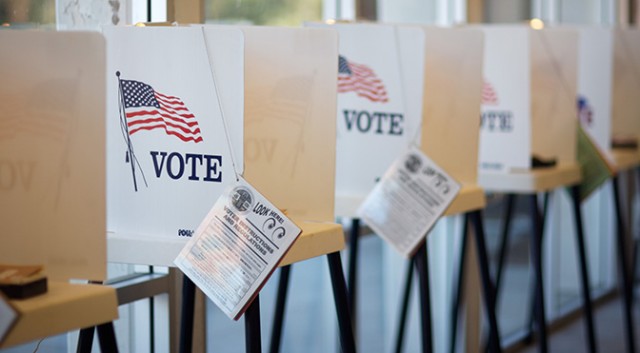
usa-voting-paper-ballot-booths-640x353

Do most of us understand this? We have the power to elect someone to represent us – at least once we get to November – and even then, you may not like your choices. But until that point, you have far less say. Money, corporations and power players bring us to the ballot box each and every election.

That is, seemingly, until this year. This is our revolt, on both parties. We’ve largely rejected traditional notions this cycle. Perhaps not you, but the larger We has.

Donald Trump is a lot of things. And while it may be difficult to digest, while many are disgusted by the very idea of him getting even this far, the simple fact is at the ballot box, in state after state, he’s winning the votes of those casting a ballot.

That is not an endorsement or a sentence of support for him as a person or even as a candidate. It’s a statement of fact. And while the collective spin room of the Republican National Committee, the national media, the remaining candidates and the candidates that have been eliminated clamor about blocking him due to the “will of the people,” it can be reasonably deduced that the people are rejecting something.

Did it ever occur that this could be less about Donald Trump and more about the other candidates or the party or the system?

“If liberty means anything at all, it means the right to tell people what they don’t want to hear.” – George Orwell

Here is where we stand, where we have always stood. Our voice can be heard through votes. For all the blustering and protests and social media posts about it, you can make your voice resonate through voting. If you do not like Donald Trump or Ted Cruz or Bernie Sanders or Hillary Clinton or John Kasich, you vote for someone else.

But what I think we’re all really hearing is there is true majority that doesn’t like any candidate. If that is the case, it requires much more effort and involvement from a collection of people who have yet to show they are willing to do what is necessary. It is grassroots, it is time consuming. It is organizing an effort to promote someone else who may not even be known or who may not even be running. Maybe you should run for office locally. To make changes, it requires changing your behavior first. It requires action. It requires talking to people, gathering a coalition of support and signatures.

That is, if it matters. But the vast majority of us is silent. The vast majority of the nation do not vote, do not get involved. Thus, to the victors, to the workers, organizers and monetary backers go the spoils.

We play into their hands when the extent of our involvement is complaining on social media, in a post stuck between a selfie, a Game of Thrones recap and an analysis of just who is Becky with the good hair.

We disappoint ourselves on a daily basis far more than the political candidates we don’t want to vote for. In fact, we create the vacuum of leadership for their existence in the first place.

In the immortal words of Ice-T, don’t hate the player, hate the game.


Standard