Dwight Howard, Kobe Bryant, Los Angeles Lakers, Mike D'Antoni, NBA, Orlando Magic, Phil Jackson, Shaquille O'Neal, Stan Van Gundy

Howard’s Hotel California


Dwight Howard never wanted the Los Angeles Lakers. 
He knew he would never match up to the expectations, the history, the legacy. Yet true to his personality, Howard smiled on the outside in the preseason following his trade from the Orlando Magic to the Lakers. He said mostly all the right things, mostly because there’s no way he’d say the wrong things.
Howard told us he wanted to win a championship. As opposed to telling everyone he doesn’t? And that’s the thing with Howard: his actions have always spoken louder than words.
From arriving as such a fresh-faced teenager who spoke about his Christian faith and all that he hoped to accomplish until this moment, wearing the famed Lakers purple and gold nearly a decade later, Howard’s hopeful words have never changed.
He always says what you want to hear, you just can’t tell if he believes it or only says it because he longs to be liked.
Howard had it all in Orlando: a small-market team that embraced him as Shaq The Second, willing to let him run the roost and act like a kid, because, that’s what he was. 
The Magic had a coach in Stan Van Gundy who exhausted all options in making Dwight’s strengths obvious, while hiding his weaknesses. Van Gundy protected Howard, both on and off the court. He defended him in the media. He surrounded him with shooters.
In Orlando, it was all about Dwight – and mainly only the good parts. Taking cues from Disney World just down the street, it truly was Dwight’s Magic Kingdom.
Just four short seasons ago, it looked like it couldn’t get much better: there was Howard, strong, agile and dominant in his own way, the centerpiece of a team that reached the NBA Finals. 
In retrospect, Stan Van Gundy did more for Dwight Howard that even Dwight Howard. 
Van Gundy put Howard at the rim, drawing defenders and creating a defensive scramble that forced help and freed up shooters like J.J. Redick, Courtney Lee, Hedo Turkoglu and Rashard Lewis to fire away or attack the rim themselves. Throw in Jameer Nelson and Mickael Pietrus, the Magic had athleticism, shooters and tons of ball movement.
It was perfect for Howard, who was allowed to control his environment, in the middle of the paint, and took the spotlight off his offensive weaknesses, like creating his own shot, developing a mid-range jump shot or a series of post-moves.
But nothing lasts forever. And everything ends badly or it wouldn’t end. Yet it’s still perplexing why exactly Howard grew so sour on Orlando. Or on Stan van Gundy.
Howard got SVG canned and himself traded out of town. He was indeed the second coming of Shaq in that regard, but nothing like him on the court. Which is why following Shaq’s path to L.A. is a big problem.
The Lakers are the complete opposite of the Magic, and it shouldn’t take much knowledge of professional sports or the NBA to know that. The Lakers are the Yankees of pro basketball, and therefore, everything is magnified. Every comment, every missed free throw, every loss and win. Howard’s worn out on the drama already – and we’re barely 50 games into his stay in L.A.
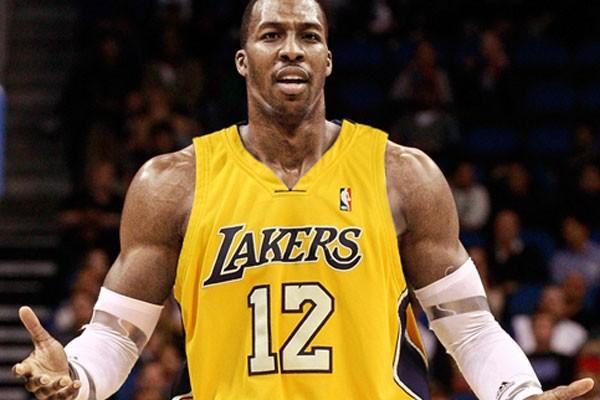
This could be Heaven or this could be Hell for Howard. If he committed himself to the Lakers, it would end part of the merry-go-round and media circus. But he only perpetuates it with his non-committal attitude. He thinks he’s being coy; he’s just being annoying to Laker fans and the media.
Likewise, it could be heavenly if Howard would develop the parts of his game that were masked by the Magic and Van Gundy. But he hasn’t shown signs of improvement and remains very limited offensively. You still have to have Howard close to the rim to be effective. You can’t just toss him the ball in the post and let him go to work. He’s not Shaq. He’s not Ewing, Mourning or Olajuwon, gifted big men who could score in a variety of ways.
Howard doesn’t need to shoot threes, even though he likes to joke about it. None of those guys did. But he’s got fewer offensive capabilities than Dikembe Mutombo. Howard’s also missing something else nearly all of the great and dominant centers have had: a mean streak. All of the best go into beast mode, where they physically take over games, snear and mean mug it down the floor, their presence known and felt. Howard just smiles, afraid that someone won’t like him.
So instead of being the awesome match everyone assumes it will be, it’s been Hell so far for the Lakers and for Howard. It’s exacerbating all of his flaws: his need to feel wanted and loved, his limited offensive ability, his cloak-and-dagger comments about the future.
Yet truthfully, the Lakers didn’t lose out on this trade, even if Howard doesn’t stay. The guy they traded, Andrew Bynum, has lost his knees and his mind (seriously, check out his hair). Bynum hasn’t played this season for the Philadelphia 76ers, and might not ever be what he once was – which was the No. 2 big man in the NBA.
And there’s the point: the Lakers needed to find someone to transition the face of the franchise to once Kobe Bryant retires. Howard could be that guy. And they didn’t really give up much to get him. If it doesn’t work out and he bolts town, then at the very least they have cap space to spend in 2014 on some other big name free agent.
Trust me, someone will want to play in L.A. and take over after Kobe is gone. The Lakers biggest mistake was in choosing Mike D’Antoni over Phil Jackson (which is still too weird to talk about). Jackson certainly would have made this work better and Howard would be more apt to stay. Then again, Jackson wouldn’t have stayed as long as Dwight, so you’d be right back here in a few years anyway.
Howard is an enigma, perhaps even to himself. He doesn’t know what he wants, and perhaps when he does, he’ll be too old to use it. He’s looking for what he already had and in the process of doing so, he’s created a beast, fed daily by the overactive L.A. media. But just like the Eagles sang, you just can’t kill the beast. This thing has spun out of control now.
Mitch Kupcheck says he’ll stand firm, that he won’t trade Howard today and that Howard will be another in a line of legendary Lakers.
At least someone believes that. At least someone wants that.
Problem is, it’s not the guy the Lakers need wanting and believing it.
Problem is, Howard can’t get out so easy now. There’s too much money on the table. Too much damage to Howard’s rep should he leave another team when times got tough. And that, for many reasons, matters to Howard. He may want things a certain way, but it goes hand in hand with being liked. You’re not well liked when you bail on the league’s marquee franchise, not when nearly everything for your future and the team’s is set on you. And he’ll have about $30 million extra reasons to make it work.
Howard just really hoped he would be able to recreate the magic he had with the Magic in some nondescript, less pressure-packed place like Dallas, Brooklyn or Atlanta, where he’d be revered as a much as he was for his first eight years in Orlando. But this is the Lakers. They focus on winning banners, not the happy pursuit of them.
In a way, he really did find the Hotel California.
Howard is caught looking for a passage back to the place he was before, and while he can check-out, he can’t really ever leave.
Standard
Dwight Howard, LeBron James, Miami Heat, NBA, New Jersey Nets, Orlando Magic, Stan Van Gundy

Murdering the Magic

It has been somewhat fitting that Dwight Howard has played the first eight years of his career with a team nicknamed the “Magic” because nothing could personify Howard more than that.
The word implies so many things. Magic can be enchanting and mystical. It often toes the line of believability. And ultimately, magic proves to be false and misleading.
All of these things describe Dwight Howard, because after a wild 12 hours on Thursday – and taking into account what occurred leading up to Thursday – the magic is gone. And the Magic (at least the Orlando basketball version) are dead. Symbolically, of course.
In perhaps the most odd and compelling post shoot-a-round media conference ever, we got to see the end of an athlete’s aura firsthand.
Roughly seven hours before Orlando’s game against the New York Knicks, Magic head coach Stan Van Gundy confirmed that management had told him that Howard had asked for him to be fired.
Within a few minutes of this discussion, Howard appeared – completely and utterly unaware of what Van Gundy had been sharing with the media – and put his arm around Van Gundy. To say this was awkward or surreal cannot even begin to describe it. It was painful, yet comical – like any Steve Carrell episode in “The Office.” Howard had only heard the last few words, something about Van Gundy being the coach of the team until he was told he wasn’t. Which led to this:
Howard: “Stan, we’re not worried about that, right?”
Van Gundy: “That’s just what I said. We’ve got to be worried about winning games. Are you guys done with me? You talk to him now.”
As Stan exited stage left, the media closed in on Howard.
You know that feeling when someone approaches a group and they were just gossiped about, but the person approaching is all smiles and thinks things are great and everyone in the group just sort of grins because of the comical irony of it all? That might describe it.
Or better yet – it was like Michael Corleone calling out his brother Fredo: I knew it was you – you broke my heart, Dwight.
Except Stan The Man isn’t heartbroken. Howard messed with the wrong man. Van Gundy’s been (symbolically) murdered before, when he was removed as head coach of the Miami Heat in December of 2005 by Pat Riley, with executive producer credits going to Shaquille O’Neal and Dwayne Wade.
Van Gundy disappeared after being stabbed in the back – and the front – by his mentor Riley. He humbly had to suggest he was resigning as coach of the Heat to spend more time with family, despite all evidence that Van Gundy, a basketball junkie, was just as obsessed and driven to guide O’Neal and Wade to a title for the Heat as Riley would have been.
What the whole scene Thursday told us from Van Gundy’s point of view is this: He has done this dance before. He knows how this ends. He won’t be coaching the Magic much longer. But he just doesn’t care this time. He won’t play the company line or protect his conspirators. He’s not going down alone on this one. He’ll be taking Dwight’s rep as a smiling, fun-loving, cape-wearing lovable giant with him.
Additionally, Van Gundy is ensuring that this circus ends. Howard won’t be able to get away with this again, not now. Hell, the entire NBA and basketball world knows what kind of person Howard is now.
Rumor and innuendo are like magic in and of themselves. They could be true or might not be. But once rumors are confirmed, the magic disappears and all you are left with is the cold, hard truth. Coaches have been fired because of superstar pressure on the front office before; Howard is hardly the first to try this move. It’s just that it hasn’t ever unfolded like this before – where the coach knows and tells everyone he knows.
Following Van Gundy’s departure from the media circle, a reporter immediately told Howard what Van Gundy had said. Howard looked floored, but not in an innocent way. More like, “Dear God…they know” – like he’d been caught with his hand in the cookie jar.
Howard asked for the reporters to cite their sources and the media kept telling Howard that Van Gundy was the source – that he’d just confirmed it. This time, Howard has been sold out by his boss and his boss’s bosses. It was a brilliant move by Van Gundy – tell the truth and then leave the scene to let Dwight flail in the wind.
Somehow, Howard looked like he wanted to lie down or needed some Pepto, despite going on for a few minutes to explain that he had not said “nothing to anybody” and adding that he’s just a player and management controls who the coach is.
As a follow-up to that magical act, Howard went out and put up a stinker against the Knicks – eight measly points and eight lackluster rebounds in 40 minutes. He only took two shots in the first half, appeared unaggressive and disinterested most of the game and did not score until the very end of the third quarter.
And thus, the old Dwight Howard, he of capes and crucifix’s, was thoroughly destroyed in 12 hours, undone by the weight of his own lies.
He’s been posing as an NBA super-duper-star. To be sure, Howard is a supremely gifted and talented individual. As a 18-year-old, before jumping to the NBA, he was the valedictorian of his class at Southwest Atlanta Christian Academy and as a seemingly devout Christian, spoke of genuinely hoping that one day, the NBA logo contained a crucifix.
But eight years later, Howard is telling his boss’s bosses to terminate his direct supervisor. Now that’s not very Christian like.
He also played the Magic as a whole through the disingenuous trade demand saga of the last year, then flopped back and forth on opting-in or out of his contract at the trade deadline last month. A report last week stated that Howard finally changed his mind and opted in not because of some deep love that he’s been professing for the city and the fans, but because the Twitter backlash on the whole situation began to wear on him.
Twitter pressure? Really? Really?
How about the pressure of, you know, performing where you should. At some point, someone needs to call out Dwight for his inability to truly dominate games as he should be? He’s averaging 20.6 points and 14.4 rebounds this season, as one of the last remaining – perhaps the only – dominant big man in basketball. He wants to replicate Shaq, but he’s not even in Shaq’s general vicinity. He can’t even buy a ticket to where Shaq’s general vicinity is.
Howard ought to be averaging 28 and 15. He could be. But he doesn’t. And he never will.
Because to Howard, it’s all about the show. Wear a cape, win a dunk contest, smile his 1,000-watt smile. Create some drama. Entertain the people. He doesn’t crave a championship; he craves attention. How else could his wish list of destinations include New Jersey (soon to be Brooklyn)? The Nets are horrible.
If Howard wanted to win a title, he’d go to the Lakers or to Dallas or to the Knicks – or just stay with the Magic. But he wants to be the man in a new arena in a new city where there will be gobs of attention paid to Jay-Z’s team once it move’s this fall. At least LeBron James joined up with some good players – Howard won’t even have Deron Williams. Basketball wise it’s a worse situation than the one he’s currently in.
Speaking of LeBron, if LeBron is a such a hated villain for mishandling his exit from Cleveland with the spectacle of “The Decision” and joining a proverbial All-Star team with Bosh and Wade in Miami, then what on earth does all of this make Howard?
It has to be worse. Does it make him a hypocrite? Does it make him shallow? I think it does.
It makes him superficial and egotistical and shows he only cares about phantom recognition for what little he has truly accomplished while riding the coattails of people with the same skill set that came before him and were better. His inherent flaw and weakness is that he thinks he’s better than he is.
In other words, Stan Van Gundy was right to treat him like Fredo Corleone.
Because that is exactly who Dwight Howard is. 
Standard