American culture, culture war, Dodge Ram, Jeff Daniels, NFL, Paul Harvey, Society, Super Bowl commercials, Super Bowl XLVII

Americans Made a Country


An interesting thing happened during an interesting fourth quarter of an already interesting Super Bowl on Sunday night: I felt the urge to get some dirt on my hands.
Thanks to Dodge, the voice of Paul Harvey and some of the most clever and emotional advertising we’ve seen in years, we got a clear winner of the Super Bowl ad wars and a really, really good commercial that wasn’t just selling a product, but doing so much more.
It was causing us to think. 
After a weird power outage in the Mercedes Benz Superdome during the early moments of the third quarter of Super Bowl XLVII, the Baltimore Ravens saw their momentum evaporate as the San Francisco 49ers nearly eliminated a 22-point deficit, before pulling out a victory in a thrilling finish. And it was then, as the game came down to crunch time, on a night with all these interesting stories and subplots, that something much more interesting, impactful and profound occurred.

God made a farmer, Dodge made a commercial and America made its growing division all the more evident.

[You can view the video by clicking here].
The culture war in America became even more evident in the moments following Dodge’s two-minute, still picture and old voice-over ad. Just examine the reactions to the spot itself. Half the country probably had tears in their eyes while the other half were rolling their eyes. Some thought it righteous (in a good way), others thought it ridiculous.
It goes beyond how brilliant the marketing strategy itself was, though make no mistake, someone at Dodge is getting a massive promotion over this. It’s the ultimate “duh” moment: who buys trucks? Farmers! What do they value? Um…let’s see…hard work, pride in how straight they plant their fields, church, passing down a farm through generations.
Who doesn’t care about any of that? Urbanized populations, big cities, corporations, people who care about gas mileage or the environment, atheists and perhaps, mostly, non-whites? Does Dodge care if they don’t care or if they don’t buy a truck? My guess is most of the people that fall into these categories weren’t driving trucks prior to viewing the ad, anyway. And if all they got out of it was Googling “Paul Harvey” to find out who he was, then really, we all came away winners.
Yet I can’t stop thinking about the reaction to the ad, the division of America and our ever-expanding cultural war.

Most commercials, especially during the Super Bowl, try a clever new way to sell you a product. And certainly, Dodge wants to sell Rams. But this, this was different. It spoke more directly to the values of middle class Americans. Think of the images they used: a church, a flag, a family praying before a meal, tractors, plows, dirty hands, open fields.

Not one single shot of the truck until the end. Not one mention of Dodge verbally, and only visually when the truck appeared. Just a tag line: “For the farmer in all of us.”
Those who chided, bristled and mocked the ad and its contents are missing the point. This wasn’t just about farmers and it wasn’t just about trucks.
There is a farmer in all of us, and probably through the generations, through our ancestors, we were all, indeed, farmers. Farming itself is an ideal and a visualization of something different: feeding people, clothing people, an honest day’s work. The open fields represent the possibility of what’s to come, of freedom, of opportunity, of doing something on your own.
Make no mistake, this message resonates with many in this country.
One part of our nation yearns for this kind of commercial, of this kind of code of ethics.
Another part of our culture posts snide remarks on social media and jokes about not knowing Paul Harvey.
One side is thankful that God was brought into our living rooms during the Super Bowl, another is offended.
And it’s this striking difference between these two groups that says the most about where we are as a society. We’ve gotten less serious. It’s why we don’t wear dresses, suits, ties and hats as we once did. We’ve desensitized ourselves to violence and sexuality. It is why we can watch the GoDaddy make out commercial without losing our lunches now.
So why is this ad about farmers and trucks, invoking so much praise and backlash at the same time? Because it serves as a rallying cry for one side of our American culture, an offensive example for the other.
The negative reaction was immediately what you would expect: too many white people, too much God. Give us more CGI-entertainment, they demanded, and don’t begrudge everyone a Carl’s Jr. commercial with some model’s chest covered in hamburger grease. Nobody seems offended when Mercedes Benz shows off its new luxury model being driven by a white 40-year-old, with meticulously coiffed hair, in Brooks Brothers clothes. The same as no one seems to mind how young and affluent blacks are targeted by Puff Daddy in Hennessy ads.
In turn, the positive reaction was also in line with generalized expectations: farmers loved it, rural populations and those from rural areas thought it was brilliant. Ignore that many migrant workers weren’t accurately represented. That’s not the point, either, really.
We’re just looking for ways to be offended so we can complain about it. And we are becoming further and further entrenched in our viewpoints. We’re so self-involved we’ve ceased to evolve.
No, we were never perfect as a nation – a far cry from it. We’ve got quite the history. But while we strive to be evolving socially, we’re losing out morally and ethically. We’ve just plain stopped striving to be anything more than novice social commentators, being snarky about power outages and Super Bowl ads. We do all this through unemotional ways of communicating and we wonder why we’re facing such a massive disconnect with each other.
We’ve come to a point where we are so singularly sure ourselves, we skip over the part of becoming informed. Newspapers and magazines and books are dying not because of technology, but because we’ve simply stopped reading. And what we do read is of vampires, werewolves and adolescent magicians.
We already think we know everything and therefore we learn nothing.
The same half of our country who thought that the “God Made a Farmer” ad was racist, stupid or just plain didn’t concern them will remain oblivious to the fact that, according to recent studies, the world’s food production must increase between 75 and 90 percent by the year 2050. Not sure if Wall Street or pharmaceutical giants can find a way to make up that gap. But we could always ask Siri on our iPhones to do a search on the Web.
Can you determine who liked the ad based on what they do or where they live, what they value and what they stand for – flaws and all? Certainly.
At least it clear who they are, what they do and what they value in the ad.
If I had been watching American news, however, from a foreign nation the past few months, I’m not sure what I would be able to determine about America based on recent events.
So they honor freedom, but they incarcerate the largest number of people per capita in the world? They claim to support freedom from tyranny, but they shoot each other in public schools, theaters and walking down the street? They demand and beg for innovation, yet teach their children to be employees, not entrepreneurs? They want people to venture out and start small businesses, but then the government will tax you exponentially for becoming successful and tell you that you didn’t build it? They say to give them the poor, the weak, the huddled masses that cannot defend themselves, but they allow abortion and pretend the homeless don’t exist?
Chances are, you got lost in some buzzwords there: abortion, incarceration, taxes, gun control. But odds are you missed what might be the biggest point of all: that we teach ourselves and our children to be good employees, not entrepreneurs.
Collectively, we’ve ceased to have vision or to dream – the very things our country was founded upon. No matter what generation, race, creed, religious affiliation, we dreamed and innovated and worked for things in this country. No one ever said I want to be project manager or a software security analyst when they were little. And that’s where we’ve started to lose everything else we did, or have, or should hold true.
We can shift in our seats, squirm uncomfortably and cringe when we hear God used in a TV ad about trucks, scoff at farmers and what they do, or what race makes up the majority of this working group. But as Jeff Daniels said in an epic speech on the show Newsroom a few months ago: “The first step to recognizing a problem is realizing there is one. America is not the greatest country in the world anymore.”
But it can be. We can get it back. Even if farming and Dodge trucks aren’t your thing, that’s fine.
To change our future and to make what matters most to us matter again, we’ll need to make ambition, education, truth, honesty, compassion, fairness, faith, belief, hope, logic and common sense in much larger quantities.
We can make all of these things prevalent and valued again. But we have to drive our plows straight. We have to check for weeds in our fields. We have to get up early and stay up late. We have to care for our children and others as much as we do ourselves. We have to go to the school meetings, put the flag out front and build a future where the fields are wide open with possibility. Our collective tools don’t have to be plows and tractors and trucks.
So God made a farmer. And Dodge made a commercial.
Now, our culture needs to make up its mind: what do we want to be? Let’s at least get our hands a little bit dirty, work together and find out how well Americans can make a country. 

Sounds better than another domain name commercial, doesn’t it?


Standard
American culture, American People., Fiscal Cliff, Gun Control, Hollywood, Sandy Hook Elementary, Society, United States

The Unused Power of the People


Much has been made of the now-averted “fiscal” cliff, but truthfully, we’ve gone off the selfish cliff.
From almost forgetting the horror of Sandy Hook to our resignation that it’s OK to raise taxes and spending as long as it’s not my taxes, we just don’t seem to care unless we are affected directly.

What will it take for us as a people to act? We have so much more power standing collectively than fighting as individuals.

Should someone come into your home and just grab whatever money you have in your wallet or purse each night? Would that do it? Would you feel violated? Outraged?
I know several friends and family members that are completely fine with the argument that the country’s wealthiest earners should pay more in income and payroll taxes.
“I don’t make over $400,000 a year,” said someone to me recently. “Why should it bother me? And those people should pay more.”
It should bother you, me and everyone because even though it’s not you this time, it will be next time. They’re coming for more money. And they start with the rich and work their way down the line.
See, the conversation and discussion is all wrong – this isn’t just about one economic group in this nation, it’s about all income levels. Whether you pay $150 in taxes or $1.5 million, where is every dollar going and why?
What we should be asking – no, demanding – from our elected officials is this: why is there a need to raise taxes on anyone? Why do you need more of our money? We can’t trust you with what you get from us now!
The package that was passed earlier this week to avert said “fiscal cliff” will add $4 billion in debt. How is that even possible? How do you raise taxes and over time still add that much money to the deficit? What’s worse is the deal made by Congress earlier this week was seen as a compromise – of course it was. Because they created this mess, let’s all congratulate them for averting disaster and putting off the debt ceiling conversation for three months.
Well done, guys and gals.
What if we all agreed to not vote for anyone, any incumbent, who contributes to raising the debt? We might get 100 new elected officials every year for the next four years, but we’d eventually find people who do what we want them to, right? Because as crazy as it sounds, that’s what our elected officials in Congress are there for – to do the will of the people. They represent us.
Except they don’t. They represent themselves and re-elections. And as for the “us”, well, we can’t get out of our own way and get our stuff together in terms of values, guiding principles and general decorum.  
There was an article posted late Monday night about how all the staffers and members of Congress had to order out and get pizza and wings on New Year’s Eve and how depressing that was.
I laughed because I thought it was the punchline of a joke. That’s not sad. Millions of Americans eat like that every New Year’s Eve – and not by choice. Millions of Americans work late into the night on a holiday because they get triple pay for overtime. We need more because now we give more than ever before in our history.
Meanwhile, we spend less time with family, with friends, with spouses.
This vacuum is why Facebook and Twitter exist. They keep us connected to the world when we’re so wrapped up in ours. Except they dehumanize our relationships, take the emotion out and make everything instant and matter of fact.
What do we get when we spend less time with our children? Or better yet, what do they not get from us? How about our spouses? Are marriages stronger? Relationships of any kind, when less time and energy and effort go into them?
And we ask ourselves how we ended up with the massacre of elementary school students? Shootings in a movie theater? High divorce rates? Rising debt? Unmotivated masses, shrinking more each day into their own bubbles.
Wake up! We are the problem. We don’t take the time to fix it. We talk about it on Facebook and Twitter or at our holiday parties and then we move on. Next issue. On to my personal problems, right?
Wake up! Is it going to take your child’s elementary school being unspeakably shaken by tragedy before something is actually done to protect them? I mean, I’m in favor of the Second Amendment, but I’m not sure why anyone needs to be able to buy a Rambo-style machine gun and as much ammo as they can fit in their car trunk.
But Congress can’t talk about that for a few more weeks because they’re “fixing” the “fiscal cliff” they created by mismanaging our money to begin with. So what makes us think these geniuses can fix something like coming up with a logical, modernized second amendment that while protecting the rights of citizens to arm themselves, won’t allow for them to pretend they are preparing for Red Dawn, Part II?
That debate that everyone said we needed to have on gun control lasted in the media for all of 10 days – right up until Christmas and Kim Kardashian announcing she was becoming Kayne West’s baby momma.
We’re running out of time, my friends. What our ancestors and American decendants worked so hard to build in terms of values is being short-sold by our own selfishness, obsession with the material and overall failure to act. We expect others to clean up these messes, but we don’t take action – or build sustained action – ourselves.
There is great power in the people – us, the collective whole that make up our society. If we can set aside these specific arguments, say on faith, tax brackets, marriages, for a brief moment and look at the bigger picture to unite under, we’ll have a greater success at reclaiming and reestablishing our guiding principles that sustain our first world way of life and the freedoms we so take for granted.
Is this the kind of world we want to live in or leave our children with?
Case in point: a recent pollsuggests a majority of Americans don’t feel it’s necessary for Congress to force Hollywood to produce less violence in their products. Yet when every fabric of our vast knowledge suggests that violence begets violence, especially when exposed to the young, why wouldn’t we want that? What if we absolutely forbade anyone under the age of 18 from seeing an R-rated movie, even with a parent?
Our collective selfish nature says we don’t want them to take away what we, as adults, enjoy so much. Do we? Because since Sandy Hook, I can’t watch a violent movie, kudos to you who can. It’s difficult to separate reality from art now. As I said then, everything is different – and it has to be. The very essence and core of our lives is at stake.
What are we doing? What’s it going to take? What will be our breaking point?
Because we are already, quite rapidly, defining our downfall.
Standard
Adam Carolla, Culture, NBA, President Barack Obama, Society

The Culture of Me

Someone find me Doc Brown, because I need a flying DeLorean to get me the hell out of here.
Because I’m terrified of present and scared of the future.
The future used to hold so much intrigue: what we would be, how technology would shape us, how life would be different. But what I’ve come to realize is that all we’ve done in the course of our history as a society is screw up a really good thing.
This isn’t about politics or gender or any one particular thing. It is wholly about a feeling that we’re not as dignified as we once were. Not stuck up, or hoity-toity. Just dignified. Certain things were beneath us as individuals or as a collective unit known as America.
Not anymore. There’s nothing beneath us because we’ve reached the bottom.
Two things this week have made me very sad and very sacred and very, very certain that we’re headed down a path that apparently only bothers people like me.
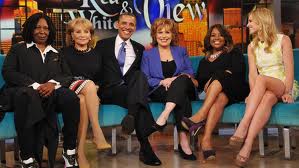
First, President Obama appeared on “The View” yesterday. Talked shop with Babs and Whoopi, got in a little celebrity gossip time about Kim Kardashian. Showed those middle-age housewives who are home at 10:00AMon a Tuesday that he’s totally cool in touch with how they feel on important issues like knowing that Kim was married to a basketball player for 72-days last year.
What?
How is this dignified? How is this befitting the stature of the office of the President of the United States? How is this a good resource of government time and money? And those who say he’s just like everyone else are missing the point – I don’t care about the party as much as the office he holds and what it should mean to us. At least Adam Carolla agrees with me.
I had friends who claimed it was a ridiculous argument or conversation to have. And therein lies my point: why is this out of the question that someone would find this to be beneath the President? How far have we slipped that this doesn’t warrant some commentary from someone in the media? It has little to do with politics. Again, I could care less about which party is doing it – I want them all to stop and have some dignity. Carry themselves with class. Why is that so much to ask?
My second travesty of the week was the news that the NBA is planning on allowing advertisements on uniforms at some point in the next few years.
“We told our owners that it was not something we were considering doing for next season,” NBA deputy commissioner Adam Silver said a few weeks ago, “but that it was something we should at least discuss doing for the season after next. We showed them some of the traditional soccer jerseys used in Europe and we showed them some of the valuations that soccer jerseys are getting and some estimates of ranges of values for logo rights on NBA jerseys.”
Wow. Well, by all means, let’s be like Europe. And let’s make the concession that we won’t be doing it next year – we’ll keep our dignity, damn you – until 2014. Then, let’s kill the last bastion of decorum in sports by squeezing out every available dollar possible.
Do you like the MLS New York Red Bulls? Then you will love the Toyota Spurs. Estimates say that the four major sports leagues in the United States are losing about $370 million by not advertising on uniforms. What about the dignity gained by not advertising on uniforms?
This isn’t us. Or at least tell me it isn’t us. Do we honestly care that much about squeezing in every revenue dollar that we’re willing to put a name or logo on everything? At least Nike makes the uniforms.
Please tell me that we still hold a few things valuable. Please tell me we have a little bit more integrity and decorum than this. My fear is, we don’t, because in so many others sectors of our daily lives and our society, well, we don’t.
Just take a look around sometime – our self-involvement is all encompassing. Because people believe they, themselves, are the most important person in the world. That’s why people cut you off in traffic: wherever they are headed is more important that where you are going. It’s why they sneak in and grab the nearly-sold-out-hot-toy-of-the-season from your hand during Christmas shopping – their kid or relative is much more deserving or more important than yours is.
People who have no children or one child and a part-time job will look someone who has two jobs, five kids and a whole lot more going on in life and tell them without sarcasm and in a completely straight face that “I am are just so busy, you couldn’t possibly understand.” It’s why your kid’s accomplishments top anything another kid could do. It’s also why your wedding, birthday or bar-mitzvah is the most important day in everyone else’s life – because it’s yours.
We are inherently self-centered people that have very little self-awareness and thus we’ve lost all appropriate decorum in a given situation.
We go to people’s homes and don’t offer to take off our shoes because we don’t even think about it. We don’t offer to clean-up or bring a dish when invited to dinner. We don’t call and cancel reservations we can’t keep. We are rarely honest, rarely sincere.
And we are dumb enough to expect more from our politicians and from athletes? We’re just like they are. They fail to keep promises. Fail to be more dignified than someone else in debate. We don’t clean up our messes (like the national debt) and we bring nothing to the table – like taking a pay cut as a member of Congress, giving back healthcare or pensions.
Well, what I meant was, YOU need to give back…I’ve earned mine.
We are what we are now: greedy and selfish. I’ve had people thank me for being so kind for opening up doors recently. That’s because my father taught me politeness. You compliment people. You walk on the outside of the sidewalk to protect people. You say pardon me, excuse me and thank you. Or at least we used to do those things.
Now, you can be on a Monorail with a stroller in Walt Disney World, the doors open and there’s a crush to push your stroller with a sleeping two-year-old out of the way just to get 14 extra seconds in the Magic Kingdom. That thing is in MY way!
What the hell is wrong with us?  Everyone’s gotta get theirs. We are reaping what we’ve sewn. Decades of telling everyone they are special in their own right, passing out trophies and awards to everyone for everything – for just participating – so that no one feels left out.
Here’s the thing: it’s OK to work harder than someone else and have that acknowledged. Sometimes you win, sometimes you lose. There is a lesson in both.
We should open doors. We should be polite.
But we are not. We are just plain rude.
We are obsessed with us. We are a Culture of Me and Is.
We have no sense of unity, no common purpose. We can’t even agree to disagree most of the time.
If “Back to the Future” were made now, Marty would have just taken the DeLorean and not tried to save Doc. He would have used the Sports Almanac and never admitted his mistake. He would have left Doc in the Old West to get run down by Mad Dog Tannen.
Maybe I’m just a curmudgeon (at the ripe age of 32), who thinks with longing about a simpler time when we actually gave a damn about manners, decency and showed a little decorum in how we presented and carried ourselves.
And maybe that never truly existed.
But man, if it did, I’ll be waiting on a time machine to take me there. 
Standard