Around Thanksgiving, VCU men’s basketball coach Shaka Smart could feel it.
Energy.
Smart was following his team onto the practice court in the Bahamas prior to the start of the early season Battle 4 Atlantis Tournament. VCU, always the underdog, was preparing to play in tournament filled with ranked and well-regarded teams like Memphis, Duke and Missouri. As in the past, VCU faced a tall order in taking on college basketball giants and super conference staples.
This was the kind of challenge the coach and his players lived for, and they had proven their mettle many times over, as NCAA Tournament darlings in 2011 and 2012, when the Rams advanced much further than expected by analysts. In 2011, as an 11-seed, they became the first team to play in the early “play-in” games to win five games and advance to the Final Four after toppling giants Kansas, Georgetown and Purdue.
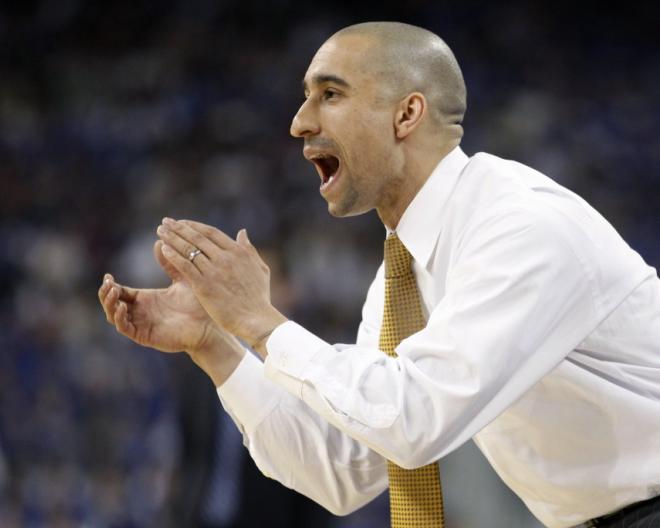
So nothing about this stage was new to Smart or VCU. That’s why as the Rams made their way onto the floor in the Caribbean last fall, shouting, chanting and bouncing around, it brought a wry smile to Smart’s face.
“Let’s wake up the space!” he shouted.
As Sports Illustrated basketball guru Seth Davis has said, it’s one of my favorite sayings because of what it implies: make your presence known in the area and space around you with energy, enthusiasm and positivity. Do something unique and different.
Smart has done that, not just in his journey as coach at VCU, but also by bucking every notable trend in sports and turning down the steady flow of cash from the major conference schools who’ve courted him the past several years to stay at the school, which until joining the Atlantic-10 conference this season, played in the Colonial Athletic Association.
In other words, Smart decided to wake up the space of college basketball by staying at VCU. So many coaches have left the smaller programs for the bigger ones and look flat-out miserable in doing so. Don’t get me wrong, there’s great honor and tradition at places like UCLA, Kansas, North Carolina, Duke and Indiana.
But if you think Bill Self, who left Illinois for Kansas about 10 years ago, is happy this morning following last night’s massive debacle against TCU, I can assure you he’s not. He called his team the “worst” Kansas has ever put on a basketball floor. Now, he’s certainly attempting to motivate his team before the stretch run and it is unlikely he actually means it. Nor, I would assume, does Self necessarily regret taking the Kansas job – he’s been highly successful and won the 2008 National Championship.
Yet the point remains: what is happiness? What do we desire? What is our passion? What do we trade off each day in order to do what we think we must instead of what we should?
This does not just apply to men’s college basketball or sports. (And yes, that’s your official warning I’m about to get into the recess of your brain and make you think.)
The entirety of human existence and interaction, our American culture and government, our families – everything. Why do we sell out and sell ourselves short? Why do we conform?
Why is it so odd to us that someone like Smart didn’t take the money, the fame, the pressure and the challenge? Why do we see the Illinois job as a bigger challenge or more prestigious than building VCU into a basketball power from a small conference? Because every assumes or acknowledges it to be so? Who is everyone? Former coaches, analysts and players who couldn’t make it as far as Self?
We spend a lot of time critiquing those who do it better, instead of learning to carve our own niche.
Someone shared with me the other day a video by Allan Watts, a British-born philosopher, writer and speaker, who basically broke down Eastern philosophies for Western society in understandable ways. He theorized and spoke often about this very thing.
We’re in a bad way, as a culture and society. Current and recent events simply serve as reinforcement to this truth. And our best chance of change, hope and shifting our current individual and collective paths are those four words by Shaka Smart.
In all of human accomplishment, we have ignored what we were told could not be done or should not be done and pressed on. Why? The word impossible should not exist because we cannot completely ever prove such a thing. Oh, we have data and research and historical precedent, but the future is not known; we write our individual and collective stories with each passing day.
So the world was flat, eh? We couldn’t possibly escape the clutches of Great Britain’s massive empire? It looked like Hitler could not be defeated before World War II. How could we possibly travel to the moon? You want to build a place in space to dock a vessel, refuel and have someone stay for months at a time? Sure, we’ll call it the International Space Station.
People used to die from the common cold, now we don’t miss a day of work. We’ll always have to go outside to a shed to use the restroom. The only way to cross water is on a boat? Tell that to the Brooklyn Bridge, the Golden Gate Bridge and the Panama Canal. What about the radio, the television, the microscope, the cellular phone, the personal computer, the internet, glasses, airplanes, cars, GPS, electricity, the light bulb, the Sistine Chapel, penicillin, vaccines, supplements and 3-D?
And so VCU was told it was impossible to advance – from the CAA, from a “play-in” game, from the 11-seed – to the Final Four. But VCU said they could. There was data to prove this theory and any evidence to the contrary looked foolish. But Smart and his team woke up the space, changed the data, wrote a new chapter in history.
Tell me again why we can’t cure cancer? Why someone won’t break some sports record? Why we can’t travel through time? Why we cannot eliminate world hunger or tackle every issue facing our society and government today?
We cannot because we don’t wake up the space. We don’t break free of our set way of thinking that someone else can do it, but I cannot. The only difference between you and that other person is they didn’t stop believing, didn’t stop chasing their passion and didn’t listen to others who had also stopped dreaming.
This is what my wife and I constantly try to remind our children. Some days I’m certain we fail and use the world can’t or shouldn’t. But we try.
Our oldest son, who’s 11, wants to play college and professional baseball. I do not know whether this will happen or not. Many others have this dream and few make it. Are the odds long, the chances small? Of course they are. Will it take extraordinary dedication, effort, persistence and sacrifice? Most certainly.
But it’s not impossible and we will never tell him so, even if everyone else around thinks it’s a pointless endeavor and unrealistic. You know what? We make our reality, that’s what it’s realistic. We will do our best to make sure our four children grow up believing that nothing is impossible and they can do anything.
Can you imagine a world different than the way it is now?

What if Edison had believed all those who said it was a waste of time to fiddle around with creating light, who told him he was playing God and it was morally wrong to do such a thing? Think of a world where Shakespeare was told to stop writing, da Vinci painting, Mother Theresa giving, Michael Jordan from shooting a basketball.
Throughout time, humans have reached a point where they stopped seeing what was and imagined what could be. Take indoor plumbing: Basically, someone got tired of going outside in the cold, the rain, the wind, to, well…you know.
We should follow our passions, our inspirations. But the vast majority don’t because we’re stuck in believing that we must have money, and having money to survive and pay for the things we need means doing things we don’t like. But do we need all that we have or want, or do they serve as placeholders and soothing agents to what we gave up in the first place?
As Watts said, “you will spend your life completely wasting your time. You’ll be doing things you don’t like doing in order to go on living – that is to go on doing things you don’t like doing – which is stupid. Better to have short life, that is full of what you like doing, than a long life spent in a miserable way.”
And as he further elaborates, really, we just perpetuate the cycle, educating our children to live the same kind of way we do – ripping away the ability to dream. We’re making drones, worker bees. And none of us want that. But do we have the want to want it bad enough to be different?
So let’s begin to change it, ourselves, in whatever ways we can.
What do we want to do most? What passions do we have? Where does your energy reside? How do you let the world know you’re here?
Can you feel it?
Let’s wake up the space.
 worldbetweenlines.com