Bob Knight, Indiana Hoosiers, Indiana University, Jeff Meyer, John Beilein, Michigan Wolverines, NCAA College Basketball, Rick Pitino, Tom Crean

All Apologies


The head men’s basketball coach at Indiana University is, to put it mildly, unpredictable on the sidelines.
He stomps his feet. He shakes his fists. He berates officials. He screams. He teaches.
He’s not wearing a red sweater.
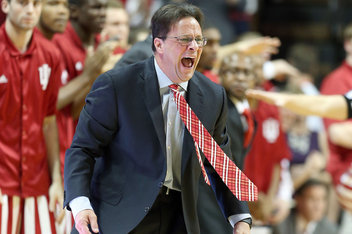
 
No, Tom Crean isn’t Bob Knight – but he’s closer than you think. In fact, that much was evident following Indiana’s intense-laden, 72-71 victory over Michigan in Ann Arbor on Sunday.
Moments after a hold-your-breath final 20 seconds, moments after Jordan Morgan’s tip bounced around and around – but not in, moments after IU captured their first outright B1G regular season championship since 1993, there was another moment: Crean confronting current Michigan assistant – and former Indiana assistant – Jeff Meyer.
And Crean couldn’t stop himself from saying something.
“You know what you did!” Crean shouted. “You helped wreck the program! You helped wreck our program!”
He ran away with a grin that can only be described as half Cheshire cat, half Grinch Who Stole Christmas.
It was rebellious, it wasn’t entirely classy, yet given the circumstances, it wasn’t entirely unforgivable.
As a member of Sampson’s Indiana staff, Meyer had made impermissible phone calls to recruits, calls that along with Sampson and fellow assistant Kevin Senderoff, would put the storied program on sanctions that would nearly break the Hoosiers. Crean was hired, as has been documented, not knowing the full content of the allegations and sanctions and went to work with what might resemble a JV roster in the B1G. There were two walk-ons who’d scored a combined 36 career points.
Crean’s first season, 2008-09, the Hoosiers were 6-25. Six and twenty-five. Worst in school history. The following season, 2009-10, IU went 10-21. In 2010-11, 12-20.
Forget last year’s 27-9 Sweet 16 team. Those three seasons in basketball purgatory don’t ever leave you. They stick and stay – a funk that’s not easily removed. And it’s the anger behind those 66 beatings in three seasons that built up and came up Sunday on the court at Crisler.
It didn’t just boil over – it was directed at a person who played a large part in helping facilitate those 66 losses in three seasons. Following the game, Michigan coach John Beilein commented on how Michigan would always conduct themselves with class and how Meyer helped build Michigan basketball “brick by brick” since arriving in 2008 – just months after leaving IU and being a part of a staff that destroyed it brick by brick.
Coaches can sometimes act like the kids they coach. Tom Crean is no different. This may surprise many outside of Hoosier Nation, but Tom Crean has become somewhat unpopular. He cut down the nets last week after a loss. He’s getting into people’s faces, smirking and possibly enjoying some of these wins a bit too much. He’s brash.
He’s also not changing a thing. And in the process, he’s prepping his team for the NCAA Tournament. Indiana won that game with three timeouts just sitting on the table. They played through the missed free throw, the Zeller lay-up and the frantic final seconds without calling for a huddle. Crean’s players know what to do – which is an unbelievably good quality come tournament time. You never know when you’ll be out of timeouts with 30 seconds to play and trailing by four.
Indiana won ugly Sunday, trailing most of the game. The Hoosiers looked poor in losing, at home, to Ohio State on Senior Night. As I said last week, these are college-age kids and you can’t predict how they will play. But Tom Crean is coaching really well. And Hoosier fans are hoping these last couple seasons are the rebirth of another era.
It’s not. It’s the start of a new one.
Crean is not Bob Knight. He’s not throwing chairs or attacking his players. You know who Tom Crean really is? He’s Rick Pitino circa 1992-96 at Kentucky.
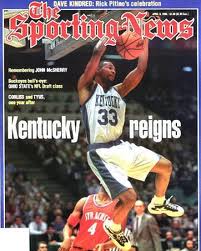
After the nightmare Kentucky went through in the late 1980s, Pitino had to rebuild that storied program, same as Crean, from the ground up, without star recruits. The Wildcats went 14-14 in 1989-90. And when Kentucky started winning again, Pitino enjoyed it, relished in it and made sure you knew it.
He started dressing his players in crazy uniforms, they responded with crazy games – like the legendary 31-point second half comeback against LSU in 1994. The roster began to fill with NBA-quality players who wanted to play for a fiery, intense guy like that. After that Duke loss in the 1992 regionals, Kentucky went on to play in the Final Four in 1993, 1996, 1997 and 1998 (without Pitino, but with his players), winning national championships in 1996 and 1998.
Indiana could be primed for a run like that, and the Hoosiers could become insufferable to the rest of the nation. With another stellar recruiting class coming up, Indiana is back and isn’t going away again anytime soon.
And neither is Tom Crean.
Do we wish these coaches wouldn’t do embarrassing things? Certainly. Then again, coaches like Pitino and Crean are the only ones bold enough to take on challenges like Kentucky and Indiana have faced and deal with the humbling losses.
Crean defending the program, unleashing a mocking tirade on a former assistant who, in a way, put him and the school through hell for three seasons of beatings, is more defensible that so many other coaches actions – most notably the actions of the man who Crean will be measured against, Knight.
Knight and so many coaches get caught up in discussing and taking controversial stances on things outside of what they know, which is little besides college basketball.
This was different – and it’s not something Crean should apologize to Meyer for.
We’ve become a little overly PC on the apologies. We apologize – and demand apologies for – nearly everything. We’re offended by the action, but we can also become offended if the apology doesn’t suit our ridiculously high standards. Was it sincere? Did they mean it?
Why don’t we just stop and examine what exactly demands an apology? Why can’t we deal with letting conflict exist? So Crean doesn’t think much of Meyer and his recruiting practices. Who cares? It’s overshadowing so many other stories from this game, this weekend. Last Wednesday, people wanted Crean and IU to apologize for cutting down the nets in their own building.
Why do we care? And why do we care to the point that we need to hear “I’m sorry.”
All these apologies. Ugh. I like a stern handshake, a vigorous pat on the back, a deep, lingering look directly into someone’s soul through their eyes. It’s the Michael Corleone “Fredo, I knew it was you!” moment. And it’s OK. People are allowed to not like one another – it’s what makes something a rivalry, which is now sorely lacking in sports because, well, everyone likes everyone so dang much.
If Crean wants to apologize for representing Indiana University poorly in a public setting then fine. If Crean feels like he should set a better example for his players, then fine. Apologize all over yourself, Tom. But Crean shouldn’t apologize to Jeff Meyer. Jeff Meyer should be apologizing to Tom Crean, to Indiana University and it’s fans.
If Crean continues on this path, no doubt he’ll have other things to apologize for.
Like winning. A lot of winning. 
I guess, in a way, he could be a lot like Bob Knight. 
And it’s the one thing he won’t ever need to apologize for. 

NOTE: The blog has been updated to accurately reflect that Meyer was never found guilty of major violations, but was part of the coaching staff that did. Meyer was cleared by the NCAA having committed minor infractions relating to phone calls and the NCAA found at the time that they paled in comparison to Sampson and Senderoff.
Standard
Arizona, Duke, Ed O'Bannon, Indiana, Jeff Sheppard, Mike Krzyzewski, Miles Simon, NCAA College Basketball, North Carolina, Rick Pitino, UCLA

The State of College Basketball


College basketball fans, media pundits, NCAA regulatory members, and hoop junkies from sea to shining sea:
A few days ago I had an interesting conversation with a friend. It began with a question: in your opinion, what was the greatest period of college basketball? Our answers aligned: the 1990s to early 2000s.
For some time, we recalled some of the great teams and players from that era of amateur roundball, of which there are far too many to name here. We lamented, with that nostalgia in mind, how over the past decade we have become bigger fans and followers of the pro game than of college basketball. And we wondered where the game was headed from here, this point, with no truly great teams.
But to identify the state of college basketball is to essentially begin with why that is so.
On its surface, the college game seems to be maintaining the foundation that was built so long ago. If we were to name some of the top teams and coaches from those glory years of the 1990s and early 2000s, we would find many of them still thriving near the top of the collegiate ranks: Indiana, Michigan, Duke, Kansas and Arizona. And the NCAA Tournament remains as exciting as ever, with surprises coming each year that no one can foresee, lovable underdogs like George Mason, VCU and Butler.
Hereto with, attendance and viewership remains high: the NCAA Tournament commands record crowds and audiences, as well as massive TV contracts, where now you can view every NCAA Tournament game between partners CBS and Turner. And look at the atmosphere created at campus’ all around the country, like Indiana, where Bloomington was bursting with energy and enthusiasm – enough to make Dick Vitale blush – prior to the Hoosiers showdown with then No. 1 Michigan on Feb. 2.
It is a testament to the love and devotion of college basketball around the country. At a time when so much about sports seems to let us down, from performance enhancing drugs and contract disputes to petty personality conflicts and illogical ways of determining a champion in the other big college sport (to be clear, we are talking about you, BCS), college basketball remains a sport filled with unified team ambition. Players and coaches focus on the mission at hand, working together towards a common goal of a tournament bid, a conference title, a Final Four run. 
There is something about the one-and-done playoff format of college basketball that will forever hold its grip over the NBA and the institution of the seven game series. Are you good enough to be the best, on one night, in one shining moment? Coaches hold a much greater aura of respect and authority than they ever could in the pro game. In other words, they seem to have a point.
Yet there is still something unsettling about the state of the college game. Something is missing.
While college basketball will go on, its transfixing hold on us might continue to dwindle without proper intervention. Thus, today, we lay out our plans of prosperity for the game.
First, we must no longer dance around the issue of prep-to-pro eligibility. The “One and Done” is a silent killer of the unspoken pull we have to the college game. Imagine if Kentucky returned all their players from last year’s championship team, combined with this current team? Could they threaten Indiana’s 1976 undefeated team? How many schools would be dominant with more players in school than in the NBA? Thusly, how many great games would we have on a week-in, week-out basis?
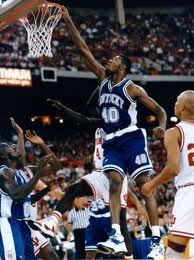
Part of the reason the 1990s and early 2000s were great is that the teams were deeper. Think of those Duke, Arkansas, Kentucky, Arizona, North Carolina and Kansas teams that were so loaded during that period. And once one of those schools lost a couple seniors and a junior, another loaded, talented team was ready to take the mantle. Kentucky played in three straight championship games between 1996-98, with rosters that overlapped, yet changed completely.
From the Untouchables in 1996, with Antoine Walker, Ron Mercer, Derek Anderson, Walter McCarty, Tony Delk and Jeff Sheppard – and so many more – to the 1997 runner-up team (that lost the title game in OT) featuring Mercer, Anderson, Anthony Epps, Scott Padgett, Wayne Turner and Cameron Mills on to the 1998 team with Sheppard (back from redshirting since the team was loaded), Turner, Padgett, Mills, Allen Edwards and Nazr Mohammed.
Nearly all went pro, but there was just a slew of talent that passed through that program from 1993 to 1999, and even if some only stayed two seasons, like Mercer and Walker, those that stayed three of four were the continuity that bred basically a dynasty.
That’s just one program. Duke seemingly went to every Final Four over a 15-year period, won titles in 1991, 1992 and 2001 – they nearly won the 1994 title as well – with an abundance of talented and memorable players like Grant Hill, Christian Laettner, Bobby Hurley, Shane Battier, Trajan Langdon, Rashawn McLeod, North Carolina featured talent like Eric Montross, Rasheed Wallace, Jerry Stackhouse, Vince Carter, Antwan Jamison and Shammond Williams over a period of 1993-1998. Final Four appearances in 1993, 1995, 1997 and 1998, and the National Championship in 1993.
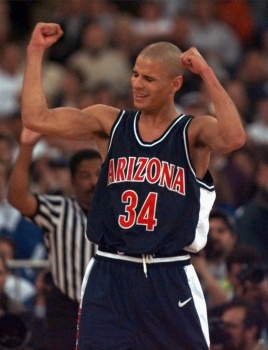
And here was Arizona’s talent, from about 1994-2003: Damon Stoudamire, Khalid Reeves, Miles Simon, Mike Bibby, Michael Dickerson, Jason Terry, Richard Jefferson, Jason Gardner, Gilbert Arenas, Luke Walton, Salim Stoudamire, Hassan Adams and Andre Igudola. Three Final Fours, two title games, one NCAA Championship (1997).
That’s barely scratching the surface: Michigan’s Fab Five, Indiana’s early 90s reign atop the Big Ten, Purdue’s streak of conference titles, Michigan State’s loaded rosters and Final Four appearances – and we haven’t even mentioned the Big East, with Syracuse, Georgetown, Connecticut (titles in 1999 and 2003). Or Stanford’s rise from 1996-2002 that challenged Arizona in the Pac-10. Or Florida’s budding program that led to back-to-back titles in 2006 and 2007, or Michigan State’s loaded rosters and Final Four appearances, or Maryland taking on the big boys of the ACC and winning the 2002 title.
And I did all that from memory, without looking up a single player – not to prove I could, but because this was the era where even the best of the best went to school, at least for a little while. It’s most likely not even a full or comprehensive list. Undoubtedly, I am missing names and teams.
Now, many will see this as a plea that players stay in school, to which I would argue is a misplaced objective.
No, my fellow basketball fans, we may never see that era of hoops at the collegiate level again. Because the truth is, I can’t name more than 25 current college basketball players, and I feel like I’ve watched my fair share of games over the past three or four years. But we’re doing a great disservice to the game in general by waffling back and forth on this issue of age.
Either pressure the NBA to institute a new rule where players cannot enter the league for two – or even three – years post graduation, or lift the restriction altogether, allow them to go to the NBA directly out of high school, yet adding the caveat that if you choose to enter college, you cannot be drafted for two or three years.
Second, we’re stripping the fabric of college basketball and college sports completely away with conference realignment. It is an abhorred tragedy that the Big East will soon cease to exist. The Big Ten is now the Bloated 14, with the additions of Nebraska, Maryland and Rutgers. Syracuse in the ACC? Utah in the Pac-10, er, 12? Texas A&M in the SEC?
We are losing our rivalries, which are the underbelly of college basketball. No Syracuse vs. Georgetown is like no Indiana vs. Purdue, no North Carolina vs. Duke. Rivalries made college basketball what it was, what drove it to greatness. I remember just as much from our golden era in-conference games and tournaments as I do NCAA Tournaments. Big Monday and Super Tuesday on ESPN, Pac-10 Thursday nights on Fox Sports West, SEC and Big 10 games on Saturday and Sunday afternoons.
These are the ties that bind. Yet everything has a price, and for the right price, we’ll dissolve any institution? That is, except for the institution of the NCAA, right?
Money and the NCAA transition nicely to our next critical item: the student-athlete.
Tell me, dear citizens of Krzyzewskiville, Rock, Chalk Jayhawk and so many college basketball villages coast-to-coast, how much is someone a traditional college student if they practice, travel and play games late at night during the school week? You’ll hear some folks tell you stories that illustrate that this was always the case, but what would be omitted is that due to said conference realignment, teams are crossing multiple states and time zones to play now.
How quickly can Iowa get back from a Tuesday night game in New Jersey? Miami to Syracuse? Nebraska to Maryland? The season lasts from mid-October through March, meaning student-athletes can completely focus on the student part for about six weeks at the start of the year and six weeks at the end of the year.
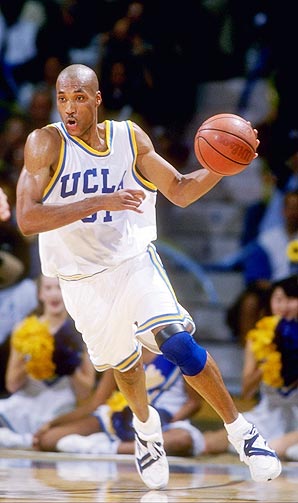
Perhaps – just perhaps – it is time to begin to turn a portion of the proceeds over to the student-athletes. And maybe not during school, but as the case of Ed O’Bannon (former UCLA great who led the Bruins to the 1995 title) vs. the NCAA proved, if you are going to use someone’s name and likeness that long after they were a student-athlete, then perhaps some of the money earned from doing so should be shared.
In 2011, the 31 conferences that received automatic bids received $180.5 million, which is then divided by the number of games each conference played over a six-year period. Each game is worth $240,000. Which meant a conference like the Big East, which played 109 games over the span of 2005-2010, took in $26.1 million. According to Forbes, by 2017, one game in the NCAA Tournament will be worth roughly $377,369 and a single game played in 2012 will have accrued a gross value of $1.9 million.
Quite a deferred play by the NCAA. Now, isn’t that just the way Dr. James Naismith drew it up?
We get confused on the numbers, when really, the battle was technically over whether or not they should receive anything but school expenses? That’s the definition of a full-ride scholarship. The NCAA simply muddied their own waters by introducing the stipend, and upping it to $300 is laughable – not because it’s only $300, but because this is the line, apparently, between heinous evildoers of sports and the kind and gentle NCAA bylaws?
What’s the difference again? Morals and ethics are being defined by the very people who make the rules here. Simply put, if any amount of money changes hands, it’s pay for performance, now we’re just arguing over fair market value.
As crafty as the “most of us go pro in something other than sports” slogan is, it doesn’t mention that most student-athletes name and likeness are used for profit over not just a college or conference, but a sanctioning body. The NCAA is like the bank in monopoly, except no one ever hits Free Parking.
Does this open a can of worms? Maybe, but no more so than continuing to use an outdated term like “student-athlete”.
Which brings us back to the beginning. The very era we hold near and dear began this battle cry and pulled back the curtain.
As Charles Pierce wrote about on Grantland.com last week, it was the Fab Five at Michigan who hand-checked the NCAA on this matter. As the university used Chris Webber, Jalen Rose, Juwan Howard, Jimmy King and Ray Jackson in the ways of advertising that would make Mad Men proud, the players started asking questions.
Fast-forward to the present the NCAA is dipping it’s pen in company ink: allowing for video games to feature the name and likeness of players, who’s video game counterparts wearing the same jersey numbers additionally feature similar skills to those of the real athletes.
You’re telling me it’s happenstance that USC’s QB #3 from the 2003 NCAA Football game was right-handed, white and had a similar throwing motion, to, say, Carson Palmer…who wore No. 3, was right-handed and white. It’s one thing to tell the players to keep the amateur in athletics, quite another to use them for profit on merchandise. When I was a kid, I didn’t just want an Arizona jersey – I wanted Miles Simon’s #34 jersey, Jeff Sheppard’s #15 or Steve Wojciechowski’s #12.
There was no coincidence.
It’s not a matter of should that player get a percentage of those jersey sales after their time in school is done, but how. As others have suggested recently, just put it aside and allow the athletes to have it after they leave school. That way, they aren’t getting paid while in school and under scholarship, but it could be a graduation present of sorts, a thank-you for all the money generated by you and your achievements, notoriety and skills while in college.
And so, my fellow basketball fans, the state of the college game is like a double-digit lead: a mirage. All looks fine on the scoreboard, but the momentum has shifted and a sea change is taking place.
We can either embrace this and embark on a new path which will benefit us all in terms of fairness and product, or we can continue to keep our head in the sand as our great sport falls further into the overall sports abyss. But this game will still be pure, still provide joy and opportunity as long as we remain united in common purpose and intent, as long as we maintain our resolve for logic and realize that moving forward can bring us closer to the glory of the past.
The state of college basketball is at the line with a one-and-one opportunity.
Let’s make them both.
Standard
Kentucky Wildcats, Larry Bird, LeBron James, Magic Johnson, Michael Jordan, NBA, Rick Pitino, Scottie Pippen, Walter McCarty

The "It" Factor and LeBron James

They are who we want to be, but can’t be because they can do things, or at least have the ability to do things, we couldn’t. We idolize them, though we shouldn’t, because it’s what we want.
This was a statement made by a friend at the conclusion of a nearly four hour conversation around sports, athletes, our reality, their reality and what it all means. Some alcohol may have been involved.
It all centered around LeBron James and his play, not just in the NBA Finals, but the nonsensical idea of debating a 26-year-old’s legacy when he is not even halfway through his career.
My stance is and remains simple: I’ve accepted James for who he is. He is a hybrid version of Scottie Pippen and Magic Johnson, two of the greatest basketball players I have ever seen. Noticed I said two of the greatest, not the greatest. James is not in the same league or category as Michael Jordan or Kobe Bryant. And not just because of the rings. It is because he is a completely different kind of player.
My friend’s stance is and remains just as simple: As a former athlete, like myself, he can never understand why James has all the physical tools, but none of the mental makeup of the all time greats. To him – and even a James defender like me – we cannot understand how he has shied away from the leadership, the hunger and desire required to be in the realm of Jordan, Bird, Magic, Kobe and Bill Russell.
“We had that desire and 10 percent of the talent,” my friend says, voice raised and fists clutched. “I can’t root for a guy like that – it’s wrong against every notion of what sports are supposed to be about.”
And then he dropped the quote on me that led this blog.
Is that why we watch sports? Move beyond the entertainment and escape from our everyday lives, and ask yourself why you watch sports. We have a vested interest in teams and players we know nothing about. We loathe them and love them at the same time. We bemoan their salaries and then turn around and buy their jerseys.
For me, I do it because I am a history guy. I majored in it in college and love the stories. That’s really all history is, somebody’s story or interpretation of what happened. Their reality becomes ours.
So for someone like me, sports are a big part of my life so that one day I can tell people, we were there when “it” happened. I do not often recall games from 10 years ago, but I can tell you who won and the interactions I had with the people in the room. I know where I was for the 2004 American League Championship Series, when the Boston Red Sox became the first team in baseball history to come back from a three game hole and win a seven game series.
I can tell you where I was when the Indiana Pacers and Detroit Pistons had their brawl. I can tell you about being in Yankee Stadium, as a Red Sox fan, with my dad, a Yankee fan, on September 11, 2008 – when the emotion of the seventh anniversary of 9/11 and the eighth-to-last game ever to be played in the “House That Ruth Built” had grown men in the Brox bleachers in uncontrollable, sobbing tears.
Basically, whatever “it” is, it was great and you should have been there.
But do we really want to be the people we watch? Do we wish we had their talents and their reality?
The only way I can explain it is this: our reverence fades and we try to replace it, but never can. I have a personal example with this.
In 1996, the University of Kentucky won the NCAA men’s basketball championship. I watched the game with my family as a high school sophomore on Spring Break in Sanibel Island, Florida.
The team was loaded with NBA talent: Tony Delk hit seven threes in the game, Walter McCarty was an athletic freak who ran, dunked, slashed and defended. Antoine Walker was too big a star to be in college. Jeff Sheppard was a pogo stick with deadly range. Ron Mercer was a sensational freshman destined to led the team the following year. Not to be listed as footnotes: Derek Anderson, Nazr Mohammed, Wayne Turner and coach Rick Pitino.
They were called “The Untouchables” because they were so good, no one could hang with them. Nine players ended up in the NBA from that team.
Two months after they won the title, I found myself in a Lexington dorm room at Rick Pitino’s basketball camp. One of my good friends was a huge Kentucky fan and had talked me into going with him for a couple of years. It was always enjoyable and you picked up some good drills, plus, every now and then, some of the players would be around and you could watch them play pickup ball in the evenings after dinner.
That year was different. We’d be watching the players of the current reigning National Champions. That week was different, too. Every player was there – and they were acting as camp instructors and coaches.
As luck would have it, I ended up on Walter McCarty’s team.
The week was a blur. McCarty was on cloud nine after winning the title and, as a senior, he was headed to the NBA Draft, so he was in a great mood and fun loving. The seven of us chosen to play on his team felt like his buddies, members of a special posse for the man they called “Ice”.
We had a pregame chant (we played twice a day in between drills and stations and McCarty was with us at least 12 hours a day):
McCarty: “Who you with?
Us “”Ice!”
McCarty: “Who you with?
Us: “ICE!”
McCarty: “What time is it?”
Us: “Game time!”
McCarty: “What time is it?”
Us: “GAME TIME!”
It’s been 15 years and I still have that etched in my brain. McCarty laid down a nickname for me – “Flyin’ Brian” – for the way I hustled and flew all over the court. He nicknamed everyone on the team. We had pizza and video game parties in his room several times and he’d point at us during the player scrimmages when we did something. We’d all yell out “Ice!!!” in unison.
We were hooked. It was surreal. At 16, I spent a week hanging out with a future NBA player who was riding a wave of good reviews following the NCAA Tournament. In two weeks, he’d be picked 19th overall in the first round by the New York Knicks.
Throughout the week, I felt terrible for my friend. He was the Kentucky fan, but not as lucky with his assigned coach. Each night, I’d relay to him in graphic detail the events of the day, from what shoes McCarty had on to how funny his jokes were. It was a simultaneous feeling of guilt and joy. I could not contain the joy of having hung out with McCarty all day, but telling him made me feel like he was dying a little on the inside.
I left that camp the biggest Walter McCarty fan on the planet. For his first year in the NBA, I followed his box score every day, hoping to see how well he did. It was personal. I had shared experiences with him and we were buds.
Except we really were not. I suppose it’s the same feeling someone gets from a fantasy camp, those guys that spend $50,000 to go and play with Michael Jordan at his camp for a day. You want to share that floor, that moment, with them.
Over the years, I lost track of McCarty’s career and certainly didn’t follow him as closely as I did as an impressionable teenager. And like many fans, you follow a player you like and then you move on – always looking for the next one, the next superstar, the next thrilling moment, the next time you’ll be sharing real time and hard reality with them.
And so it is with LeBron. He’s dealing with an entire generation of media and fans that grew up with Jordan, Magic and Bird, Pippen and Kobe. We’ve seen greatness and we want it again. We just want it to be better than it was before, we want LeBron to be better than anything we’ve ever seen, mainly just so we can say we saw it and we were there.
But it can’t be better, because nothing can ever be replicated. Take my week hanging out with Walter McCarty. I will absolutely not have another experience with an athlete as cool as that. Too many mitigating factors at play: my age, my peak interest in basketball, McCarty’s rise to mid-level celebrity, Kentucky on the heels of a title, Pitino the hottest coach in basketball, possibly playing some of my best ball and growing into my own as a shooter that summer and the hype of “The Untouchables.”
It was unexpected and could not be compared. Jordan wasn’t expected to win six rings. At 28, when we won his first one, we just hoped he’d win a couple and be in the conversation. James is 26. Every game his legacy is dissected, every game our opinion of him moves.
And yes, some of it is deserved. When you preen and dance and take the mantle of King or Chosen One and join up with two of the top 10 players in the league, you’re going to be despised. That’s a whole other discussion, frankly.
Just for now, we have to stop doing a disservice by comparing James to Jordan and the other greats. Not for James’ sake – but for our own. Because no matter how good or how bad, he’s never going to be good enough for us.
Remember, we can’t make them be what we want as people or athletes. And even if we could, we wouldn’t really want it that way because it wouldn’t feel real. But it does not stop us from wanting that of athletes and of sports. 

We still want to be there when it happens.
Whatever “it” is.
Standard