American culture, American People., Culture, faith, family, Life, Logic, motivation, philosphy, pop culture, psychology, Society & Culture, Sports, Uncategorized

We Hope for Baseball

Image result for baseball

The collective emotional roller coaster our homes, communities, states, nations and world have experience over the past week cannot be quantified with words.

But damn if it’s not like me to try. Leave it to a pandemic for me to sit down and type my first entry in so long I cannot recall.

The world around us moved so fast last Wednesday that it seemed unreal. The NBA was suspending its season?

Huh.

Thursday saw universities shuttered, college basketball conference tournaments cancelled, high schools move to eLearning.

Um, what?

Friday felt like the bottom fell out, the cancellation of the NCAA Tournament, a new kind of March Madness. Spring sports cancelled – including the College World Series in June – throwing eligibility questions and team rosters for the 2020-21 season into a quagmire that didn’t feel so giggity giggity.

And we thought the news was all filled with doom and gloom before?

I told my wife Friday afternoon that my brain hurt. I couldn’t comprehend much more that day, think of any more angles to cover or next steps after the next steps. I needed wine tequila and a hoodie.

2020 will be forever remembered as when “Social Distancing” became apart of the American lexicon, when everyone from the age of two to 92 could recite proper hand washing protocols.

It will be remembered when we learned everything in our economy is connected, that an essential freeze halted us in our tracks. We quarantined, we worked from home. We overreacted, we under-reacted.

We hoarded toilet paper.

Everything has effectively been put on hold. Youth sports, book clubs. Going out to dinner, a family cookout with grandparents. Spring break. Every Disney Park closed for weeks, every zoo and museum closed. No choir concerts, no parades, no church in person, no events really of any kind.

Everything. Has. Stopped.

But have we learned?

Nothing we didn’t already know.

That faith, hope and love are some good things He gave us, and while the greatest is love, the most important might be hope.

We need to hope we can get back to normal before July. Before June.

We’re holding out hope for high school baseball in our home state. My son, a senior, is a part of a team that won a state championship last season. His friends from his travel teams, scattered across the state, all want the chance to play before college. Most won’t get a chance to play in college, but it is not about that specifically.

It’s about Senior Night. It’s about Prom. It’s about hearing your name called for the final time. Crossing the stage with a diploma at graduation and graduation parties of definitely more than 10 people.

It’s about all we’ve taken for granted. The commute to work filled with podcasts that have fresh content about sports, movies, politics, whatever. Seeing our co-workers, sitting face-to-face in meetings, teaching in a classroom filled with people.

It’s been merely a week, and even the introverts like me don’t think we really understood how significant social distancing could be to the fabric of what it is to be American.

Maybe this is a chance to re-learn, to re-think the daily life and throw our routines out of whack. Are we adaptable? Are we unbeatable? Can we turn a negative, a 100 negatives, into a positive? Are we just catch phrases, or can we rise to the challenge and endure?

We’re always taking about how busy we are (I’m looking at, well, all of us).

Well, how about now? Time to read. Time to listen. Time to think. To take a walk. To get to know our spouses and kids again. To find a way to serve a purpose greater than ourselves.

Maybe this is our wake-up call.

What is truly important, and what is not.

Sure, we’ve clung tight to family. Personally, we haven’t turned into The Shining family around here…yet. And we appreciate our home, our jobs, our friends and our freedoms.

But hope, man.

Hope might be the most fascinatingly human emotion there has ever been. And we need it more than ever.

No matter your beliefs, your political allegiances, whether you call this a hoax or are digging your doomsday bunker as I type, this is history happening for better of worse in real time.

It is a stark reminder we are not in control, not even a little bit, not even at all. But like any good book or movie (that we’ve all probably re-watched or re-read three times by now), hope is a good thing.

It could be the hope we’ll stop losing our ever-loving minds. Hope that those who aren’t taking it serious will wake up to the fact that COVID-19 is a bit more threatening than we thought a week ago, or even a day ago.

Hope is why Hallmark is running Christmas movies in March. It’s why Disney+ put Frozen II up months before they were supposed to. It is why classic sports re-runs are a welcome distraction. Why Tom Brady going to Tampa Bay and leaving New England was something else to talk about for a few hours.

Because we do not know where this going. We do not know the impact on the economy, on our jobs, on our daily lives yet. And we won’t fully for some time.

But we hope.

We hope for the sick, we hope for the cure, for strong leadership, for our friends, for our industries, for our kids.

We hope for an appreciation of the life we lived two weeks ago and for a future that might be close to it.

So, yes, we hope for baseball in this house. And we hold out that hope, because without it, well, it just makes the brain hurt.

Stay safe. Stay informed. Stay good to each other.

Stay hopeful.

Standard
American culture, American Politics, Life, pop culture, Society, Society & Culture, Uncategorized

One of These Days

tree_roots

There are no words, really, though I’ll type a thousand as therapy.

I’ve been staring at that picture of the tree above, with its old, bulky roots, for a few days, as the violence that has once again rocked America has once again led to a chorus of outcry for change. Perhaps what we need is a change in mindset to remember our roots as human beings.

As President John F. Kennedy once said, “For, in the final analysis, our most basic common link is that we all inhabit this small planet. We all breathe the same air. We all cherish our children’s future. And we are all mortal.”

That mortal part, we do not seem to value it enough.

One of these days, we’re going to wake up, I think.

One of these days, we’re going to realize we’re killing each other over senseless anger, I think.

One of these days, a friend will call and simply ask how it’s going, I think.

One of these days, the headlines won’t be filled with both the tragic and the trivial, I think.

I think I might be wrong.

One of these days, we’re going to reap it.

One of these days, someone with their finger on a very important button will go too far.

One of these days, we’ll just stop responding to texts and calls.

One of these days, we’ll just give up.

I hope I am wrong.

Yes, Black Lives Matter. And white lives matter. Asian lives matter. Christian lives matter. Muslim lives matter. Young lives matter. Old lives matter. American lives matter. Russian lives matter. Iraqi lives matter. Women’s lives matter. Men’s lives matter.

Our short-sighted solution to respond to an event by pulling into tighter, highly defined groups of ethnicity, race, gender or religion isn’t working. We’re dividing ourselves further and playing into the devil’s hand of hate.

In 1963, most of the world watched in astonishment as President Kennedy was assassinated in Dallas. Last night, nearly 53 years later, mere blocks from Dealey Plaza where Kennedy was assassinated, five Dallas police officers were assassinated by snipers, on the heels of two men shot to death by police in Minnesota and Louisiana.

We’re regressing, America.

We can argue about guns and who can have them, or if it makes sense to allow military grade weapons available to civilians all day long. We can get snarky about deleted e-mails or business ethics of presidential candidates for months. But that’s not the division that ails us.

Simply put: how do we legislate kindness, compassion – or the simple ability to leave each other alone?

On Monday, the United States celebrated its 240th birthday. As majestic fireworks filled the sky, I doubt I was alone in pondering the sheer awe of time that had passed since those responsible for declaring our independence had put ink to their cause.

I also wondered how long we have left, how much has changed since the late 1700s in the world and how one of the greatest things about being American is not only freedom, but feeling relatively safe in our everyday lives.

We are no longer safe. And if we are no longer safe, we are no longer free.

When guns are fired from downtown skyscraper parking garages (Dallas) or from interstate overpasses (Washington, D.C. many years ago), when people are shot in their cars reaching for their wallets (Louisiana) you start questioning your safety nearly all the time.

All this does is serve to separate us more. We pull back into our homes, our neighborhoods and stay out of the cities and protests. Freedom to assemble shouldn’t have to come from the fear of being shot.

The song remains the same. We’re dividing ourselves.

Technology and social media have put a wedge in our society. We might be perhaps more disconnected that we were hundreds of years ago, when there were far fewer of us and our homes were miles apart.

We all have a voice and opinion and want to be heard.

The problem is, no one is saying anything worth hearing.

We market ourselves in blur of posts and pictures. If the intent was to be connected with people we don’t see as much anymore, maybe that was an itch we didn’t need to scratch if this is all we plan to do with it. If we wanted to see and talk to all those old friends and family more, would distance matter? We could still pick up a phone and catch up.

We’re a nation of creepers on social media, as if a picture of smiles and 140 characters of text tell the whole story. No one is perfect. But we pretend to be, and we’d prefer to take swipes at other people – their errors and mistakes – by calling them out on social media.

We’re jealous and envious of those with seemingly more than us.

It’s either that or the common obsession we have to know who Taylor Swift is dating now. And as much as I think we’re all a little too interested in celebrity boyfriends and girlfriends gossip, it’s probably the former.

We’re on social media to stalk people we used to like or be close to, but aren’t anymore and this is our totally American way of snooping in from time to time on their life.

So many angry people in the world, yet they all look happy in the photos.

What does this have to do with the most recent tragedies in Dallas, Louisiana and Minnesota? The same as it did for Columbine, Sandy Hook, Aurora, Fresno and more.

Simply put, we just don’t treat each other very well and we’re hiding behind two things: a lack of self-esteem and insecurity.

I usually try to come up with a positive message at the end here, to tie it all together, to provide a spark of hope in an otherwise dark moment.

All I can come up with this time is that we can only take care of ourselves. Preaching, lecturing isn’t working. To be the change you want to see in the world, I suppose it’s the Nike tagline.

Just do it.

If we raise our children right, hug our spouse, wave to the neighbors, keep our commitments and just try our best to not stab each other in the back, shutdown the apps a little more, we’ll hopefully lay down an example to the next generation.

It would be nice if we were happy in the life we have, not the life we want others to perceive we have.

Worried about what to do yourself? Want your voice to matter in the world? At a loss of how to raise your children to avoid this in the future?

Start there.

Love yourself, your family and your life. Be proud of who you are and kind to those who aren’t like you. The young ones are watching.

And maybe, one of these days, they will have a chance to save us.

One of these days, I hope I am right.

Standard
American culture, Culture, culture war, Politics, pop culture, psychology, race relations, Society & Culture

As The World Burns

It’s beginning to look a lot like Christmas.

That is not such a good thing.

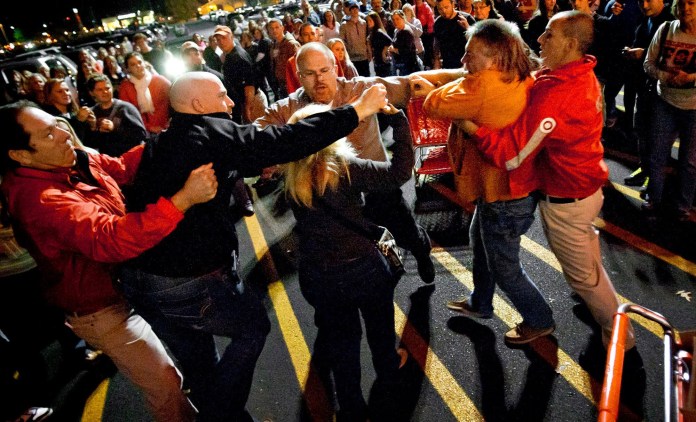
Here we sit, as the world burns around us, and lament the trivial, the inconsequential, the minutia. We fight over saving an extra 20 percent in the Target parking lot. black friday

I have come to the conclusion that we must secretly want it this way. Or we are lazy. Or we do not care. Or it is just easier to ignore it and focus on our first world problems, holiday plans, on the gifts we must buy. We do not really want to talk about it or do anything about it. We just want to complain about it for a hot minute and move on to the next thing.

We put a proverbial Band-Aid over it and hope it goes away?

Oh, you are probably wondering what “it” is. You want to define “it”? Fine, I suppose that is fair.  “It” is undefinable. “It” is everything, anything and nothing at the same time.

“It” is the topic of the day. “It” is immigration, race relations, religion, poverty, politics, international affairs and the economy. “It” is gun control, Hollywood celebrity culture, concussion protocols, domestic violence, locker room language and bullying.

“It” is how families communicate, nuclear and extended. “It” is marriage, divorce, parenting and children. “It” is our increasing reliance on technology. “It” is our jobs, our anxiety, and our fears, our obsessions with the material and immaterial of the world.

“It” is every little thing we deal with on a day-to-day basis.

Perhaps most of all, “it” is you.

Yes, you – the one who thinks I am writing to everyone else and doesn’t think that these (hopefully) thought provoking pieces of less than literary prowess over the past few years are directed at them.

It is directed at you.

It is also meant for me.

When my writing changed a few years ago, it was because the way I think changed and evolved. A funny thing happens as you age, you start paying attention to more than just box scores. You marry, have children and find yourself watching less SportsCenter. Why? Because in the grand scheme of things, it just doesn’t matter as much, while what we are doing to ourselves does as a society matters all that much more.

But a key realization occurred along the way: talking does little. Writing seems to do less. People do not want to hear about the ills of the world, much less so what they can do to improve it. We do quite a bit of talking in our public and private lives. Actually addressing “it” and finding real solutions is a much more difficult proposition.

And this is because we simply do not listen.

We hear, but we don’t listen. We can’t talk about anything that leads to a civilized, give-and-take discussion and solution, because mostly, we’re unwilling to budge on our positions, to meet others halfway. We react, we get angry, we get hostile. To most, an idea of a solution to any problem is agreeing that we are right. It is part ego, part vanity.

Devaluing the ideas, thoughts, and concerns of others while simultaneously self-promoting our own as fact and truth is as dangerous as it is foolish.

To most of us, we might recognize this, so we back-off. It is not worth the argument, the fight. We Band-Aid our lives for the sake of doing the dance. We won’t talk about “it” – whatever “it” happens to be, because all it will end in is hurt feelings, angry words and emotional outbursts.

So we bottle it all up inside, allowing it to take residence in our proverbial mental garbage bin of all the things we’ve ignored, swallowed and tried to forget over the years. These situations become like sticks of unlit dynamite.

And then, at some unknown point in the future, the most meaningless thing sets off the wick and we explode, looking like we need a straight-jacket and some prescription drugs.

We’re all a little crazy.

But that is because we allow ourselves to be. We think we’re saving face. We’re not. Clear and honest communication is a central part, but actually listening and being willing to bend, to meet in the middle on whatever “it” is would most likely serve us all well.

This much is true: if we agreed to disagree from the beginning and worked to a solution that neither feels entirely great about, but comfortable with, we might actually get somewhere in this world.

Our world view is significantly altered by the fact that I am me and you are you. We’re a country and world full of people with specifically engineered lives, with experiences vastly independent from one another.

We share the same period of time and space in this universe, but we experience that time and space in very different ways, which means we do not – and cannot – see the world the same way.

So why are we so surprised when people of opposing viewpoints and political parties, living in different cities, towns and regions, with entirely different life experiences disagree with us?

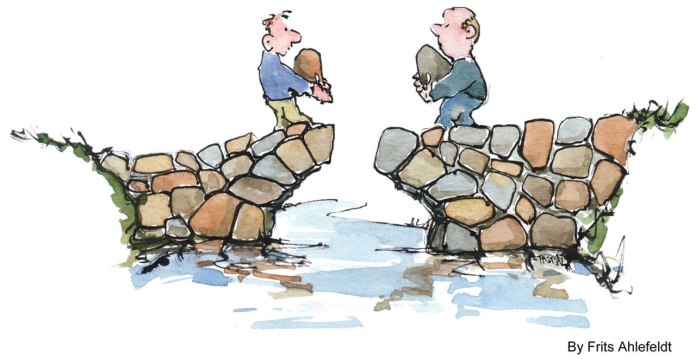
We will never agree on anything because not one of us looks at everything the same way. It is not about forcing someone else to see why they are wrong and you are right.On the contrary, it is an attempt to build a bridge toward the middle where you see where they are coming from.

bridge


That is problem solving. That is relationship management. That is how we were designed to interact. We are not all geniuses in all aspects of life and its infinite mysteries, nor are we complete morons, either. We’re a melting pot of races, religions, ethnicities, social, cultural and economic backgrounds.

We – READ: you and I – would be better off if this were not just a pipe dream, but something we actually exercised ourselves and taught to our children. You – yes, you – will be wrong sometimes. You will be right sometimes.

Sometimes, you might be either, neither or both.

The same goes for me, your parents, in-laws, children, their friends, teachers, your co-workers, the guy working construction and the lawyer on 5th Avenue, the President, Congress, Roger Goodell, Chris Rock and the waiter at your restaurant.

Be in the world, not above it. People are people, their problems are real because they experience them. Don’t shut them down. When we refuse to grow, we refuse to change – and change is largely inevitable. Growth is good. Sticking to your old habits, beliefs and traditions is not necessarily something to be proud of.

So this holiday season, start a new tradition.

Try.

Try to be honest. Try to be kind.

Try to avoid the Social Media tar pits that cannot be one. Try not to take the bait. Try to understand there are people who do not have food, shelter or friends.

Try to not be too swayed – or angry – with those seeking your vote, your money, your donations and your time. Try to give back a little more than you take.

Try to understand the other side, someone else’s perspective as best you can. Try not to shut down or shut out. Try open minded. Try accepting what you can.

I don’t think you should necessarily succumb to the world, give in to all opposing views and beliefs and acknowledge they are somehow right. But the world is not going to fully come your direction, either.

Try to build a bridge.

At least your half of “it,” anyway.

Standard
Life, NFL, Philosophy, pop culture, positive thinking, Rashard Mendenhall

Pulling a Mendenhall

Last week, I heard a story on the radio that rated the Midwest, specifically the major metropolitan close to the suburb I reside in, as one of the hardest working cities in America.

No doubt, many who heard this locally puffed their chests out a little bit with pride. Others perhaps slightly lamented this fact, as they thought about the hours put in to their specific jobs and all the things they’d rather be doing. Both these groups and anyone in the middle carried on with their day, which was likely spent trying to impress someone else.

The brutal truth is this: We cede power of our self-worth to someone else’s opinion. In fact, we care way too much about what people think of us. We spend too much time wracking our brains over a comment someone makes, spinning it out of control in our own mind to the point of obsession.

Sadly, we let this define us. From our self-worth to emotional balance, we are infinitely more worried about someone’s opinion reign supreme over what we say we value.

Actions must always speak louder than words, and sometimes you’d be amazed at where you will find a voice of reason. I’d never given much thought to Rashard Mendenhall, an NFL running back who just announced over the weekend he was retiring at age 26. I did not know what his likes or his interests were, nor that they would even be close to my own.

In fact, upon hearing of his retirement, the immediate reaction I heard on talk radio was that of ridicule, mostly because why would someone throw away a promising NFL career at 26? All that money! All that fame!

mendenhallThen, you read Mendenhall’s thoughtful comments, delivered without a press conference or fanfare, and you get it. Or at least you should. He speaks of the changes in our society and not finding a way to fit in:

Today, game-day cameras follow the most popular players on teams; guys who dance after touchdowns are extolled on Dancing With the Starters; games are analyzed and brought to fans without any use of coaches tape; practice non-participants are reported throughout the week for predicted fantasy value; and success and failure for skill players is measured solely in stats and fantasy points. This is a very different model of football than the one I grew up with. My older brother coaches football at the high-school and youth level. One day he called me and said, “These kids don’t want to work hard. All they wanna do is look cool, celebrate after plays, and get more followers on Instagram!” I told him that they might actually have it figured out.

And he is absolutely correct. Times have changed, rapidly so, over the past 10 to 15 years. The increasingly connected world we have created through technology makes it a more social place, but a less emotional one. We do just kinda want to look cool.

If we look hard-working, put together and speak well, watch all the right shows and drive the right cars, then we’ve got what exactly? A meaningless, consumer-driven existence that we have built solely on what others think is meaningful or cool.

And that group of “others” is a rabid bunch, documenting every up-and-down. One minute, you are beloved, the next, a bum. In this constant over analysis, we forget there are no experts, just opinions. And as we know, Americans have lots of opinions – and we are paid and unpaid to share them.

As Mendenhall says:

There is a bold coarseness you receive from non-supporters that seems to only exist on the Internet. However, even if you try to avoid these things completely — because I’ve tried — somehow they still reach you. If not first-hand, then through friends and loved ones who take to heart all that they read and hear. I’m not a terribly sensitive person, so this stuff never really bothered me. That was until I realized that it actually had an impact my career. Over my career, I would learn that everything people say behind these computer and smartphones actually shape the perception of you — the brand, the athlete and the person.

Perception shaping reality? Around these parts? No… you don’t say. There is a snowball effect to perception, one of the lessons we did not learn from early educational books. And when we start to feel its effects, it damages us in many, many ways.

From our parents, to our coaches, our teachers and friends, we begin to rapidly care about what other people think of us. In a vacuum, influence is not necessarily a bad thing. When it changes who we are, why we do or do not do certain things, then influence holds too much power over us.

It strips away individuality that produces well-balanced and centered people. There is certainly enough room for all of us, with our various likes and interest, just not enough acceptance. We’re all like the movie “Mean Girls” and life continues to operate like the cool kids table in the cafeteria. That is, if you let it.

Mendenhall is getting out of professional football, at least to my understanding of what he’s saying because he is a person of various interests who wants to live a full and complete life. He’s done the NFL and it was fun, but now, it’s time for something else.

Over my career, because of my interests in dance, art and literature, my very calm demeanor, and my apparent lack of interest in sporting events on my Twitter page, people in the sporting world have sometimes questioned whether or not I love the game of football. I do. I always have. I am an athlete and a competitor. The only people who question that are the people who do not see how hard I work and how diligently I prepare to be great — week after week, season after season. I take those things very seriously. I’ve always been a professional. But I am not an entertainer. I never have been. Playing that role was never easy for me. The box deemed for professional athletes is a very small box. My wings spread a lot further than the acceptable athletic stereotypes and conformity was never a strong point of mine. My focus has always been on becoming a better me, not a second-rate somebody else. Sometimes I would suffer because of it, but every time I learned a lesson from it. And I’ll carry those lessons with me for the rest of my life.

steve-jobsThese are lessons we have all previously learned and now ignored. How many times are you questioned? Daily? Weekly? If you do not do whatever everyone else is doing or how they would do it, then obviously you must not love it or care about it, right? There is an unprecedented level of competition that has entered our minds – a battle between others and ourselves. A game of one-upsmanship, where anything you can do I can do better. I care more about my job than you do because you did not respond to the “urgent” e-mail at 10:05pm last night.

But rarely is that so. Most of us care. Most of us try. But this fight to keep perspective, it is a challenging one. It would be nice – yet unrealistic – if we all just believed when someone said they were working on it, taking care of it or that they tried their best.

Let your actions be your words.

Worried about your height and if people think you are too short or too tall? Worrying about it won’t make you grow, or shrink. Your ancestors and the gene pool took care of that long before now.

Worried about what clothes you wear, what car you drive, how you talk or what others will say when you meekly admit to having never watched “The Wire” or “Breaking Bad”? Why? What does any of that mean or say about you anyway?

To be proud of who you are and what you like is to be an individual, which means you are different. You are not just one of the crowd. We are not cattle, to be prodded toward unity. In the modern age, ridicule and harsh words are used as scorching prods and we are well branded by each other.

Mendenhall’s final statement rings most true:

As for the question of what will I do now, with an entire life in front of me? I say to that, I will LIVE! I plan to live in a way that I never have before, and that is freely, able to fully be me, without the expectation of representing any league, club, shield or city. I do have a plan going forward, but I will admit that I do not know how things will totally shape out. That is the beauty of it! I look forward to chasing my desires and passions without restriction, and to sharing them with anyone who wants to come along with me!

I could not think of anything better: a decision to be and live freely, without worry of judgment without expectation of what everyone else thinks.

We all kind of have a plan, but cannot begin to predict how it will play out. Uncool and unpopular and un-put together as that may seem, we could all afford to be called some of the most passionate people on the planet, who follow dreams and see what the road of life has in store. What if we were called some of the most relaxed, or even-keel, down-to-earth people in America?

Now that would be a statistic based on opinion I could learn to care about.

Standard
In Utero, music, Nevermind, Nirvana, pop culture

Come As You Once Were

When I heard a few days ago that Nirvana’s In Utero was turning 20 years old last Saturday, I had a rush of emotions:
“Wow…am I that old?”
“It can’t be that long…I remember when and where I was when I bought the album!”
“That also means it’s been nearly 20 years since Kurt Cobain died.”
Almost immediately, I went and listened to some of my favorite Nirvana tracks, not just from In Utero, but from Nevermindand Unplugged in New York. It had been far too long, and those songs are like an old friend.
Then it happened – I was transported back to my mid-1990s self: awkward, yet outgoing, athletic, yet awkward (again), somewhat intelligent, but mortified of being labeled that way. In other words, I was transported back to the first-world problems of American teenage angst. The whole period of being a teen can be defined as ill-conceived and awkward.
And as Nirvana got popular, I was hitting that most-awkward phase, between the ages of 12-14, where you don’t know what the heck is going on every day. Your life is constantly in a state of physical, emotional and mental flux (partially because you make it that way, partially due to hormones). One day, I was a jock, the next day I was a geek. I worked on a farm and grew up with country music, but I liked kneeboarding, Airwalks and a killer guitar solo. WHO WAS I?!?
I felt, as I am sure most youths do, an identity crisis, during my teenage years. What are the characteristics that make up who you are, what you were and what you will be? Music set the tone (no pun intended) for so much of what took place during that time of life: how you dressed, spoke, acted. What friends liked, what those who weren’t friends liked.
In this reflection of youth and Nirvana and music, it occurred to me that I was listening to it differently than I did before. And then it became clear: what a reflection that is of real life.
We hear what we want to hear – in conversations, relationships, friendships, in music. I heard what I wanted to hear the first time I listened to “Heart-Shaped Box”, the same as other people did when they watched Johnny Carson or Richard Pryor. A connection is made because you become a receiver open to the message in the first place.
Basically, you’ll find what you’re looking for in all aspects of life. It’s just that you don’t know that as a teenager. Hence, the aforementioned angst.
And as adults, that lack of angst, as we wade through life’s turbulent waters and figure it out, creates the need for nostalgia. Which is how or why Nirvana is re-releasing a special edition of In Utero with remastered tracks. The problem is, the album and the band, are themselves a reflection of life in general: it was never meant to be mastered in the first place, because it cannot be.
Humans are built for conflict, for drama, to operate in a state of threat from time to time, due to how our brains were hard-wired during hunter-gatherer days. And in the absence of genuine conflict now, or real tension or threat, sometimes, we’ll just create it for ourselves. Hence, perhaps the chorus of “Heart-Shaped Box”: “Hey! Wait! I got a new complaint…forever in debt to your priceless advice.”
We’re a constantly critiquing society. We are the ultimate critics, intent enough to not leave well enough alone or mind our own business. And nothing is ever good enough. Which is where my thoughts usually go when I hear In Utero. It wasn’t good enough for everyone. But it wasn’t intended to be. How, in any manner, could Nirvana follow-up Nevermind? It was a nearly impossible task.
The record company and all the big-wigs wanted another Nevermind in 1992-93. Kurt Cobain, all things considered, was a wildly intelligent and introspective individual. He knew he couldn’t please everyone. In fact, he knew that by and large, he wouldn’t please anyone with a follow-up. So he did what he thought he would want to hear if he were a fan: he went more raw and unpolished.
Recorded in a few weeks, in Minnesota, in February, with little embellishments, In Utero is in a weird way the best follow-up album I can think of. The drums were recorded in a kitchen, and rumor has it Cobain recorded the vocals in six hours. It is raw, and it is quite good. And the music still sounds amazing, 20 years removed.
Naturally, the corporate machine rejected it at first. Which is exactly why the band – and namely, Cobain – loved it.
Cobain knew you can’t keep doing the same exact thing. First of all, it’s boring, secondly, it wears out eventually. What’s popular doesn’t stay popular forever.
Listening to the band again, intently for the first time in a long time, I wonder if Nirvana would make it today, with that increased cynicism? I fear they would have been torn apart by critics by 1998 or 2000, after a few more albums anyway, and Cobain probably would have ended up doing the same thing he ended up doing.
Cobain never wanted that life, that fame, that “voice of a generation” status. I honestly don’t think he was THE voice of a generation. There really is no one, true voice. You can argue that it’s a hodge-podge, random allocation of voices that define us every so often.
The boomers reacted the same way with John Lennon as Generation X did with Cobain. The preceding generations in both instances could have cared less – it meant little, I am sure, to my grandparents in 1980, that John Lennon had been shot, the same way mine could have cared less about Cobain’s death in 1994.
For the baby-boomer generation, the Beatles were alternative the same way Nirvana, Pearl Jam, the Smashing Pumpkins were alternative to a generation in the 1990s. Alternative essentially means what it’s always meant. It’s rejecting whatever the current status is in favor of something else.
And before you become an adult and start to stop caring so much about what other people think or what other people do, or how you look and how much money you have and turn away from that machine and just live your life, you are actively looking for something else. Something that tells you don’t have to like what all those people in movies and magazines and music videos tell you to look and act like, largely because you don’t look or act anything like them.
Any number of people or events can serve that role. Throughout history, we’ve had probably thousands of them. From public figures to national events, these voices come from music, art, sports, politics, religion, science, farming (seriously, check out Paul Harvey). They all become voices because we listen, we are receivers. We intrinsically memorize and memorialize.
But these voices stuck out because we were out looking for them in the first place. And it’s deemed popular because so many people found it appealing. Remember, pop culture is defined as mass consumption of something. Being too high brow or underground just means not enough people to make a majority relate to it.
To this day, I don’t know if it was good or bad in Nirvana’s case. Do you want enough people relating to you if your mindset is that of apathy, regret and angst? What does it say about us when the underground or alternative becomes popular culture? Probably nothing and everything at the same time. Some people actually relate, while others sort of fake it because their friends say they should.
The answer exists where it usually always does – somewhere in the middle – which is usually equated to being stuck or trapped. Cobain felt this – that he couldn’t become popular and maintain the respect of the artists and genre he admired, yet he couldn’t stay there, either. Again, this is a relatable occurrence for us, for our lives. We can’t stay teenagers forever, we’d go crazy. We can’t sit in limbo in our jobs, our relationships and our friendships.
We’re constantly seeking change – and it doesn’t totally matter whether it’s positive or negative; any change will do so long as it’s not in the middle. Yet that will remain where Nirvana resides, in the middle of the height of 1990s and the grunge/alternative scene, because that’s where Cobain chose to end it.
Think about it though: as humans, we are in a state of constant change. Every single second of our lives, in fact, we are changing. There is no constant, truly, in our lives. This rises to hyperactive levels as teenagers (at least in our own minds). But then we gain more freedom, more control. We mature, for the most part, calm down, settle down and move on with the process of just being alive and enjoying that wonderful, sweet fact.
Music provides the total opposite effect of change to us: it stays constant, forever captured in the state it was recorded and released in. Within that consistency, we find comfort.
When our head is telling us we’re so busy and we have all this drama and conflict, we seek out something that comforts us. So we go back and find what we know, something that won’t change as the world does around us: music.
And Nirvana represents that period of time in large part because they remain unchanged, forever there, in the middle. A place where we don’t want to live, but don’t mind visiting from time to time. I may not be anything like that kid I was, I may dress differently and have a much clearer understanding of exactly who I am, but I can still feel welcome to drop-in.

In a way, you can truly come as are. 


Standard