American Politics, Donald Trump, Hillary Clinton, Philosophy, Politics, Uncategorized, United States

Love in the Time of Trump

hith-white-house-attacks-e

Perspective.

It can be gained. It can be lost. It can be ignored. It can be shared and heard.

Empathy.

It can be gained, shared, lost, and ignored as well.

Love.

It can be shared, in a variety of forms. It can be. It can come in various forms. It can be gained, earned and lost.

Freedom.

It can be exercised. It can be taken away. It can be fought for. It can be earned.

Compassion.

It can be shown.

And all of these attributes, these feelings, these emotions are a choice.

Much like the choice we had in voting (or not).

There are 330 million Americans of all age, race, creed, religion and orientation. Roughly 122 million of those voted in the Presidential election held earlier this week. Of those, the last count I saw showed that 59.9 million voted for Hillary Clinton, 59.7 million voted for Donald Trump.

Some of those who voted for the candidate who did not win the Electoral College – Clinton – are outraged, upset and frankly stunned.

Some of those who voted for the candidate who won the election – Trump – are outraged, upset and frankly stunned.

For entirely different reasons.

Some of us care deeply about issues like the second amendment, healthcare, pro-life, illegal immigration, infrastructure and jobs. Within that group, some of us are willing to overlook the words and actions of a candidate and place a vote for someone we perceive to be the lesser of two evils.

Some of us are tired of being blamed for hatred and violence, for being accused of being racists or bigots because we care more about the future of the Supreme Court than we do name calling. And that is not meant as condoning or endorsing name calling, hate speech or demeaning women.

Some of us care deeply about gun control, healthcare, abortion rights, open borders, LBGT rights and climate control. And within that group, voters were willing to overlook an equally flawed candidate who was paranoid, hid secrets, took money from foreign powers and in some cases, didn’t disclose the truth. Voting for that person is not meant as condoning lying or pay for play, either.

Some of us are Republicans, some of us are Democrats. Some of are neither, either or both. Some of us did not particularly like either option.

We had a choice on Tuesday. We chose. We had the same choice in 2012, 2008, 2004 and so forth. We had a choice in mid-term elections. We had a choice to protest, or a choice to accept the results of this election and every other. We can voice optimism; we can voice fear.

But really, we have a choice every single day. Realize where you live, what incredible freedom you have.

For heartsick Democrats, you now find yourself in the position that others who disagreed with President Obama have been in for several years – just in a completely different way. You wonder: “What rights will be infringed on? What issues do I care about will be ignored? What is happening to our country and those things which I find to be vitally important to progress?”

Simply stated, while the issues may be different, the sentiment is the same one shared by others over the past eight years who asked similarly: “What rights will be infringed upon? What about the issues that I care about? What has happened to our country and the things which I find to be vitally important?”

For joyous Republicans, you have a responsibility now to govern not just for yourselves, but for finding compromise with all Americans who do not see things as you do. You have a chance to do what you feel was not granted to you under the previous administration: hear all voices.

You see, we agree in earnest on much more that we are led to believe. We may be on opposing sides of key issues, but it striking how quickly we want compromise when we are not in a position of power. Your No. 1 issue may be the right to life, while someone else’s may be climate control.

Here is the one constant since the first days of this country’s existence: we may not and perhaps will never agree. You may get something you like, and I might get something I like. And then the next time, it might go the other way.

It’s called compromise, compassion and understanding. Very few countries actually have this. That is why the United States of America remains a beacon for a world where voices are routinely ignored.

If you have not enjoyed the past eight years, you chose to try something else. If you do not enjoy or find the kind of progress you wish for in the next two, four or eight years, you will have the choice to band with others in selecting something different.

But let us know not lose that perspective. That the freedom to choose in itself is the greatest political victory that has ever been granted in the history of mankind.

While the outcomes may be tough to accept, the alternatives are just too hard to fathom. We could live under tyranny. We could live under real oppression. From man’s earliest days until now, trillions have lived and died without choice, without the chance to vote for their voice to be heard.

Do not, in either winning or losing, ever forget that.

And do not lose the perspective that ultimately, no matter who runs the country’s business for a relatively short period of time, what affects and effects our lives the most is – and has always been – the manner in which we treat each other and in how we raise our children.

Reduced to a bumper sticker slogan in a lot of respects, it does not diminish the importance of the adage that we should strive to be the change we wish to see in the world.

And if we truly want to drive out hate and turn it into love, we do that in the time of Trump that same as we should have been doing in the time of Obama, Bush, Clinton and Reagan – within our four walls.

Practice what we preach – and from the looks of social media, we’re doing a lot of preaching at the moment.

I know we just held a draining, divisive election. It is far easier to get swept up in labels, in words, in emotion that it is to take a moment and understand things from the other side.

Break the numbers of this election down: Out of 10 people, roughly 5 voted for Trump and 5 voted for Clinton. Out of 10 women, 4.2 voted for Trump, 5.8 voted for Clinton. Out of 10 Hispanics and Latinos, 2.9 voted for Trump.

Basically, everyone is surrounded by someone of a different gender or race that voted for the other candidate. We’re no better than each other, but we can be better for each other. We can be better to each other.

While the election may have flipped the party in control of the nation’s highest office, it does not change that we are all Americans. We have too long overemphasized the presidency, and not realized that the most important changes that can occur are in our own backyard.

If we pay closer attention to local elections, town, city, county, and state issues, we’ll build better futures in ways that more directly impact us. I saw relatively few – if any – comments or posts on social media about their local elections.Take care of the foundation first. Do not get lost in the weeds.

Be a shepherd, not a sheep. Do not fall for what Orwell described as “groupthink” in believing everyone sees the world the same.

Again, I know it was a draining, divisive election. It usually is.

But it’s time to choose again. Today, tomorrow and every day.

Choose to not assume the worst in people. Choose to believe in the inherit goodness of most people. Choose to believe that not everyone who voted for Trump is a racist, womanizing, fear mongering bigot. Choose to believe that not everyone who voted for Hilary is a big government, gun removing, lie endorsing, liberty draining, hypocrite.

Choose compassion. Choose empathy. Choose compromise. Choose love. Choose perspective. Choose to look past the labels.

When we choose those things, there are no “winners” and “losers.” Just people working together to make the world a little bit better each day.

That is what has – and will always – make America great.

Standard
American culture, Philosophy, Politics

Revolutions & Evolutions

When John Lennon and The Beatles sang of everyone wanting a revolution and blaming an institution, there was an aura of credibility to the fact it was an era of uprising.

The powerful lyrics about evolution and changing the constitution ended with Lennon telling everyone it would be alright.

beatles revolution

And he was right. The world’s axis has continued to spin for another 40-plus years since that song was recorded in 1968.

The 1960s are often referenced as the preeminent decade when the world was changing, a zero hour for counter-culture, and a revolutionary time when people really wanted to change the world.

In reality, the 1960s were just another decade where a lot of altering and history making events happened at the same time – different and yet much the same as potentially the 1770s, 1860s, 1950s or even the 1990s.

And each time, the message is much the same: We do not like the way things are and believe they can be better.

History, as they say, repeats itself. Sometimes, it just needs to mix up the beat or the chorus or the bridge. But we’ve been playing the same tracks over and over.

Some decades or eras are marked by violence, others by relative peace. But all are marked by men and women who fundamentally are consumed with the idea of seizing power and controlling the masses.

Whether it be a monarchy, a dictator, a president or a parliament, it is not about changing the world – it is about controlling the people in it.

The message is always the same: “I know what is right and what is best for the vast majority of you. Allow me to lead you to an unspecified time in the not too distant future where the world will shine brightly and we will be placed upon top of a hill.”

Be careful, therefore, of mortals who seek to be idolized by man. Ego, vanity, greed. These deadly sins have steered many men and women in the wrong direction, under the false pretense and belief they are part of a positive uprising, a part of the light, a part of truth, that they too shall be a part of history.

If you care to emotionally detach yourself from a political party, from a country, from a religion for a moment, you’ll eventually arrive at the assessment that all the world’s political and ideological dramas come from the same place: we are right and they are wrong.

Now, “we” and “they” could be anyone. It could be the United States, Russia, China, Great Britain, France or Spain. It could be Muslims, Catholics, Protestants, Christians, Jews, Buddhists, or Hindus. It could be Democrats, Republicans, Tea Parties or Green Parties. Perhaps it is Democracies or Communists. It could be Coke or Pepsi. Nike or Adidas. New York Yankees or Boston Red Sox. Gay or straight. Man or woman.

revolution

Each and every affiliation we have and cling to in this world generally has an opposite. We’ve taken ourselves to this generic labels of good and evil, dark and light, when in reality, we do not truly know which is which.

How often to do we look back at our own American history and see we were indeed the bad guys in a situation? At least a couple times, right? But let us move past slavery and our treatment of Native Americans because it was so long ago. Let’s not live in the past, right Mark McGwire?

We pretend to have evolved and changed, but that is all it is – a front which matches our social media pictures and status updates, yet hides the broken infrastructure of our marriages, homes and society.

The violence at home and abroad shifts and varies from year to year, decade to decade. What once took place in the act of war (and difficult to even imagine then) now takes place in our cities, trains, subways, schools and offices worldwide.

We pledge to stop it or solve it, but we’re only saying that to get elected. Seven years ago, we thought we’d turned over some great new chapter of hope and change. We have received roughly the same amount of political jabs, shades of gray and dishonesty as before and some change.

As we prepare to pick another political “leader” in roughly 22 months, we’ll be choosing most likely a new president from an old list. A man attempting for a third time who cannot believe he didn’t win in 2012. A woman doing exactly the same, whose husband was president 20 years ago. Another man whose brother and father were president.

They will all attack each other verbally. The media will attack them. In fact, they already have (at least the New York Times still puts Mr. and Mrs./Ms. in print, so there’s a tad bit of decorum left in the world, I suppose).

These candidates will all claim to be different than their relatives. They will also claim to be different than their records and their previous versions of themselves. We’ll all be left with trying to figure out who is lying and who is telling 40 percent of the truth and who can get five percent of what they say they want to accomplish, accomplished.

This dour message is both meant to depress, educate and invigorate.

Whether we’re discussing terrorism, religion, politics or something else, we do indeed have the power to impact the future.

However, we must first learn to evolve and grow beyond what we are now and what we have been in the past.

It is quite simply how and in what manner we treat each other as human beings. As long as we belittle and disrespect and disparage, all this only continues.

hebdo

Last week it was Paris, next month it may be Rio. In 2007-08, George W. Bush had incredibly low approval ratings. In 2013-14, Barack Obama has had incredibly low approval ratings. We’re using arguments about past wars and past years as some sort of verbal weapon in an attack on something happening now. We’re attempting to repeal and rollback.

These may be valid or necessary – in the eyes of those doing the rolling and repealing and beyond – but we’re simply changing band-aids. Our cuts won’t heal without an ointment to salve our wounds. We just keep cutting the same areas over and over.

Ask those closest to you to describe you in one word. What would their answers be? Love? Faith? Smile? Funny? Caring? Or would it be something else? Depressed? Rude? Angry? Busy?

We’re constantly yearning for change, change, change. But we’re not quite ever sure what that looks like – and we’d most likely need the whole thing explained to us a few times, anyway.

Look at it this way: Ask yourself what you’re doing and what or whom you are doing it for.

No matter who you are, in roughly five or six generations, no one is going to even remember your name. In roughly two generations, they won’t recall what you did for your occupation, what your childhood was like, what your favorite songs or colors were. They won’t know what your favorite hat was, what you got your spouse for their birthday or what it was like when you got married.

It’s quite simple. From the words of Lao Tzu:

“If you are depressed, you are living in the past.

If you are anxious, you are living the future.

If you are at peace, you are living in the present.”

This is not meant to be depressing, either. On the contrary, it is quite freeing. You only need worry about the here and now. The past is over and the future has yet to occur.

Additionally, the world you live in now, the people you surround yourself with and how you treat them, which will be your legacy. Though your name may not last through the infinite time the universe will, your legacy in this world will.

How you treat and interact with your little world will influence those around you – your children, your family, your friends, your colleagues.

Perhaps their actions and behaviors will change as well. And that is something truly revolutionary.

Or maybe, just evolutionary.

Either way, it will indeed be alright.

Standard
American culture, Culture, culture war, Politics, pop culture, psychology, race relations, Society & Culture

As The World Burns

It’s beginning to look a lot like Christmas.

That is not such a good thing.

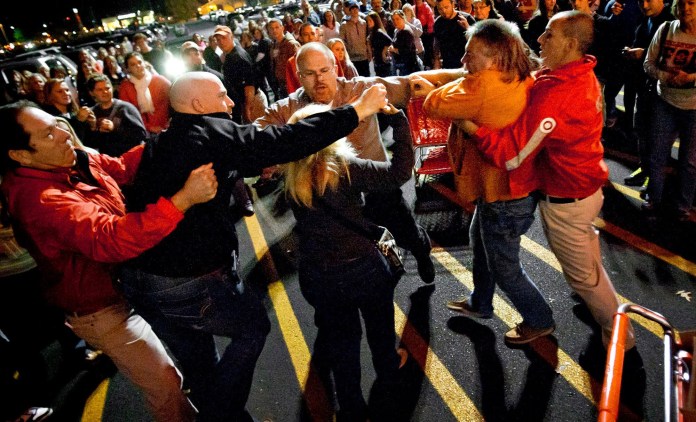
Here we sit, as the world burns around us, and lament the trivial, the inconsequential, the minutia. We fight over saving an extra 20 percent in the Target parking lot. black friday

I have come to the conclusion that we must secretly want it this way. Or we are lazy. Or we do not care. Or it is just easier to ignore it and focus on our first world problems, holiday plans, on the gifts we must buy. We do not really want to talk about it or do anything about it. We just want to complain about it for a hot minute and move on to the next thing.

We put a proverbial Band-Aid over it and hope it goes away?

Oh, you are probably wondering what “it” is. You want to define “it”? Fine, I suppose that is fair.  “It” is undefinable. “It” is everything, anything and nothing at the same time.

“It” is the topic of the day. “It” is immigration, race relations, religion, poverty, politics, international affairs and the economy. “It” is gun control, Hollywood celebrity culture, concussion protocols, domestic violence, locker room language and bullying.

“It” is how families communicate, nuclear and extended. “It” is marriage, divorce, parenting and children. “It” is our increasing reliance on technology. “It” is our jobs, our anxiety, and our fears, our obsessions with the material and immaterial of the world.

“It” is every little thing we deal with on a day-to-day basis.

Perhaps most of all, “it” is you.

Yes, you – the one who thinks I am writing to everyone else and doesn’t think that these (hopefully) thought provoking pieces of less than literary prowess over the past few years are directed at them.

It is directed at you.

It is also meant for me.

When my writing changed a few years ago, it was because the way I think changed and evolved. A funny thing happens as you age, you start paying attention to more than just box scores. You marry, have children and find yourself watching less SportsCenter. Why? Because in the grand scheme of things, it just doesn’t matter as much, while what we are doing to ourselves does as a society matters all that much more.

But a key realization occurred along the way: talking does little. Writing seems to do less. People do not want to hear about the ills of the world, much less so what they can do to improve it. We do quite a bit of talking in our public and private lives. Actually addressing “it” and finding real solutions is a much more difficult proposition.

And this is because we simply do not listen.

We hear, but we don’t listen. We can’t talk about anything that leads to a civilized, give-and-take discussion and solution, because mostly, we’re unwilling to budge on our positions, to meet others halfway. We react, we get angry, we get hostile. To most, an idea of a solution to any problem is agreeing that we are right. It is part ego, part vanity.

Devaluing the ideas, thoughts, and concerns of others while simultaneously self-promoting our own as fact and truth is as dangerous as it is foolish.

To most of us, we might recognize this, so we back-off. It is not worth the argument, the fight. We Band-Aid our lives for the sake of doing the dance. We won’t talk about “it” – whatever “it” happens to be, because all it will end in is hurt feelings, angry words and emotional outbursts.

So we bottle it all up inside, allowing it to take residence in our proverbial mental garbage bin of all the things we’ve ignored, swallowed and tried to forget over the years. These situations become like sticks of unlit dynamite.

And then, at some unknown point in the future, the most meaningless thing sets off the wick and we explode, looking like we need a straight-jacket and some prescription drugs.

We’re all a little crazy.

But that is because we allow ourselves to be. We think we’re saving face. We’re not. Clear and honest communication is a central part, but actually listening and being willing to bend, to meet in the middle on whatever “it” is would most likely serve us all well.

This much is true: if we agreed to disagree from the beginning and worked to a solution that neither feels entirely great about, but comfortable with, we might actually get somewhere in this world.

Our world view is significantly altered by the fact that I am me and you are you. We’re a country and world full of people with specifically engineered lives, with experiences vastly independent from one another.

We share the same period of time and space in this universe, but we experience that time and space in very different ways, which means we do not – and cannot – see the world the same way.

So why are we so surprised when people of opposing viewpoints and political parties, living in different cities, towns and regions, with entirely different life experiences disagree with us?

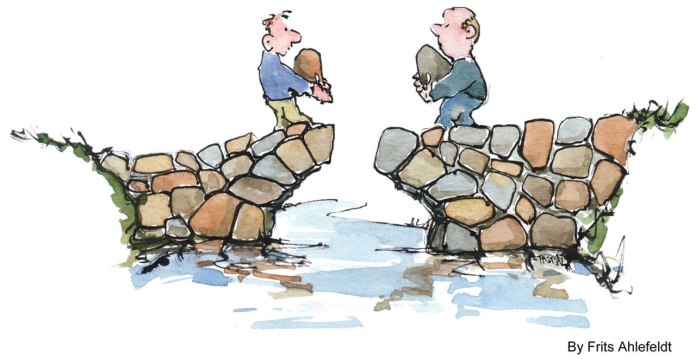
We will never agree on anything because not one of us looks at everything the same way. It is not about forcing someone else to see why they are wrong and you are right.On the contrary, it is an attempt to build a bridge toward the middle where you see where they are coming from.

bridge


That is problem solving. That is relationship management. That is how we were designed to interact. We are not all geniuses in all aspects of life and its infinite mysteries, nor are we complete morons, either. We’re a melting pot of races, religions, ethnicities, social, cultural and economic backgrounds.

We – READ: you and I – would be better off if this were not just a pipe dream, but something we actually exercised ourselves and taught to our children. You – yes, you – will be wrong sometimes. You will be right sometimes.

Sometimes, you might be either, neither or both.

The same goes for me, your parents, in-laws, children, their friends, teachers, your co-workers, the guy working construction and the lawyer on 5th Avenue, the President, Congress, Roger Goodell, Chris Rock and the waiter at your restaurant.

Be in the world, not above it. People are people, their problems are real because they experience them. Don’t shut them down. When we refuse to grow, we refuse to change – and change is largely inevitable. Growth is good. Sticking to your old habits, beliefs and traditions is not necessarily something to be proud of.

So this holiday season, start a new tradition.

Try.

Try to be honest. Try to be kind.

Try to avoid the Social Media tar pits that cannot be one. Try not to take the bait. Try to understand there are people who do not have food, shelter or friends.

Try to not be too swayed – or angry – with those seeking your vote, your money, your donations and your time. Try to give back a little more than you take.

Try to understand the other side, someone else’s perspective as best you can. Try not to shut down or shut out. Try open minded. Try accepting what you can.

I don’t think you should necessarily succumb to the world, give in to all opposing views and beliefs and acknowledge they are somehow right. But the world is not going to fully come your direction, either.

Try to build a bridge.

At least your half of “it,” anyway.

Standard
American culture, Life, Logic, Philosophy, Politics, Uncategorized

Upshot with a Downside

And….it just happened.

Another one of those, check yourself before you wreck yourself moments in modern day America.

dunce-capThe New York Times announced yesterday a new site, Upshot, which will essentially explain how to read the news that you, um, well…read. Aside from the whole Globo Gym vibe, what’s not to like, right?

According to their statement, Upshot believes many people do not understand the news as much as they would like [read: apparently we’re idiots]. We want to grasp big, complicated stories – like Obamacare, inequality, political campaigns, real estate and stock markets, but we’re just incapable of doing so, they say.

So the good folks at the totally cool, non-egotistical Times are going to help us all out in order to allow us the privilege of carrying on a conversation with family, friends and co-workers.

Sweet! Thanks, NYT!

Syrup-y sarcasm aside, I do see one reason to do something like this. We’re in the midst of a golden age of data. We’ve got data about data about how we react to data. Sites like FiveThirtyEight are giving us charts, numbers and graphs about all kinds of trends in science, economics, education, politics and sports.

If you truly want to know the numbers behind something – anything – now is your time to bask in the knowledge those numbers exist in droves. The only problem is we cannot keep up.

Before we can comprehend and understand something, there is a new hot topic just waiting to be data-driven into your newsfeeds and give you a headache – to which the data totally will tell you how many Tylenol you should take depending on the placement, angle and duration of said headache.

But there is another problem with the age of information – or several.

Do we need it? I mean, ALL of it? What are we doing with all this newfound information? And how can this education compete with our other obsession? You know, the one where we are celebrity-crazed and self-serving our own interests?

getty460x276Case in point: suppose the data told you that social media was awful for you, would you quit? Or that HBO programming was written to promote a set of Illuminati based ideals? Or what if they said it is unhealthy to have more than 150 friends on Facebook?

What if some set of analysis told us that all of this was trivial and meaningless?

Or how about this one: say some information is unearthed that proves we were better off emotionally in the 1830s, 1950s or 1980s and that all this technology, this rapidly evolving world is actually hindering our enjoyment of life?

Data talks, but we don’t always have to listen, right?

Over the past few years, I’ve been accused of perhaps being a bit too idealist. Generally speaking, I can understand why.

Nowadays, you cannot be too positive. It does not jive with the vibe. Anger, resentment, hostility bring reaction. And as Scott Van Pelt of ESPN said recently on his radio show, about Toronto mayor Rob Ford, it serves as no better proof that the best thing to be is famous, because it brings a reaction.

And we react the most to this culture of celebrity and negativity. Whoever is stirring the pot doesn’t matter as much the fact that we allow it to be stirred.

Which is entirely the reason why writing like this doesn’t get a push for eyeballs from The New York Times or Grantland: it’s not the trending, data-driven, analytical pieces being devoured and shared. Nobody wants to read it, they say.

By no means am I lamenting my status or place in this wired, literary world.

In fact, I am quite content with leaving these pieces for some future generation to unearth : “Look at this guy, it was like he time-traveled 60 years into the future and tried to convince people to proceed with caution and appealed to their common sense and values! What a maroon – those people needed Upshot to explain the news for crying out loud!

The truth is, it is a wired world – and it’s hard to get by with a smile. (Thanks to Cat Stevens for the inspiration to that hokey line.) Regardless, it remains: positivity at best seems to sell a product. Tony Robbins and quite a few out there make a good living encouraging others to stay positive.

That has never been the point of this, though.

Our contributions to society at large, to life in general, do not have to be based on a data set, or be outwardly public and self-serving.

We continue to do ourselves an injustice by ignoring the tipping point, you know, the one where we are farther and farther removed from the crux of our core values. But those are not punch lines, they should not be used as psychological tools.

In the film, The American President, Michael Douglas’ character, Andrew Shepherd has a great retort about how you win elections:

“You gather a group of middle-aged, middle-class, middle-income voters, who remember with longing an easier time, and you talk to them about family and American values and character.”

The response was intended to vilify the opponent who had gone on personal attacks against him, or to address the general perception of American politics in the 1990s and winning elections – which is still very much true today.

But the stark reality is what was missed in that quote, which is that there is truth in it. On some level, it is indeed what people are looking for. It is what might win elections because it is what people actually want: A time where things moved just a shade slower, trusted easier, worried less.

Values and character are not ideals to be strived for, but instead to be lived. They are proven through prudence, rationality, frugality, respect and pragmatism. In short, none of the things we truly are currently in society as a whole.

We assume that all this information will lend us a greater understanding or perspective on any number of topics, certainly of humanity and our role on this planet. It will not, because in some way, the message of Upshot is true: we do not understand everything. We cannot.

We were never probably meant to.

But what we can do is use this data and information to better ourselves. And if we are able to accomplish that, to make our lives better individually, then we’ll gradually make this world a better place, too.

Now that’s an upshot with no downside.

Standard
American People., Democrats, faith, Politics, Republicans, United States

The Responsibility of Today


To what do we actually owe one another? To what do we owe the future? What is each person’s responsibility to each other? Is it financial? Is it goodwill? Is it a combination of the two?

Are we not a family, this nation? Something must elicit our national sense of duty and pride. Some sense of self-sacrifice, yet an individual responsibility to maintain our own identity, our own burdens.

Just as in a family, some things we share. Some things are mine, some are yours and some are ours. What we often disagree most about in this country is what you should share with me. The other side is always the one trying to take from you or not giving enough in return.

We’ve lost our ability to communicate. We’ve lost our ability to tell the truth and be honest.

Truth remains absent from our national vocabulary. Whether it is out of fear of truth getting out, telling it outright or the fear of what people will do with it, the truth is often hidden from the public eye.

While I am firmly on one side of the political spectrum and long ago made up my mind on which candidate I will cast a vote for, it is apparent that the interpretation of what is true and correct varies greatly across the political landscape.

For example, we cannot erase our national debt without both cutting spending and raising taxes. It is disingenuous to suggest otherwise. Many corporate CEOs have come out recently to state the same thing. This isn’t a partisan issue, it’s an American issue.

This is not just a slogan or a tagline about making the nation better for our children and their children. This is becoming about survival. We cannot continue to loan money out to everyone under the sun, borrow money from China and overspend at home without the truth and reality that it will destroy us.

If the goal is to do what is right, then, as Mark Bertonlini of Aetna and the other aforementioned CEOs mentioned this week, any fiscal plans must include tax reform and limiting the growth of health-care spending.

But Republicans don’t want to raise taxes on anyone, while Democrats want to raise taxes on the wealthiest Americans and don’t want to raise taxes on just the middle class or limit the growth of federal health care spending.

Yet no one wants to discuss the silent truth that limiting all spending and increasing taxes across the board, or broadening the base, is the only way we can begin to address the debt crisis head on.

The simple truth is you cannot tax just the wealthiest two percent of Americans in order to eliminate our deficit. It is not just the wealthy and rich that will see their taxes increase, as there aren’t enough wealthy people to tax at a high enough rate.

Yet we hear no discussion about what this must mean to the middle class and their taxes. Why? Because it loses voters, of course. And this is the problem: no one is being honest about this crisis, especially not during an election. Frankly, it’s unpopular at any time to discuss raising taxes, most especially on the middle class.

We fail to see our own hypocrisy on this. As President Abraham Lincoln once said, “You cannot escape the responsibility of tomorrow by evading it today.”

To put it bluntly, we’ve reached a point that even taxing all income classes won’t offset the spending.

If finances are tight at home, we don’t spend as much on eating dinner out at a restaurant, or trips to the zoo, or random toys for our children or on their Christmas presents. This is essentially a tax on them. Children are the middle class of the American family. Because leadership overspent, they must deal with the fallout.

It doesn’t mean its fair. But it doesn’t mean it’s not true, either.

What most parents don’t do in that situation is even after raising “taxes” on our children do we continue to spend what we always spent on our own non-essentials. Yet this is what our government will do. We’ll raise taxes on one class, or another, or all, then continue to spend, spend, spend beyond what we’re taking in.

Then again, with issues such as these and so many others, what do we really expect from our leaders? And what should we expect when we exhibit the same poor behavior ourselves, from lack of restraint to being close minded?

We lack the discipline and faith to accomplish our goals. We lack the fortitude to actually behave as we tell people we believe you should. In a way, we should stop blaming politicians and elected officials. They are simply mirroring how we act. They are us. And until we can change ourselves, we can never expect more from them.

Yet this topic is often too difficult or logical for many to have. Asking people to be reflective on their own thoughts and actions is a challenging proposition. Even now, those who read this will believe this is about others, not them. No, this is about you. It’s certainly about me and my own imperfections.

Judging others is easy; labeling people just as simple. Someone cuts you off in traffic, then by all means, give them the finger. How dare they infringe on you and where you are going. Speaking of traffic, is your work commute slow? Blame slow drivers and construction or the weather, because nothing on earth is more important than where you are going.

If your child is failing in school, it must be the teacher’s fault. Not getting that promotion at work, then you should certainly lash out at co-workers, cop an attitude and represent yourself poorly to prove a point.

We’re a critical bunch without ever critiquing ourselves. We’re defensive and protective of our individualities.

Everything is about us. How we are wronged, how we are affected and affected. The greater good only matters if we’re included in that greater good.

How can we expect more from others than we do from ourselves?

Far too often, we let the media dictate what we’re told. And what we hear is often the greatest distortion.

In the 24-7 news cycle and the era of sound bites, words and twisted and manipulated and misconstrued all for the sake of crafting a presentation of what the host or channel wants you to hear. We’re in a dangerous time with the medium of mass media. Straight journalism, reporting, is overwhelming marred and skewed by opinion disguised as fact.

It is a moral hazard to use and twist people’s words into your own, add in descriptive adjectives and repackage it for an impressionable audience. Yet this occurs every minute on MSNBC, FOX and CNN.

Men like Lincoln, Jefferson, and probably both Roosevelts would never be elected today. Lincoln would be called a flip-flopper, indecisive and an extremist.

But have you ever changed your stance? None of us can possibly say that on every topic and issue under the sun we’ve remained unchanged over time. New information and experiences exist. We get older. Our circumstances change. Our opinions are ever-forming and ever-changing – at least they should be.

A lighter example of this was when, as a sports writer, I routinely attacked Peyton Manning. I didn’t like his approach to his teammates, his famous Manning Face and his failure to lead his team in the playoffs to more wins or accept his share of the blame in losses.

Then, one year, he played a spectacular season with a badly injured knee. On top of that, he was humble; keeping stories about all the procedures he received on the knee out of the media. He owned his failures and shared credit. To this day, I don’t know if I was always wrong or if he ever changed or I did, but my opinion changed.

Basically, because life and events are evolving, so should be our opinions and our stances. However, our values and our faith should always remain. Faith is a funny thing, another difficult proposition to discuss. Faith is not religion. Religion is man’s creation, in all its interpretations and variety.

This is just my own understanding of faith. Most would argue faith is deeply connected to religion, and in many cases, I suppose this to be true. However, I have faith in my wife. It is a belief and a trust. I have faith in my children, my family and friends and even faith in some (but not all) of my abilities. I have faith in my favorite sports teams (doesn’t always work out so well).

Faith does not have to be the absence of logic; on the contrary, they can work hand-in-hand.

It is therefore that I would argue that this is not a call for blind faith or religious faith, but faith in each other. That we still have time to change, that we still have time for a grassroots effort of building back up the guiding principles we were founded upon.

We rebuild, we educate ourselves on what we do not know, we work together, and we put aside bitterness.

Politically, there are few who are not supportive of the Constitution or the Bill of Rights. That’s our starting point. Socially, we begin to pull back the reins on the “me-first” attitude. That’s not your parking spot. Everyone else is trying to get to work, too.

It cannot be stressed enough that this begins with us. We are the people in “We The People.” We do not necessarily need to speak in a unified voice to be heard, but we must speak all the same. What is right and just never changes, it just wears different clothing. It’s permissible for us to debate, to stand up for what we believe, while also expressing openness for others to do the same.

The truth is, if we do not change our attitudes, our hearts and minds remain locked away and our resentment and anger builds. This will only lead to failure.

We are a nation divided, not only politically, but socially as well. This has been growing for some time. It is time move on from our division and seek solutions in the facts, in real truth and in moving away from the selfishness that has guided us as individuals for too long.

This is the responsibility of today and we cannot put it off until tomorrow.

Standard