belief, Logic, Parenting, Philosophy, Religion, Santa Claus

Believably Unbelievable

Another calendar year has nearly come and gone. 

We’re facing “The Holidays” again, left wondering where 2013 went and feeling like spring or summer was just last week when it was months ago.
The reminders of the passage of time are all around us, constant notifications that the world continues to press on, whether we want it to or not. And we’re constantly battling the notion we may be missing the good stuff.
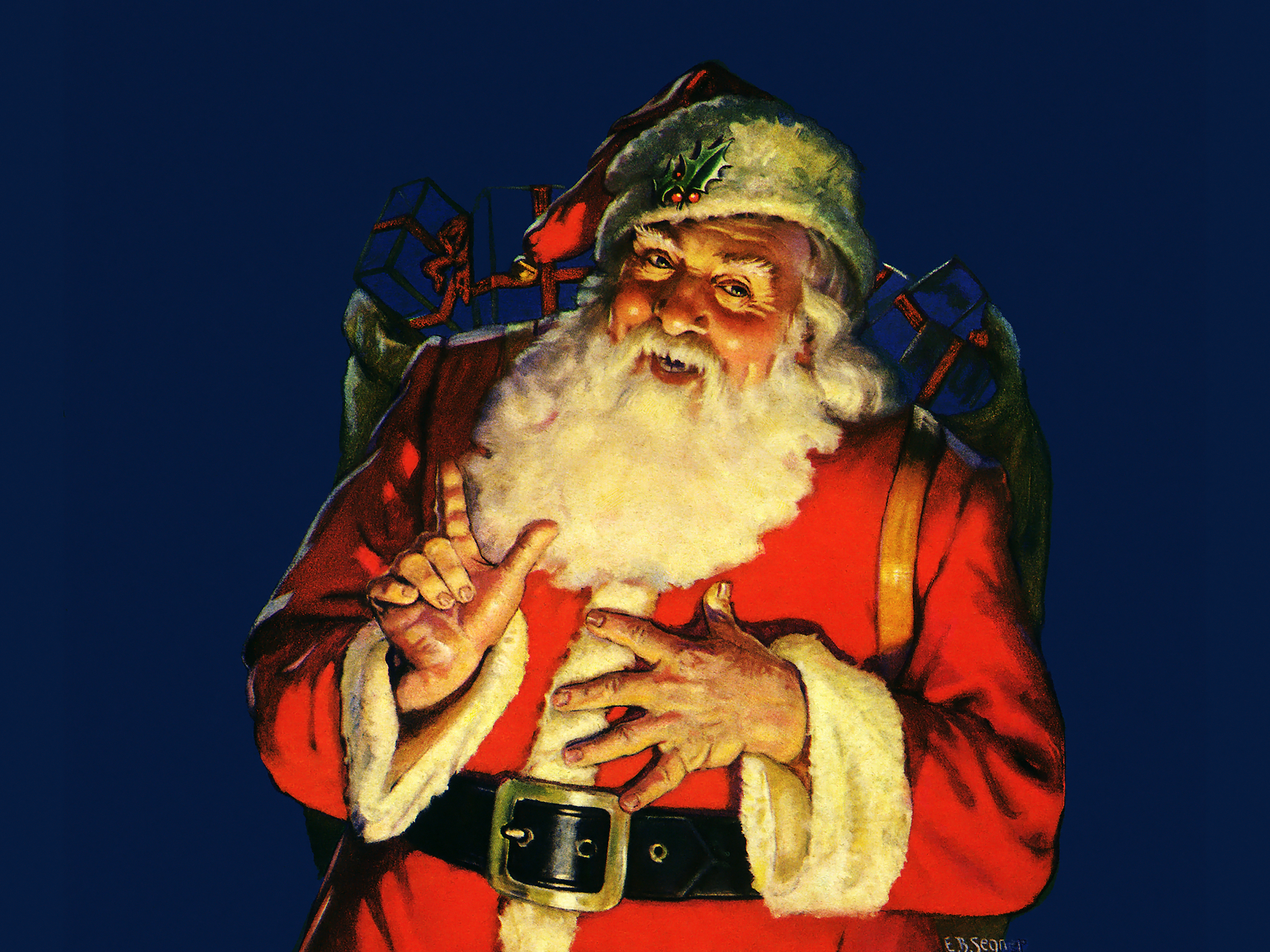
My most recent encounter with this came earlier this week, when my family renewed a family tradition of watching Christmas movies, like “The Santa Clause.”
And as my seven-year-old daughter climbed into my lap, the scene near the beginning that is the crux of this enjoyable farce hit home: the conversation about whether Santa Claus is real between Charlie and, and…Tim Taylor, er, Tim Allen – wait, I’ve got it – Scott Calvin.

Our children haven’t asked us about Santa being real yet, really, just like they haven’t asked about Jesus or heaven being real. 

That is not meant to combine the two onto some equal ground, mind you, but to merely point out the association of belief in something you cannot see. 
So many logical, rational and data-driven people will tell you it is dangerous to foster notions of a fat man in a suit taking presents to every child in the world that’s been good in one night, just the same as many non-Christians or atheists question the legitimacy of Jesus – from conception to birth to death. 
Now I’m not looking to turn this into a religious forum, it is not my job to judge beliefs one way or the other against my own. Everyone is entitled to an opinion. 

But belief is simply an opinion with conviction, and some choose to back up their beliefs, convictions and opinions with facts. Others with emotion. Belief is just an acceptance of something as truth or factual – with a heavy dose of perception of what we allow ourselves to emotionally accept as true or fact. 
We use facts, pictures, models, graphs and statistics to prove what we want others to believe, but in our world, belief is an emotion, a feeling.
You can show me all kinds of numbers on why Android is better than Apple, or vice versa. All it comes down to is what I like, what I think once I use both products. We can argue over politics, but that’s as much belief and emotion as anything else. We try to use facts and figures there as well. We even break down human relationships to statistics and figures, qualities, advantages and disadvantages.
But what about what we cannot explain? Why someone lives or dies through an ordeal? How certain events have inexpiable outcomes, how they defy logic and science and physics? What makes you happy and sad?
Research has found that the brain is sensitive to any form of belief that improves the chances of survival. Just like that, we have our answer for why we love, why we believe in God – or do not – and for the purposes of this prose, why we choose to allow our children to believe in Santa.
It’s an idea, more than an actual person. Does Santa exist? I don’t know

But neither do you.
Perhaps he did hundreds of years ago, like any legend, and simply delivered toys one year to the children of some small village. 
We often say that when people pass on, they are in a better place. We do this for a variety of reasons. Perhaps we believe it, perhaps we’re saying it to someone for comfort. Is that true? I don’t know. But it brings us some sense of peace all the same.
So is allowing your children to believe in such an idea detrimental? I don’t know

But neither do you.
It can foster vivid creativity, as the pure imagination of what happens in the early hours of December 25 runs wild. If at any time you believed in Santa as a child, just think of the mental images and scenarios your mind envisioned. 

Again, this is not endorsing Santa Claus the person, more explaining the idea that allowing belief is a good thing.
We truly don’t know what happens when we die. There is no absolute fact because no statistics, figures or images can support it for us. But the belief or lack of belief in religion, in mythical holiday figures, is more or less a coping mechanism in our brains for just how big and unknown the world is. It would be quite difficult to deal with the vastness or mystery of it all if we did not cope through belief.
For some, enjoyment and peace in life can be found in believing in a reason, a higher power. For others, not believing explains a chaotic theory of life. Either way, the person has chosen that path as a way to believe in the purpose of their own existence.
Life is an emotion, a sensation, really – that has no explanation. There may be all kinds of statistics, but those statistics are just numbers really, not people.
For the logical, Santa Claus is as much a farce as creation, as believing in miracles. For this group, for example, saw the end of the Auburn-Alabama game last week as merely the end of a sequence of statistics that led to a low probability that occurred given the right set of circumstances. In fact, the probability was .007%. 
For the emotive, it was a game won out of belief, out of some special moment that occurred because of want, need, desire. And belief.
It really comes down to choice: what you choose to believe – but believing in something, all the same.
As a man, built on gut reactions, emotions and feelings, I see the creativity, the vivid imagination of my children, who currently believe in Santa Claus, who can see heaven in their minds and think Disney World exists in the sky (because we take off on an airplane and land there) and I believe that these are the kinds of children who might grow up to do something really cool.
I don’t know if that means cool as in changing the world cool. 

But neither do you.

At the very least, if allowing the perception or the belief that such a figure exists fosters special neurons in their brains to fire that spark imagination and creativity, then I am personally fine with that. Even after they stop believing in that figure, those neurons and synapses will still continue firing, still dreaming, still creating. Because they believe such things could exist. 

This is how you create. And creating is good.

It’s the step that happens before all those statistics showing how effective or ineffective the creation was. And when you create something, it has to be believed before it’s seen.
Funny how that works.
Seeing isn’t believing.
Believing is seeing.
And perfectly fine for you and your kids if it happens to be a large old man in a red velvet suit who squeezes down chimneys, eats cookies, never finishes the milk and reverse burglarizes your overly decorated home on a secular holiday.
Just go with it.

Before another year passes and you miss out on all the good stuff. 


Standard
Life, opportunity, Philosophy, positive thinking, resolve

The Life in Little Spaces

Last week, a dear friend of mine texted me with a heartfelt request: please write something light-hearted and fun.
When was the last time you wrote something fun? I like your writing, always have and you know that, but it is so serious. I worry people will think you are depressed.”
I thought on that for a bit. I can see his point. I shuffled through this blog and found that even when I thought I was being light, I was still being heavy in tone and message.
And for the past week, I’ve been searching for something, anything, that I can write about that would be fun, fluffy and less “on-edge.”
But I cannot do it; at least not at this moment.
I am not depressed. I’m actually quite happy. I suppose if you want funny, try The Onion – uh, at least the online version anyway. I enjoy comedy and humor. I can’t wait for Anchorman 2, and the clips of the British gentleman arguing about Michael Caine impressions crack me up.
But perhaps I’ve changed.
My writing comes from a place of inspiration and motivation, which is where I think I should probably be spending the majority of my time – inspired and motivated. And I am inspired and motivated by very little: just to change the world and make it a less selfish, self-serving place, with less complaining and more enjoyment, where people interact positively and attempt to do good.
I wish I could blame this on my kids and say that being a father changed me. It did, in so many wonderfully challenging ways, but my wife and I had children long before my mindset changed. For better or worse, this is my voice now. I am compelled, not out of a belief or right and wrong, but because it feels like a calling, a destiny.
And as the great voice of our times, Ke$ha, once said, we are who are.
Someone of perhaps equal importance from the past, some dude named Gandhi, once said your values become your destiny.
I cannot speak for anyone’s values but my own. Values come from what we believe, which is really just opinion. And we all opine. Life is opinion and simply a matter of perspective.
And it can change if you allow it, from a number of different sources – which is the beauty of life. It could be a movie, a song, an event. Death has a way of putting life in perspective. Loss often affects us more than any gain. Loss accomplishes what we should have known and appreciated all along – that we had it but did not realize it.
What holds us back? Simply stated, us.
There is really no difference between you and those you would deem as accomplished outside of perseverance, motivation and belief. The problem is, those are increasingly hard to come by. They cannot be bought – though we certainly try in a variety of ways – through books, speakers, events, inspirational videos and the like.

Yet all that is temporary and fleeting. Longer term, only we can build the path we seek. It doesn’t come to us, wrapped like a Christmas present.

Success in a box? For me? Why, you shouldn’t have.

Life is our gift, yet we are constantly looking for a gift receipt. We’re looking for discounts and sales, return policies and guarantees in life, in relationships.
One day, someday, wishing, hoping – none invoke any amount of self-resolve needed to define life your terms.
Negativity breeds, infects and spreads. Ignore it, get away from it. Laugh at it. Do something to remove yourself from it and the negativity of the world.
I’ve come to understand it is the stuff we don’t think matters that we actually think matters. Just look at your social media feeds. Your own timeline and those of your friends will tell you everything you need to know about what your focus is on.
Life occurs in the space between the spaces. Too esoteric? What I mean is you will find your values, your truths and beliefs in the moments between moments.
Who are you when no one is looking? Do you take pride in keeping yourself well-presented, not for others, but for you? Do you hold the elevator? Let the car waiting in during a traffic jam? Do the dishes at someone else’s house? Look people in the eye? Are you honest, yet reserved with how brutal and hurtful that honesty can be? Do you show tact and general decorum? Take your shoes off when entering someone’s home? Call instead of text?
You see, those moments, and thousands more like them occur on a daily basis and we miss our real opportunities to make an impact in the world or to show who we really are. We’re stuck thinking it’s these big, life-defining events that display who we are. On the contrary, we define our own lives in the seemingly insignificant moments in between those moments.
If the world feels like it’s attacking you, putting you down and betraying you, then you ought to be proud. Don’t be like the world – we already say it’s messed up enough, so why would you want to fall in line with it?
Therefore, I’ll keep writing about what motivates me, without compensation, because no one needs to pay me to be who I am.
As for the humor, well, I suppose I can work on that, too. Come to think of it, my voice impressions are pretty good.
Perhaps I’ve just became more interested in making an impression than doing one.


Standard
children, Life, Philosophy

Life’s Tough, Forget the Helmet

It is difficult to identify when it all began. Was it a slow progression, or just a band-aid like effect? Were we intentional about it, or was it just a subconscious social switch?
Whatever the case may be, we have become weak as individuals, which make us weak as a society.
I think I’ve noticed signs for some time, but the biggest was when several, if not all, of our surrounding communities postponed Halloween trick-or-treating this year due to an expected heavy rain storm.
While this is not intended to be a political statement or commentary on the towns and cities that made the decision, it is what it is. I’m certain the town and city councils or members of governing bodies who make such decisions did their due diligence and determined it was best for the children to stay out of the elements.
So this conjecture I have about weakness is not based just off one incident, yet instead serves as a microcosm of a bigger argument.
My wife and I looked at each other just downright confused. We waxed nostalgic about how “back in my day” we’d have put on a coat and got ourselves some candy. I’ve worn a mask in 80-degree heat and gone trick-or-treating with a winter coat due to flurries.
There are other indications, too. The helmets, knee pads, thigh pads, elbow guards and mouthpieces children are now recommended to wear riding a bicycle is a good one. Yeah, uh, I learned to ride my bike in the country. We had a gravel road and no concrete. Needless to say, I bled.
And my father, as kind as he is and was, looked at me and simply said, “How bad do you want to learn to ride that bike?” His point: it’s going to take some effort and some education.
My first basketball court was on dirt. The ball went through the basket and hit the ground – and pretty much stayed there. You had to pound the rock to dribble more than twice. And with enough use, the dirt court became a clay court.
How bad do you want it?
We drink water from bottles, which is still somewhat absurd and probably will be to me forever. We use gallons of sanitizer to protect us from spreading germs, but we seem to be sicker, longer, with a common cold than we used to be.
As a father of four, I certainly wanted people to wash their hands before holding my child as a baby. And I’m not so tough that a good Disney themed band-aid isn’t useful when it’s actually unnecessary. Like, there’s not even a scratch there unnecessary.
But aren’t we taking it all a bit too far? It seems strange considering we’re regressing in so many other areas – like general decency and kindness – but we’ve coddled ourselves and our children to the brink of crippling ourselves, and worst of all – them.
My wife and I play with our kids a lot, but we also tend to kind of let them go. Short of intruding on someone’s personal space or property, I’d prefer to let them learn and imagine. And, if it happens, get a little bump now and then.
Because that’s life.
It’s not all giggles and sunshine and 15 popsicles in an hour. They are going to get hurt in some sort of fashion and I don’t want them reacting thinking that the world has ended if they do.
We’ve made strides that will help them learn from our mistakes. Concussion testing, disease prevention, merging biology and technology, education and new information about the way children learn and what they learn are all moving us forward to a new age and one filled with opportunities.
But on the opposite side, we’re quickly ripping those opportunities away with over-protection. I want them protected and safe at school, at airports, in the home. I don’t want them terrified of engaging in life and trying new things.
It’s a delicate balance that we constantly struggle with. Do we hold them and tell them it will be alright? Or do we look at them and tell them to get up and get moving again? Studies have indicated that we should probably be doing more of the latter.
College-age students are increasingly showing signs of social anxiety – most likely (and this is an assumption) tied to coddling and to the increased use of texting and social media as the main channel for which relationships are formed or maintained.
This protection comes from wanting the best for our children, no doubt. To have it better than we did. But the graph doesn’t just go up for quality of life because time passes and we enter new decades or that the present is what we once thought of the future. We’re operating under the assumption that everything is continuously improving.
That’s just not the case. There may be more and more of everything available to us, but it cannot replace or duplicate simple values, rules and ethics that are basically self-taught.
No matter how much pain or discomfort there is, parents cannot go to a middle school dance and make everyone be nice. They can’t be there on the playground during recess. They cannot be on the field of play. And they can’t be there when a job becomes stressful or you’re working to find balance between family and a job.
It’s called growing up for a reason: it implies that you are moving upward, which is a universal sign of increasing something. In the general context, it’s education. It’s maturity. It’s becoming aware of what is socially acceptable, of the unwritten rules of our culture. It’s find out what the individual values are and how they relate to the community values around them.
And it doesn’t stop. It continues well past the age of 18 or 25. We are always learning and re-evaluating and re-applying until the very end of life. There is no manual, no how-to. Only opinion.
Which is why I’ve formed this one: we are unaware of the fact that we are becoming weaker. We don’t want the right things bad enough to risk failing or damage. We only see the possible pain – not the growth that comes after that moment or what we will learn about ourselves in either succeeding or failing.
Yoda was right. Do or do not. There is no try. The problem is, we are reaching a point where we don’t even try. We just expect someone to give it to us or to help us – we’re teaching ourselves and our children to work the systems to benefit them at every angle.
And yes, in some ways, this ties back to moving a holiday because the weather was a little wet, windy and cool.
Worried about catching a cold? Put on a coat. Frantic about a test? Study for it. Nervous about what someone might say? Ask.
There’s an old saying about prevent defense in football – it prevents you from winning. As a country, our culture has shifted into a prevent defense mode. If all the elements aren’t lined up and perfect, we pull back.
We are preventing ourselves from winning the game of life. We are preventing our children from accomplishing all the things we dream of and for them, setting up so many guardrails and safety nets that there’s little risk.
But the greater the risk, the greater the reward. Better still, the better the character and resolve.
Sometimes, the only road to ride on is gravel and you don’t have a helmet.

How bad do you want it? 
Standard
Life, passage of time, Philosophy

In the Here & Now

Except the ticking of the clock, there are constant reminders that life is ever-constant, always changing, moving. 
As time marches on, I become more evident of it, more appreciative, more selective. 
There was the conversation where my wife and I realized our oldest son is now the same age her youngest brother was when we met and started dating. It was a discussion about Halloween costumes and how he might not dress up this year. 
That didn’t seem right, not because a sixth grader might not want to dress up – but just that we were at a point of time in his life where it was even a discussion. 
Our youngest son, and youngest child, is a precocious two-year-old and loves Scooby-Doo. So did his five-year-old brother and his seven-year-old sister. And by the end of next Thursday night, all will have worn the same Scooby-Doo costume for Halloween. 
Moments like this present themselves numerous times a day or week, specific and unique to all of us, but somehow still shared. That radio station playing a “classic” song that you remember as a new release. Ever look down at your phone and just get amazed that you’re even holding such a device?
Maybe it is just me. 
It is within our shared recollections where we probably notice it the most. Next month marks the 50th anniversary of the death of JFK. Bob Knight just turned 72. Michael Jordan is 50. 
That is when you find yourself looking around a bit more. You see the lines on your parents faces. You hear your son’s voice deepening, seemingly by day. You feel it when you first wake up in the morning, with every joint popping as you slowly get out of bed.
And you wonder, where is the time going? Like a dream, memories mount over time, but jumble together into a haze. When your five-year-old puts on a pair of cowboy boots, you recall the ones you donned in 1985. You think of the grandfather who gave them to you and how long it’s been since his passing. Memories take form in Instagram-like filters. I can see my childhood house, but the color looks like an old, not fully developed Polaroid. 

So we shake our heads, and simply ponder life for a bit. Where did the time go?
The answer is simple. 

Where it’s always gone, at the same exact pace it’s always moved. 
And you realize: this is life. Just let it sink in for a fleeting moment.

Life is watching your wife play a superhero, building a business out of motivation and passion, while multitasking 402 everyday things like homework, practice, laundry, groceries and random tasks that each day bring. Life is finding the time to steal a kiss hello or goodbye. Life is off to the races, happening in one hundred different places. 
It’s hearing your mother cry as she struggles with the toll that Alzheimer’s has taken on your grandmother. Life is being speechless, because there are no words. It is fear that you won’t know what to say the next time you see her. Or if she’ll remember you at all.
Life is seeing your child learn to read, your entire family bow their heads in prayer and read a passage from the Bible each night. It’s hearing a teacher tell you your son has been kind and compassionate, taking time at recess and in class to spend it with children who have autism and being overcome with busting pride to the point of tears. 

It’s the crisp air of fall, of picking pumpkins and baking seeds. It’s wrapping presents for your kids and playing Santa. Life is everything happening to you and around you. And it can be overwhelming trying to figure out a place in it, or how everything is effected and affected by every decision, no matter how small, that you make.

Life will go on, as it always has, at the same speed it always does. 
As the popular quote goes, when it’s over, it isn’t the dates and years of birth and death that matter. It’s that little dash in between.
That dash is life for not just you, but for everyone else in your particular life.
That dash is every Sunday morning making pancakes, every night one or all of your children end up in your bed. It’s late nights watching baseball games and sitting in traffic for 45 minutes to get to work. It’s summer vacations as a kid, break-ups and make-ups. It’s bad decisions and a clean slate. 

That dash represents every breakthrough, every smile, every tear. Every moment of anxiety, of dread, of panic, of laughter you’ll ever have.  The good and the bad, the friends you have and the ones who’ve fallen out of touch. 
Because when everyone sees that dash, it will inevitably invoke some memory or meaning. And we are remembered not for the hours worked or the production of our days, but considerably more for how we made everyone in our life feel.

Life is emotion – and in some cases, lack thereof. And that dash represents every time you smiled at someone who frowned. Every time you called and just left a quick “thinking of you” message for a friend. 

The dash is flowers for no reason, an extra hug and kiss goodbye, every “great job, I’m proud of you” spoken to eyes searching for approval. It’s held doors, holding hands, making time when you really believed there wasn’t. It’s leaving a little extra tip at dinner, going ahead and having the ice cream. It’s the extra mile you ran to get rid of the ice cream so you could be around longer. 
Time stops for no one. But the truth is that realization should bring some sense of comfort, make it easier, not harder. We can’t get any of this moment back. So worrying about what cannot be controlled, which is everything that happened to this point, is fruitless. It cannot be changed. 

And it means that the future, which hasn’t happened yet, cannot really be controlled. So that deadline at work, while important, in proper perspective, is just a blip. There will be another. And another. 
Thus, your life, your dash, becomes more about how you choose to spend it and the manner in which you spend it. Because it will be spent. This moment right now is the only thing that matters. 
Life is fickle, and it doesn’t promise answers or reasons. The more tightly we squeeze it, the less grip we have. 
So ease up. Take the time to take your time. Laugh, smile, cry, learn, love. Live your dash and make sure your dash holds as much meaning as it possibly can. 
If there were ever a time to embrace, engage and just be you, well, the here and now is better than never. Everything is both starting and ending simultaneously. 

Find that little dash in between the beginning and end of everything, because in that moment, that is where life happens.
Time can do everything but turn back, meaning we never get another chance to be in this moment. Don’t trap yourself in the past or engage solely in planning for the future. 
Because now is where you are, and if you waste it in the before and after, you miss what is. 

Life.
Standard