amateur athletics, Conference realignment, Jay Bilas, Johnny Manziel, NCAA, PEDs, TV

50 Shades of Green

Pop quiz, hotshot: which is worse: the PED plague taking over sports, or the seedy underbelly of amateur athletics? Which blows up sports first? What do we do?
(Bonus points for anyone who correctly guessed the Speed reference.)
In one corner, we’ve got doubt casting a long and eerie shadow over pretty much every sports feat we’ve witnessed over the past…past…what? That even makes this performance enhancing drugs business even more difficult to process. How long have we been living under a rock at the magnitude of this epidemic?
In the other corner, we’ve got athletes selling conference championship rings, signing memorabilia for cash and taking duffle bags of dough from agents. Again, the question of when this became more than an anomaly is vague as well, but I remember seeing Johnny Be Good, any despite immediately knowing it was a terrible movie, had a sinking feeling that recruitment of a high school athlete could indeed be that shady and lacking any moral regard.
For either issue, the how and when don’t really matter all that much. It’s more telling to focus on the why. Why do athletes take PEDs? Why do people prey on young athletes with a carrot of cash? Why are athletes dumb enough to take either when they know the rules?
And the answer lies in the green the runs the entire operation. It’s bigger than any system, bigger than any person. And if we learned anything from Oliver Stone and Michael Douglas is that money never sleeps. 
It’s a person’s desire to live a life different than a normal person. The same reason some people play the lottery – the want of more. But rarely can people tell you why, or at the very least keep answering why’s until they get to the root of it all.
As time has passed, because we don’t address either in a fully comprehensive manner, it has manifested and multiplied into this current state, slowly eating away at the fabric of sports, and in many ways, our culture.
People want to win. It’s why we keep score. But we’ve always acknowledged in life and in sports when it’s done the right way. When that started to change was when someone discovered you could win without doing things the right way – with shortcuts. We establish rules because they allow us to go fast. Think of brakes on a car in the same manner – they allow you to go fast, safely, with the idea that using them when needed prevents danger from becoming a reality.
This logic is the backbone of nearly everything we do. It’s there because 98 percent of us don’t need the rules to tell us what is acceptable and what isn’t, but rather to protect our hard work and honesty from the 2 percent that do not follow the rules.
And over time, in sports and in life, we’ve needed to add more rules because more and more people have lost that navigational compass – a conscious – that guides them along the way. But when you don’t address it, the problem gets worse. When you turn a blind eye instead of maintaining relevancy, you secure a future filled with less certainty and more chaos.
This is where athletes who get engaged in the use of PEDs find themselves. Caught in some fog of needles and pills. Is it right that the guy trying to take your spot might be taking PEDs and if you don’t, you’ll be cut or traded? No. Is it right for you to take them to gain a performance edge which allows you to get a raise and break records? To most, the answer is no.
But it is fair that your sport, for some reason, is targeted heavily while others remain blissfully passed over in the public eye? Again, no.
We cannot be naïve enough to believe that this has been largely limited to Major League Baseball, and if we are, there’s some oceanfront property in Utah I’d love to show you sometime. Then again, perhaps we’re not being naïve. Maybe we’ve just chosen this path, to stick our heads in the sand, for fear of what would happen to us trying to process that nothing is real anymore.
If we allow ourselves to start asking all the questions we should, it would require something that cannot be done: an alternate reality.
We already laugh when we’re told the 1992 and 1993 Fab Five teams didn’t make the NCAA Final Four. They did, and you can take down the banners and forbid them from school grounds, but it happened.
The same as if we’re to try wipe off McGwire, Sosa and Bonds juiced fingerprints off the home run records. We’re going to pretend Maris’ 61 still stands? Or what if we allow ourselves to wonder if a number of teams would have won a championship had a key player not been under the PED influence? Can it be wiped away? Did the Red Sox not win the 2004 World Series? The Yankees the 2009 title? Or would they? How can we know?
We begin entering some weird, strange reality where Doc Brown can’t even stop the space time continuum from being destroyed.
This state of chaos and confusion is also where the NCAA now finds itself. It’s been reduced to the media uncovering broken rules around eligibility and recruitment. It’s openly mocked in social media by a well respected former athlete turned lawyer turned intelligent analyst of college basketball, but really, so many things.
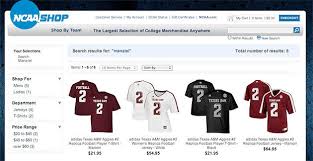
Yesterday, Jay Bilas pointed out the hypocrisy that has been occurring in the NCAA for quite some time. He tweeted screenshots of the official NCAA online store, that allows you to search the name of a player and actually displays matching results. So, if you type in Manziel, a Texas A&M #2 jersey comes up.
Ruh-roh.
To really drive the point home, the NCAA has repeatedly stated it does not make a profit off a player’s name or likeness. Which doesn’t pass the straight-face test at all considering when I play an NCAA football video game and there’s a right-handed QB #7 under center for USC who has the same skill attributes, as say, oh, Matt Barkley.
So yes, this is a problem. Big problem.
An even bigger problem for the NCAA, which is in the midst of a lawsuit with former UCLA basketball star Ed O’Bannon that threatens to blow up their monopoly on making money off the athletes – even long after their amateurism ends. (Again, think video games, highlight videos, retro jersey sales).
Like anyone caught in the act, the NCAA turned off their search functionality by mid-day.
Too late.
On the other hand, you have the reigning Heisman Trophy winner dumb enough to be recorded doing a signing session and telling the broker to pretend it never happened.
Can all of these people actually be this dumb? Can the NCAA not have someone ensuring they are remaining compliant with their own claims? Can athletes who know the rules – especially in 2013, especially a Heisman Trophy winner already under fire – not be silly enough to break them.
Should college athletes be paid is a debate that has been going on for some time and will continue, but what cannot be debated is that currently, the rules don’t allow you to accept payment for your autograph, no matter what NCAAShop.com is doing.
At some point in time, it all made sense – student-athletes were just that. And for their time, effort and commitment in the extracurricular, they were awarded scholarships which paid for their school. But there was a tipping point, as there always is, where TV and merchandising made it painfully obvious that student-athletes weren’t really students first at these massive conference institutions.
Why?
Because TV pays lots and lots of money and the better you are the more you are on TV and the more merchandise and hype you sell. It’s fifty shades of green: from advertisers to broadcast media to colleges and universities to presidents and athletic directors and coaches.
This isn’t just an old building in need of refurbishment. This is like a apocalyptic movie where an entire major city is destroyed and only fragments remain.
If you think I’m being crazy and spouting hyperbole, you can read on and you will think again.
Imagine a world where college athletes could be treated more like free agents, or paid by schools or their conferences. Imagine a world without the NCAA tournaments or playoffs, where championships are driven completely by corporations and TV conglomerates who bid the highest amount to show the games.
Don’t believe that would ever happen? Why not?
What holds the NCAA together is member institutions. What happens when those institutions start breaking off. If conferences and universities can start creating their own networks – which they have, obviously – then they have already begun the process of removing the middle man.
We are only a few steps away from an agreement not between CBS and the NCAA, but between the Big Ten, Big XII and ACC and CBS. And as the conferences continue to re-align and grow into super conferences of schools who are good in multiple sports, there’s even more money to be had.
And where there’s more money to be had, there will be even more people with their hands grabbing for it.
So whether it’s the PED circus crushing baseball (and soon enough, the other major sports) or the shamatuerism of college athletics, the real question then isn’t going to be why, when or how. It will be: what’s next?
What lies beyond the end of the NCAA and the fall of non-professional sports seems less optimistic than what lies beyond PEDs. If history has taught us anything, what happens after the downfall ultimately determines the course of the future.

And where there are shades of green, there will be shades of gray. 

What do we do?

What can we do?


Standard
Alex Rodriguez, Lance Armstrong, Major League Baseball, NBA, NFL, PEDs, Ryan Braun

The Modern Arrogance of PEDs

As a society, it feels like we are always operating under the assumption that modernity is good, that being a part of a modern era means that we are advancing. Perhaps it is experience gained as we age, or perhaps it is because of all the technological and communication advancements made make us just feel so efficient, so intelligent, so very advanced as people.
Or perhaps it is just arrogance.
We find value in purpose if we convince ourselves that we are “better” people than those who came before us, those insufferable rubes we call our ancestors.
Just look at us now, with our Facebook, Twitter and Instagram feeds, our Vine videos. We think we’re pretty special, taking pictures of our food with camera filters. We think people care to know what we think of the latest scandal in 140 characters or less.
But we’ve missed the point of the social media medium. It is not the technology that is too blame, instead it is how we use it. Communication and connection were made easier by these software applications – how we implement them is another manner entirely.
What does this have to do with sports, you might be wondering?
Really, it has everything to do with sports, especially right now, as the sports world as we know it sits bathing in performance enhancing drugs (PEDs). Almost daily, another user is identified, another lab busted, another player suspended or under suspicion of use.
Are all of these men and women, accused or proven guilty one and the same? Most assuredly not. Alex Rodriguez, Lance Armstrong and Ryan Braun are in a different world from the junior tennis player who took the wrong over the counter medication and tested positive.
We should all fear the kind of athlete, like Braun or Armstrong, who not only seeks to gain these advantages, but maliciously works to destroy those who stand in their path.
This is simply modern arrogance transferred into sports. We are scrambling to justify players using PEDs with a litany of fun excuses: hey, it’s just part of the culture of sports now; it’s really not that bad; does it matter if everyone is doing it; if they want to risk their health for my entertainment, who cares?
Rationalizing the use of PEDs in this manner is almost adolescent in nature, which is to say, does not make us very advanced.
Those excuses sound like lectures parents dole out on their kids during teenage years: if everyone was jumping off a bridge, would you? What does it matter if my friends Johnny and Tommy are doing it as long as I am not? Hey, it’s just what the kids do now.
So many of us have grown weary of this issue, the collective groan could be heard on the moon every time another story breaks.
Speaking of the moon, how would we feel if we heard Neil Armstrong had taken something that enhanced his ability to get to, and walk on, the moon? Cheapened a little? Like maybe we believed in something that wasn’t entirely real? Here is a landmark in the accomplishments of man, a moment that people of every race, faith and stature can point to and say, “humans can do anything.”
With the asterisk: as long as we take something to enhance our performance.
Look, I get it. It’s a tired and seedy story. It’s a slippery slope. It’s an argument we’ve all had in offices, living rooms, sports bars across the nation. What defines the line? Wouldn’t any drink that isn’t water that replenishes nutrients faster be categorized as a performance enhancer? Are all supplements bad?
There is most definitely no easy answer. No real, concrete line. How do we justify taking prescription drugs or medicines that improve your health when sick, physically or mentally, but stand on a bully pulpit when it comes to PEDs?
After all, those drugs allow you to perform your job better and possibly get a raise. They hide your mental or physical flaws from the outside world, giving off a false image.
The only response I can offer is this: there is a big difference between taking those kinds of drugs, which allow you to get back on a level that everyone else is on, and PEDs. If you are depressed, for example, not everyone around you is. A drug that helps level out the chemicals in your brain to a normal range simply put you back on par and allow you to live a life close to what many others enjoy.
They do not falsify your accomplishments and put you above the rest of your peers who are not doing the same things.
But I suppose, just ask yourself, do you feel something isn’t right about drinking Gatorade? About taking daily vitamins? Probably not.
Look, I take supplements. Just not the ones that improve hand-eye coordination, increase my muscle mass considerably and allow me to recover faster than people who aren’t taking them. Whether or not you’re just trying to get back out there and you owe it to the team, using HGH does still imply you are gaining an edge. You can call it speeding up your recovery, if it helps you convince yourself you weren’t looking to cheat – but it is still an edge over every other injured player who isn’t using it.
And there’s the rub, really. This is why we call something cheating: doing something that someone else in a similar position is not. It’s not so much about the morality of right and wrong, we blur those lines all the time.
Really, this is another mixture of PEDs and our society. We distinguish all the time what we will tolerate and what we won’t.
Barry Bonds was a noted jerk, as now is Braun and Rodriguez. However, guys like Derek Jeter use “good” steroids like cortisone to recover and we cheer their gutsiness. David Ortiz was caught with a positive test, and we just smiled. He’s Big Papi, so he’s cool. And I’m sure it was just for a little while to recover from something.
And this says a lot about our society, too. What kind of person you are, or portray yourself to be, will largely determine how willingly we accept or forgive you for a future issue. Do what we expect, based on what we know, and we will react accordingly.
This war, this battle in sports on drugs and PEDs, is driven by the media, and by people like me, too. Sons of old school fathers, fathers to young athletes. The last thing I want my three sons and daughter doing is taking something that enhances their performance to gain an edge on somebody else.
Remember the Ice Cube movie, “Friday”? (Oh yes, I’m going there.) Ice Cube is getting ready to fight the dude who played Zeus in “No Holds Barred” and wants to grab his gun. His father begs him to do it without the aid of a weapon, outside his fists.
I’ll give you another example, from an episode of the last season of “Boy Meets World” (yes, I’m going there, too). Cory and Topanga are just married and living in a dump. The pipes are spouting brown water, the place should be condemned and there’s a screaming baby in the apartment next to them.
They beg his parents for a loan to buy their dream house. Cory’s dad firmly says no, with little explanation of why they won’t. Later, Cory fixes the pipes himself (without deer antler spray), takes a clear glass of water from the faucet and demands his father drink it.
Finally, Cory gets it. It’s not that they couldn’t help – or did not want to. But if they would have, it would have robbed them of something that can’t be completely explained, that sense of accomplishing it on your own, of figuring it out, or doing it.
My argument against using PEDs and my reasons for continuing to wish for a cleaner sports world cannot be explained much better than that, with a hokey reference to a TGIF show and a the only semi-serious part of a comedy starring Ice Cube and Zeus.
Call me self-righteous and tell me I am naïve. Tell me I need to get with the times and just accept where the world is now, that all the athletes do it and have been for 20 years. Call them gentleman’s rules, unwritten guidelines, or just fair play.
Without that, what are we doing this for anyway? Money? Fame? Glory?
If that truly is the case, then we are far from advancing our society and culture.
Modernity is a myth for us, or at least it will continue to be, until we actually fix the faucet ourselves.

Standard
blood doping, cycling, Lance Armstrong, Livestrong Foundation, Mark McGwire, PEDs, Sammy Sosa, Tour de France

Living Not So Strong


On its Web site, the Livestrong Foundation states that its mission is to “inspire and empower” cancer survivors and their families. The foundation has provided numerous people and families with the tools and resources to help overcome the emotional and physical damage of cancer. 

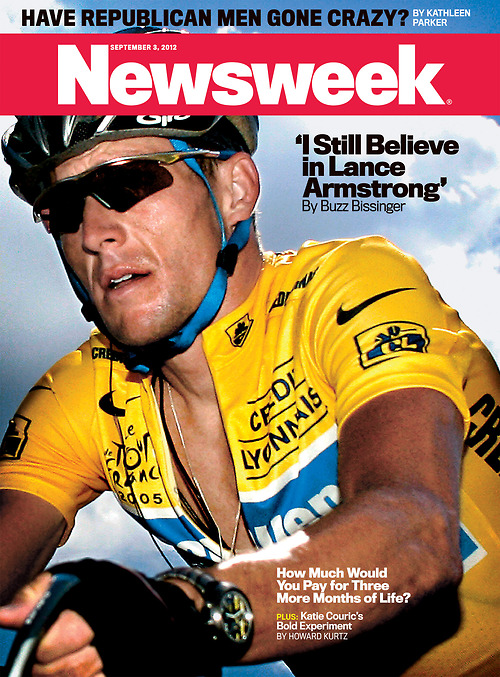
This country now needs a foundation to help us overcome the emotional damage of Lance Armstrong.

The foundation of the, well, his foundation, is built on the secrets and lies of the now disgraced hero and cyclist.
And the fallout from Armstrong’s doping admission to Oprah Winfrey this week leaves many of us feeling sick to our stomachs. We feel duped, cheated and lied to. The entire country spent the better part of a decade rooting for this man and fell victim to his charm – and his yellow bracelets.
No one cared about cycling before Lance Armstrong unless you were into cycling. No one cared all that much after he left, either. But you give football and baseball loving folks the story of a man who survived cancer, who sweats his way through France against all those cheating European bikers and overcomes all of it to capture every Tour de France from 1999-2005 and you’ve got an All-American Legend.
We can deal with flaws. Most of our heroes have them, even the fictional tales of Superman, Spider-Man and Batman showcase men who have their own secrets, weaknesses and fears to overcome. In some cases, they have strength, ability and powers not obtained through natural means. 

But Batman never blood-doped. Spider-Man doesn’t stick a needle in his butt.

Some, as I mentioned last week, just don’t care. One of my best friends has told me that my morality writing is some of my worst. This is due in part to his lack of regard for sports performance enhancing drugs. There are so many in the same state of mind: either it just doesn’t move the needle (no pun intended) and they don’t care what athletes do to entertain us and succeed, or it’s just a tired, drawn out storyline.
Essentially, why do we care anymore? If they all do it – and so many of our sports heroes appear to fall from grace nowadays in this very manner – then why do we bother with it anymore? We should just accept it as a new normal and move on.
But some of us can’t. I can’t. It does matter. And it’s bigger than just being a morality play or holier than thou attitude from the self-righteous.
The simple fact is, we all make mistakes. Ninety-five percent of Americans are just normal, average, every day people. And it’s inspiring to those of us in that 95 percent to hear and see others doing extraordinary things. It pushes us through our cold January mornings, slogging through traffic to an office. It inspires us to coach our children and instill a never-give-up attitude, a sense of hard work paying off and knowing that if you do, good things can happen.
When we find out our inspirational stories were missing some seedy chapters, it’s cheapened. We are cheated because they cheated. And it’s a feeling that doesn’t go away, no matter what is accomplished.
As many people have pointed out, what does it matter how Armstrong came to fame, but how he used that fame – to push for more cancer research and support the families afflicted by this terrible disease. There is truth to that, no doubt. But when the face and inspiration of the cause is found to have doped his own blood, and much of his success is now credited to gaining an edge on the competition not through determination, preparation and hard work, but through downright cheating – and then denying it for 10 years – it’s not so inspiring anymore.
In the summer of 1998, the home run chase between Mark McGwire and Sammy Sosa captured many fans, fathers and sons throughout the nation. My dad and I were no different. And at 18, I was in a strange transition time in my life. My father and I, always on good terms and already having a good relationship, bonded even more. We weren’t even fans of the Cardinals and Cubs, but watching these guys chase history, embrace each other and thrive under the spotlight was something we shared. We were watching history, together. And it brought us closer together, as sports so often has.
And then it became clear that something fishy had happened. All Dad and I could think about was McGwire talking about touching Roger Maris’ bat and touching with his heart.
“And a steroid needle,” I joked.
Suddenly, while Dad and I still had a deep bond and do to this day, our memories of it are tainted. It feels like it happened under false pretenses. And perhaps that’s where we get that sick feeling from.
That 95 percent of us want good things to happen. We want love, we want money, we want happiness. But many of us won’t allow ourselves to cross these moral lines and reach these things under false pretenses. If that makes me a righteous hypocrite that lives in a fantasy world of ethics that no longer exist, even to my closest friends, then fine. I don’t care.
Because for me, and for so many out there, I’d rather fail horribly by natural means and by my own weaknesses and failures than succeed through unnatural ways. I don’t want to win by doing what others aren’t, maybe because it means we know we went toe-to-toe with the other guy and were just better on that day.
This is precisely why it is so difficult for us to have heroes anymore. We don’t know who’s best is beefed up. What’s real and what’s a mirage?
Like Armstrong, we find out too many were not at all heroic in their means, but only their deeds. In Armstrong’s case, his end result as a record-shattering cycling champion, who’s own story of cancer survivor wove a heroic tale that all Americans could root for, was largely in part only accomplished because he manipulated his own blood in order to perform better.
No matter where we all collective reside in the discussion on PEDs, let’s all agree on one thing: that we’re not going to praise Armstrong for finally coming clean and admitting something he vehemently denied for years and years, legally and in the court of public opinion. Would a husband or wife call their cheating spouse of a decade direct, honest and candid when they finally admit to it only after everyone proved what a liar they were? I doubt it. Thou doth protest too much, eh?
I don’t care that he choked up when apologizing to members of the Livestrong charity. He didn’t Livestrong. He lived rather poorly in how he conducted himself – not just with the doping. And he’s only crying because he got caught, not because he’s sorry. That’s not regret or remorse. That’s self-pity for wishing he had not been exposed. Huge difference.
Heartfelt and sincere? Please. Colonel Jessup showed more accountability and remorse in A Few Good Men than Armstrong can fake at this point.
We’re partly to blame. We’re so thirsty for heroes that we’ll gobble down any story and trust anyone. And now we’re cynical as the years pass with our heroes. We’ve got to start standing for something more, or we’ll keep falling for anything.
After all, the U.S. Postal Service sponsored most of the those tour teams that Armstrong rode to victory seven times. I wonder where a government entity got their sponsorship money? Taxpayers perhaps?
See, no matter which way you look at it, in the end, really we all pay a price for “inspiration and empowerment.” Live strong, indeed.

Standard