Billy Chapel, Farewell Tours, For Love of the Game, Hero Worship, Mariano Rivera, MLB, New York Yankees

Please, No Mo

The greatest closer of all-time left the mound at Yankee Stadium last night.
Finally.
Though I can easily be described as the exact opposite of a New York Yankees fan, I tip my cap to Mariano Rivera. Truly a gentleman, one heck of a pitcher, who quite possibly threw the most disgusting, disturbing and unhittable pitch we’ll ever see.
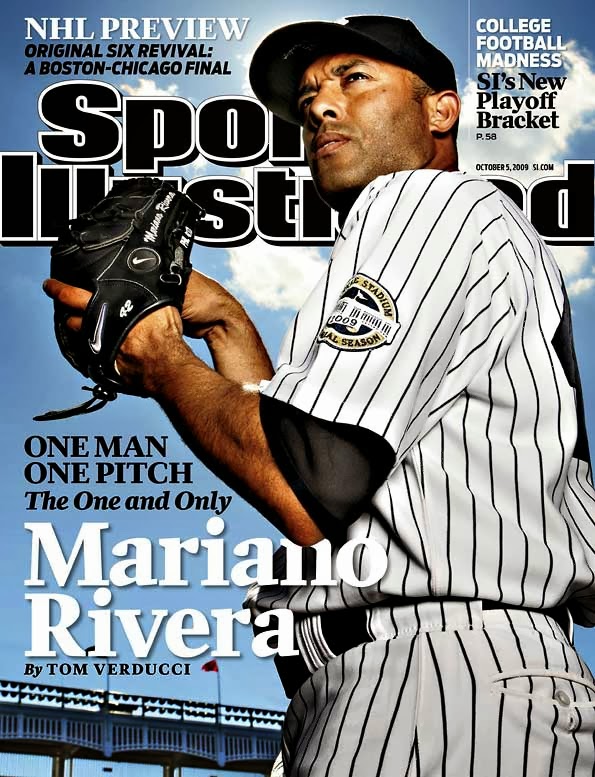
A baseball wasn’t meant to do that, as many have said, but the fact that Rivera threw that cutter for nearly 20 years with such consistency and success is what is most astounding. Rivera is without question the greatest closer in baseball history – both in the regular season and the post-season. And you can certainly tip your cap to Rivera for coming back after blowing out his knee last year. He wouldn’t let it end that way, and returned to save 44 games this season.
It’s remarkable, it’s a great story and Rivera a great player.
But…

About this farewell tour, one that, frankly, was wildly mishandled and represents just another chapter of our sad downturn into hero worship. It represents the media’s massive stranglehold on our society and how said hero worship says more about us because we let it happen than it does about the players who seem to pull the “no, stop it, well, OK, tell me how much you love me” act.
Lost in the sentimentality of last night, the gushing Twitter hashtags, the overarching media slobber fest, the genuinely great moment when Derek Jeter and Andy Pettitte came to take him off the mound, the tears, the emotion, was the fact that this wonderful moment had already been overdone and overblown before it even actually happened.
When Rivera announced this would be his last year, you probably could have predicted this would happen. Endless stories, standing ovations, tributes in every city for the last six weeks of the season. I don’t so much blame Rivera – we did this mostly ourselves. But Mo was a party to it, never said to stop, and soaked it all in.
It was a obvious he enjoyed it – and who wouldn’t? An entire year of everyone, including your arch rivals, showing you the love? It’s the ultimate ego trip.
Yet I remain wildly disappointed in us for the whole charade. What happened to us? Why is it a lead story that the underachieving and eliminated Yankees contemplating playing Rivera in centerfield against the hapless Astros this weekend? What about the exciting playoff races still happening? What about the Pirates making the playoffs for the first time since 1992?
1992!
You know what a fun, feel-good, easy story to write about that is? But baseball was overshadowed by Rivera’s farewell campaign. We’re a cult of personality, for sure.
And I can’t help but note that Todd Helton, perhaps the best player in Colorado Rockies history, retired without much fanfare as well this season. The difference? He waited until almost the very end of the season to do it. They held a modest ceremony and gave him a horse.
I texted a friend: “Why is Helton getting a horse?”
His response: “No idea. Maybe some connection to his Tennessee roots? Maybe he has a horse farm? We’ll never know because it might interfere with the great Rivera Farewell Tour.”
And he’s right. I’d never argue that Todd Helton reached Rivera’s level of performance or had the same impact on the game. And I get it – Rivera being one of the most recognizable Yankees is a lot different that Helton being the most recognizable Rockies.
But my goodness, this year has been nearly all Mo all the time. Goosebumps at the All-Star game, standing ovations, farewell ceremonies the last month in several cities. Campaigns demanding you recognize him as a hero, talk radio conversations about why he is or is not worthy of hero status. Stories about his legend growing each day, about him never sharing his true secret to the cutter, but helping other pitchers with the finer points. Practically every major paper and magazine in the country ran a story about it.
ESPN has a “Follow the Farewell” sub-page. AT&T allowed you to send him goodbye messages. The San Diego Padres gave him and his family beach bikes. Rivera barely pitched against the Padres during his career, or at Petco Park.
Good grief.
A little much, is it not? In a world of snark and constant criticism, I must stand apparently alone in my belief we’re gone overboard on the Mo Mania. Searching Google for a solid 15 minutes did not yield many results that showed any – even remote – criticism of Rivera’s farewell tour. In fact, one of the few a I found was from a newspaper…in Ottawa, Canada.
So perhaps this is falling on the angry deaf ears of folks who see nothing wrong with it. Perhaps I’m just a very old soul trapped in a still somewhat young man’s body. I just find the whole thing to be missing a shade of tact and a smidge of humility.
That’s not all on Rivera, either. We do this hero worship thing quite well. Yet Mo still did the 650 interviews and 400 posed pictures (all estimates) for TV, radio, newspapers, web sites and magazines. You can’t blame the guy completely for enjoying it a little bit, or a lot.
But I think I would have respected it more had Rivera pulled a Billy Chapel and just signed a ball telling them he was done. No fanfare, no big production, just riding off into the sunset and moving on.
Instead, the year-long goodbye left Thursday as somewhat anti-climatic. And you run the risk of it becoming a joke, which while Rivera seemed to avoid, others have not. Kareem Abdul-Jabbar got blasted for his retirement tour in 1989, Brett Favre and Michael Jordan mocked slightly – but mainly because they came out of retirement.
Sadly, MLB Commissioner Bud Selig announced over a year in advance – much like NBA Commissioner David Stern – that he would be leaving. Are they expecting the same – or even half – the farewell?
George Strait is doing it in country music, like so many musicians and bands before him. I mean, I get it, you want to give people a chance to say thanks for the talent and entertainment, but after a while, the novelty wears off and you’re just staring at someone who appears like they don’t really want to leave the stage, like they just want to hear the really, really loud cheers and feel that emotion.
Which makes it actually less so. The longer we have to say goodbye, the easier it becomes.
Let me repeat, I respect Rivera’s career, his impact on the game and what he did off the field, as well. But this…well…aren’t we just a tad embarrassed? Maybe, for once, life should imitate art. Even a somewhat hokey baseball movie disguised as a romantic comedy from 1999 got it right.
Please, fellas, from now on, just tell them you’re through.

For Love of the Game.


Standard
Big League Tours, Mickey Mantle, New York Yankees, Old Yankee Stadium

Fans of our Fathers

[Note: In honor of Father’s Day, I am re-posting a column I wrote for the Daily Journal in September 2008 in honor of my dad – and sons of fathers everywhere.]
There are a litany of reasons why baseball is no longer America’s favorite pastime, but an argument could be made that it is still America’s go-to sport in times of bonding, stress and leisure.
We watch football now for its fast-paced, violent nature – it keeps our attention span because of the shortness of each season. (And because we need 22 points from our starting running back in order to beat a friend in our Fantasy Football league.)
But I have a newly concocted theory about why baseball has fallen off our list of great loves. I formed this theory from Box 215, Seat C2 in Yankee Stadium last weekend with my dad.
Now for anyone who’s read this space more than once, many of you know I’m a card-carrying member of Red Sox Nation.  And dear old dad is a Yankee fan.
That last paragraph is in some respects what’s wrong with baseball. It couldn’t – and can’t – keep fans of teams. It keeps fans of players.
Allow me to explain.
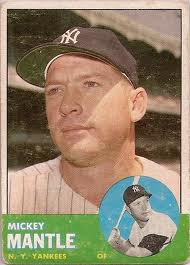
My father became a fan of the New York Yankees during his youth in the 1950s. I say that, and many of you immediately think of Mickey Mantle, Yogi Berra and Whitey Ford.
When my old man went off to serve his country in the late 1960s, he had a shoebox collection of baseball cards of these players and many others. They were a treasured part of his youth, his favorite team and his favorite sport.
While he was away for 18 months, my grandmother trashed the box while cleaning out his room, unaware of its contents. My father was devastated by this news upon returning home from South Korea.
People do not collect baseball cards like that anymore, and certainly are not affected at that level by the loss of them.
Cards or no cards, the passion continued. He’s loved watching and rooting for the New York Yankees all his life. Once a Yankee, always a Yankee.
Until free agency came along, that is, and basically everyone’s been a Yankee over the last 20 years. If you had a decent year, George Steinbrenner would Godfather you into a Yankee uniform (in other words, make you an offer you couldn’t refuse). Never a big fan of the Yankees anyway, it was easy for me to hate them when they gulped up free agents and bought titles.
And then the Red Sox started doing that in the last 10 years, so perhaps it is all the same.
The hard truth is that all we’re rooting for is laundry. The players are gone from year to year. If Mantle played today, he would never have played his whole career in Yankee Stadium. Once his Sabermetrics dropped, he’d be traded to another team, with the Yankees still paying his salary five years later. Furthermore, if this were 40 years ago, Pedro Martinez would have never left Boston. It just wouldn’t happen.
Nevertheless, my dad remains true to the Bronx Bombers. And in all his life, he’d never seen the pinstripes play in the hollowed and fabled grounds at 161st Street in the Bronx.
I thought this was a travesty that needed to be corrected. So, for his 60th birthday, with the help of my wife, my mother and of course, Glenn Dunlap and the great folks at Big League Tours in Greenwood, we set off last weekend for the Big Apple and a big weekend of baseball.
You see, I may not be a fan of the Yankees, but I’m a fan of my father.
It was the trip of a lifetime, for him and for me.
A rainout forced a Saturday doubleheader – we spent 11 hours in Yankee Stadium and we were truly in awe for every minute.  We didn’t want to leave, because as soon as we stepped off the Subway, you could feel it.
History.
Alive – and nearly speaking to us, with its ghosts and the roar of the crowd. It’s almost as if there were horns and trumpets playing every so softly, like something straight out of a movie.
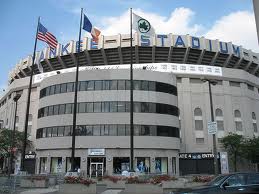
Here we were, inside “The House That Ruth Built” – a place where the Great Bambino smashed so many home runs and teamed with Lou Gehrig to form the 1927 Murderer’s Row lineup. In fact, it was Ruth that hit the first home run in the stadium, a three-run shot to defeat – you guessed it – the Boston Red Sox – in the first game played in Yankee Stadium during the 1923 season.
Sitting there, roughly 25 rows behind home plate, you could almost hear the speeches given on those hallowed grounds, ones that are as revered in sports and life as any made by a president or politician.  Namely, Gehrig’s “Luckiest Man” speech and Knute Rockne’s “Win one for the Gipper” speech.
Then, your head starts spinning when you realize Yankee Stadium has been host to 37 World Series. Wrap your mind around the fact that Gene Tunney, Joe Louis and Muhammad Ali all fought here in some of the greatest boxing matches ever. Remember that the New York Giants and Baltimore Colts played here in one of the NFL’s greatest games in 1958.
Three Popes have celebrated Mass inside the stadium; a memorial service for 9/11 victims was held here on Sept. 23, 2001.
There’s the Frieze (the white architectural work that runs all around the stadium’s outfield walls). There’s the Big Bat (as shown on several episodes of “Seinfeld”) and of course, Monument Park.
I don’t think I’ve ever had goose bumps and the hair stand on the back of my neck for a longer period of time in my life. And that was before the games even started.
When they played a video commemorating New York and the 9/11 victims, showing the tattered and torn American flag, you could have heard a pin drop. When “God Bless America” finished, the cheering at the end by the crowd was so loud your ears rang. 
It was quite emotional, sharing that moment of silence surrounded by New Yorkers who would never forget and reminding us that we shouldn’t either. But it was also a reminder of how baseball soothed the pain that fall of 2001, providing us with a memorable World Series between the Arizona Diamondbacks and of course, the New York Yankees.
Once the games began, delightfully, I watched my father’s eyes beam with joy as we witnessed the 10th and ninth final games to ever be played in Yankee Stadium. In a way, we had become a part of its history as well.
Dad can forget about those lost baseball cards now. He has something much more special.
Just like so many, my dad and I played catch when I was a kid. He coached my Little League teams and came to every game in high school. In the summer of 1998, we glued ourselves to the McGwire and Sosa home run chase. In 2004, my mother wouldn’t let us speak to each other during the ALCS between the Yankees and Red Sox, in large part because a year earlier the playful banter between he and I got so carried away she couldn’t take hearing about it.
Our trip to an 85-year old stadium meant far more than a trip to a football game ever could.
That’s something that the NFL can’t ever get its hands on: the history of the sport, the bonds formed between millions of fathers and sons playing catch. Where else, in what other sport, can you step into a field or a stadium and feel its history so vividly?
And it will soon be gone.
The way sports should be is to not necessarily make us fans of a particular multi-million dollar player or a specific play – but of history and of the bonds formed through time spent together.
Because at the heart of all sports experiences, is a love of the game. Many of us developed our love of baseball or basketball or football or field hockey or swimming from our experiences as youths and in part because of the passion of our parents.
We’re fans of our fathers and fans of our mothers and what they loved. That’s how sports are passed down, generation to generation – not because of David Ortiz or Derek Jeter, but because of how we remember with fondness watching the exploits of Jeter and Ortiz, the same way our parents did Mantle and Ted Williams. And sports are passed down fondly because we share them – together.
And that’s why dad and I had to go, because it was Yankee Stadium.
Because it was my father.
I may not ever be a fan of the New York Yankees, but I’ll always be a fan of my father.
Standard
Derek Jeter, Don Henley, Eminem, LeBron James, New York Yankees

After The Boys of Summer Are Gone

Don Henley wrote nostalgically once about “The Boys of Summer.” A huge hit in 1984, years later Henley told Rolling Stone that the song represented a questioning the past and was about aging. A key line in the song that represents much of this sentiment and self-reflection: “Out on the road today, I saw a Deadhead sticker on a Cadillac. A little voice inside my head said don’t look back, you can never look back.”

It’s an ironic image for the 1980s: once counter-culture, fans of the Grateful Dead  driving around Cadillacs – a status symbol both of maturity and a touch of wealth. 

And whenever I hear it – and you still hear that song this time of year – I think of Derek Jeter. 

Didn’t expect that, did you?

For much of his career, I have held quiet and unassuming hatred for Derek Jeter. He represents the New York Yankees, and as a Boston Red Sox fan, he is the face of the arch-rival’s franchise. Therefore, if you are like me, you are just simply predisposed to disliking the guy.

At least that’s what I thought from 1995-2004. Then, on July 1, 2004, it became a genuine, sports hatred.
The Red Sox and Yankees – nearing the height of their rivalry, were battling tooth and nail in an extra innings game. With the score tied at 3 in the 12th inning, with runners at second and third and two outs, Sox outfielder Trot Nixon hits a pop-up down the third base line. Watching the game, you were certain the ball was heading foul into the stands.

Suddenly, there’s Jeter, screaming into the picture and making an over-the-shoulder catch. He is at the wall, so the force of his momentum launches him over the railing and into the stands. He makes the catch and cuts his chin, but the play ends the inning. Jeter leaves the game, but the Yankees win – and naturally, the announcers are drooling over him like the kid in that “Stacy’s Mom” video fawning over Rachel Hunter.

The announcers go on and on about what a leader “Jete” is, what a gamer, what a captain. It’s nauseating. It’s get-a-room-uncomfortable. It’s nails on a chalkboard to Red Sox fans. Remember, there were wounds still not healed from the previous October, so Sox fans hated everything Yankees even more so than normal. 

In hindsight, it was an amazing play. But I could never see it as such at the time. I was too young to appreciate it.

Fast-forward to the present.

Derek Jeter sits on the cusp of 3,000 hits and suddenly, I am nostalgic. 

After a contentious contract negotiation with the Yankees last winter, and with age becoming a factor, Jeter’s on the tail end of his career. And despite being a Yankee, I cannot help but feel sad that we’re losing something here. 

Jeter reminds you of the old boys of baseball. The Mantle’s, the Ryan’s – and some combination of both. He is a pretty tough cat, but he’s got this high amount of celebrity cache. The man has been with nearly every attractive celebrity female on the planet. 

Somehow, with all that happens in the current media age (Twitter, Facebook and 24/7 scrolling tickers) Jeter has managed to be in the public eye without anyone really knowing anything. It is like old Hollywood, really. People say they saw Jeter out doing this or that, hanging with this woman or that woman, but there’s no pictures, no proof – just stories. It’s mysterious, but not in a bad way since it leaves something to the imagination.

With Tiger Woods, once it all came out, there was literally nothing left to the imagination. In fact, your imagination died painfully as you scrubbed your eyes with Clorox. Either Jeter’s really, really good and doesn’t text people or he’s paid off everyone in Manhattan to keep quiet. And either way, that is pretty freakin’ cool.

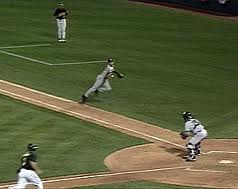
Despite advancing in age and putting tons of miles on the tires with all the Yankees postseason runs, Jeter just went on the disabled list for the first time since 2003. He has really been a model of efficiency offensively and defensively. He is the only guy who could pull off forcing Alex Rodriguez to move to third base and then have people say that A-Rod was a better shortstop. And Jeter holds so many memories of iconic plays – mainly the flip play, where he tossed the ball to Jorge Posada to tag out Jason Giambi while running the opposite direction after cutting off a throw from right in 2001. 

I still don’t like Derek Jeter, yet I cannot help but feel odd (and old) that his time left in baseball is short.

We forget that athletes age too. Oh, we see it. We can see the gray hair and the loss of physique. We watch them stumble and get burned because they have lost a step – but we are not really comprehending it. At first, they get by on raw talent and athleticism. But in the end, it is all about being a cagey veteran who knows how a situation on the field or on the court will play out because they have been there, done that. 

This is where Jeter is at, like so many before him – getting by on what he knows and how the movie plays out. He has the script, he’s just executing the lines with more nuance. But the time is coming where he will not be able to get by on his wits anymore. 

And what does he do then? Naturally, he retires and becomes a manger or a TV analyst and becomes something entirely different. The better question is, what do we do next? 

It is always odd watching guys like Charles Barkley, Dan Marino and Troy Aikman in the studio or calling games. To anyone under the age of 30, that is all these guys are – old dudes referencing a game they once used to play. People view them with a sort of “Sure, I bet, old man” reverence, which is to say, “I hear you, but it’s just words.”

To anyone over 30, we remember how good these guys were. We were there, we saw their prime and we still hold them in high regard. 

And that difference in how people view athletes from one generation to the next is a striking similarity to Don Henley’s song and how we operate day-to-day in our own lives. It is why someone who enjoys Eminem does not get why people think NWA was controversial. It is why LeBron James can never be Michael Jordan. It is why I cannot begin to tell my kid how cool “Tecmo Bowl” was, because he has an X-Box and can run his own franchise, create himself as a player and set the price of popcorn in the concession stand. 

Perhaps that is why we can’t look back. We can never look back because only you understand the intrinsic value of what you’re looking back at if you were actually there to witness it.

In other words, for both Jeter and for me, getting older sucks.

Standard