basketball, Bobby Plump, Gordon Hayward, Indiana Hoosiers, Indiana Pacers, Larry Bird, Milan, NBA, Purdue, Tom Crean

This is Indiana…do we still ball?

This is Indiana.
Where we apparently don’t care about professional basketball.
If you are from Indiana like I am, you know there is very little we take more seriously and keep close to our heart than basketball.
Hoops may not have been born here, but it is where the game is played and followed with an unbridled passion, one that others (like New York, Chicago, Kansas and North Carolina) imitate but can never duplicate.
We are Hoosiers. We are “I love you guys.” We are the Milan Miracles, Bobby Plump, Hinkle Fieldhouse, IU, Purdue, red sweaters, Bobby Knight, comb-overs, Gene Keady, thrown chairs and Digger Phelps. 
We are Chrysler Fieldhouse, where Wooden was born and raised, The Wigwam, Big O, The Undefeated Season of ’76 and “The Shot.” We are The Big Dog, Damon Bailey and Steve Alford. 
We are Larry Bird. We are Slick Leonard. We are “Boom Baby”. We are 8-points in 9 seconds and a choke sign to Spike Lee in Madison Square Garden. We are still engaged in a 15-year battle over single-class basketball.
Basketball is who we are. Or maybe it was who we were.
This is Indiana (no, really, this is Indiana).
And right now, this is kind of pathetic.
Our numbers are dropping in high school basketball attendance. You can blame class basketball, but then again, you can’t. We’re kind of excited about the revival of Indiana University under Tom Crean, but they just locked up a stellar recruiting class and the only way I heard about it was through IU fans on Facebook. If this were 1992, people wouldn’t shut up about it.
And Purdue fans – is there such a thing right now? – are as quiet as a field mouse. Purdue and Indiana used to not only matter nationally, but they were what this state thought about most. Butler made the NCAA title game two straight seasons – the second time without sensation and Brownsburg native Gordon Hayward – and people were excited for about 10 minutes.
Speaking of Hayward, have we forgotten about this kid? You know, the one that hit a crazy game winner in the 4A state championship game, then led Butler to the title game his sophomore year and now is an outstanding young NBA player for the Utah Jazz? Where’s his book? Where’s his cult following? He did what Bailey and Alford couldn’t do – stand out in the NBA – and I don’t see anyone under 15 wearing his jersey to school.
What the hell happened to us? What happened to rusty rims hanging from barns, dirt courts and old men in coffee shops? My parents (IU fans) and their best friends (Purdue fans) couldn’t even watch games together because they were afraid of what they might say. Now? Purdue and IU rarely come up in conversation.
What the hell is wrong with us? We’re dying a painful basketball death here in Hoops Holy Land and everyone seems to be shrugging their shoulders.
The biggest case in point: the Indiana Pacers.
After years of complaining (including from me) about the dynamics of the team, how they (or RonMetta WorldTestapeace) ruined the great shot they had in 2004, the strip club shootings, the gun charges, well, they at least have been getting it right lately.
After giving the Chicago Bulls all they could handle as a spunky 8-seed in last year’s playoffs, the Pacers secured the 3-seed this year, clearly their best regular season in nearly a decade. They are young, fun, filled with talented players who work together as a team. They feature a hometown kid, George Hill, and have likeable players and hard workers all over the roster. They are ran by Larry Bird. This is the quintessential “Indiana” basketball team – fun, likeable, fundamental, hard working.
And they had the second-worst attendance in the NBA this season. Frankly, the Pacers attendance has been in the dregs of the league for over 10 years.
This is not about a small market. We fill up Lucas Oil Stadium just fine – even during a 2-14 season.
Win or lose, we just don’t come to Consec…er, Bankers Life Fieldhouse.
I could go on and on about how great it is in the Fieldhouse, what a value it is (and I’ve done that in previous columns over the years), but we’re just not listening. We just don’t care. And that, my friends, is what scares me the most.
The Pacers are about to take on the Miami Heat in Round 2 – an epic affair and what could prove to be the best series in the Eastern Conference and we’re acting like it’s a kindergarten soccer tournament. We’re losing our identity. Or as R.E.M. once said, we’re losing our religion.
I know there are so many things different about 2012 than there were about the 1980s and 1990s; our options are far greater. The Pacers are not the only “game in town” when it comes to entertainment and sporting options anymore. We’re a busy lot, with much to do and places to go. And that’s fine, really. It’s a sign of the times.
Now we could dissect how it’s easier to go to eight Colts home games than 20 or so Pacers games. But the cost is probably the same. And yes, it’s an expensive night out for a beer and a hot dog, but you tell me what isn’t expensive these days.
Just tell me what’s happening to us? Was it truly the Malice at the Palace? Was it a loss of trust? General disinterest? Are we know a football town? A football state? I can’t believe it. I know Peyton Manning was here, orchestrating one of the greatest runs in NFL history – but football and basketball season collide for but a brief few months.
Maybe we’re just not cut out for the NBA here. Even when the Pacers were rolling in the 1990s, it was nothing like the Colts “Blue Fridays” at workplaces around central Indiana. Maybe it’s the length of the season. Or for some reason the dichotomy of how NBA players are perceived by our Midwestern culture. Maybe it’s because college basketball has always mattered here more than professional basketball and people only have enough energy to fully engage in one team.
Yet, really, none of this matters. These “reasons” and excuses are just that – reasons and excuses. They don’t speak to the heart of the matter – that this is Indiana. Basketball is in our blood. We live and breathe it.
Or at least we used to.
We are in danger of losing this team one day, sure. (And it will be oddly amusing when people who never went to games begin to complain.) But more important, we’re in danger of losing our essence, our character and our culture if we don’t snap out of this basketball funk we’ve been in.
This is Indiana.
And if we’re not careful, they’ll be talking about how we once balled. 
Standard
Charlotte Bobcats, Chicago Bulls, Michael Jordan, NBA

Rare Air

Not that this should surprise you, but we live in a very cynical world. We easily turn on people, especially those in the public eye.
Except in the case of one man: Michael Jordan.
Why has no one really – and I mean really, truly – taken Jordan to task for his lack of prowess in owning and guiding the Charlotte Bobcats?
Simple.
It’s Michael Jordan. His Airness. The true G.O.A.T. And attacking “The Man” isn’t fun or easy. But he’s making it easy.
The Charlotte Bobcats, shortened 66-game season or not, are one loss away from becoming the worst team in the history of the NBA. The Bobcats sit at a measly 7-58 – a .108 winning percentage. The Bobcats have lost 22 straight games.
This cannot be qualified as tanking – you have to have tried at some point during the season to actually notice a drop in productivity to qualify as tanking. These guys just plain stink.
They aren’t even close to the vicinity of competitive, with an average margin of loss is 13.9 points per game. The next closest team isn’t even half that number – the Cleveland Cavaliers lose by an average of 6.8 points. They’ve tied a record for most consecutive home losses by at least 20 points with three. The Chicago Bulls beat the Bobcats about a week ago by the ridiculous score of 100-68 – and the Bulls were without reigning MVP Derrick Rose.
If I wanted to write 2,000 words on their level of sucktitude, I could. Easily. But I’d rather question the motives and the heart of their owner. Actually, to be honest, I’d rather not.
This is Michael Jordan. And I’ll always remember Jordan as Air Jordan.
I owned countless posters. I wore out the tape of “Come Fly With Me.” I had the shoes, the shorts, the t-shirts. Like pretty much every American kid, I idolized and adored Jordan from 1990-1998.
And all I want to do is channel my inner Apollo Creed and give him the speech from “Rocky III”: What the hell is the matter with you?
He is Michael Jordan. What is he doing? I could care less about his legacy. As a player, it’s complete and cannot be touched.
I just want to know what he is thinking. Why buy the team? Is he bored of smoking cigars, gambling and playing golf? Apparently not – because he’s still doing these things while owning the Bobcats.
He hired and fired Larry Brown, but hey, who hasn’t, right? But to replace Brown with Paul Silas, who should have been put out to coaching pasture years ago, begs the question: are you trying to lose? I mean, who better to coach a team of young players than a coach who has trouble relating to young players and the current generation. And the only proof I need of that is the fight he had with Tyrus Thomas less than 10 days ago.
We’ve metaphorically killed nearly everyone else during or after their playing careers, but we’re afraid to touch on how inept Jordan is as an owner. And perhaps it’s because of the reverence we treated him with – both as young fans and the media. For so long, he could do no wrong.
He punched teammates in the face – well, he’s just trying to lead and motivate! They should raise their game!
He has a huge gambling problem – well, even the best need to blow off some steam; besides, it’s his money.
He cheated on his wife, perhaps multiple times – no one understands the pressure of being Jordan, so who am I to judge?
Well, we should judge him. And we should have shamed him a little more. Perhaps that would have balanced out the massive ego – the same one that ran amuck in 2008 at his Hall of Fame induction ceremony, where in his speech he came off as selfish, bitter and hostile.

Jordan only pays attention when the media does, or when he feels like it or when it’s raining and he can’t play 36 holes. For all the game has given to Jordan, what has he given back to it? Fantasy camps where he charges thousands of dollars just to get a glimpse of him?
Look at his peers. Magic and Bird are uber-ambassadors for the game. Bird coached and is now a GM. Magic coached, owned and mentors players. Even Isiah has tried; he may have been terrible and put the New York Knicks back a decade, but he did try – he was just bad at his job.
Jordan just doesn’t even seem to be trying. He complains about costs of being an NBA owner and staunchly sided with the owners (somewhat expected, but highly ironic) during labor negotiations last year. It’s tough to take him seriously as an owner who complains about player greed when Jordan made $36 million for the Bulls in 1997-98.
Perhaps that’s his problem – he’ll never think of any player as highly as he thinks of himself. And while this is probably true – it also has a damning effect on his ownership abilities and personnel evaluations.
Some people point to his involvement with the players – like practicing with them. But Jordan doesn’t practice to mentor – he does it for himself. To prove that he’s still got it, to prove to everyone else he’s still got it. He’s still that guy who uses every slight to prove something, except he’s searching for it in ways that won’t lead to good things in this stage of his life.
He drafted Kwame Brown in 2001, then unretired, then rode the 18-year-old’s ass for two years telling him how bad he was. Doug Collins idly sat by and watched. The same Doug Collins who’s done amazing things with the young Philadelphia 76ers in a tough Eastern Conference the past two years. Collins is the same coach, except in Washington, he was the No. 2 guy to Jordan. And he wanted Michael’s approval.
Everyone wants Michael’s approval. Even his friends. I’ve always wondered why Charles Barkley was friends with Jordan, with all the smack talk Jordan peppered in Barkley’s direction. Chuck doesn’t take crap from anyone, except Jordan. Everyone else ends up verbally abused or thrown through a plate-glass window by Chuck. But not Jordan.
Jordan loves all of this. He loves being the ultimate alpha-dog. It’s another ego boost. Which is why it seems like Jordan refuses to surround himself with good basketball minds that might disagree which his choices of roster moves. He doesn’t want to be told he’s wrong.
Jordan recently disputed this notion. He said he has people who tell him no and who challenge him. Funny thing is, you never hear about it. All you see are the results piling up. A horrible team ran by a cheap boss who’s employing a coach who picks fights with his players.
He better be careful. Charlotte had problems holding on to a team once before, with the Hornets. And fans don’t come out in droves for years on end to watch disinterested and terrible basketball teams. If he thinks the money and cash flow are tough now, wait until next season’s ticket sales come in.
I guess I just remain shocked. When he took over as an owner, I imagined he’d have problems with the players by demanding too much from them and expecting the same extraordinary effort he put forth. I figured he’d try to buy and lure some of the best players, especially the ones wearing his brand. And I assumed he’d become one of those guys out in front of the media, demanding better effort, posturing as always. But the thing is, he’s the complete opposite of that: absent, buying cheap players, a quiet and aloof owner.
Are these the new Jordan Rules? A massive, out-of-control ego that passively engages in business affairs?
To give him the benefit of the doubt any longer is to give him too much credit now. If you think this season is an aberration and has been an angle to get Kentucky phenom Anthony Davis, I’d counter with that I’m starting to wonder if he has paid enough attention to know who Anthony Davis is.
Michael Jordan always was groundbreaking.
But this…thisis truly rare air.
Standard
David Stern, Indiana Pacers, Los Angeles Lakers, Metta World Peace, NBA, Ron Artest

End the Era of World Peace

And that settles it.
The NBA – and David Stern specifically – have no spine.
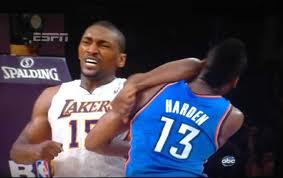
There is no other conclusion to be made regarding the league and the man in charge after they took more than 48 hours to decide that Metta World Peace (the artist formerly known as Ron Artest) should receive a pathetic seven-game suspension for his vicious elbow to the head of James Harden on Sunday.
I read one columnist describe it as an “incident that was as ugly as they come in sports. Vicious, violent and wholly unnecessary.”
Man, that sounds oddly familiar.
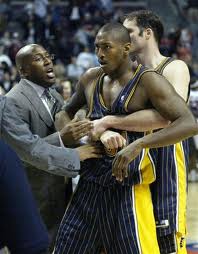
Oh, right, World Peace was anything but peaceful during the Malace at the Palace in 2004. He was, however, vicious, violent and wholly unnecessary.
When are people going to get it? Rometta World Peaceatest is certifiably insane. And he has no business in a public forum to display his crazy.
Remember the speech from Nicole Kidman to Tom Cruise in “Days of Thunder” when he’s chasing the taxi cab? After she tries to bail out of a moving vehicle traveling at high speed, he follows her on foot and she breaks it down for him: He’s an infantile egomaniac and he’s scared. Control is an optical illusion that most people learn to cope with. And once you get a glimpse of it, the fear of the unknown sets in.
And Ron Artest is one scared individual.
He thanked his therapist after winning an NBA championship. My immediate question was: which one?
Forget all this crap about emotion and being excited he dunked over Kevin Durant. He violently jacked some dude in the side of the head, knocked him out and didn’t even offer to help him up.
Seven games? How about seven years? Ban this guy – for good.
And I’m a Lakers fan.
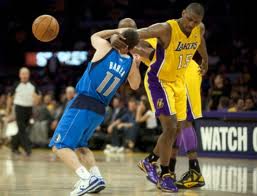
I’m also a fan of not wanting to see someone seriously hurt or injured at the hands of a man who’s been suspended 11 times in his career for over 100 games. Everything Artest does is unnecessary, just like his forearm shiver to JJ Barea last year that looked like a wrestling clothesline. I know it was the highly annoying JJ Barea, but still, we have to draw the line somewhere.
Punishment should fit the crime, in both civil and sport arenas.
Except if this was a civil issue, and Artest had a violent history like he does in the NBA, he’d be getting worse than seven games (or the equivalent of 15 days in jail and community service).
But the NBA does not think about morals, justice, right and wrong. It thinks about dollar signs and TV ratings. So it took 48 hours to decide that seven games was appropriate – because that amount of time won’t totally derail the Los Angeles Lakers title hopes.
If you are the Lakers, you can totally win a first round series against the Denver Nuggets without Metta World Peace/Ron Artest.
Can you get past the Oklahoma City Thunder in a potential Round 2? What about the San Antonio Spurs, Los Angeles Clippers or Memphis Grizzlies in the Western Conference Finals? Probably not.
And what looks better for the league? Lakers-Thunder in Round 2 or Nuggets-Thunder? How about Lakers-Clippers in the conference finals? Or Lakers-Grizzlies? Or a classic Lakers-Spurs series? What about the NBA Finals? More fans tuning in to see Lakers-Celtics or Lakers-Heat than, say, Grizzlies-Celtics? Spurs-Heat?
I’m not suggesting the playoffs are fixed. What I am suggesting is the NBA isn’t stupid. It sees the match-ups and it knows the Lakers – even with Artest/World Peace being a washed up has-been – stand a better chance of going deeper into the playoffs with World Peace than without him.
So let’s not pretend the punishment fit the crime and that seven games is supposed to deter The Artist Formerly Known as Ron Artest from doing, well, Ron Artest like things in the future.
There’s crazy and then there’s crazy.
And Metta World Peace is and always has been crazy.
He can change his name, dress up his charitable work, be an advocate for mental health awareness (ironic, since he has none) and pretend he’s not that same guy who charged into the stands eight years ago, but he is.
People who cover him in L.A. routinely mention you can see a different person in Ron Artest each day, you can see his inner conflict. He’s got an angel on one shoulder and a devil on the other, constantly battling each other.
He doesn’t know who he is. He responds to both Metta and Ron. When you’ve got dueling banjos upstairs, how do you that comes out when someone gets involved in an emotionally contested game against an upstart rival who wants to overthrow your team’s reign as the Western Conference dynasty?
I’ll tell you how it comes out: with one of the most vicious and nasty physical acts against another player I’ve seen since Kermit Washington decked Rudy Tomjanovich decades ago.
And the longer you let him have an opportunity to display his crazy, the more opportunity there is for him to play a game in his mind: how can I top that last one? How can I get more attention?
C’mon Stern, show some fortitude. 

End the era of World Peace in the NBA.
Standard
Dwight Howard, LeBron James, Miami Heat, NBA, New Jersey Nets, Orlando Magic, Stan Van Gundy

Murdering the Magic

It has been somewhat fitting that Dwight Howard has played the first eight years of his career with a team nicknamed the “Magic” because nothing could personify Howard more than that.
The word implies so many things. Magic can be enchanting and mystical. It often toes the line of believability. And ultimately, magic proves to be false and misleading.
All of these things describe Dwight Howard, because after a wild 12 hours on Thursday – and taking into account what occurred leading up to Thursday – the magic is gone. And the Magic (at least the Orlando basketball version) are dead. Symbolically, of course.
In perhaps the most odd and compelling post shoot-a-round media conference ever, we got to see the end of an athlete’s aura firsthand.
Roughly seven hours before Orlando’s game against the New York Knicks, Magic head coach Stan Van Gundy confirmed that management had told him that Howard had asked for him to be fired.
Within a few minutes of this discussion, Howard appeared – completely and utterly unaware of what Van Gundy had been sharing with the media – and put his arm around Van Gundy. To say this was awkward or surreal cannot even begin to describe it. It was painful, yet comical – like any Steve Carrell episode in “The Office.” Howard had only heard the last few words, something about Van Gundy being the coach of the team until he was told he wasn’t. Which led to this:
Howard: “Stan, we’re not worried about that, right?”
Van Gundy: “That’s just what I said. We’ve got to be worried about winning games. Are you guys done with me? You talk to him now.”
As Stan exited stage left, the media closed in on Howard.
You know that feeling when someone approaches a group and they were just gossiped about, but the person approaching is all smiles and thinks things are great and everyone in the group just sort of grins because of the comical irony of it all? That might describe it.
Or better yet – it was like Michael Corleone calling out his brother Fredo: I knew it was you – you broke my heart, Dwight.
Except Stan The Man isn’t heartbroken. Howard messed with the wrong man. Van Gundy’s been (symbolically) murdered before, when he was removed as head coach of the Miami Heat in December of 2005 by Pat Riley, with executive producer credits going to Shaquille O’Neal and Dwayne Wade.
Van Gundy disappeared after being stabbed in the back – and the front – by his mentor Riley. He humbly had to suggest he was resigning as coach of the Heat to spend more time with family, despite all evidence that Van Gundy, a basketball junkie, was just as obsessed and driven to guide O’Neal and Wade to a title for the Heat as Riley would have been.
What the whole scene Thursday told us from Van Gundy’s point of view is this: He has done this dance before. He knows how this ends. He won’t be coaching the Magic much longer. But he just doesn’t care this time. He won’t play the company line or protect his conspirators. He’s not going down alone on this one. He’ll be taking Dwight’s rep as a smiling, fun-loving, cape-wearing lovable giant with him.
Additionally, Van Gundy is ensuring that this circus ends. Howard won’t be able to get away with this again, not now. Hell, the entire NBA and basketball world knows what kind of person Howard is now.
Rumor and innuendo are like magic in and of themselves. They could be true or might not be. But once rumors are confirmed, the magic disappears and all you are left with is the cold, hard truth. Coaches have been fired because of superstar pressure on the front office before; Howard is hardly the first to try this move. It’s just that it hasn’t ever unfolded like this before – where the coach knows and tells everyone he knows.
Following Van Gundy’s departure from the media circle, a reporter immediately told Howard what Van Gundy had said. Howard looked floored, but not in an innocent way. More like, “Dear God…they know” – like he’d been caught with his hand in the cookie jar.
Howard asked for the reporters to cite their sources and the media kept telling Howard that Van Gundy was the source – that he’d just confirmed it. This time, Howard has been sold out by his boss and his boss’s bosses. It was a brilliant move by Van Gundy – tell the truth and then leave the scene to let Dwight flail in the wind.
Somehow, Howard looked like he wanted to lie down or needed some Pepto, despite going on for a few minutes to explain that he had not said “nothing to anybody” and adding that he’s just a player and management controls who the coach is.
As a follow-up to that magical act, Howard went out and put up a stinker against the Knicks – eight measly points and eight lackluster rebounds in 40 minutes. He only took two shots in the first half, appeared unaggressive and disinterested most of the game and did not score until the very end of the third quarter.
And thus, the old Dwight Howard, he of capes and crucifix’s, was thoroughly destroyed in 12 hours, undone by the weight of his own lies.
He’s been posing as an NBA super-duper-star. To be sure, Howard is a supremely gifted and talented individual. As a 18-year-old, before jumping to the NBA, he was the valedictorian of his class at Southwest Atlanta Christian Academy and as a seemingly devout Christian, spoke of genuinely hoping that one day, the NBA logo contained a crucifix.
But eight years later, Howard is telling his boss’s bosses to terminate his direct supervisor. Now that’s not very Christian like.
He also played the Magic as a whole through the disingenuous trade demand saga of the last year, then flopped back and forth on opting-in or out of his contract at the trade deadline last month. A report last week stated that Howard finally changed his mind and opted in not because of some deep love that he’s been professing for the city and the fans, but because the Twitter backlash on the whole situation began to wear on him.
Twitter pressure? Really? Really?
How about the pressure of, you know, performing where you should. At some point, someone needs to call out Dwight for his inability to truly dominate games as he should be? He’s averaging 20.6 points and 14.4 rebounds this season, as one of the last remaining – perhaps the only – dominant big man in basketball. He wants to replicate Shaq, but he’s not even in Shaq’s general vicinity. He can’t even buy a ticket to where Shaq’s general vicinity is.
Howard ought to be averaging 28 and 15. He could be. But he doesn’t. And he never will.
Because to Howard, it’s all about the show. Wear a cape, win a dunk contest, smile his 1,000-watt smile. Create some drama. Entertain the people. He doesn’t crave a championship; he craves attention. How else could his wish list of destinations include New Jersey (soon to be Brooklyn)? The Nets are horrible.
If Howard wanted to win a title, he’d go to the Lakers or to Dallas or to the Knicks – or just stay with the Magic. But he wants to be the man in a new arena in a new city where there will be gobs of attention paid to Jay-Z’s team once it move’s this fall. At least LeBron James joined up with some good players – Howard won’t even have Deron Williams. Basketball wise it’s a worse situation than the one he’s currently in.
Speaking of LeBron, if LeBron is a such a hated villain for mishandling his exit from Cleveland with the spectacle of “The Decision” and joining a proverbial All-Star team with Bosh and Wade in Miami, then what on earth does all of this make Howard?
It has to be worse. Does it make him a hypocrite? Does it make him shallow? I think it does.
It makes him superficial and egotistical and shows he only cares about phantom recognition for what little he has truly accomplished while riding the coattails of people with the same skill set that came before him and were better. His inherent flaw and weakness is that he thinks he’s better than he is.
In other words, Stan Van Gundy was right to treat him like Fredo Corleone.
Because that is exactly who Dwight Howard is. 
Standard
Bill Polian, DeMarcus Cousins, Jon Gruden, Mike Krzyzewski, NBA, NFL, Paul Westphal, Raheem Morris, Tom Coughlin, Tony Sparano

Face the Firing Squad

I have to pose the question, in light of current events, why would anyone want to coach in professional sports? You have the shortest leash of perhaps any job in America with the most unrealistic expectations combined with the most volatile conditions.
Perhaps it is the pay. Or maybe it is the power. It certainly would be the pinnacle of the profession.
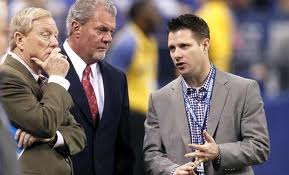
On Monday, a day after the conclusion of the NFL season, the Tampa Bay Buccaneers fired head coach Raheem Morris. The St. Louis Rams also parted ways with Steve Spagnuolo, the Chicago Bears fired general manager Jerry Angelo and ended the services of Mike Martz as offensive coordinator. The Indianapolis Colts let go of Bill Polian and his son, Chris. The Miami Dolphins also fired Tony Sparano. And that’s just what I could think of off the top of my head, there could have been more.
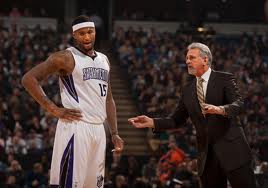
But then today the Sacramento Kings fired Paul Westphal, just seven games into the season – just 11 days after the season began on Christmas Day.
Even with the NBA’s reduced 66-game schedule, that’s the equivalent of an NFL team firing a coach after one game.
Were these firings justified? In the proper context, perhaps.
With a bigger picture outlook, what exactly do we require from coaches? Better yet, why do we keep rehiring the same ones who failed so miserably prior to their current position?
Because it is not a “what do we want” from them issue. That much is clear: championships. Owners and fans want coaches who bring gold back at the end of a season.
But realistically, 31 coaches will not win a championship each year in the NFL. Roughly the same number of losers exists each year in the NBA and Major League Baseball.
We somehow operate under the premise that every team should be good or make the playoffs in every sport. They can’t.

No, really, they can’t.

Some teams are just bad and will remain that way until a coach has enough time to put his practices and methodologies in place and the players respond accordingly.

But the instant a team doesn’t make a miraculous worst-to-first turnaround we get jealous, demand our favorite teams get the same and grab the pitchforks, banners and start shouting, “Fire him. Fire him now!”

We certainly love teams that click and quickly succeed after recent failures, but in reality, they fuel the cycle. In turn, it ends up shortening the lease for the coach who did it.

Morris’ Tampa Bay team clearly underachieved this season. A promising team with talent that won 10 games in 2010, they won just four games this season. In three years, Morris went 17-31 after replacing Jon Gruden, who was in turn let go by the Buccaneers in 2008, after he went 57-55 with the team over seven seasons.
Gruden’s tenure included three division championships and a Super Bowl win.
I suppose if Gruden wasn’t doing a good enough job for his boss, Morris certainly was not, either. But Morris wasn’t coaching Gruden’s players; the Bucs has a ton of young talent come in through the draft, playing in a division against the likes of Atlanta and New Orleans, two teams who have been perennial playoff teams in recent years.
The Colts firings seem most justified, as they poor draft selections over the past five years were radically and violently exposed to the fan base and to the rest of the league once Peyton Manning sat out the season following a series of neck surgeries. A team that finished 14-2 and lost a tight Super Bowl to New Orleans just two seasons ago – and went 10-6 and made the playoffs last year with nearly the exact same roster – managed to start out 0-13 in 2011 and finished 2-14 with the rights to the No. 1 pick in April’s draft.
As I wrote in the fall – someone has to lose their job over this in Indy, and someone did. Perhaps Jim Caldwell is safe because it has been evaluated that the coaching is acceptable, but the talent is poor.
Look, I’m all for change if something’s not working. I advocated for Polian’s firing, as well as Caldwell’s, earlier this season. I questioned Caldwell’s methods and his credentials and the man responsible for hiring him and picking the players in Indianapolis.
But I’m also in favor of a good stew, which takes time to cook and requires patience and the right ingredients.

And here’s where we have to start really analyzing everything.

Why didn’t the Dolphins just fire Sparano after the 0-7 start? Why do it after the team rallies around him and wins six of its final nine games? Isn’t it humiliating and emasculating to continue to coach a team knowing what’s floating out in the media?
Why fire Westphal a few days after the season begins? How did his job approval amongst his employers drop so drastically in 11 days that he was canned? Why not just fire him during the offseason, you know, the one with the lockout that saw the NBA not play a game for six (!) months? Did this have something to do with DeMarcus Cousins and the trade demand?
There’s goals, aspirations and then there are realistic (and in many cases, unrealistic) expectations.
I read a recent interview with Duke head men’s basketball coach Mike Krzyzewski. Coach K’s third season at Duke was abysmal. In 1982-83, Duke was 11-17 and 7th in the ACC. He said if he had began his career 20 years later, he would have been fired. But in a time where people were allowed to truly build a program and had ownership support, or in this case, school support, Coach K got Duke on the right track shortly thereafter. In the roughly 30 years since that 1982-93 season, Duke has won four national champions, made the NCAA Tournament 28 times in 29 years and advanced to the Sweet 16 or better 22 times.
Look at it this way: who are these NFL teams going to hire? Most likely a former NFL coach who had his own ups and downs in the past.
Ironically, Gruden is one of the hottest coaching prospects despite his intentions to stay on as a member of the ESPN “Monday Night Football” broadcast team. The same guy who was barely .500 in seven seasons with Tampa Bay.
Coaches are getting hired and they turn right around and start a game of Russian roulette with job security.
What were the Kings goals for Westphal when he took the job? I can’t imagine the Kings told Westphal, “We’ll have to let you go if you enter Year 3 with a 2-5 record 11 days into the season.” Never mind the incredibly raw talent Westphal has to work with in Tyreke Evans and DeMarcus Cousins (a head case).
What we need are more specific boundaries and performance plans for professional coaches. Maybe they should be unionizing in professional sports coaching like players do. Because this little game we play makes it awfully difficult to believe coaches have any real authority over their players.
They have little time to follow through on the ideas and plans that probably got them hired in the first place.
Yet we’re up and down on coaches all the time. Tom Coughlin went from the “This Seat Is So Hot My Pants Are On Fire” back in 2006 to winning the Super Bowl and receiving a lucrative contract extension in about 12 months.

How does that happen? Was Coughlin really that bad or really that good? Or was it somewhere in the middle?

There is something to be said for longevity. Not just in a coach sustaining it, but being given it.

In December 2008, I wrote a similar column about this topic, when six NBA head coaches had already been fired in the first month and a half of that season.

Reggie Theus was fired in Sacramento after the Kings’ 6-18 start. Bad? Absolutely. Indefensible? Not entirely.
In 2007 the Kings traded away their best player and most valuable commodity, guard Mike Bibby. At the time of Theus’ firing, Kevin Martin, Brad Miller and Francisco Garcia, the Kings’ best players, had missed significant time.

So the question I posed three years ago was this: who are the Kings going to bring in to coach this team and make them that much better for the duration of the season?

And, if you’re going to fire a coach, why not do it during the offseason? Unless, his name is Isiah Thomas, you’re basically wasting your time.

Nowadays, it would take a coach six or seven teams (or more) over 15 years (or more) to accomplish what they have.

It’s a merry-go-round of professional coaching. No new ideas, but the same astonished reactions when these coaches fail all over again. At what point do coaches just stop interviewing when these jobs open up, since they know they will be fired sooner rather than later?

For once, I’m glad I’m not involved in professional sports.

There’s more stability in the current job market.
Standard