Last night, I was faced with a most troubling decision.
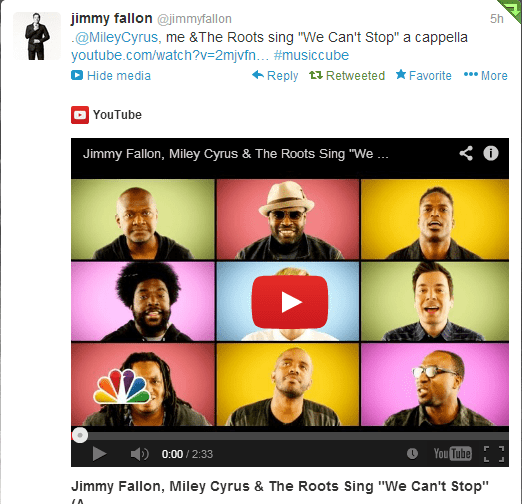
As I thumbed through my Twitter feed, I came across a tweet from one of my favorite entertainers, Jimmy Fallon.
But it was a video featuring Miley Cyrus. For reasons that should be obvious, I cringed.
Oh, the dilemma.
See, on the one hand, everything that Jimmy Fallon does is amazing. But on the other, pretty much everything that Miley does make me want to lock my daughter in our house until she’s 30.
Convinced Fallon is the next Johnny Carson, I finally clicked on the link to his A capella version of “We Can’t Stop” with Miley Cyrus and The Roots, despite an aforementioned aversion to Cyrus and her recent antics.
I loved it.
I think (and desperately hope) this probably speaks more to Fallon being great at everything than this does the song or artist itself. Yet it was so well done, I couldn’t stop listening to it. I hit replay probably 10 times. There was harmony, tenderness and sadness – you forget that in between the music video weirdness, tongue sticking out weirdness and a variety of other weirdities, Miley Cyrus can indeed sing.
I was moved by the little video – and that was without really listening to the words.
And then I did listen to the words.
The more I listened to the song – then Googled the original version of the song and listened to it, too – I noticed that the lyrics were not just completely out of my realm, but wondered what segment of society they were relatable to? A much segmented part of our youth population I am guessing.
Hey, I get it; the song is catchy, has a good beat and sounds fun. It could be every major pop hit we’ve had for the past few years. Lyrics do matter, regardless of what anyone tells you. What a song says is as important and influential as its sound.
Yet I am not that old. I’ve listened to tons of pop, rock and alternate music and grew up in a pretty good era for it.
That said, what the recent stream of young artists say in these tunes has a whole lot more to do with us than it does them, since we buy it, play it on repeat and call it “my jam.”
I think we get the message: Miley Cyrus has matured from that little Hanna Montana girl she used to be. But it is a farce, from the outsider perspective, to say Miley knows who she is right now. She’s 20. She has no clue who she is. Most everyone I’ve ever known would agree. “Twenty?” they answer. “Oh, I was a disaster.”
And everyone between the ages of roughly 28 and 100 is nodding in agreement. You just can’t know, but the problem is you think you do. At that age, you are stuck between adolescence and adult, emerging rebellion and responsibility.
Is Miley Cyrus tormented and struggling? Maybe. Certainly to her, she is. To the vast majority of 20, 21, 22-year-olds, what they see as a struggle varies greatly from what Miley Cyrus sees as a struggle.
They can’t afford to dance with “Molly” and wave their arms in clubs like they don’t have a care. They can on weekends, I suppose, between jobs and/or classes, then reality hits on Monday morning when they wake up in a dorm with a presentation due that afternoon, or they are late for their job.
For Miley, she’s missing a key component to this dichotomy: the earlier you begin entertaining the rest of us, the less you are like us. Likewise, we can’t relate to you, even if we grew up with you. You live in your own box long enough, when you speak, the words that come out won’t make sense to us. Just ask Britney Spears.
The conventional vanity of our pop-culture driven world cannot be afforded – monetarily or morally – by really anyone outside the very circle that creates it in the first place.
Us “normal folk” watch it all and are either horrified or entertained – and sometimes both. But we watch. We watch because it’s there, and because 25 percent of it looks fun, and because we’re pretty sure the singers, actors and athletes we watch are going to implode in a variety of sadly predictable ways: drugs, bankruptcy or because they are actually just bad people.
Yet it remains a cycle we have been unable to stop for at least the past 40-50 years: we gorge ourselves on what they do, their accomplishments and products, which makes them rich and bored, in turn causing them to gorge on things like drugs, mansions or any number of material items that the rest of us aren’t addicted to, in part because we can’t afford them and our version of reality kept the need for self-control.
In this song, “We Can’t Stop”, Miley sings of not stopping and doing what she wants. This is both an idea that we can totally relate to, yet at the same time have no concept of the specific meaning she has in her mind when the lyrics pass her lips. Because we haven’t experienced what it is Miley won’t stop.
And this is exactly the point where our worlds differ: she means what she sings, while we’re listening to it and enjoying it in a generalized, passive sort of way. It’s not necessarily the lyrics don’t have meaning, but they don’t really mean anything to her audience.
Where she can’t stop (though I do wonder if even Miley knows what exactly she won’t stop or if it’s just the idea of being a rebellious figure that’s so appealing to her), the rest of us must. We must stop because we have wages to earn, classes to attend and families to start.
Simultaneously, I’d like to believe there is a majority of us between the ages of 16 to 35 (assuming that’s her new demographic) that would prefer to not disrespect everyone that cares about us.
In some ways, it’s true; you can say and do whatever you want. It’s called free will and it’s a beautiful gift. But it’s what you do with that gift, or the others given to you that define who you are. And when you live in a world that most exclusively defines people by who you are, then it matters.
You can’t say you won’t stop and will do whatever you want, and then bemoan the media attention paid to your every breakdown, break-up and drug bust. Or, as Miley said earlier this week, that you don’t have a plan and just want to be popular. Talk about vanity.
It’s the same as saying you don’t like drama – but then you fill your life, your newsfeed and timeline with it and then actively seek ways to confirm that, again, you don’t like drama. In reality, you are a drama addict. We get it: important things are happening to you and it’s a bummer sometimes. But it’s only important to you because it’s happening to you.
To be fair, we’re all a little self-centered; naturally, this is because we are us. I inherently care way more about what’s going on in my life than you do because it’s, well, my life. But our society is shifting that line of demarcation – the line that holds the balance in order. We’re losing our civility on these matters.
Now, we’re mostly just self-involved. The only reason everyone else usually cares to listen is because they care about you. Fail to return the favor and ask about them or listen to them, and they will most definitely start checking out on your life and all its drama.
As Mr. Miyagi once said, we must learn balance.
Self-control is not lame, it does not say anything about you other than that you have it and respect yourself and others enough to show it. But too many are taking Miley’s approach, where expressing one’s desires or partying habits is a way of showing individual freedom. This is a free country, so by all means, enjoy.
Just know that not being able to stop yourself is a sure sign of gluttony and greed. Doing whatever you want, no matter the consequences or repercussions, for yourself or others is the epitome of being not just self-involved, but a full-fledged megalomaniac. Needing credit, needing constant attention, demanding your voice be heard for no reason other than hearing yourself talk.
It’s ours, we constantly say. This country is now ours, this generation, this time. But we really mean that it’s mine. And we want everyone else to know it.
However, I’m reminded of a great passage I read recently, that speaks of how every precious thing in the world is hidden. From pearls, gold and metal to corn and nuts – all hidden somewhere. The same can be said of kindness, knowledge, self-awareness, perseverance and love. They are not easy to find in the world, or within others. But if you work hard enough to find them or cultivate them yourself, you will be rewarded.
What does all that have to do with Miley Cyrus, popular culture, and Jimmy Fallon?
I honestly don’t know, but repeatedly watching that video they made caused me to pull this narrative together and come to this conclusion: I am disappointed in the laziness of a culture that demands they can’t stop doing all the things that speak of greed and gluttony, while refusing to do anything redeeming, good or kind.
If we’re going to grab the mic and demand to be heard, we better have a message worth hearing.
Maybe Miley is right about something grander than what she sings, because she is actually spot on: we can’t stop. As a nation, we like to “par-dy”, do whatever we want. Our Molly is what it’s been for many years and decades: unquenchable, unrelenting, power – at home and abroad.
And chasing that power had led us to this point, where a former cute and cuddly child-star is now a wannabe grown-up at 20, being provocative solely for the sake of attention and being famous – not even because she’s actually provocative.
We can’t even be sincere anymore about being insincere.
But hey, at least I know my decision to click on the video was worth it.
Jimmy Fallon never disappoints.

 worldbetweenlines.com