
“They are who we want to be, but can’t be because they can do things, or at least have the ability to do things, we couldn’t. We idolize them, though we shouldn’t, because it’s what we want.”
This was a statement made by a friend at the conclusion of a nearly four hour conversation around sports, athletes, our reality, their reality and what it all means. Some alcohol may have been involved.

It all centered around LeBron James and his play, not just in the NBA Finals, but the nonsensical idea of debating a 26-year-old’s legacy when he is not even halfway through his career.
My stance is and remains simple: I’ve accepted James for who he is. He is a hybrid version of Scottie Pippen and Magic Johnson, two of the greatest basketball players I have ever seen. Noticed I said two of the greatest, not the greatest. James is not in the same league or category as Michael Jordan or Kobe Bryant. And not just because of the rings. It is because he is a completely different kind of player.
My friend’s stance is and remains just as simple: As a former athlete, like myself, he can never understand why James has all the physical tools, but none of the mental makeup of the all time greats. To him – and even a James defender like me – we cannot understand how he has shied away from the leadership, the hunger and desire required to be in the realm of Jordan, Bird, Magic, Kobe and Bill Russell.
“We had that desire and 10 percent of the talent,” my friend says, voice raised and fists clutched. “I can’t root for a guy like that – it’s wrong against every notion of what sports are supposed to be about.”
And then he dropped the quote on me that led this blog.
Is that why we watch sports? Move beyond the entertainment and escape from our everyday lives, and ask yourself why you watch sports. We have a vested interest in teams and players we know nothing about. We loathe them and love them at the same time. We bemoan their salaries and then turn around and buy their jerseys.
For me, I do it because I am a history guy. I majored in it in college and love the stories. That’s really all history is, somebody’s story or interpretation of what happened. Their reality becomes ours.
So for someone like me, sports are a big part of my life so that one day I can tell people, we were there when “it” happened. I do not often recall games from 10 years ago, but I can tell you who won and the interactions I had with the people in the room. I know where I was for the 2004 American League Championship Series, when the Boston Red Sox became the first team in baseball history to come back from a three game hole and win a seven game series.
I can tell you where I was when the Indiana Pacers and Detroit Pistons had their brawl. I can tell you about being in Yankee Stadium, as a Red Sox fan, with my dad, a Yankee fan, on September 11, 2008 – when the emotion of the seventh anniversary of 9/11 and the eighth-to-last game ever to be played in the “House That Ruth Built” had grown men in the Brox bleachers in uncontrollable, sobbing tears.
Basically, whatever “it” is, it was great and you should have been there.
But do we really want to be the people we watch? Do we wish we had their talents and their reality?
The only way I can explain it is this: our reverence fades and we try to replace it, but never can. I have a personal example with this.
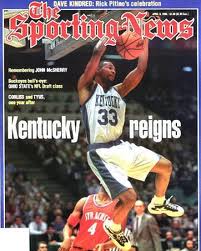
In 1996, the University of Kentucky won the NCAA men’s basketball championship. I watched the game with my family as a high school sophomore on Spring Break in Sanibel Island, Florida.
The team was loaded with NBA talent: Tony Delk hit seven threes in the game, Walter McCarty was an athletic freak who ran, dunked, slashed and defended. Antoine Walker was too big a star to be in college. Jeff Sheppard was a pogo stick with deadly range. Ron Mercer was a sensational freshman destined to led the team the following year. Not to be listed as footnotes: Derek Anderson, Nazr Mohammed, Wayne Turner and coach Rick Pitino.
They were called “The Untouchables” because they were so good, no one could hang with them. Nine players ended up in the NBA from that team.
Two months after they won the title, I found myself in a Lexington dorm room at Rick Pitino’s basketball camp. One of my good friends was a huge Kentucky fan and had talked me into going with him for a couple of years. It was always enjoyable and you picked up some good drills, plus, every now and then, some of the players would be around and you could watch them play pickup ball in the evenings after dinner.
That year was different. We’d be watching the players of the current reigning National Champions. That week was different, too. Every player was there – and they were acting as camp instructors and coaches.
As luck would have it, I ended up on Walter McCarty’s team.
The week was a blur. McCarty was on cloud nine after winning the title and, as a senior, he was headed to the NBA Draft, so he was in a great mood and fun loving. The seven of us chosen to play on his team felt like his buddies, members of a special posse for the man they called “Ice”.
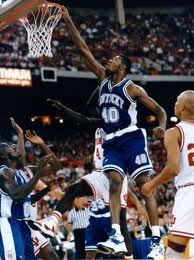
We had a pregame chant (we played twice a day in between drills and stations and McCarty was with us at least 12 hours a day):
McCarty: “Who you with?”
Us “”Ice!”
McCarty: “Who you with?”
Us: “ICE!”
McCarty: “What time is it?”
Us: “Game time!”
McCarty: “What time is it?”
Us: “GAME TIME!”
It’s been 15 years and I still have that etched in my brain. McCarty laid down a nickname for me – “Flyin’ Brian” – for the way I hustled and flew all over the court. He nicknamed everyone on the team. We had pizza and video game parties in his room several times and he’d point at us during the player scrimmages when we did something. We’d all yell out “Ice!!!” in unison.
We were hooked. It was surreal. At 16, I spent a week hanging out with a future NBA player who was riding a wave of good reviews following the NCAA Tournament. In two weeks, he’d be picked 19th overall in the first round by the New York Knicks.
Throughout the week, I felt terrible for my friend. He was the Kentucky fan, but not as lucky with his assigned coach. Each night, I’d relay to him in graphic detail the events of the day, from what shoes McCarty had on to how funny his jokes were. It was a simultaneous feeling of guilt and joy. I could not contain the joy of having hung out with McCarty all day, but telling him made me feel like he was dying a little on the inside.
I left that camp the biggest Walter McCarty fan on the planet. For his first year in the NBA, I followed his box score every day, hoping to see how well he did. It was personal. I had shared experiences with him and we were buds.
Except we really were not. I suppose it’s the same feeling someone gets from a fantasy camp, those guys that spend $50,000 to go and play with Michael Jordan at his camp for a day. You want to share that floor, that moment, with them.
Over the years, I lost track of McCarty’s career and certainly didn’t follow him as closely as I did as an impressionable teenager. And like many fans, you follow a player you like and then you move on – always looking for the next one, the next superstar, the next thrilling moment, the next time you’ll be sharing real time and hard reality with them.
And so it is with LeBron. He’s dealing with an entire generation of media and fans that grew up with Jordan, Magic and Bird, Pippen and Kobe. We’ve seen greatness and we want it again. We just want it to be better than it was before, we want LeBron to be better than anything we’ve ever seen, mainly just so we can say we saw it and we were there.
But it can’t be better, because nothing can ever be replicated. Take my week hanging out with Walter McCarty. I will absolutely not have another experience with an athlete as cool as that. Too many mitigating factors at play: my age, my peak interest in basketball, McCarty’s rise to mid-level celebrity, Kentucky on the heels of a title, Pitino the hottest coach in basketball, possibly playing some of my best ball and growing into my own as a shooter that summer and the hype of “The Untouchables.”
It was unexpected and could not be compared. Jordan wasn’t expected to win six rings. At 28, when we won his first one, we just hoped he’d win a couple and be in the conversation. James is 26. Every game his legacy is dissected, every game our opinion of him moves.
And yes, some of it is deserved. When you preen and dance and take the mantle of King or Chosen One and join up with two of the top 10 players in the league, you’re going to be despised. That’s a whole other discussion, frankly.
Just for now, we have to stop doing a disservice by comparing James to Jordan and the other greats. Not for James’ sake – but for our own. Because no matter how good or how bad, he’s never going to be good enough for us.
Remember, we can’t make them be what we want as people or athletes. And even if we could, we wouldn’t really want it that way because it wouldn’t feel real. But it does not stop us from wanting that of athletes and of sports.
We still want to be there when it happens.
Whatever “it” is.
 worldbetweenlines.com