Billy Beane, Daryl Morey, ESPN, Houston Rockets, Major League Baseball, Moneyball, Oakland A's, Paul DePodesta

Use Your Illusion: The Truth Behind "Moneyball"

One night this week, my wife and I saw the trailer for Moneyball. We both want to see it, but probably won’t because of two key subplots conspiring to keep us from seeing the film:
1. Our son, and fourth child, is due in less than two weeks, and once that happens, we won’t see a movie in the theaters that doesn’t involve animation until at least 2015.
2.  I can’t stand to pay to see a movie I already know the ending to.
Look, I was intrigued by the idea of a film with Brad Pitt playing Billy Beane, the general manager of the Oakland A’s, who back in 2002, threw himself in the Sabermetrics camp and became a believer in the work of Bill James.
There’s some great lines in the trailer and Pitt is Pitt. As my wife notes, in every film we’ve seen of his, he’s always shoving some sort of food in his mouth and talking while doing so. It’s just funny because we do that, too.
But I know how this ends and so do you [SPOILER ALERT: The A’s win the division!]
Yet beyond knowing the ending, I have a bigger issue with Moneyball, both the movie and the system. Better yet, my issue lies with the notion that it’s solved some great mystery or unearthed this hidden secret that cures disease. The press are fawning all over the movie, which in turn has led to even more glowing reviews of the 2003 book, which in turn has led to some universally agreed notion that Moneyball was brilliant and somehow the work of Einstein-like statistical geniuses.
And that it even really worked to the extent we’re led to believe it did.
Here’s the deal: the whole premise suggests that the Oakland A’s were a down on their luck, cash-strapped Major League Baseball team in the winter of 2001 and that Beane, using Bill James’ Sabermetrics, threw caution to the wind and shocked everyone by building a baseball team around undervalued players who would contribute pieces to a larger puzzle. Michael Lewis then wrote a book about it.
In truth, while the A’s were cash-strapped, they also won 102 games and made the playoffs in 2001.
Every team would have a hard time duplicating a 100-win season, no matter if you are the A’s or the New York Yankees with a payroll four times as large.
Yes, the A’s lost Jason Giambi, Johnny Damon and Jason Isringhausen, all three of whom were critical players to the 2001 team, to free agency that winter. Yes, they didn’t exactly replace those guys or their production but wound up winning 103 games in 2002. In fact, they averaged 95 wins, won four division titles and made the playoffs five times from 2000-06. A tip of the cap is owed, to be sure.
Now, naturally, the film will fabricate or embellish some of the story to make it more entertaining or dramatic. It’s not just the “Hollywood touch” that grinds my gears, but this notion that the Oakland A’s were made up of players from the scrap heap.
Take Jeremy Giambi, Jason’s brother, for example. Jeremy Giambi played in 124 games for the A’s in 2001, with over 400 plate appearances. That’s not the scrap heap.
David Justice, though not as productive as he had been earlier in his career with the Atlanta Braves, wasn’t exactly a slouch. True, Justice hit just .241 in 2001 for the Yankees, but that was his lowest average since he was called up by the Braves in 1989, when he played in just 16 games. The year prior to 2001, Justice hit .286 with 118 RBI and had an OPS of .977. Justice was also injured in 2001, missing 51 games. It’s not totally out of the question to think that Justice just had a bad, injury riddled 2001 season. Again, he wasn’t exactly rescued off the scrap heap or ignored. He was just getting older and broken down and most teams didn’t want to take the risk.
As for replacing Johnny Damon, let’s not get all revisionist that this was the blow to end all blows, some superstar ditching poor Oakland leaving them with a leadoff hitter gap the size of the Bay to fill.
If we’re going to use stats, we can’t just pick and choose which ones work and which ones don’t fit our neat little message of Moneyball.
So try this on: Damon hit just .256, with 9 home runs and 49 RBI in 2001, which according to Baseball-Reference.com’s fun little Wins Above Replacement (bWAR), he was worth a grand total of 2.7 wins more than his replacement that season.
It’s the same for Isringhausen, who was 2.2 wins above his replacement. The two combined for 4.9 wins more than their replacements would have given them in 2001.
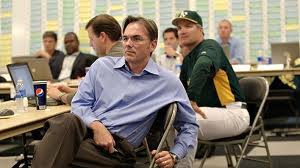
But even those stats don’t tell us the complete story. Despite all the moves, the replacements for Damon, Giambi and Isringhausen didn’t fully replace their production in 2002. Justice missed most of May with an injury and played in just 118 games. He didn’t even top Damon at the plate in terms of production, hitting just .266 with 11 home runs and 49 RBIs. Near identical numbers to Damon’s sub-par 2001 season (same number of RBIs, but the downside is, Justice was supposed to be a power hitter, not a leadoff man).
You may be asking what this all means and why the six paragraphs of boring stats that only diehard baseball fans care about?
Because I’m using them to make a point: Moneyball isn’t all that it’s cracked up to be. It helped a team whose owner didn’t want to spend money stay competitive, but really, a majority of any team’s success is luck. The stats say that the 2002 A’s lost 11 wins from their 2001 roster, but somehow ended up with one more win than the previous season. How?
Well, since there must be a logical answer for everything, it has to be this wild, kooky and adventurous Moneyball thing, right?
They outplayed their potential and talent, winning a ton of one-run games. Here’s some more fun facts: in 2001, the A’s went 21-19 in one-run games. In 2002, they went 32-14 in one-run games. What was the difference?
How about sheer luck? One-run games are luck, because according to a team’s projected record based on the number of runs scored and allowed, team records in one-run games most often veer toward .500.
The luck turned a bit in 2003, and the A’s went 25-20 in one-run games, which is still good. But they won 96 games, seven wins fewer than the previous season.
Yet even if you can argue the benefits of Moneyball, did it really win anything for the A’s? They still got beat by the Yankees in 2001, the Twins in 2002 and the Red Sox in 2003. Can you call it a method of winning if you never really win anything other than a few division titles and a wild card?
Maybe more teams should have copied the Florida Marlins system of drafting good players, signing some aging vets, waiting until it all merges for one season, win a title (which they did twice in 1997 and 2003) and then hold a fire sale after because you can’t keep the players or re-sign them?
The truth is, the A’s weren’t just lucky. They had good pitching. The pitching staff was just plain sick during that period. And the majority of their staff was homegrown. Tim Hudson, Barry Zito and Mark Mulder were all drafted by the A’s. So were position players Miguel Tejada and Eric Chavez.
Zito won the Cy Young Award in 2002, and along with Mulder and Hudson, the three combined to win 57 games. All had low ERAs. Tejada won the AL MVP and hit 34 home runs, driving in 131 runs. Chavez won a Gold Glove.
Beane and the “genius” Paul DePodesta, who was really the brainchild behind Moneyball within the organization by imploring James’ work, didn’t come up with these guys off the scrap heap or a computer program that spit out projected stats. These players were already within the A’s farm system.
So maybe the A’s were good because they nailed their draft picks and had good talent already in place. DePodestra joined the team after all those homegrown stars were there and didn’t even get involved in the A’s draft plans until 2002.
Speaking of those post Moneyball drafts, the system and its strategies hasn’t been a total hit, either. Nick Swisher was the only guy targeted in the 2002 draft that has amounted to anything in the major leagues. However, here are the players that Beane dismissed in the 2002 draft: Prince Fielder (whom Beane called too fat to play for the A’s), Jeff Francis and Scott Kazmir. Though Francis and Kazmir haven’t been that successful, in context they were far more so than the A’s other picks. And Fielder? Well, he looks like a future Hall of Famer.
To be fair, this isn’t an attempt to discredit Moneyball, either.
Clearly, Beane and DePodesta came upon something unique by finding talent and maximizing wins where other teams had not yet located it in replacement players or cost effective replacement players who’d get on base, score runs or play good defense. And Beane and DePodesta deserve much credit for accomplishing what the team did during the early to mid-2000s, especially facing two financial goliaths in the American League, Boston and New York – as well as third big spender in the Texas Rangers – who were spending more money than the A’s could dream of on their rosters. By spending just $41 million in that 2002 season, the A’s remained competitive, for sure.
But isn’t the point to win the game, in the words of Herm Edwards?
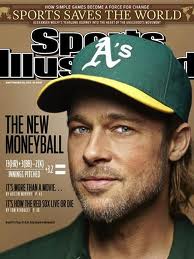
ESPN is running infomercials that point to Moneyball completely changing not only baseball, but others sports, and in some ways, it’s mildly suggested in the ads, the world. Sports Illustrated put Pitt on the cover of this week’s magazine.
Many point to the Houston Rockets and GM Daryl Morey for his work with Moneyball in the NBA. Is it really working? Since Morey took over the Rockets in May of 2007, the team has dropped in total wins in each of his four seasons (55 in 2007-08, 53 in 2008-09, 42 in 2009-10, then up just one game to 43 in 2010-11). Houston has also missed the playoffs the past two seasons.
Changing the world? That’s a bit of a stretch. I’m not even sure if it’s changing professional sports in terms of final outcome.
Considering that the A’s missed the playoffs in 2004 and 2005 and aside from winning the division in 2006, have missed the playoffs for five consecutive seasons, is it working? When you haven’t been winning with the system over a sustained period of time, can it be that much of a success?
Give Moneyball credit for getting baseball people to look beyond just batting average and RBIs and helping teams find new ways of production. But let’s try to restrain ourselves from slobbering all over it as some magical elixir that’s a proven system for winning. Hollywood’s done enough of that embellishment already.
All it does it give new meaning to Moneyball – how we as an audience got played into spending money to believe the system was and is something much more than it is.
Though we won’t ever see a book or movie exposing it as such, that’s a movie I’d get a babysitter to see. 
Standard
Barry Bonds, Boston Red Sox, Indianapolis Colts, Major League Baseball, Oklahoma City Thunder, Pittsburgh Pirates

Really Bad Eggs

Why the Pirates Are Obligated to Loot and Plunder at the Trade Deadline
More than anything in professional sports, as a fan, I just want everyone’s effort.
Just try to look like you care, because we do.
Fair or not, it’s the truth. If you are in a relationship and you’re dogging it, you’ll hear about it – at least if the other party cares at all. And that’s the point, people tell you to try harder and get better or give more effort because they care.
That’s what sports fans do. And after so long, if you believe that a team or its players stopped trying, you eventually check out.
All of this explains why no one cares about the Pittsburgh Pirates resurgent 2011 season.
For the first time in 18 long years, the Pirates are on track to have a winning record. Hell, they’re on track to win their division. If this were any other team in just about any other sport, you’d have been inundated with stories, columns and blogs about it.
Until today, when ESPN ran a story by JerryCrasnik, it was crickets.
And lack of effort explains why.
The Pirates used to be respected. They used to be the big boys on the National League block. They were “the Family” in the 1970s and in the early 1990s, they won three straight division titles headlined by the original “Killer B’s” – Barry Bonds (pre-size 22 head) and Bobby Bonilla. Then some scrub named Francisco Cabrera, the last position player on the Atlanta Braves bench, singled in a broken-down Sid Bream to win a thrilling Game 7 of the 1992 NLCS.
And since that time, all they’ve done is secure a spot in the record books as the team with the most consecutive losing seasons in all four major U.S. sports.
Over the last two decades, the Pirates haven’t even tried. Either by management or by players, they have failed spectacularly.
Oh, there was the time in 1997 that they finished runner-up in the division (albeit with a losing record). Perhaps they would have fared better if not for that bloated $9 million payroll. Even by 1997 standards, that’s obscenely low.
The explanation has been the painfully lame “we’re a small market team and we have no money.”
Then either contract the team, sell it or move it. Or perhaps teams like Pittsburgh could have and should have used some of their massive revenue sharing kickbacks to field a more competitive team.
Take 2008, for example: The Pirates had a payroll of roughly $50.8 million. But they were given $39 million in revenue sharing.
What in the world are they doing with their money?
Well, they did build PNC Park for the 2001 season – which the Pirates opened with a 100 loss season.
What a waste.

The Pirates blew a golden opportunity there. After years of attendance decline (they dropped to an average of 12,577 fans per game in 1995), the 2001 season saw fans come out in droves to the new stadium. 

But what did they do with the 2001 average attendance of 30,834? As one might guess with a team that finished tied for the worst record in baseball at 62-100, they dropped back to 23,148 fans per game in 2002.

It’s basically been falling ever since, hitting 19,479 in 2009.

In every year since 1992 except the 2001 season, the Pirates are at half the league average in attendance.
It’s not something that you can blame on a market. In fact, just stop blaming markets and fans altogether. You bought the team, you knew what you were getting into, the market, the stadium situation, all that. You either want to own that particular team and try to make it a winner or you don’t.

Lots of small market teams draw fans – as long as they are competitive. Look at the Indianapolis Colts or the Oklahoma City Thunder. Good players and good teams bring in fans. Fans want to watch their home team contend.

Forget actually winning, we just want contending. Contending means you have a chance.
As a kid, I enjoyed the underdog. In many ways, I still do. Some of my favorite teams have been underdogs. Others are the big market bad boys who spend among the most. For instance, the Boston Red Sox paid $52 million out in revenue sharing in 2008, but they also spent $147 million.
The difference between the Sox (2nd in payroll) and the Pirates (29th of out 30) was astronomical, both in the money and wins departments, as the Sox paid three times as much for their roster as the Pirates did – and the Sox revenue sharing dues were more than what the Pirates paid for their entire roster.
Even if the Pirates could not afford a decent team for the last 18 years, why didn’t they try something, anything, to prove they cared? The Oakland A’s did not have any money either and they turned to stats and metrics to get the most bang for their buck. They’ve even got Brad Pitt starring in a movie about it – “Moneyball”.
The Chicago Cubs haven’t won a World Series in 102 years, but for the most part, they’re trying. You don’t find them on the list of those receive revenue sharing (yes, there are other reasons, like TV contracts and a massive fan base).
For crying out loud, even the Florida Marlins try once every seven years before selling off half the team. They’ve won two World Series titles in the last 15 years just by growing talent and having one season to see if it wins before blowing it up. The Pirates don’t even do that.
Until now. Now is there chance to redeem just a little bit of the last shameful 18 years. To give back to the poor schmucks that stayed with the Pirates and kept coming to games and buying the black and gold.
With a 50-44 record, the Pirates are a half-game up in the NL Central. Granted, the Central is perhaps the weakest division in baseball – but the Pirates are right there. There’s a little thing called the trade deadline just around the corner.
Do something, Pirates.
Pick up an arm. Pick up a bat. Hell, pick up both. There are difference makers out there. Just do something. Anything.
Just try.
Standard
Allen Iverson, Brett Favre, Major League Baseball, NBA, NFL, Sports, Tiger Woods, Yankee Stadium

From the Vault: A Few Good Fans

(Note: The following was originally written a little over two years ago, but some portions have been updated to fit the current times. It is being re-posted on this blog at the request of a Cube follower)
Dear Sports,
I hope this letter finds you well.
Oh, who are we kidding? We both know where this letter finds you – and it’s a hell of a long way from well.  
We need to talk, sports. We need to create a dialogue, an open line of communication – something you have a hard time doing amongst your owners and players in nearly even major damn sport America has.
If we don’t start communicating and conducting some much needed group therapy, I fear that we’ll drift further apart until our relationship is irrevocably damaged.
And the truth is, a divorce would hurt you much more than me or the rest of us fans.
You need fans, you really do. You think we just follow you in droves? We survived for hundreds of years without you, frankly. We made things in this country. We can get obsessed over muscle cars again, if we have to. We can play Angry Birds, we can all get into music and films. We don’t need you to survive.
We love you, but we’re not feeling the love from you right now.
Sure, you secretly despise us for our irrational behavior, our lofty expectations and our demands. And granted, it’s embarrassing for you when we wear paper bags during a bad decade or two. Or when we drink ourselves into a stupor and throw empty cups onto your players. Or when we confront them in the parking lot after the games.
We can take responsibility for our actions. Can you?
You haven’t exactly been treating us like royalty as of late.
Some of your guys (we’re looking at you, Charlie Villanueva) are Twittering, er, Tweeting (whatever bird sound it is) – at halftime, no less – to stay in touch with us. Sweet, really. But, um, maybe they should take it just a tad more serious?
See, we think that our favorite teams paying triple what a doctor or president makes (or roughly about 300 times what we make in our profession) brings on expectations that for six months during the season, they should, you know, try really, really hard and stuff.
And yes, Allen Iverson, I’m talkin’ about practice too, man.
Speaking of taking things serious, that’s part of the problem. Most of the time, when we fight, you accuse us of taking things too seriously and we don’t think you take it quite serious enough.
Different worlds, I suppose. You are not the one who has to clumsily explain the Tiger Woods sex scandal or baseball’s steroid era to their impressionable, inquisitive and sports obsessed nine-year-old.
Thanks for that, and all the naked athlete cell phone pics, by the way. It’s been a real treat spraining my thumbs trying to change channels when a new story breaks. And I’m fairly certain my children think I have a stutter because of my stumbling and baffled responses to their questions. But I digress.
As fans, we lack the resources, the guilty pleasures, the comfort of the payday you provide your players and coaches. In fairness, the vast majority of us don’t have the inherit skill to break down film, the athleticism, the stamina required or the knowledge of a particular sport. Then again, neither do many of the “gifted” people who announce the games for you, but that’s another story.
The one place we seem to outnumber you is in the passion department. We care about you a heck of a lot more than you care about us.
As professional leagues, you lack the passion that got you there – you forgot what it was like to be where we are. Remember empty stadiums? Remember when very few people wanted your autograph or thought your sport was a tad stupid?
Yet the passion of the athletes, owners and league offices pushed you to new heights from the 1950s-1990s. And the growing fan bases of your various sports helped a little bit, don’t you think?
So we ask, where’s the passion?
And that passion has little to do with work ethic. Most athletes are workout fanatics, busting their humps to chase a variety of things: respect, pride, trophies and, of course, a little coin.
Generally, though, pleasing the fans comes last. That’s cool, we’ve dealt with it and that simple fact explains so much.
It’s apparently why roughly 1,100 seats at the new Yankee Stadium are obstructed view. We’re not smart enough, apparently, to figure out why, in this day and age, any stadium – let alone Yankee Stadium – would be built with obstructed views. To us, that’s so 1920s.
The seats in new Yankee Stadium certainly don’t cost 1920s prices, though, do they? Even though we’re living an economy that reminds us of December 1929.
And yet, you still want $1,500 for ticket. For a single game.    
I gotta tell ya, Sports, the vast majority of us don’t make $1,500 every two weeks. And those that do are pulling into gas stations and watching it float away in a river of oil. 
So cut us some slack, will you? We’re looking for a little latitude, the same as you were with the steroid era, the NBA referee scandal and the BCS.
Now, we’re not dumb. We don’t expect $10 tickets to the Super Bowl. But work with us a little.We’d at least like to have seats that we paid for at the Super Bowl. Don’t shuffle us under the bowels of the stadium to watch it on TV because your people couldn’t get the stands together in time.
This is why we’re asking, and here’s the juicy part, where we hold all the power in this relationship – the part where you need us, but we don’t need you.
Oh, we want you, all right. Like a fat kid wants a cupcake. We lust after you, but if we can’t afford you – if you come between us and the mortgage, our kid’s college tuition, our groceries or potential family vacation…well, you’re gone.
This means that eventually, you’re really gone.
Oh sure, we don’t directly pay your salaries. These days ticket sales are just a small piece of the cash pie. But we fans find it more than ironic that your leagues are all arguing over pieces of that pie – a pie that’s adding up to $9 billion in revenue for football.
But if we stop coming to games, due to the economy or just being plain pissed off, well, who buys your $7 hot dogs and $8 beers? Who buys a t-shirt or jersey? Still think you’ll have $9 billion to argue over?
If concessions and novelties aren’t moving in the arena or the stadium – does the provider wish to continue leasing its services to you? If you have no place to play because no one is coming to your games, what are your franchises worth to rich Russians then?
Seriously, if it gets that bad in other aspects of life, if we’re just scratching for crumbs and we’re all shopping at Goodwill – if it’s a depression…well, you can think that far ahead can’t you?
If we can’t afford TiVO, cable TV, DirecTV, DISH, whatever…well, forget about live attendance – who’s watching from home? And if we’re not watching, how do the advertisers’ spots get noticed? And if the sponsors aren’t selling any products or finding any value, their money comes off the billboards, pregame shows…you get the point.
Or maybe you don’t. Maybe, for once, we need to explain it for you.
As an individual, what I spend on you over the course of a year is probably equal to what Frank McCourt spends in an hour of divorce attorney fees. If you lose me, or better yet, pieces of my wallet, you could care less because there are millions more just like me that will shell out the cash.
But what if a large portion of us fell by the wayside? What if 30 percent suddenly stopped spending our greenbacks on you? What about 50 percent? What about 60 percent?
Working up a sweat just thinking about it, aren’t you, Sports?
If this recession affects 95 percent of Americans, which has been indicated, isn’t it reasonable to think that a large percentage of that group might be cutting back on those things deemed unnecessary?
Sports, in times like these, your prices become unnecessary.
So, again, you need us.
In the spirit of Jack Nicholson and “A Few Good Men“, let me paraphrase:
You need us in your stands. You need us in your seats, holding beers, brats, gloves and banners. You need us on that wall – you want us on that wall. And our absence is the very thing your athletes and coaches don’t talk about in locker rooms.
You survive under the very blanket of security that we provide and we’re starting to question the manner in which we provide it. We’d rather you just said thank you by slashing prices and making things more affordable. 
We’d appreciate it if you built stadiums in the 21st Century that you can actually see the entire field from any seat, instead of giving us another worthless bobblehead night. Either way, we don’t give a damn if the economy has affected your bottom line – we are your bottom line!
And the bottom is about to fall out of this relationship.
Sincerely,
One of a Few Good Fans
Standard
Charlie Sheen, Dave Anderson, ESPN, Josh Hamilton, Major League Baseball, Major League II, Texas Rangers, Tim Kurkjian

Them’s The Breaks

Sometimes, things just happen and it’s no one’s fault.
While we can blame certain people for certain things – like, say, Charlie Sheen for brining “warlock” and “tiger blood” into the American lexicon – it’s not quite so easy to place responsibility at any one person’s feet.
It’s important to remember this when the topic turns to Texas Rangers star outfielder and 2010 MVP Josh Hamilton’s recent injury.
In the first inning of the Rangers Tuesday game against the Detroit Tigers, Rangers third base coach Dave Anderson told Hamilton no one was covering home on a foul-ball pop-up that both the Tigers third baseman Brandon Inge and catcher Victor Martinez moved over to catch.
Detroit pitcher Brad Penny just stood on the mound – never really even moving towards home. That left the base wide open.
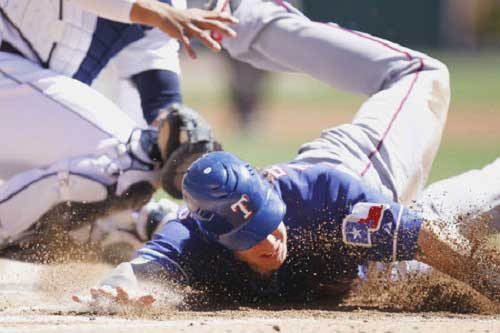
Anderson repeated the fact twice. Suddenly, Hamilton tagged up and began making the 90-foot journey to home – which prompted Martinez, who was about 50 feet away, to break towards home as well.
As you might guess, the guy with the 40-foot head start got there first.
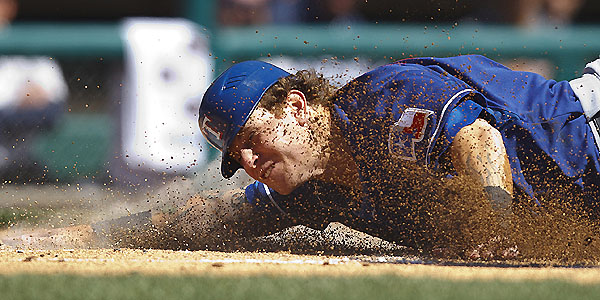
Hamilton went in all Pete Rose-ish (headfirst) and Martinez applied the tag.
And then Hamilton felt a bit of pain. Turns out, he had a small fracture develop in the humerus bone in his upper arm because of the play.
Now, Hamilton’s on the shelf for six to eight weeks. He can’t touch a bat for a month.
Then Hamilton went all crazy ex-girlfriend on Anderson after the game, calling the play “stupid” and “dumb” in the past few days and in not so many words, blaming Anderson for his injury.
He also kinda, sorta implied that he was an innocent bystander just doing his job by listening to his coach.
“I listened to my third-base coach,” Hamilton said at the time. “That’s a little too aggressive. The whole time I was watching the play I was listening. [He said] ‘Nobody’s at home, nobody’s at home.’ I was like, ‘Dude, I don’t want to do this. Something’s going to happen.’ But I listened to my coach. And how do you avoid a tag the best? By going in headfirst and get out of the way and get in there. That’s what I did.”
Come on, Josh. That’s comical in and of itself.
We all know that no one is the pros really listens to their coaches.
Apparently Hamilton is clairvoyant. He just knew that something was going to happen.
Well, if you feel that strongly about something, if you just know you’re going to get hurt, then don’t run.
And maybe don’t go in head first.
How quickly Hamilton forgets that last year he scored from second base on an infield hit. As ESPN’s Tim Kurkjian pointed out, Hamilton called it his proudest moment at the time.
Anderson referenced that as well yesterday.
“You think about in the past what we’ve done,” he said. “He’s scored from second on a groundout to the infield twice. He’s scored from first on a long single. We’ve done double steals with him. That’s a part of our game is being aggressive and taking advantage of situations. The unfortunate part is that he got hurt. But if you go out and play the game and play hard, those things are going to happen.”
So if you are Josh Hamilton, what you can do is show two sides of a coin: you’re either aggressive and hungry enough to want to score on weird plays like that, or you’re more of the cautious type. But you can’t be both.
This whole saga got blown a little out of proportion on Wednesday, with sports radio dials everywhere dissecting the play 30 different ways.
Headfirst or feet first? Was it important to even try in the first inning of a game in mid-April? Was it Anderson’s fault because he kept repeating it like he wanted Hamilton to go? Was Hamilton just a good soldier? What does this say about the future of baseball, in youth ball or the pros – will players start thinking more for themselves on the basepaths?
Seriously, fellas? I know it’s a little slow these days – NFL lockout dragging on, NBA playoffs not yet started, no real attention grabbing headlines – but to spend nearly two hours of your show on subplots in this one play that really don’t exist is a bit much, even for a guy like me.
I shudder to think what the current media would have done with Roger Dorn when he was told to get out there and take one for the team in “Major League II.” We would have heard Dorn was a company line-toeing stooge, or that Jake Taylor’s old-school ways had gone too far this time.
We ruin so many moments in sports and life by over analyzing them.
Just let it be.
Hamilton tried to score – and if he would have, people would be talking about what an amazing, gutsy, heads-up play he made. That plays like that are the difference between great and good.
So he got hurt, so what? Yes, he’s out six-to-eight weeks. Yes, he can’t even swing a bat until mid-May. But let’s look at Hamilton’s track record for injuries:
April 2011         Fractured arm
Sept. 2010        Fractured ribs
June 2010         Hamstring tightness
May 2010          Knee
Sept. 2009        Pinched nerve (neck)
June 2009         Torn abdominal muscle
April 2009         Strained ribs
Face it, the guy was going to miss some games at some point. Since getting into the majors full-time in 2007, Hamilton has played in 133 games or more only once in a season (2008).
“I can understand that if I was pulling things like hamstrings or quads and it was not actual high-intensity things like hitting walls,” Hamilton said. “I’m making plays that the game calls me to make and I’m getting injured that way. That proves to me that I can get hurt anytime doing anything. I’m tired of talking about it, to be honest with you.”
But he said he wouldn’t change the way he plays.
“How else would I play?” Hamilton said. “You can get hurt by doing anything.”
Bingo, kid. Them’s the breaks, as they used to say.
It took him a few days, but at least he understands what most of us already did. You can’t prevent the Sports Gods bringing the pain. Ricky Henderson once got frostbite from falling asleep with an ice bag on. People fall down stairs, throw out their backs bending over to pick up their kids’ toys.
Um, how shall we say, “stuff” happens.
Thankfully, Hamilton did apologize to Anderson publically and privately yesterday.
“I let my emotions get ahead of thinking things through,” Hamilton said. “The more I think about it, the more I understand that I take responsibility for what happened because I had the choice not to go or the choice to go. I just appreciate Dave having confidence in my ability to think I could make that play.”
Hamilton also added, “The object is to score and if you go feet first, that gives them all this up here to tag. It is what it is. It’s over. It sucks it happened, but it happened. We’ll deal with it.”
Exactly.
And hopefully you’ll deal with it better next time.
Standard