Baseball Hall of Fame, Baseball Writers of America, Major League Baseball, Morals

Voter Frauds

We might want to remember yesterday, January 8, 2014, as a date we will not remember. We can forget that this was the date that everyone left stopped caring about the Baseball Hall of Fame.

Just look at this mess.

From who got in to who did not, from who voted and whom they voted for to who gave their vote away, this has become one of the single dumbest topics in all of sports.

Oh, I used to care – even when my friends who had long since cared were forced to reckon with my soapbox about steroids and Pete Rose and why baseball still mattered.

But this nonsense is stripping away the final remaining people who actually cared.

The last thing most of us want to do is listen to these smug little men take their 15 minutes every year and give superfluous reasons as to why they put Craig Biggio 11th on their ballot.

Greg MadduxOr why Greg Maddux – GREG MADDUX (that’s right, all CAPS) – didn’t deserve their vote due to some preposterous unwritten rule that says because Babe Ruth wasn’t a unanimous Hall of Fame choice in 1936, no one can be.

If 11 voters left Ruth off their ballot nearly 80 years ago, then by Zeus, Greg Maddux should be left off dozens more, right? Is this an SNL sketch about Bill Bradsky? What are we doing?

Has any of these voters taken a moment to think about how comical this is? They are taking themselves and this process so serious that it is scaring people away from the topic at all.

There was a time that the debate on what to do with the players who admitted or allegedly used steroids was a decent conversation worth having. Leave them out? Create a separate wing? Change their plaques? And if we ever actually addressed that issue, Rose would have to be allowed in, too.

Now? Well, like a growing legion of baseball fans, I’m of the opinion it just doesn’t matter. We’re so caught up in the minutia; the whole thing comes off as childish as the game’s very nature.

We’re looking at you, writer guy who says he will not vote for anyone from the steroid era, then defined it with beginning and end dates and goofed when admitting you voted for a player within those dates.

Oy.

And we’re glaring at you, indigent, self-righteous hypocrites obsessed with slamming Dan LeBatard for allowing Deadpsin.com readers to vote on his ballot and proclaiming LeBatard unqualified to vote anyway – but left Maddux off your ballot entirely.

Yikes.

Who said these writers are “worthy” of casting a vote, anyway? Because they write the “beat”? Because they “cover” baseball? Thank goodness our American government doesn’t allow the same voting process. Only talk show hosts and political pundits would be allowed to choose the president, based on the fact they “cover” it for media outlets.

That coverage, as outlined in a fantastic piece on Grantland yesterday, including ignoring steroids in baseball, forgetting to cover it like Sammy Sosa forgot the English language during his suspicion period, or just not covering it at all until enough people started covering it they switched sides and picked up a pitchfork and started finally talking about what they’d seen and heard for 15 years.

It’s easy to be honest after the truth has come out.

You cannot pretend these players did not play. You cannot ignore an era. You just have to deal with it. Just like all the collegiate banners brought down, we still know who played and what year they went to the Final Four or won the National Championship. It cannot be erased from our memories. There are pictures and everything!

hall of fameIf this stance of ignoring players from the steroid era because the playing field was unequal, then why did the sportswriter forefathers allow in players prior to African Americans involvement in the league? Was that a level playing field? How about the cleats those guys wore versus today?

But the absolute worst offense is throwing stones inside a house of glass. Baseball is trying to do the impossible: create a perfect center of worship to compare all players from all generations equally.

It cannot be done. It should not be done. And until we can get over that, the process will be as convoluted, unintelligible and comedic as it was during yesterday’s afternoon of shouting.

Major League Baseball ought to just have a voting day where every fan – informed or not, just like the rest of our voting systems – can cast one vote for one player. Top three make the Hall of Fame, with a minimum number of votes or a certain percentage of the vote.

Is that a good idea? Probably not. In fact, I am certain it could be a terrible one, with many flaws and loopholes. But it can be no worse than listening to this nauseating yearly dissertation from sports writers who take themselves far too seriously.

And the worthless exercise where we try to convince them all how flawed their logic is has not made bit of difference. Trying to convince someone with flawed logic is an ironic oxymoron. It is a noble exercise in futility.

So I do not care if someone gave away their Hall of Fame vote to a poll on Deadspin.com any more than I do to listen or read another rationalization on why a handful of guys do not belong in the Hall based on reasons that have nothing to do with numbers and statistics, yet everything to do with morality, honesty and various shades of gray.

Until there is less lack of intelligence in this entire, much broader conversation about the process in general, there is probably going to be fewer and fewer people paying attention and caring to this sideshow.

Kind of like politics, with its sniping, arguing over points of emphasis that are not really points at all, backroom deals, dark corners, suspicion and biased, media driven stories.

Baseball really has become as absurd and obscure as our political system.

And, if you are looking to continue to push that whole America’s game status, well, that’s about as American as you can get these days.
Standard
Los Angeles Dodgers, Los Angeles Lakers, Major League Baseball, NBA, NFL, Yasiel Puig

Rules Meant to be Broken?

Most likely, it is as old as the law of the jungle.
Someone probably scribbled it on ancient papaya with one of those really official feather ink pens.
And it could be encased in glass in some national museum that you cannot probably get into at the moment (cough, cough).
They are the official, unwritten Rules of Baseball.
And I say official and unwritten with the same intent as I used ‘most likely,’ ‘probably’ and ‘could be’ – because the unwritten Rules of Baseball just don’t exist. Like Captain Barbossa says in “Pirates of the Caribbean,” their more what you would call guidelines.
As such, there is no punishment or fine for breaking them, except for those called for the in unwritten Rules of Baseball guidebook, which no one has ever seen, but referred to often.
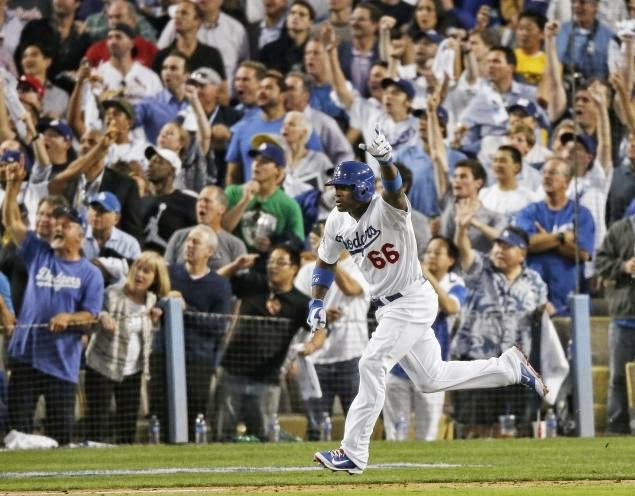
And based on his latest actions, Los Angeles Dodgers rookie sensation Yasiel Puig is apparently getting dangerously close to setting off the unsounding alarm. The elders may be gathering and the keeper of the code will be looking up just how to deal with him.
Because you just can’t show boat like that. You can’t hit a deep ball, flip your bat, throw up your hands like you’re in a club and watch it like a firework on Independence Day.
Well, you can if you’re Puig and you can make up the time and stretch what you thought was a home run but hit the fence into a triple. And then you can celebrate that like someone who just drove in the go-ahead run in Game 7 of the World Series.
Except it was Game 3 of the NLCS and the Dodgers were down 0-2. And Puig didn’t have a hit in the series.
Then again, there was more energy in that moment than any other so far in the postseason, outside perhaps of David Ortiz’ grand slam on Sunday night that gave the Boston Red Sox new life in their ALCS matchup with the Detroit Tigers.
And if there is something that is and has been sorely lacking in baseball, compared to so many other sports, it’s the massive star power, that excitement, that ability that brings oohs and aahs each game.
As I had said before, we’ve spent way too much time talking about a relief pitcher in his early 40s this summer. Mariano Rivera has been great, and was one of the greatest players of the past couple decades. Notice the has and was in that last sentence? Because it’s in the past, which is the point: the game is stuck in the past.
Everything good and bad about baseball is intrinsically connected to the past. Past players, historic numbers and legends born long ago, grainy images giving us a link to our fathers heroes.
Case in point: one of the main stories on SportsCenter and ESPN today? The 25thanniversary of the Kirk Gibson Home Run in the 1988 World Series. While no doubt a legendary moment in the game, with an incredible call from another legend, Vin Scully, it’s a lead story? Baseball is having some trouble here finding a modern narrative.
While other sports, like the NFL and NBA honor the past, they put great emphasis on the present and future. And because baseball prides itself so much on history, when something like PEDs comes along, it causes such a tremendous uproar because it would create a space-time continuum shift the likes of which would make Doc Brown squirm in his lab coat.
How can we possibly compare all of these numbers we’ve pointed to and prided ourselves on if we don’t know which ones are legitimate? Do we go back and asterisk the books? Do we have eras? What do we do? It’s been a decade long headache.
Meanwhile, the NFL and NBA, which have similar, yet not as publicized issues with PEDs, escape relatively unscathed, partly due to the fact they have not propped up their historical numbers as a thread. The games evolved. The three-point line was invented. It moved back. New rules came into play that increased or decreased scoring. The field goal posts moved to the back of the end zone and headshots were addressed. They are dealing with player safety.
But in baseball, they’ve always been slower to adopt the game to the changing of times. It’s grand ties to history remain both its greatest asset and curse.
Which is why it was strange to hear so much today on TV and radio about Puig and how he carried on last night – and how he carries himself. Many of the old guard talk about doing things the right way, they brought up his struggles with the Dodgers and giving maximum effort, and partying with LeBron James and hanging out with Jay-Z.
They don’t want that, not from a rookie. It messes with those unwritten rules of baseball. But the game might need that if it wants to grow and gain new fans or earn lost fans back.
Did Puig look foolish last night? Oh, most definitely. He embarrassed himself by watching his hit and then over-celebrating on third base. It tends to ruffle less feathers when our athletes act a bit more professional, possibly because in our daily lives, we have to act a bit more professional.
Can you imagine sprinting around the office celebrating every time you closed a deal, or came in early on a timeline? Our frame of reference dictates a lot of that discussion.
Yet I can’t forget what I heard my Dad say when I was a little boy, watching the Lakers with him in the mid-1980s, as Magic Johnson led Showtime. It was fast, up-tempo and exciting. You never knew what was going to happen.
“I work hard all day, every day, doing the same things,” he said. “And that’s fine. But I’d like to get a little excited watching basketball and not know what they’re going to do.”
And some people hated that style of play. They didn’t like all the flash, just wanted the classic substance they grew up with and were used to. Totally a matter of opinion. But Magic wasn’t breaking any unwritten rules with no-look passes and a faster tempo. Just speaking to a different crowd.
There’s room for both.
Which is why baseball needs Yasiel Puig just as much as they do retaliation plunking and a hundred players who, as Carlos Beltran said, pretend like it was an accident when they hit a home run so to not give the pitcher motivation. It can all work in baseball – there’s room for everyone.

Just have to see if those unwritten rules have room for a section on it.
Because it might be just as much fun to talk about Puig’s antics as it is for someone else to watch Puig do it so dramatically, so recklessly.
Now, who keeps the code, anyway? 
Standard
Alex Rodriguez, Lance Armstrong, Major League Baseball, NBA, NFL, PEDs, Ryan Braun

The Modern Arrogance of PEDs

As a society, it feels like we are always operating under the assumption that modernity is good, that being a part of a modern era means that we are advancing. Perhaps it is experience gained as we age, or perhaps it is because of all the technological and communication advancements made make us just feel so efficient, so intelligent, so very advanced as people.
Or perhaps it is just arrogance.
We find value in purpose if we convince ourselves that we are “better” people than those who came before us, those insufferable rubes we call our ancestors.
Just look at us now, with our Facebook, Twitter and Instagram feeds, our Vine videos. We think we’re pretty special, taking pictures of our food with camera filters. We think people care to know what we think of the latest scandal in 140 characters or less.
But we’ve missed the point of the social media medium. It is not the technology that is too blame, instead it is how we use it. Communication and connection were made easier by these software applications – how we implement them is another manner entirely.
What does this have to do with sports, you might be wondering?
Really, it has everything to do with sports, especially right now, as the sports world as we know it sits bathing in performance enhancing drugs (PEDs). Almost daily, another user is identified, another lab busted, another player suspended or under suspicion of use.
Are all of these men and women, accused or proven guilty one and the same? Most assuredly not. Alex Rodriguez, Lance Armstrong and Ryan Braun are in a different world from the junior tennis player who took the wrong over the counter medication and tested positive.
We should all fear the kind of athlete, like Braun or Armstrong, who not only seeks to gain these advantages, but maliciously works to destroy those who stand in their path.
This is simply modern arrogance transferred into sports. We are scrambling to justify players using PEDs with a litany of fun excuses: hey, it’s just part of the culture of sports now; it’s really not that bad; does it matter if everyone is doing it; if they want to risk their health for my entertainment, who cares?
Rationalizing the use of PEDs in this manner is almost adolescent in nature, which is to say, does not make us very advanced.
Those excuses sound like lectures parents dole out on their kids during teenage years: if everyone was jumping off a bridge, would you? What does it matter if my friends Johnny and Tommy are doing it as long as I am not? Hey, it’s just what the kids do now.
So many of us have grown weary of this issue, the collective groan could be heard on the moon every time another story breaks.
Speaking of the moon, how would we feel if we heard Neil Armstrong had taken something that enhanced his ability to get to, and walk on, the moon? Cheapened a little? Like maybe we believed in something that wasn’t entirely real? Here is a landmark in the accomplishments of man, a moment that people of every race, faith and stature can point to and say, “humans can do anything.”
With the asterisk: as long as we take something to enhance our performance.
Look, I get it. It’s a tired and seedy story. It’s a slippery slope. It’s an argument we’ve all had in offices, living rooms, sports bars across the nation. What defines the line? Wouldn’t any drink that isn’t water that replenishes nutrients faster be categorized as a performance enhancer? Are all supplements bad?
There is most definitely no easy answer. No real, concrete line. How do we justify taking prescription drugs or medicines that improve your health when sick, physically or mentally, but stand on a bully pulpit when it comes to PEDs?
After all, those drugs allow you to perform your job better and possibly get a raise. They hide your mental or physical flaws from the outside world, giving off a false image.
The only response I can offer is this: there is a big difference between taking those kinds of drugs, which allow you to get back on a level that everyone else is on, and PEDs. If you are depressed, for example, not everyone around you is. A drug that helps level out the chemicals in your brain to a normal range simply put you back on par and allow you to live a life close to what many others enjoy.
They do not falsify your accomplishments and put you above the rest of your peers who are not doing the same things.
But I suppose, just ask yourself, do you feel something isn’t right about drinking Gatorade? About taking daily vitamins? Probably not.
Look, I take supplements. Just not the ones that improve hand-eye coordination, increase my muscle mass considerably and allow me to recover faster than people who aren’t taking them. Whether or not you’re just trying to get back out there and you owe it to the team, using HGH does still imply you are gaining an edge. You can call it speeding up your recovery, if it helps you convince yourself you weren’t looking to cheat – but it is still an edge over every other injured player who isn’t using it.
And there’s the rub, really. This is why we call something cheating: doing something that someone else in a similar position is not. It’s not so much about the morality of right and wrong, we blur those lines all the time.
Really, this is another mixture of PEDs and our society. We distinguish all the time what we will tolerate and what we won’t.
Barry Bonds was a noted jerk, as now is Braun and Rodriguez. However, guys like Derek Jeter use “good” steroids like cortisone to recover and we cheer their gutsiness. David Ortiz was caught with a positive test, and we just smiled. He’s Big Papi, so he’s cool. And I’m sure it was just for a little while to recover from something.
And this says a lot about our society, too. What kind of person you are, or portray yourself to be, will largely determine how willingly we accept or forgive you for a future issue. Do what we expect, based on what we know, and we will react accordingly.
This war, this battle in sports on drugs and PEDs, is driven by the media, and by people like me, too. Sons of old school fathers, fathers to young athletes. The last thing I want my three sons and daughter doing is taking something that enhances their performance to gain an edge on somebody else.
Remember the Ice Cube movie, “Friday”? (Oh yes, I’m going there.) Ice Cube is getting ready to fight the dude who played Zeus in “No Holds Barred” and wants to grab his gun. His father begs him to do it without the aid of a weapon, outside his fists.
I’ll give you another example, from an episode of the last season of “Boy Meets World” (yes, I’m going there, too). Cory and Topanga are just married and living in a dump. The pipes are spouting brown water, the place should be condemned and there’s a screaming baby in the apartment next to them.
They beg his parents for a loan to buy their dream house. Cory’s dad firmly says no, with little explanation of why they won’t. Later, Cory fixes the pipes himself (without deer antler spray), takes a clear glass of water from the faucet and demands his father drink it.
Finally, Cory gets it. It’s not that they couldn’t help – or did not want to. But if they would have, it would have robbed them of something that can’t be completely explained, that sense of accomplishing it on your own, of figuring it out, or doing it.
My argument against using PEDs and my reasons for continuing to wish for a cleaner sports world cannot be explained much better than that, with a hokey reference to a TGIF show and a the only semi-serious part of a comedy starring Ice Cube and Zeus.
Call me self-righteous and tell me I am naïve. Tell me I need to get with the times and just accept where the world is now, that all the athletes do it and have been for 20 years. Call them gentleman’s rules, unwritten guidelines, or just fair play.
Without that, what are we doing this for anyway? Money? Fame? Glory?
If that truly is the case, then we are far from advancing our society and culture.
Modernity is a myth for us, or at least it will continue to be, until we actually fix the faucet ourselves.

Standard
Barry Bonds, Baseball Hall of Fame, Major League Baseball, Mark McGwire, MLB, Performance Enhancing Drugs, Roger Clemens, Sammy Sosa, Steroid Era

No Hall Pass


Here are your 2013 Major League Baseball Hall of Fame inductees, those who had careers that catapulted them to Cooperstown:
(Insert sound of wind, crickets or picture tumbleweed drifting through the Old West).
That’s right, no one was elected to the Baseball Hall of Fame this year, the first time since 1996 that’s happened. The lack of inductees – technically, there were three, but they all died in the 1930s and were elected by the veteran’s committee – means that it’s the first time since 1960 that the induction ceremony will include no new or living honorees.
If this isn’t a condemnation of performance enhancing drugs and the era of 1990s and early 2000s, I don’t know what is. The names are there: Mark McGwire,
Barry Bonds, Roger Clemens, Sammy Sosa. 
They are all floating out there, names as big as their arms and thighs and heads in the baseball world. 
The stats are there, too. Home runs, strikeouts, hits – record shattering accomplishments litter their resumes.
But something else is there, too.
The asterisk, the black mark, the whispers. The performance enhancing drugs.
I had a friend tell me recently that he didn’t care about the steroids. He wanted the juice dripping off the ball. If someone wanted to ‘roid out for his entertainment and smash the ball 500 feet to provide good theater, even if it wrecked the man’s body or health, then so be it.
And really, I’m not sure I care about that, either. Granted, health is an issue – but it’s their bodies, it’s their decision, it’s their long-term health. Who am I to tell them what they can and cannot do?
I’m much more concerned about how we view this as fans and mothers and fathers. We spend all of our time telling our children to work hard, then we allow others to cut-corners in life on the path to success and riches? If that’s a jealous comment, then fine, though it’s not intended to be.
Someone once asked me if I could have taken a few pills or injections back in high school that would have turned me into a D-1 college basketball player and future NBA star, would I take it. My answer was and remains: no. I want to always know what I did or didn’t get was solely based on my own merits. We’re already fighting advantages in sports and in life. Some people are smarter in general, others more methodical. Some are fast, some are slow. Short, tall, strong, lean. These can all be used as advantages and disadvantages.
The best are the ones that maximize what they have, they rise to the top. If you have a Hall of Fame, it does imply these are the best, the ones to strive for and mimic and be like. They are the standard.
Who wants that standard mixed with performance enchancers? Many would argue that why wouldn’t you want to improve your performance, in whatever realm you do it? I’ve got no problem with supplements and vitamins and flu shots – things that prevent and fill in gaps I can’t get from food. Optimal nutrition. New ideas in the realm of sleep, rehab, surgery and nutrition are all good.
But if you’re in a controlled group where 50-60 percent of the people are doing one thing and 40-50 percent are doing another, that taints your sample and your results. How can you compare the two? How do you know, specifically, who was doing what?
Steroids don’t allow you to hit the ball, that still takes practice. But it does allow you quicker bat speed – not in a natural way. HGH doesn’t make you better, it just helps you recover from injury faster than the other guy.
But we’re not even really debating all that today, are we?
The question is, what to do with those that we know or suspect did use these drugs and enhancers? Do we place them among the other baseball legends who accomplished their now broken records without those items? What does it say about us – and more importantly – to our young athletes if we do?
The criticism of the writers for failure to elect anyone is so misguided. Attacking the system and who votes and elects members is diverting attention away from the real conversation.
Which, essentially, is simple. You can keep the money you made entertaining us, the fame given by us and all the trophies you were awarded, but you will not be permitted to be forever remembered and represented as a standard-bearer of what we want our athletes to achieve. 
Forget separate wings of the Hall, the conversation about the character clause. I don’t care if half the players in the Hall of Fame were jerks, they didn’t disrespect the game itself. You did. If Pete Rose doesn’t get in for gambling on baseball, you don’t get in for cheating your peers in baseball.
Barry Bonds wants us to turn the page, to stop being angry. OK, we have. Now what? Well, we just sent you the message: Go away.
It’s that simple, we’ll move on when you move on. You’re not getting in.
We won’t forget you, but you won’t be remembered with a bust, either. 
Standard
Boston Red Sox, John Lackey, Jon Lester, Josh Beckett, Major League Baseball, Terry Francona, Theo Epstein

Red Sox "Chicken" Out

And now we know why the Boston Red Sox collapsed last month, ceding a nine game lead in the American League Wild Card race and going 7-20 the final month of the season.
The “how” it happened is so much more disappointing, humiliating and numbing than just missing the playoffs in historic, failing fashion.
It wasn’t the starting pitchers inability to get through four innings. It wasn’t the bullpen blowing late leads. It wasn’t the lack of offense or some defensive error by Marco Scutaro with a broken bat flying at his head.
No, it wasn’t the resurrection of some curse.
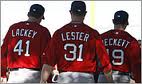
It was 25 guys, 25 cabs. It was the downright unlikable John Lackey, the fan favorite Jon Lester and the staff ace Josh Beckett drinking beer, eating fried chicken and playing video games in the clubhouse during games.
And that’s really just the tip of the iceberg. Just read this column in the Boston Globe.
Look, I get that since 2004 and especially since 2007, many fans hate the Boston Red Sox just as much as they have and do hate the New York Yankees. Winning and massive payrolls do that.
But somewhere along the line, the Red Sox became what all their fan base loathed the most: a roster of All-Stars and uninspiring players with massive paychecks who didn’t get it done when it mattered most. The clubhouse issues speak to that.
What’s most unsettling is this is not that team I began rooting for as a teenager in 1995. It’s not the team that won the two titles in 2004 and 2007. What most outsiders miss is that yes, 2004 ended the “Curse of the Bambino” and ended 86 years of frustration, sleepless nights and anxiety wondering if you would ever see your team win – but – it was the manner in which the Sox did won that mattered more.
Boston didn’t beat New York at its own game by trading for and/or signing a group of All-Stars.

Sure, they had Pedro and Manny, but that team had Mark Bellhorn, Bill Mueller, Kevin Millar, Mike Timlin and Trot Nixon. They were dirty. They chewed tobacco. They looked like they had been wearing the same hat since Opening Day, and some days, if the wind was blowing right, you could probably confirm that by smell. Pine tar covered their bats and their helmets. They worked hard, acted stupid and cared deeply about one another. From 2003-2008, you rarely heard a peep from the clubhouse about issues that didn’t involve Manny Ramirez taking a leak behind the Green Monster.

So it wasn’t so much the dramatic comeback against the Yankees in the ALCS, but who they were in terms of character versus who the Yankees were.
Nothing epitomized this more than the famous play where Alex Rodriguez slaps the ball out of Bronson Arroyo’s hand, and doing so with quite a bit of femininity. As he pouts and whines on second base after they call him out, there are Orlando Cabrera, Bellhorn and Millar laughing their asses off. The image is striking still today: a $200 million dollar man throwing a fit after slapping a ball out of a pitcher’s glove, and a somewhat rag-tag group of infielders mocking him.
Needless to say, I miss that team.
I miss rooting against, well, what the Red Sox are now. But this is the crux of being a fan. We’re really rooting for laundry and the numbers on the jerseys and the faces that fill those jerseys change ever year. Eventually, you find yourself rooting for a team that wears the same uniform but doesn’t fill it the same way.
I’m often more passionate about the years my favorite teams didn’t win a title, but came damn close despite having no business being there. It was the desire and the hard work in 2003 and 2004 that made those teams special. One lost a Game 7 in the ACLS, one won. But both years were special seasons.
The emotions of being a fan change all the time as you age. At the end of the day, you don’t just want your team to win, but you want them to do it the right way because it proves something, to you, your kids, your friends who are fans of other teams. It says “We did it the right way.”
I can deal with winning by not always doing it the right way and buying a top player or getting a trade done or being lucky instead of good. Those things happen in sports; the best or most likable teams don’t always win. It’s tough to swallow, but you end up rationalizing Carl Crawford’s contract, Diasuke Matsuzaka’s entire career and many other things as long as the team does well.
What I can’t deal with is the top three starting pitchers, two of which used to be in the category of hard-working gamers (Lester and Beckett) sitting around drinking beer, getting fat eating fried chicken and playing Halo while the rest of their teammates are trying not to blow it. There seems to be something missing there, an intangible of some kind.
And it doesn’t help when you pitch so poorly when you are playing that it looks like you’ve been…well, drinking beer and eating fried chicken and playing video games.
Some guys went to the optional batting sessions. Many did not. Some worked on their conditioning, while others, um, clearly, did not.
Jacoby Elsbury, Dustin Pedrioa and Papelbon, by all accounts, continued to stay committed and work, while others detached. You’d expect this haberdashery from Lackey, whom everyone in America seems to think is a royal punk and a clubhouse cancer. But Lester? Beckett? Big Papi? David Ortiz said all the right things to the media, but privately didn’t do much to bolster the team. Once, he burst into Francona’s press conference complaining about a box score that took away a hit.
Tim Wakefield, usually Mr. Red Sox, was preoccupied with chasing his 200th win and then saying it was only right the team brought him back next year. Adrian Gonzalez, terrific on the field, complained about the schedule and playing so many weekend night games. And manager Terry Francona was dealing with his own issues, as well, from prescription drugs to a separation from his wife and his son being in Afghanistan.

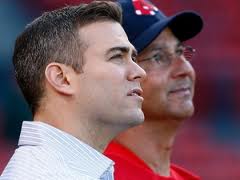
So that’s how the historic collapse came to be, a utter lack of passion for the game and for each other. The Sox have parted ways with Francona, which is bittersweet, but he’d lost the team. Wonder-boy general manage Theo Epstein is probably gone to the Chicago Cubs, which, despite his two World Series titles, leaves a bitter taste because of Lackey’s contract, Diasuke’s epic failure, Crawford’s struggles and you know, the general lack of chemistry in the clubhouse.

Maybe the players will start policing themselves and the new manager can break through to motivate them. But at the end of the day, the players have to care. And no one can do that but them.
Which is what makes the “how” it happened so humiliating and numbing. It’s not very Red Sox like. When they failed before, it was because of errors or ghosts or just not being very good. But this time, they killed the team from within.
And after two days of hearing the gory details of the collapse, I still don’t know how to tell my 9-year-old son who’s a diehard fan, who plays travel baseball and says he one day wants to play in college and the pros. And who’s favorite pitcher is Jon Lester. Who has Fat Heads of Beckett, Youkillis, Ortiz and Pedroia on his wall.
My son looks up to these guys. They are the favorite players on his favorite team of his favorite sport. It’s like the Sox are a girlfriend who broke up with you, punched you, took the big screen, the dogs, your money and burned your clothes over the period of a month, then came back three weeks later and told you they thought you were stupid, they hated everything you liked and never loved you.
It’s the ultimate kick to the groin to find out they not only failed, but they did so being basically about that guy. Dysfunctional, pampered, entitled.
Guess I need to start explaining to my son what term “Bush League” means. But I’ll leave the rest of the downfall out. It’s just embarrassing.
Or at least it should be.
Standard