Dwight Howard, LeBron James, Miami Heat, NBA, New Jersey Nets, Orlando Magic, Stan Van Gundy

Murdering the Magic

It has been somewhat fitting that Dwight Howard has played the first eight years of his career with a team nicknamed the “Magic” because nothing could personify Howard more than that.
The word implies so many things. Magic can be enchanting and mystical. It often toes the line of believability. And ultimately, magic proves to be false and misleading.
All of these things describe Dwight Howard, because after a wild 12 hours on Thursday – and taking into account what occurred leading up to Thursday – the magic is gone. And the Magic (at least the Orlando basketball version) are dead. Symbolically, of course.
In perhaps the most odd and compelling post shoot-a-round media conference ever, we got to see the end of an athlete’s aura firsthand.
Roughly seven hours before Orlando’s game against the New York Knicks, Magic head coach Stan Van Gundy confirmed that management had told him that Howard had asked for him to be fired.
Within a few minutes of this discussion, Howard appeared – completely and utterly unaware of what Van Gundy had been sharing with the media – and put his arm around Van Gundy. To say this was awkward or surreal cannot even begin to describe it. It was painful, yet comical – like any Steve Carrell episode in “The Office.” Howard had only heard the last few words, something about Van Gundy being the coach of the team until he was told he wasn’t. Which led to this:
Howard: “Stan, we’re not worried about that, right?”
Van Gundy: “That’s just what I said. We’ve got to be worried about winning games. Are you guys done with me? You talk to him now.”
As Stan exited stage left, the media closed in on Howard.
You know that feeling when someone approaches a group and they were just gossiped about, but the person approaching is all smiles and thinks things are great and everyone in the group just sort of grins because of the comical irony of it all? That might describe it.
Or better yet – it was like Michael Corleone calling out his brother Fredo: I knew it was you – you broke my heart, Dwight.
Except Stan The Man isn’t heartbroken. Howard messed with the wrong man. Van Gundy’s been (symbolically) murdered before, when he was removed as head coach of the Miami Heat in December of 2005 by Pat Riley, with executive producer credits going to Shaquille O’Neal and Dwayne Wade.
Van Gundy disappeared after being stabbed in the back – and the front – by his mentor Riley. He humbly had to suggest he was resigning as coach of the Heat to spend more time with family, despite all evidence that Van Gundy, a basketball junkie, was just as obsessed and driven to guide O’Neal and Wade to a title for the Heat as Riley would have been.
What the whole scene Thursday told us from Van Gundy’s point of view is this: He has done this dance before. He knows how this ends. He won’t be coaching the Magic much longer. But he just doesn’t care this time. He won’t play the company line or protect his conspirators. He’s not going down alone on this one. He’ll be taking Dwight’s rep as a smiling, fun-loving, cape-wearing lovable giant with him.
Additionally, Van Gundy is ensuring that this circus ends. Howard won’t be able to get away with this again, not now. Hell, the entire NBA and basketball world knows what kind of person Howard is now.
Rumor and innuendo are like magic in and of themselves. They could be true or might not be. But once rumors are confirmed, the magic disappears and all you are left with is the cold, hard truth. Coaches have been fired because of superstar pressure on the front office before; Howard is hardly the first to try this move. It’s just that it hasn’t ever unfolded like this before – where the coach knows and tells everyone he knows.
Following Van Gundy’s departure from the media circle, a reporter immediately told Howard what Van Gundy had said. Howard looked floored, but not in an innocent way. More like, “Dear God…they know” – like he’d been caught with his hand in the cookie jar.
Howard asked for the reporters to cite their sources and the media kept telling Howard that Van Gundy was the source – that he’d just confirmed it. This time, Howard has been sold out by his boss and his boss’s bosses. It was a brilliant move by Van Gundy – tell the truth and then leave the scene to let Dwight flail in the wind.
Somehow, Howard looked like he wanted to lie down or needed some Pepto, despite going on for a few minutes to explain that he had not said “nothing to anybody” and adding that he’s just a player and management controls who the coach is.
As a follow-up to that magical act, Howard went out and put up a stinker against the Knicks – eight measly points and eight lackluster rebounds in 40 minutes. He only took two shots in the first half, appeared unaggressive and disinterested most of the game and did not score until the very end of the third quarter.
And thus, the old Dwight Howard, he of capes and crucifix’s, was thoroughly destroyed in 12 hours, undone by the weight of his own lies.
He’s been posing as an NBA super-duper-star. To be sure, Howard is a supremely gifted and talented individual. As a 18-year-old, before jumping to the NBA, he was the valedictorian of his class at Southwest Atlanta Christian Academy and as a seemingly devout Christian, spoke of genuinely hoping that one day, the NBA logo contained a crucifix.
But eight years later, Howard is telling his boss’s bosses to terminate his direct supervisor. Now that’s not very Christian like.
He also played the Magic as a whole through the disingenuous trade demand saga of the last year, then flopped back and forth on opting-in or out of his contract at the trade deadline last month. A report last week stated that Howard finally changed his mind and opted in not because of some deep love that he’s been professing for the city and the fans, but because the Twitter backlash on the whole situation began to wear on him.
Twitter pressure? Really? Really?
How about the pressure of, you know, performing where you should. At some point, someone needs to call out Dwight for his inability to truly dominate games as he should be? He’s averaging 20.6 points and 14.4 rebounds this season, as one of the last remaining – perhaps the only – dominant big man in basketball. He wants to replicate Shaq, but he’s not even in Shaq’s general vicinity. He can’t even buy a ticket to where Shaq’s general vicinity is.
Howard ought to be averaging 28 and 15. He could be. But he doesn’t. And he never will.
Because to Howard, it’s all about the show. Wear a cape, win a dunk contest, smile his 1,000-watt smile. Create some drama. Entertain the people. He doesn’t crave a championship; he craves attention. How else could his wish list of destinations include New Jersey (soon to be Brooklyn)? The Nets are horrible.
If Howard wanted to win a title, he’d go to the Lakers or to Dallas or to the Knicks – or just stay with the Magic. But he wants to be the man in a new arena in a new city where there will be gobs of attention paid to Jay-Z’s team once it move’s this fall. At least LeBron James joined up with some good players – Howard won’t even have Deron Williams. Basketball wise it’s a worse situation than the one he’s currently in.
Speaking of LeBron, if LeBron is a such a hated villain for mishandling his exit from Cleveland with the spectacle of “The Decision” and joining a proverbial All-Star team with Bosh and Wade in Miami, then what on earth does all of this make Howard?
It has to be worse. Does it make him a hypocrite? Does it make him shallow? I think it does.
It makes him superficial and egotistical and shows he only cares about phantom recognition for what little he has truly accomplished while riding the coattails of people with the same skill set that came before him and were better. His inherent flaw and weakness is that he thinks he’s better than he is.
In other words, Stan Van Gundy was right to treat him like Fredo Corleone.
Because that is exactly who Dwight Howard is. 
Standard
Derek Jeter, Don Henley, Eminem, LeBron James, New York Yankees

After The Boys of Summer Are Gone

Don Henley wrote nostalgically once about “The Boys of Summer.” A huge hit in 1984, years later Henley told Rolling Stone that the song represented a questioning the past and was about aging. A key line in the song that represents much of this sentiment and self-reflection: “Out on the road today, I saw a Deadhead sticker on a Cadillac. A little voice inside my head said don’t look back, you can never look back.”

It’s an ironic image for the 1980s: once counter-culture, fans of the Grateful Dead  driving around Cadillacs – a status symbol both of maturity and a touch of wealth. 

And whenever I hear it – and you still hear that song this time of year – I think of Derek Jeter. 

Didn’t expect that, did you?

For much of his career, I have held quiet and unassuming hatred for Derek Jeter. He represents the New York Yankees, and as a Boston Red Sox fan, he is the face of the arch-rival’s franchise. Therefore, if you are like me, you are just simply predisposed to disliking the guy.

At least that’s what I thought from 1995-2004. Then, on July 1, 2004, it became a genuine, sports hatred.
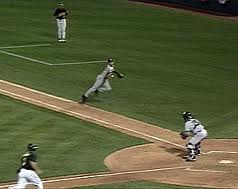
The Red Sox and Yankees – nearing the height of their rivalry, were battling tooth and nail in an extra innings game. With the score tied at 3 in the 12th inning, with runners at second and third and two outs, Sox outfielder Trot Nixon hits a pop-up down the third base line. Watching the game, you were certain the ball was heading foul into the stands.

Suddenly, there’s Jeter, screaming into the picture and making an over-the-shoulder catch. He is at the wall, so the force of his momentum launches him over the railing and into the stands. He makes the catch and cuts his chin, but the play ends the inning. Jeter leaves the game, but the Yankees win – and naturally, the announcers are drooling over him like the kid in that “Stacy’s Mom” video fawning over Rachel Hunter.

The announcers go on and on about what a leader “Jete” is, what a gamer, what a captain. It’s nauseating. It’s get-a-room-uncomfortable. It’s nails on a chalkboard to Red Sox fans. Remember, there were wounds still not healed from the previous October, so Sox fans hated everything Yankees even more so than normal. 

In hindsight, it was an amazing play. But I could never see it as such at the time. I was too young to appreciate it.

Fast-forward to the present.

Derek Jeter sits on the cusp of 3,000 hits and suddenly, I am nostalgic. 

After a contentious contract negotiation with the Yankees last winter, and with age becoming a factor, Jeter’s on the tail end of his career. And despite being a Yankee, I cannot help but feel sad that we’re losing something here. 

Jeter reminds you of the old boys of baseball. The Mantle’s, the Ryan’s – and some combination of both. He is a pretty tough cat, but he’s got this high amount of celebrity cache. The man has been with nearly every attractive celebrity female on the planet. 

Somehow, with all that happens in the current media age (Twitter, Facebook and 24/7 scrolling tickers) Jeter has managed to be in the public eye without anyone really knowing anything. It is like old Hollywood, really. People say they saw Jeter out doing this or that, hanging with this woman or that woman, but there’s no pictures, no proof – just stories. It’s mysterious, but not in a bad way since it leaves something to the imagination.

With Tiger Woods, once it all came out, there was literally nothing left to the imagination. In fact, your imagination died painfully as you scrubbed your eyes with Clorox. Either Jeter’s really, really good and doesn’t text people or he’s paid off everyone in Manhattan to keep quiet. And either way, that is pretty freakin’ cool.

Despite advancing in age and putting tons of miles on the tires with all the Yankees postseason runs, Jeter just went on the disabled list for the first time since 2003. He has really been a model of efficiency offensively and defensively. He is the only guy who could pull off forcing Alex Rodriguez to move to third base and then have people say that A-Rod was a better shortstop. And Jeter holds so many memories of iconic plays – mainly the flip play, where he tossed the ball to Jorge Posada to tag out Jason Giambi while running the opposite direction after cutting off a throw from right in 2001. 

I still don’t like Derek Jeter, yet I cannot help but feel odd (and old) that his time left in baseball is short.

We forget that athletes age too. Oh, we see it. We can see the gray hair and the loss of physique. We watch them stumble and get burned because they have lost a step – but we are not really comprehending it. At first, they get by on raw talent and athleticism. But in the end, it is all about being a cagey veteran who knows how a situation on the field or on the court will play out because they have been there, done that. 

This is where Jeter is at, like so many before him – getting by on what he knows and how the movie plays out. He has the script, he’s just executing the lines with more nuance. But the time is coming where he will not be able to get by on his wits anymore. 

And what does he do then? Naturally, he retires and becomes a manger or a TV analyst and becomes something entirely different. The better question is, what do we do next? 

It is always odd watching guys like Charles Barkley, Dan Marino and Troy Aikman in the studio or calling games. To anyone under the age of 30, that is all these guys are – old dudes referencing a game they once used to play. People view them with a sort of “Sure, I bet, old man” reverence, which is to say, “I hear you, but it’s just words.”

To anyone over 30, we remember how good these guys were. We were there, we saw their prime and we still hold them in high regard. 

And that difference in how people view athletes from one generation to the next is a striking similarity to Don Henley’s song and how we operate day-to-day in our own lives. It is why someone who enjoys Eminem does not get why people think NWA was controversial. It is why LeBron James can never be Michael Jordan. It is why I cannot begin to tell my kid how cool “Tecmo Bowl” was, because he has an X-Box and can run his own franchise, create himself as a player and set the price of popcorn in the concession stand. 

Perhaps that is why we can’t look back. We can never look back because only you understand the intrinsic value of what you’re looking back at if you were actually there to witness it.

In other words, for both Jeter and for me, getting older sucks.

Standard
Chris Bosh, Dallas Mavericks, Dirk Nowitzki, Dwayne Wade, LeBron James, Miami Heat, Michael Jordan, Michael Wilbon, NBA, NBA Finals

In The Garden of Good and Evil

A guest writer and I tackle the sordid story of the 2011 NBA Finals and LeBron James:
 
Thanks, LeBron
By Wes Carmony
America owes LeBron James a thank you card.
I wouldn’t go as far as sending a gift, but a short, punchy exclamation of appreciation at the very least. We all owe him, probably no one more than Dirk Nowitzki.
Through James’ complete lack of self awareness, his preening, his championship predictions and yes, even his brilliant play, James managed to turn the Miami Heat into the greatest wrestling heels of all time. The only thing missing was LeBron distracting Joey Crawford while Dwayne Wade struck Dirk with a metal folding chair.
The man who has managed to become the most polarizing athlete of our generation turned one of the most beloved NBA superstars in the game (Wade) and an unassuming, soft spoken All-Atar (Chris Bosh) into super-villain running mates.
“The James Gang”, were led (though often times from the back) by the most physically gifted basketball player since Wilt Chamberlain. The Heat transformed the 2011 NBA Finals from a mere sporting event into a referendum on good versus evil, team versus individuals, instant gratification versus the sustained effort.
I am not a Mavericks fan; truth be told I don’t particularly care for anyone on their team.
Jason “Jet” Terry annoys me, JJ Berea reminds me of a Y-Leaguer who plays way too hard and fouls all the time. Dirk is soft, Shawn Marion and Jason Kidd are washed up and possibly decomposing. Their coach, Rick Carlisle, is a retread; their owner, Mark Cuban, a loudmouth. The Mavericks are not particularly fun to watch, and I predicted they’d be ousted in the first round of this year’s playoffs.
Yet I watched every minute of every game of these NBA Finals. Down the stretch of every fourth quarter I sat on the edge of my seat, heart pounding, pleading for the lanky German to toss in another twisting, fall away 18-footer. 
Thanks LeBron. Without you these finals would’ve been an afterthought.
As much as I rooted for you to fail before you got to these Finals, I see now how wrong I was. You wanted to be a global icon, a brand, something bigger than the game. Well, you are all of those things. You are perhaps the single biggest villain in the history of team sports. Well done.
As an avid NBA consumer this past decade, I’ve watched Dirk Nowitzki and thought the same thing everyone else thought: he’s soft, shrinks in big moments, probably a good player, but not an all time great. 
Not anymore. 
Some would say winning an NBA title regardless of the opponent would erase all of those stigmas, I call BS. Dirk presided over two of the larger post season collapses I’ve ever witnessed. Being eliminated in the first round by the 8th seeded Warriors a few years back, just days after receiving what should have been Kobe Bryant’s MVP trophy for one, completely derailing in the 2006 Finals against the Heat for another.
I suspect we won’t be hearing about those failures anytime soon. Dirk’s legacy is forever changed, partially through his own brilliance on the court, but even more so by the man he denied a title.
A Mavs victory over the Chicago Bulls wouldn’t have sparked the same rhetoric, the same reverence, or the same cache Dirk now enjoys.
Dirk owes LeBron the biggest thank you of all.
Without LeBron, Dirk is just another aging superstar capturing an elusive ring on the back nine of his career, a nice story to be sure, but one we’ve seen before.
Without LeBron, the story could just as easily have been about the Los Angeles Lakers collapsing in the second round, Derrick Rose’s growth as a player, or even the Mavs winning their first ever championship.
Instead the story is about one man standing against all that is wrong in the (sports) world, hard work and substance overcoming glamour and preening, good triumphing over evil.
Dirk isn’t just an NBA champion, he’s a hero to all of us who wanted the “good guys” to win one. 
Admittedly it sounds a little clichéd, a little fantastic – after all it’s just a sporting event. But my goose bumps and racing heart would argue otherwise.  I watched a player I never particularly cared for hoist the championship trophy last night and felt tears well up in my eyes. I’m guessing I wasn’t the only one. 
In the aftermath of the collapse, James sat at the podium and responded to a question about the effect of all of America rooting against him. He said (in true heel fashion) that essentially we would all have to go back to our little lives, our same problems tomorrow, but that he’d still be LeBron James. And he’s right, but I have to be honest, my little life is a little brighter today because of his failure.
Thanks LeBron, we all owe you one. 
~~~~~~~~~~~~~~~~~~~~~~~~~~~~~~~~~~~~~~~~~~~~~~~~~~~~~~~~~~~~~
The Hypocritical Oath
By Brian Moore
Our own hypocrisy has led to this moment – one where LeBron James is evil incarnate, some combination of The Emperor from “Star Wars”, Mr. Potter from “It’s a Wonderful Life” and Gordon Gekko from “Wall Street”.
Oh, sure, James has blood on his hands for his own wrecked image. The prediction of six or seven titles did not help. The preening and mockery of the “Welcome Party” last summer did not make us all warm and fuzzy. And “taking my talents to South Beach” became an epic punch line within days. As did giving money to the Boys and Girls Club of Greenwich, Connecticut.
He’s not innocent in all this. James wanted to be the man with his words and actions.
We are all witnesses to so many different things. Poor shooting. An ego run amok. Possible shrinkage in tight games in the fourth quarter. But also witnesses to our own hypocrisy.
I certainly can’t defend James on the shooting, the non-aggressive play, the shying away in big moments. I cannot defend the preening, the ego, the narcissism. I can’t and I won’t.
But I can’t defend our sick obsession with James, either. We kill James – and I mean shred him – for doing things others have done and continue to do. The only difference is they get a pass.
James got killed for walking off the court a few years ago and not shaking hands with the opponents following the end of a playoff series. Um, didn’t Dirk bolt off the floor with seconds remaining last night? He ran off the floor so fast, I thought he was heading to the restroom due to something he ate. Oh, that’s different because Dirk has been cast as the hero and the hero can’t do something in poor sportsmanship when he just won the title. Give him a pass.
Right this way, Dirk. Sorry LeBron, your hairline is receding at 26. You’ll be blasted for that in a column tomorrow. Plus, I didn’t like your tie.
That is not meant to be a defense for James’ actions – just pointing out the double standard.
These NBA Finals were a referendum on good versus evil? Please – it was a referendum on basketball.
I can poke holes in James’ game – the lack of aggressiveness in Games 4 and 5, the disappearing act in Game 3. But anyone notice Dallas shot something like 98.2 percent from the 3-point line? Anyone notice scrubs like Brian Cardinal and Ian Mahinmi contributing jumpers, charges and threes? JJ Barea playing out of his mind?
This all factors into the equation – or at least it should.
But we choose to only see LeBron James vs. Dirk Nowitzki. Or James vs. the Mavericks. Or James vs. the fourth quarter. Or James vs. Wade. If it’s truly a referendum on team vs. individuals, why are we doing this?
I’ve been saying this repeatedly: James is not in the same category as the greatest players of all-time. He’s a special hybrid of Scottie Pippen and Magic Johnson, perhaps the most talented athlete we’ve ever had in the NBA. He does not have the mental make-up of Michael Jordan and Kobe Bryant or Larry Bird.
If you move past the emotional, which is difficult for most, just realize what he is: Scottie Pippen upgraded with a dash of Magic. Now, take out the part of the driven, motivated, blood thirsty reputation. He doesn’t have it. He is what he is.
If he was like Jordan, and punched teammates in the face – well, we’d rip him for that, too. At 26, James has his legacy discussed and valued like a piece of stock on Wall Street.
Granted, he doesn’t help himself often, by you know, speaking. But this isn’t just a LeBron problem – it’s a we problem.
The media picked up on the reaction to “The Decision” and spun it the best way possible to reach the crowd. We’re a blood thirsty bunch, real sharks in the water – always looking for an enemy. If we smell something foul, we make it putrid and vomit inducing.
Our collective hatred of the Heat and dislike for James has made us sound like the people shouting for Barabbas. Dirk Nowitzki should thank James. Dirk’s career, however spotty in the past, is now made because he slayed the dragon. But was it really a dragon?
We’re forgetting why James went to Miami. By joining the Heat, he openly admitted he was not good enough to do it on his own. James wanted and needed help. He waved the white flag and joined another star’s team.
We should acknowledge every team needs multiple stars, we just didn’t like the way LeBron did it. That’s what this is all about: we don’t like how LeBron James handled himself, now and in the past. That’s totally fine. We are allowed to dislike how people handle themselves.
James and the Heat are hated – but they’ve sold the most the most jerseys in the NBA this season.
People say, “I can’t root for a team that came together like that – a bunch of superstars playing on the same team!” Weird, we all were pretty big fans of the 1992 U.S. Olympic team, aka, “The Dream Team”. Oh, that’s different though, because we’re the United States and it was to beat all those dirty foreigners, right?
I hear Jordan would have never left the Bulls to play with another superstar. He didn’t need to – the team drafted a top 50 player (Pippen, who who was an MVP candidate and led the Bulls to 55 wins in 1994, during Jordan’s first retirement). Charles Barkley practically burned down the city of Philadelphia trying to escape the 76ers in the early 90s, until he was traded to Phoenix, where a much better team awaited him. Then, in the late 90s, he joined Hakeem Olajuwon, Pippen and Clyde Drexler in Houston. Magic Johnson came to a team with Kareem Abdul-Jabbar, then they drafted James Worthy. Bird had McHale and Parrish, as well as Dennis Johnson and Danny Ainge.
When you are desperate to win multiple championships – which is what you have to do now in the post-Jordan era – all bets are off the table. I hope we go after Carmelo Anthony, once the New York Knicks add Chris Paul in a couple years. And we’ve never really had a problem with Boston putting three stars together.
So it has to be about the whole marketing of “The Decision.”
By my friend’s own admission, if the Mavericks would have beaten the Chicago Bulls, it would not have meant as much. Doesn’t that tell us something?
Aren’t we a little too wrapped up in this? We should see ourselves for who we are, too.
Dante Stallworth ran over someone with his car and killed the man a few years back. He served about 30 days in jail and is playing football.
And this is where our outcry, venom and moral outrage lies? With LeBron James and the Miami Heat? You know what will be funny? When time passes and everything comes full circle.
People will stop paying attention and it will die down. Comedians like Jon Stewart will start cracking jokes about how ironic it was we took this whole thing so personally and seriously. “60 Minutes” will do some piece called “The Lonely Life of LeBron James” or he’ll save some cat from a tree and James and the Heat will become sympathetic figures at some point. James will have some good games, remind people of a better version of Scottie Pippen, Wade will led them and the Heat will win a title or three.
And the media will shower LeBron and the Heat with praise, call him unselfish and one of the top 10 players all-time.
We’re all witnesses, all right.
To the biggest hypocrisy I’ve ever seen. 

Got feedback? E-mail bri_moore@hotmail.com to share.

Standard
Kentucky Wildcats, Larry Bird, LeBron James, Magic Johnson, Michael Jordan, NBA, Rick Pitino, Scottie Pippen, Walter McCarty

The "It" Factor and LeBron James

They are who we want to be, but can’t be because they can do things, or at least have the ability to do things, we couldn’t. We idolize them, though we shouldn’t, because it’s what we want.
This was a statement made by a friend at the conclusion of a nearly four hour conversation around sports, athletes, our reality, their reality and what it all means. Some alcohol may have been involved.
It all centered around LeBron James and his play, not just in the NBA Finals, but the nonsensical idea of debating a 26-year-old’s legacy when he is not even halfway through his career.
My stance is and remains simple: I’ve accepted James for who he is. He is a hybrid version of Scottie Pippen and Magic Johnson, two of the greatest basketball players I have ever seen. Noticed I said two of the greatest, not the greatest. James is not in the same league or category as Michael Jordan or Kobe Bryant. And not just because of the rings. It is because he is a completely different kind of player.
My friend’s stance is and remains just as simple: As a former athlete, like myself, he can never understand why James has all the physical tools, but none of the mental makeup of the all time greats. To him – and even a James defender like me – we cannot understand how he has shied away from the leadership, the hunger and desire required to be in the realm of Jordan, Bird, Magic, Kobe and Bill Russell.
“We had that desire and 10 percent of the talent,” my friend says, voice raised and fists clutched. “I can’t root for a guy like that – it’s wrong against every notion of what sports are supposed to be about.”
And then he dropped the quote on me that led this blog.
Is that why we watch sports? Move beyond the entertainment and escape from our everyday lives, and ask yourself why you watch sports. We have a vested interest in teams and players we know nothing about. We loathe them and love them at the same time. We bemoan their salaries and then turn around and buy their jerseys.
For me, I do it because I am a history guy. I majored in it in college and love the stories. That’s really all history is, somebody’s story or interpretation of what happened. Their reality becomes ours.
So for someone like me, sports are a big part of my life so that one day I can tell people, we were there when “it” happened. I do not often recall games from 10 years ago, but I can tell you who won and the interactions I had with the people in the room. I know where I was for the 2004 American League Championship Series, when the Boston Red Sox became the first team in baseball history to come back from a three game hole and win a seven game series.
I can tell you where I was when the Indiana Pacers and Detroit Pistons had their brawl. I can tell you about being in Yankee Stadium, as a Red Sox fan, with my dad, a Yankee fan, on September 11, 2008 – when the emotion of the seventh anniversary of 9/11 and the eighth-to-last game ever to be played in the “House That Ruth Built” had grown men in the Brox bleachers in uncontrollable, sobbing tears.
Basically, whatever “it” is, it was great and you should have been there.
But do we really want to be the people we watch? Do we wish we had their talents and their reality?
The only way I can explain it is this: our reverence fades and we try to replace it, but never can. I have a personal example with this.
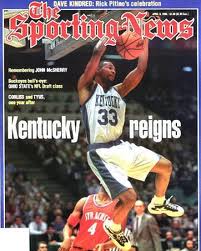
In 1996, the University of Kentucky won the NCAA men’s basketball championship. I watched the game with my family as a high school sophomore on Spring Break in Sanibel Island, Florida.
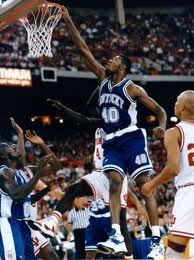
The team was loaded with NBA talent: Tony Delk hit seven threes in the game, Walter McCarty was an athletic freak who ran, dunked, slashed and defended. Antoine Walker was too big a star to be in college. Jeff Sheppard was a pogo stick with deadly range. Ron Mercer was a sensational freshman destined to led the team the following year. Not to be listed as footnotes: Derek Anderson, Nazr Mohammed, Wayne Turner and coach Rick Pitino.
They were called “The Untouchables” because they were so good, no one could hang with them. Nine players ended up in the NBA from that team.
Two months after they won the title, I found myself in a Lexington dorm room at Rick Pitino’s basketball camp. One of my good friends was a huge Kentucky fan and had talked me into going with him for a couple of years. It was always enjoyable and you picked up some good drills, plus, every now and then, some of the players would be around and you could watch them play pickup ball in the evenings after dinner.
That year was different. We’d be watching the players of the current reigning National Champions. That week was different, too. Every player was there – and they were acting as camp instructors and coaches.
As luck would have it, I ended up on Walter McCarty’s team.
The week was a blur. McCarty was on cloud nine after winning the title and, as a senior, he was headed to the NBA Draft, so he was in a great mood and fun loving. The seven of us chosen to play on his team felt like his buddies, members of a special posse for the man they called “Ice”.
We had a pregame chant (we played twice a day in between drills and stations and McCarty was with us at least 12 hours a day):
McCarty: “Who you with?
Us “”Ice!”
McCarty: “Who you with?
Us: “ICE!”
McCarty: “What time is it?”
Us: “Game time!”
McCarty: “What time is it?”
Us: “GAME TIME!”
It’s been 15 years and I still have that etched in my brain. McCarty laid down a nickname for me – “Flyin’ Brian” – for the way I hustled and flew all over the court. He nicknamed everyone on the team. We had pizza and video game parties in his room several times and he’d point at us during the player scrimmages when we did something. We’d all yell out “Ice!!!” in unison.
We were hooked. It was surreal. At 16, I spent a week hanging out with a future NBA player who was riding a wave of good reviews following the NCAA Tournament. In two weeks, he’d be picked 19th overall in the first round by the New York Knicks.
Throughout the week, I felt terrible for my friend. He was the Kentucky fan, but not as lucky with his assigned coach. Each night, I’d relay to him in graphic detail the events of the day, from what shoes McCarty had on to how funny his jokes were. It was a simultaneous feeling of guilt and joy. I could not contain the joy of having hung out with McCarty all day, but telling him made me feel like he was dying a little on the inside.
I left that camp the biggest Walter McCarty fan on the planet. For his first year in the NBA, I followed his box score every day, hoping to see how well he did. It was personal. I had shared experiences with him and we were buds.
Except we really were not. I suppose it’s the same feeling someone gets from a fantasy camp, those guys that spend $50,000 to go and play with Michael Jordan at his camp for a day. You want to share that floor, that moment, with them.
Over the years, I lost track of McCarty’s career and certainly didn’t follow him as closely as I did as an impressionable teenager. And like many fans, you follow a player you like and then you move on – always looking for the next one, the next superstar, the next thrilling moment, the next time you’ll be sharing real time and hard reality with them.
And so it is with LeBron. He’s dealing with an entire generation of media and fans that grew up with Jordan, Magic and Bird, Pippen and Kobe. We’ve seen greatness and we want it again. We just want it to be better than it was before, we want LeBron to be better than anything we’ve ever seen, mainly just so we can say we saw it and we were there.
But it can’t be better, because nothing can ever be replicated. Take my week hanging out with Walter McCarty. I will absolutely not have another experience with an athlete as cool as that. Too many mitigating factors at play: my age, my peak interest in basketball, McCarty’s rise to mid-level celebrity, Kentucky on the heels of a title, Pitino the hottest coach in basketball, possibly playing some of my best ball and growing into my own as a shooter that summer and the hype of “The Untouchables.”
It was unexpected and could not be compared. Jordan wasn’t expected to win six rings. At 28, when we won his first one, we just hoped he’d win a couple and be in the conversation. James is 26. Every game his legacy is dissected, every game our opinion of him moves.
And yes, some of it is deserved. When you preen and dance and take the mantle of King or Chosen One and join up with two of the top 10 players in the league, you’re going to be despised. That’s a whole other discussion, frankly.
Just for now, we have to stop doing a disservice by comparing James to Jordan and the other greats. Not for James’ sake – but for our own. Because no matter how good or how bad, he’s never going to be good enough for us.
Remember, we can’t make them be what we want as people or athletes. And even if we could, we wouldn’t really want it that way because it wouldn’t feel real. But it does not stop us from wanting that of athletes and of sports. 

We still want to be there when it happens.
Whatever “it” is.
Standard
Andrew Bynum, Dwayne Wade, Indiana Pacers, J.J. Barea, Jermaine O'Neal, Lamar Odom, LeBron James, Los Angeles Lakers, Rajon Rondo, Ron Artest

Something About Stones and Glass Houses

As sports fans, the collective lot of us sure have selective memories. How we define dirty play and label people has become mesmerizing.
It’s really a psycho-analysis of deeper issues. Take this past week in the NBA, for example.
Los Angeles Lakers center Andrew Bynum and forward Lamar Odom are facing somewhat deserved backlash following their actions that resulted in ejections during the Lakers Game 4 loss to the Dallas Mavericks in the Western Conference semifinals.
As the back-to-back defending champions went out with a whimper, Odom and Bynum decided to take their frustrations out physically on their opponents.
First, Odom body blocked Mavericks forward Dirk Nowitzki and was ejected with a flagrant foul – grade 2. Then, less than a minute later, the 285-pound, 7-foot Bynum delivered a nasty forearm shiver in the chest of Dallas guard J.J. Barea – while Barea was in mid-air. Naturally, Bynum was booted for his actions.
The NBA suspended Bynum for five games at the start of next season and fined him $25,000. Odom will likely receive a similar fate, only reduced in the number of games and fine.
Was it wrong? Yes. Was it dirty? Yes, absolutely.
But there is a growing number of people who are outraged by Bynum and Odom, calling them dirty players and the Lakers a classless franchise.
In fact, here’s a quote from a friend of mine:
These guys are classless, embarrassing, and horrible examples to all the kids out there playing ball. I now officially HATE the Lakers.”
Really? Do we really want to go down that path?
Because I think we’re entering a dangerous area as fans when we start generalizing and making disingenuous blanket statements about people.
Bynum and Odom’s actions were certainly in poor taste, they were dirty plays and were uncalled for. They deserved to be fined and suspended. But until that moment, neither had shown anything remotely similar in their on-court behavior.
It’s ironic that the immediate media and fan backlash was nearly the exact opposite when compared to the infamous Indiana Pacers-Detroint Pistons brawl in November 2004.
The “Malice at the Palace” began with about 46 seconds remaining in the game, when Pistons center Ben Wallace was fouled from behind by Pacers forward Ron Artest. Wallace took exception and shoved Artest. As you would expect in the NBA, this led to a lot of pushing and shoving from the players on both teams.
Artest went over and laid down on the scorer’s table and put on a radio headset to speak with Pacers radio broadcaster Mark Boyle and a fan threw a cup of Diet Coke at Artest while he was laying on the table. Artest responded by bulldozing his way into the stands and punching the wrong person. Shortly behind him was teammate Stephen Jackson, who went into the stands, fists flying.
More players – from both teams – headed into the stands, with fans running onto the court to escape the frenzy. Artest was confronted by two fans on the court and teammate Jermaine O’Neal took a running start and decked one of them in the jaw. The game was called off, as the scene was complete chaos, with folding chairs and debris being hurled onto the floor. Nine people were injured.
Shall we reassess what we determine as classless and an embarrassment to an organization?
Not yet? Well, then by all means, let’s keep going.
The Pacers-Pistons post-game commentary was certainly interesting. Studio analysts John Saunders and Tim Legler laid the blame on the Pistons fans, with Saunders calling the fans “a bunch of punks.” Rarely at a loss for words, Stephen A. Smith said that some of the fans should be arrested. He made no mention of the players.
We all lose our cool, the difference is how far do we take it? Is either of these situations, Bynum/Odom or the “Malice at the Palace” acceptable? Of course not. But the point is there are varying degrees here and apparently it only took us seven years to forget that.

Within 48 hours, Bynum had called Barrea several times to apologize. He issued a public apology during his exit interview on Tuesday. 

My actions…don’t represent me, my upbringing, this franchise or any of the Laker fans out there that want to watch us and want us to succeed,” Bynum said. “Furthermore, and more importantly, I want to actually apologize to J.J. Barea for doing that. I’m just glad that he wasn’t seriously injured in the event and all I can say is, I’ve looked at [the replay], it’s terrible and it definitely won’t be happening again.” 

Take that in contrast to this, from Jermaine O’Neal following the Pacers-Pistons brawl in 2004:

“We all knew the league is 80-85 percent black; we all know that,” O’Neal told the Indianapolis Star. “We didn’t talk about the baseball player [Texas Rangers relief pitcher Frank Francisco] just breaking a lady’s nose with a chair because she was talking. They didn’t talk about that for weeks, did they? Every day for six weeks, you see something on TV about it. They didn’t talk about [former St. Louis Blues player Mike Danton] trying to kill his agent. These are people that are not black, and that touched me a little bit because that’s totally unfair for this league to be judged off one incident.”

Race should have little to do with it. 

I said should, because on some level, it might. That brawl in 2004 brought some issues that had been bubbling for years to the surface, most notably, the declining relationships between fans who were (and are) mostly white and a league full of players who were (and are) mostly black. In addition to a league covered by a mostly white media and owners of teams who are white. So I would be remiss if I did not acknowledge that there could be some truth to what O’Neal said at the time. 

But race was used by O’Neal in the wrong way – as a distraction from the point at hand. Maybe the fans shouldn’t be throwing cups and maybe the players shouldn’t go charging into the stands looking to lay a Mike Tyson hook on someone. 

Just a thought.

Dirty plays have always been a lightning rod of conversation. We always want to know how mad the person on the receiving end was. We call the dirty play disher a cheap shot artist and embarrassing. But when it goes too far, it makes us uncomfortable, so we just write it all off as one and the same. 

It is not the same.

We call it dirty and classless when it happens on the court – when everything is at a distance. Remember the Miami Heat and New York Knicks brawls? Jeff Van Gundy wrapped around the legs of players? How about Charles Barkley fighting Shaquille O’Neal, or Kermit Washington decking Rudy Tomjanovich? 

If those situations happened post-Palace brawl, we might have reacted differently. Perhaps the outcry would have been much like it has been this week for the Lakers, Bynum and Odom. 

What can we take away from all of this? That we’re more sensitive now to on and off court physicality?
That may explain why nearly every game, if two players get wrapped up or someone goes down, there’s an overreaction – and then a chain reaction. 

Case in point: Boston Celtics guard Rajon Rondo gets hurt (dislocated elbow) after getting tangled up with Dwayne Wade in Game 3 last Saturday night. The fall is ugly, the injury nearly vomit inducing. Rondo comes back later in the game, is limited, but guts it out. When he returns, many members of the Heat, including Wade, check on him to make sure he’s OK. Game continues, Celtics win.

After the game, someone asks Wade, who’s sitting next to LeBron James, about the play and mentions the word “dirty”. James scoffs and mumbles, “That’s retarded.”

Boom – new controversy: LeBron James is insensitive to those with mental disabilities.

Sure enough, James started off his Game 4 post-game press conference issuing an apology. 

Sure enough, that story will grow. Someone will call it classless and embarrassing. 

The cycle will just continue until we’re all oversensitive to every little thing. 

On second thought…too late.

Standard