Allen Iverson, Boston Celtics, Danny Ainge, ESPN, Kevin McHale, Larry Bird, NBA, Philadelphia 76ers, Robert Parish, Stephen A. Smith

The Chief & The Answer: Old & Entitled


Some old and familiar faces made headlines this week, and what they want is respect.
Problem is, they already had it and lost it. Now, they expect the “Powers That Be” to give it to them again.  
No, it’s not Randy Moss proclaiming he’s the greatest receiver in NFL History. No, it’s not Alex Smith demanding he be named starting quarterback of the 49ers before Super Bowl XLVII.
It’s a couple of former NBA stars.
And if you are as tired of the same old story lines from Super Week and Media Day in New Orleans as I am, this might catch your attention.
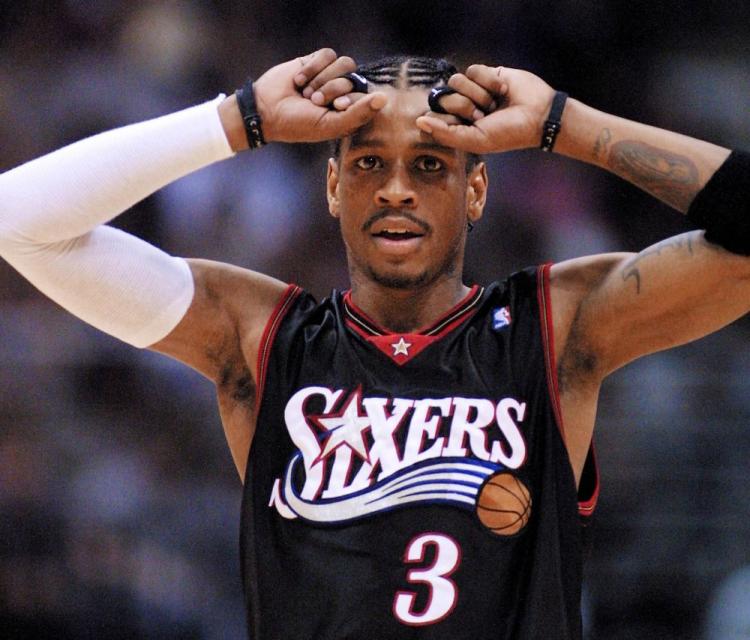
Allen Iverson
Former All-Star Allen Iverson wants back in the NBA, at the advancing age of 37. And so does 59-year-old former Celtics great Robert Parish.
They just want to be back in totally different ways.
Iverson wants back on the court, a chance to – as he calls it – complete his NBA legacy. Weird part is, he just turned down a chance to play for the Legends in the NBA D-League.
“I think the D-League is a great opportunity, it is not the route for me,” Iverson tweeted Tuesday.
Oh, that’s right, it’s only the route for aspiring ballers who need some work, those not ready for prime time players who need more practice. And we all know how Allen Iverson feels about practice.
Far be it for NBA executives to want to get a quick look at an under-six-foot guard who hasn’t played in three years and who relied heavily on foot speed, you know still has foot speed and quickness at 40.
Iverson last played in the NBA in 2009-10, briefly, with the Memphis Grizzlies and Philadelphia 76ers, the team he had the most impact on after they drafted him out of Georgetown. What Iverson forgets is what so many remember: he wasn’t very good. But Iverson wants the NBA to look past all that, and grant him a spot on a roster so he can finish what he started.
And some, like ESPN personality (and sometimes reporter/journalist) Stephen A. Smith, who covered Iverson in Philadelphia, agree with The Answer’s assessment. When asked if Iverson should have taken the Legends offer and worked himself back up through the ranks, Smith had some interesting words.
“He should,” said Smith, “but he shouldn’t have to.”
Confused yet?
“To do what he’s done in this league and for this league…to then sit there because of practice or his attitude or whatever the case may be, and to look at it and say that you don’t need it anymore – I’m one of those guys who’s sensitive to…taking care of [those guys].”
So…if we’re understanding this correctly, the NBA owes guys like Iverson – and as Smith went on to allude to Kareem Abdul-Jabbar and Robert Parish – some sort of servitude clause? Is that how employment works?
Smith contends that Iverson is being avoided because of his attitude, his work ethic in practice and varying other factors. Well, frankly, that’s probably true. There’s a tipping point with athletes. We’ll put up with them as fans and defend them for a great number of things that seem out of bounds with our own standards and ethics because they do extraordinary things. When those things stop happening, the spotlight tends to shine brightly upon those character flaws.
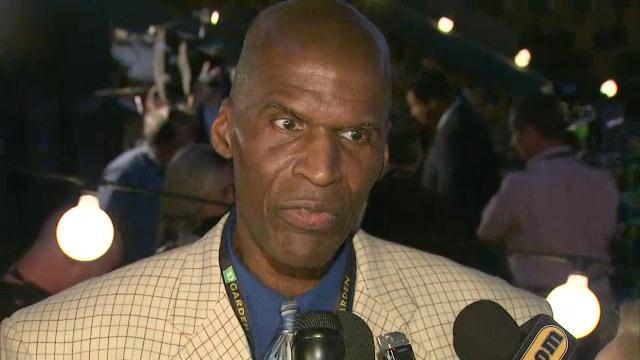
Robert Parish is looking for a job, too.
The same is true of Parish. In an interview with the Boston Globe, Parish said he was “restless” and needed “money”, therefore, wanted to get into coaching. He said he’d been trying, but had been avoided. Former teammate Larry Bird wouldn’t return his calls, Parish says.
Except that Bird countered that Parish never called him.
Then you find out that even Parish is willing to admit that his sometimes surly and aloof demeanor is still there and that he doesn’t have many friends in and around the game. He’s jealous of former teammates like Danny Ainge, Kevin McHale and Bird, who have worked in the NBA since they retired as players.
“Across the board, most NBA teams do not call back,” Parish told the Globe. “You need a court order just to get a phone call back from these organizations. I’m not a part of their fraternity.”
Welcome to the real world, Robert. Times are tough out here, too. As McHale eluded too, he attempted to get Parish on with the Minnesota Timberwolves, but they were cutting back on positions, and then, you know, McHale was horrible in Minnesota and got fired. Not really a great reference for Robert in the Twin Cities.
This is just like if you’re telling a buddy to get you an interview at a place that isn’t really hiring and then he gets laid off and you’re angry he didn’t hook you up with some work. It’s not realistic. Parish hasn’t worked much since retiring after 21 seasons in the NBA in 1997. He coached briefly, has had done some personal appearances and had a few minor brushes with the law.
He says he gave too much money away. He says he wasn’t particularly close to his teammates, but scolded Ainge and described him as selfish.
How can I help get “The Chief” a job, again, this guy is aces!
Then again, it must be hard to be a former star. You grow accustomed to the pay, the lifestyle, the pace of it all. Parish is whining about an $80,000 salary in communications for the Celtics? Know how many people would like that job? I know my hand just went up. Parish turned down that job in 2004, because he needed something in the six figure range. He also  said he didn’t like the weather in Boston and didn’t want to live there full time.
Let me just ask, Robert: what are you interviewing for again? If you don’t like the weather or the city enough to live there, you know, where the job is located, then what do you want them to do? Send you a royalty check?
There are many fine former athletes out there who are turned away simply because people don’t want to work with them, with their attitudes and their baggage. This happens all the time in the professional world. Employers are allowed to turn you away simply because you don’t fit the culture. Tough luck.
Iverson and Parish were once both great, but are owed nothing now. It must be earned again. They must prove themselves again. And they must change the attitude of entitlement. Who wants to work with that?
Quite frankly, Stephen A. Smith, I’m shocked that you’d defend Iverson, Parish and Abdul-Jabbar in this instance. Surly demeanors and people who don’t work well with others don’t typically get taken care of just because of what they did once upon a time. Wait…Smith wouldn’t understand that.
If Iverson and Parish want back in the NBA, I’ve got The Answer right here:
Be just a little bit more grateful and a little less condescending. 
 Shut up and work for it.
 
Standard
basketball, Bobby Plump, Gordon Hayward, Indiana Hoosiers, Indiana Pacers, Larry Bird, Milan, NBA, Purdue, Tom Crean

This is Indiana…do we still ball?

This is Indiana.
Where we apparently don’t care about professional basketball.
If you are from Indiana like I am, you know there is very little we take more seriously and keep close to our heart than basketball.
Hoops may not have been born here, but it is where the game is played and followed with an unbridled passion, one that others (like New York, Chicago, Kansas and North Carolina) imitate but can never duplicate.
We are Hoosiers. We are “I love you guys.” We are the Milan Miracles, Bobby Plump, Hinkle Fieldhouse, IU, Purdue, red sweaters, Bobby Knight, comb-overs, Gene Keady, thrown chairs and Digger Phelps. 
We are Chrysler Fieldhouse, where Wooden was born and raised, The Wigwam, Big O, The Undefeated Season of ’76 and “The Shot.” We are The Big Dog, Damon Bailey and Steve Alford. 
We are Larry Bird. We are Slick Leonard. We are “Boom Baby”. We are 8-points in 9 seconds and a choke sign to Spike Lee in Madison Square Garden. We are still engaged in a 15-year battle over single-class basketball.
Basketball is who we are. Or maybe it was who we were.
This is Indiana (no, really, this is Indiana).
And right now, this is kind of pathetic.
Our numbers are dropping in high school basketball attendance. You can blame class basketball, but then again, you can’t. We’re kind of excited about the revival of Indiana University under Tom Crean, but they just locked up a stellar recruiting class and the only way I heard about it was through IU fans on Facebook. If this were 1992, people wouldn’t shut up about it.
And Purdue fans – is there such a thing right now? – are as quiet as a field mouse. Purdue and Indiana used to not only matter nationally, but they were what this state thought about most. Butler made the NCAA title game two straight seasons – the second time without sensation and Brownsburg native Gordon Hayward – and people were excited for about 10 minutes.
Speaking of Hayward, have we forgotten about this kid? You know, the one that hit a crazy game winner in the 4A state championship game, then led Butler to the title game his sophomore year and now is an outstanding young NBA player for the Utah Jazz? Where’s his book? Where’s his cult following? He did what Bailey and Alford couldn’t do – stand out in the NBA – and I don’t see anyone under 15 wearing his jersey to school.
What the hell happened to us? What happened to rusty rims hanging from barns, dirt courts and old men in coffee shops? My parents (IU fans) and their best friends (Purdue fans) couldn’t even watch games together because they were afraid of what they might say. Now? Purdue and IU rarely come up in conversation.
What the hell is wrong with us? We’re dying a painful basketball death here in Hoops Holy Land and everyone seems to be shrugging their shoulders.
The biggest case in point: the Indiana Pacers.
After years of complaining (including from me) about the dynamics of the team, how they (or RonMetta WorldTestapeace) ruined the great shot they had in 2004, the strip club shootings, the gun charges, well, they at least have been getting it right lately.
After giving the Chicago Bulls all they could handle as a spunky 8-seed in last year’s playoffs, the Pacers secured the 3-seed this year, clearly their best regular season in nearly a decade. They are young, fun, filled with talented players who work together as a team. They feature a hometown kid, George Hill, and have likeable players and hard workers all over the roster. They are ran by Larry Bird. This is the quintessential “Indiana” basketball team – fun, likeable, fundamental, hard working.
And they had the second-worst attendance in the NBA this season. Frankly, the Pacers attendance has been in the dregs of the league for over 10 years.
This is not about a small market. We fill up Lucas Oil Stadium just fine – even during a 2-14 season.
Win or lose, we just don’t come to Consec…er, Bankers Life Fieldhouse.
I could go on and on about how great it is in the Fieldhouse, what a value it is (and I’ve done that in previous columns over the years), but we’re just not listening. We just don’t care. And that, my friends, is what scares me the most.
The Pacers are about to take on the Miami Heat in Round 2 – an epic affair and what could prove to be the best series in the Eastern Conference and we’re acting like it’s a kindergarten soccer tournament. We’re losing our identity. Or as R.E.M. once said, we’re losing our religion.
I know there are so many things different about 2012 than there were about the 1980s and 1990s; our options are far greater. The Pacers are not the only “game in town” when it comes to entertainment and sporting options anymore. We’re a busy lot, with much to do and places to go. And that’s fine, really. It’s a sign of the times.
Now we could dissect how it’s easier to go to eight Colts home games than 20 or so Pacers games. But the cost is probably the same. And yes, it’s an expensive night out for a beer and a hot dog, but you tell me what isn’t expensive these days.
Just tell me what’s happening to us? Was it truly the Malice at the Palace? Was it a loss of trust? General disinterest? Are we know a football town? A football state? I can’t believe it. I know Peyton Manning was here, orchestrating one of the greatest runs in NFL history – but football and basketball season collide for but a brief few months.
Maybe we’re just not cut out for the NBA here. Even when the Pacers were rolling in the 1990s, it was nothing like the Colts “Blue Fridays” at workplaces around central Indiana. Maybe it’s the length of the season. Or for some reason the dichotomy of how NBA players are perceived by our Midwestern culture. Maybe it’s because college basketball has always mattered here more than professional basketball and people only have enough energy to fully engage in one team.
Yet, really, none of this matters. These “reasons” and excuses are just that – reasons and excuses. They don’t speak to the heart of the matter – that this is Indiana. Basketball is in our blood. We live and breathe it.
Or at least we used to.
We are in danger of losing this team one day, sure. (And it will be oddly amusing when people who never went to games begin to complain.) But more important, we’re in danger of losing our essence, our character and our culture if we don’t snap out of this basketball funk we’ve been in.
This is Indiana.
And if we’re not careful, they’ll be talking about how we once balled. 
Standard
Kentucky Wildcats, Larry Bird, LeBron James, Magic Johnson, Michael Jordan, NBA, Rick Pitino, Scottie Pippen, Walter McCarty

The "It" Factor and LeBron James

They are who we want to be, but can’t be because they can do things, or at least have the ability to do things, we couldn’t. We idolize them, though we shouldn’t, because it’s what we want.
This was a statement made by a friend at the conclusion of a nearly four hour conversation around sports, athletes, our reality, their reality and what it all means. Some alcohol may have been involved.
It all centered around LeBron James and his play, not just in the NBA Finals, but the nonsensical idea of debating a 26-year-old’s legacy when he is not even halfway through his career.
My stance is and remains simple: I’ve accepted James for who he is. He is a hybrid version of Scottie Pippen and Magic Johnson, two of the greatest basketball players I have ever seen. Noticed I said two of the greatest, not the greatest. James is not in the same league or category as Michael Jordan or Kobe Bryant. And not just because of the rings. It is because he is a completely different kind of player.
My friend’s stance is and remains just as simple: As a former athlete, like myself, he can never understand why James has all the physical tools, but none of the mental makeup of the all time greats. To him – and even a James defender like me – we cannot understand how he has shied away from the leadership, the hunger and desire required to be in the realm of Jordan, Bird, Magic, Kobe and Bill Russell.
“We had that desire and 10 percent of the talent,” my friend says, voice raised and fists clutched. “I can’t root for a guy like that – it’s wrong against every notion of what sports are supposed to be about.”
And then he dropped the quote on me that led this blog.
Is that why we watch sports? Move beyond the entertainment and escape from our everyday lives, and ask yourself why you watch sports. We have a vested interest in teams and players we know nothing about. We loathe them and love them at the same time. We bemoan their salaries and then turn around and buy their jerseys.
For me, I do it because I am a history guy. I majored in it in college and love the stories. That’s really all history is, somebody’s story or interpretation of what happened. Their reality becomes ours.
So for someone like me, sports are a big part of my life so that one day I can tell people, we were there when “it” happened. I do not often recall games from 10 years ago, but I can tell you who won and the interactions I had with the people in the room. I know where I was for the 2004 American League Championship Series, when the Boston Red Sox became the first team in baseball history to come back from a three game hole and win a seven game series.
I can tell you where I was when the Indiana Pacers and Detroit Pistons had their brawl. I can tell you about being in Yankee Stadium, as a Red Sox fan, with my dad, a Yankee fan, on September 11, 2008 – when the emotion of the seventh anniversary of 9/11 and the eighth-to-last game ever to be played in the “House That Ruth Built” had grown men in the Brox bleachers in uncontrollable, sobbing tears.
Basically, whatever “it” is, it was great and you should have been there.
But do we really want to be the people we watch? Do we wish we had their talents and their reality?
The only way I can explain it is this: our reverence fades and we try to replace it, but never can. I have a personal example with this.
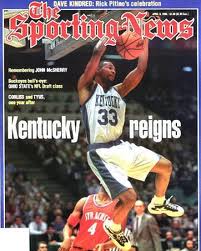
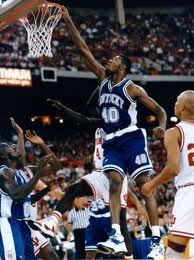
In 1996, the University of Kentucky won the NCAA men’s basketball championship. I watched the game with my family as a high school sophomore on Spring Break in Sanibel Island, Florida.
The team was loaded with NBA talent: Tony Delk hit seven threes in the game, Walter McCarty was an athletic freak who ran, dunked, slashed and defended. Antoine Walker was too big a star to be in college. Jeff Sheppard was a pogo stick with deadly range. Ron Mercer was a sensational freshman destined to led the team the following year. Not to be listed as footnotes: Derek Anderson, Nazr Mohammed, Wayne Turner and coach Rick Pitino.
They were called “The Untouchables” because they were so good, no one could hang with them. Nine players ended up in the NBA from that team.
Two months after they won the title, I found myself in a Lexington dorm room at Rick Pitino’s basketball camp. One of my good friends was a huge Kentucky fan and had talked me into going with him for a couple of years. It was always enjoyable and you picked up some good drills, plus, every now and then, some of the players would be around and you could watch them play pickup ball in the evenings after dinner.
That year was different. We’d be watching the players of the current reigning National Champions. That week was different, too. Every player was there – and they were acting as camp instructors and coaches.
As luck would have it, I ended up on Walter McCarty’s team.
The week was a blur. McCarty was on cloud nine after winning the title and, as a senior, he was headed to the NBA Draft, so he was in a great mood and fun loving. The seven of us chosen to play on his team felt like his buddies, members of a special posse for the man they called “Ice”.
We had a pregame chant (we played twice a day in between drills and stations and McCarty was with us at least 12 hours a day):
McCarty: “Who you with?
Us “”Ice!”
McCarty: “Who you with?
Us: “ICE!”
McCarty: “What time is it?”
Us: “Game time!”
McCarty: “What time is it?”
Us: “GAME TIME!”
It’s been 15 years and I still have that etched in my brain. McCarty laid down a nickname for me – “Flyin’ Brian” – for the way I hustled and flew all over the court. He nicknamed everyone on the team. We had pizza and video game parties in his room several times and he’d point at us during the player scrimmages when we did something. We’d all yell out “Ice!!!” in unison.
We were hooked. It was surreal. At 16, I spent a week hanging out with a future NBA player who was riding a wave of good reviews following the NCAA Tournament. In two weeks, he’d be picked 19th overall in the first round by the New York Knicks.
Throughout the week, I felt terrible for my friend. He was the Kentucky fan, but not as lucky with his assigned coach. Each night, I’d relay to him in graphic detail the events of the day, from what shoes McCarty had on to how funny his jokes were. It was a simultaneous feeling of guilt and joy. I could not contain the joy of having hung out with McCarty all day, but telling him made me feel like he was dying a little on the inside.
I left that camp the biggest Walter McCarty fan on the planet. For his first year in the NBA, I followed his box score every day, hoping to see how well he did. It was personal. I had shared experiences with him and we were buds.
Except we really were not. I suppose it’s the same feeling someone gets from a fantasy camp, those guys that spend $50,000 to go and play with Michael Jordan at his camp for a day. You want to share that floor, that moment, with them.
Over the years, I lost track of McCarty’s career and certainly didn’t follow him as closely as I did as an impressionable teenager. And like many fans, you follow a player you like and then you move on – always looking for the next one, the next superstar, the next thrilling moment, the next time you’ll be sharing real time and hard reality with them.
And so it is with LeBron. He’s dealing with an entire generation of media and fans that grew up with Jordan, Magic and Bird, Pippen and Kobe. We’ve seen greatness and we want it again. We just want it to be better than it was before, we want LeBron to be better than anything we’ve ever seen, mainly just so we can say we saw it and we were there.
But it can’t be better, because nothing can ever be replicated. Take my week hanging out with Walter McCarty. I will absolutely not have another experience with an athlete as cool as that. Too many mitigating factors at play: my age, my peak interest in basketball, McCarty’s rise to mid-level celebrity, Kentucky on the heels of a title, Pitino the hottest coach in basketball, possibly playing some of my best ball and growing into my own as a shooter that summer and the hype of “The Untouchables.”
It was unexpected and could not be compared. Jordan wasn’t expected to win six rings. At 28, when we won his first one, we just hoped he’d win a couple and be in the conversation. James is 26. Every game his legacy is dissected, every game our opinion of him moves.
And yes, some of it is deserved. When you preen and dance and take the mantle of King or Chosen One and join up with two of the top 10 players in the league, you’re going to be despised. That’s a whole other discussion, frankly.
Just for now, we have to stop doing a disservice by comparing James to Jordan and the other greats. Not for James’ sake – but for our own. Because no matter how good or how bad, he’s never going to be good enough for us.
Remember, we can’t make them be what we want as people or athletes. And even if we could, we wouldn’t really want it that way because it wouldn’t feel real. But it does not stop us from wanting that of athletes and of sports. 

We still want to be there when it happens.
Whatever “it” is.
Standard