What if I told you that a close friend of ours had cheated on their taxes or used drugs or been involved in any number of salacious acts? Would you believe me? Would you ask for evidence? Would you try to find another source? What if you asked me where I got my information and I could not tell you. What if I told you I swore I would not name my sources? What if you took it at face value and spread the story yourself?
And what if you found out later that none of it was true?
ESPN has a show called “Outside The Lines” where they do some version of a “60 Minutes” investigative journalism thing around sports. They have tried to peel back the layers on hard-hitting stories for years. It has been on the air for over 20 years and won numerous awards.
Last November, the show ran a story by Mark Schwarz about Syracuse University basketball assistant Bernie Fine, who had been accused of molesting two former ball boys during a long period of time as an employee of the school. The show used interviews and statements to support claims that Fine had been following the Jerry Sandusky model of coaching and teaching.
Shortly thereafter, longtime and well respected Syracuse coach Jim Boeheim vigorously came to Fine’s defense. He claimed Fine was a friend and he knew him well enough to know it was not true. ESPN then released a tape, said to be from 2002, where Fine’s wife and one of the ball boy’s spoke about Fine. In the tape she said she knew about Fine and felt powerless to stop it.
Fine was fired. Public opinion, to no surprise, was that Bernie Fine was a disgusting human being and Jim Boeheim should be admonished for defending him, as well as possibly effecting future victims from coming forward.
Fast forward to present.
Two weeks ago, one of Fine’s accusers came forward to say that he had made it all up – in fact, he’d never met Fine. Does it change public opinion? Did ESPN recant their claims? Did Schwarz apologize or recant his story?
Of course not. It is too late. The damage is done.
It has become increasingly clear that in our current culture, all that matters is the moment we are in. We’ve sped up the cycle of digesting news so quickly that before we turn off the TV, we’ve made up our mind. We take whatever we hear as the truth and we go with it. Next story.
Forget for a moment about what this says about us – that we are quick to judge, unforgiving, incapable of admitting a mistake. Think about what this says about our society. The media has become as vicious as any rapid dog or wild animal, so thirsty for headline busting stories that we’ll take whatever we can get.
When did this happen? Was it CNN? Was it “the ticker?
You used to be able to read a story in the paper and it was factual based: Here’s what happened, this is what is known, these are the lingering questions. End of story. When more information became available, there was a follow-up.
Now, well, we live well outside the lines. We do our journalistic work in the dark, in the shadows. We push the limits. We have to break through the 300 stories scrolling on the bottom of your screen, your Facebook updates, your iPhone apps. We have to get your attention. They used to say video killed the radio star. Well what in the name of Joseph Pulitzer is this? Who killed journalism and reporting? Who made us sacrifice the process of moral ethics and integrity?
Case in point: the Trayvon Martin case. The story has been carefully crafted by the media to sway opinion. Why do we need a judge and jury? The guilty are guilty because we say so – and we say so because we’ve been told so.
I honestly have no opinion on this case because I don’t know enough the facts. But take one small sample – the 911 call. What if you found out that the media had altered George Zimmerman’s 911 call? Would it change your opinion or cause you to think differently?
In the altered version, Zimmerman certainly sounds racist, describing Martin only as a race and by the clothing he wore. But if you read the transcript, which you can here: http://www.documentcloud.org/documents/326700-full-transcript-zimmerman.html, it paints a different picture.
NBC apologized for selective editing and fired the producer responsible for making the 911 call by Zimmerman sound racially motivated. They did this a few days before Easter – nearly six weeks after the events occurred and certainly well after public opinion had been formed.
Why did it take so long to do the internal investigation of the editing? The investigation didn’t even begin until March 31, and only after another media outlet essentially called them out on it.
This routinely happens and we are seemingly oblivious. Or we’re just too afraid to say anything for fear that we’ll be labled as something – anything – that makes us look like we support the “wrong side”.
This is scary to me and it should be to you. Because it is very real.
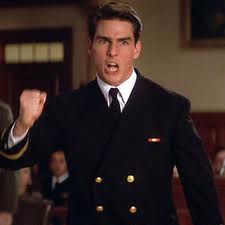
Remember Tom Cruise hammering away on Jack Nicholson in “A Few Good Men”? What if the pivotal moment doesn’t happen? It’s just before, when Nicholson’s character (Colonel Jessup) says something snarky about “pinning the defendants hopes to a foot locker and phone bill.”
Cruise’s lawyer character is shaken. He knows the punishment for falsely accusing a highly decorated officer of a crime. He isn’t sure for a few moments of whether or not to push forward, not because he doesn’t know the truth – remember, another character had confirmed the Code Red was ordered by Jessup – but because he has to get Jessup to say it. Truth has to be corroborated from all angles – multiple sources agreeing on the events.
But life is not like “A Few Good Men.” The guilty rarely crack and usually have their own version of the truth. The truth is hard enough without those who are tasked with covering the news inserting opinion and altering the story to sway public perception.
People don’t win awards and keep jobs in the business if they don’t make headlines themselves. It’s why we have shifted from a world of SportsCenter and The Sports Reporters to “Around the Horn”, where blowhards like Stephen A. Smith and Skip Bayless are able to twist and manipulate their beliefs into what is conveyed as factual opinion.
We stop using the words “I believe” or “I think” and start heavily relying on unnamed sources who were perhaps not really ever there to begin with. They hide behind laws and journalistic axioms of not naming their sources – except they are opinion columnists and talking heads, not real journalists.
Which is why the biggest media machine of all – ESPN – has become so powerful. We let it slide. It’s sports, right? It’s not as important as a death or a murder. But it is within how every situation and event is handled that becomes important. It reveals character – and we are currently severely lacking character as a society.
Take yesterday as another example. It is easier to take a blurb about the New Orleans Saints and general manager Mickey Loomis having a suite that had been re-wired that would enable Loomis to eavesdrop on visiting coaches for three years – on the heels of all the other Saints headlines lately – and let the story run wild and free. Report it, but bury this little nugget about 10 paragraphs into the story: “’Outside the Lines’ could not determine for certain whether Loomis ever made use of the electronic setup.”
They could not determine for certain? Then why is this a story? If you could not determine it, then why are you reporting it? Because it makes headlines. Because most people don’t get that far into the story. Because the damage – and the doubt – are done. You made your headline.
There are ethics and standards in journalism (you can read about them here – and yes, there is an intentional irony in me directing you to a Wikipedia page: http://en.wikipedia.org/wiki/Journalism_ethics_and_standards). Or at least there are supposed to be ethics and standards.
We are only as good as our credibility and reputation.
But how good is your credibility and reputation when your whole modus operandi is to make the news – like exchanging exclusive rights to air LeBron James’ “The Decision” with advertising and air time to him. ESPN gave up editorial independence and were in the business of simultaneously making news while covering it. We’re lucky the universe didn’t explode at that conundrum.
And while I make light of that and ESPN, news reporting is a far deeper issue that goes mostly unobserved in all aspects. We fail to notice it as it’s happening – but we do nothing to stop it, nor does our government, once we wise up and figure it out.
In the absence of factual truth, any substantiated fact or half-truth with do. We want the truth? Forget about not be able to handle the truth, we can’t handle the patience it takes to actually find out the truth. And these are the things we talk about at lunch with co-workers or at dinner parties with family and friends. To think, we seldom have our facts straight, not because of our own misunderstanding, but because of the manipulation of the corporate and global media.
I just wonder if the damage has been done. This is very dangerous and slippery slope. We need to wake up. The truth has no agenda, which is what makes it so hard to find.
How do we recant as a culture? What if it is too late for us to get our integrity back?
Or do we even care anymore?
If you find out the answer, let me know. I swear I’ll believe you – you don’t even need to share your sources.


 worldbetweenlines.com