
Deadspin, ESPN, Gene Wojciechowski, Girlfriend Hoax, Lennay Kekua, Manti Te'o, Notre Dame

The Legend of the Hoax

What do we know of legends?

They are narratives of human actions that are perceived, by both the teller and the listener, to take place within history and to possess certain qualities that give the tale some sense of probability. Basically, the legend has to feel real to both the teller and the listener.

And most legends we hear of tend to fall into a realm of both believability and uncertainty, never being entirely believed by all involved, but also never completely doubted, either.

This seems like a good time to mention that it was revealed Wednesday afternoon that Notre Dame All-American and Heisman runner-up Manti Te’o has either been a victim of a massive hoax or a party to it.

According to Deadspin.com, the story that captured a nation last fall, where Te’o’s grandmother and girlfriend both passed away within hours of each other on September 12, spurring Te’o to emotionally guide Notre Dame to an undefeated regular season, was not entirely, well, true.

This is the stuff of legend. And not the kind we’re happy to pass on through the generations.

The details are still emerging. With each passing hour Wednesday afternoon, new – and exceedingly weird – details came to light.

A hoax. A dead girlfriend who wasn’t really dead, who furthermore wasn’t really real. Rumors of either plotted connections to Te’o or from people he seems to be acquainted with. Videotape evidence and published articles and columns which contradict each other. Conspirators almost begging to get caught through Twitter feeds in December.

There isn’t enough room to dive through all of it here, but you can read the Deadspin.com article and the follow-up on ESPN.com to get caught up or review.

What this blog does is look at the angles, the shades of gray and searches for reasoned answers through all the nuance of a story, trying to draw a narrative.

Yet this is difficult.

There’s really only two outcomes: either Te’o is a gullible victim of an odd and well-executed hoax that rocked him to his core or he was a disgraceful and participating piece of a hoax that in the worst possible way garnered sympathy and publicity.

Either way, there are so many questions, it is hard to determine which version is the truth. If Te’o was a victim in all this, our first option, then why did he feed information to the media that seems to contradict his latest comments?

In his statement, Te’o said he had a phone and online relationship with Lennay Kekua. Yet in published articles and interviews, there’s a narrative of Te’o having met her years earlier after a game at Stanford, where Kekua attended. How can she be the most beautiful person you’ve ever met, if you’ve, well, in fact, never met? (And yes, the above is a link to a page from the South Bend Tribune where that story has now been removed.)

How can you develop such an emotional bond with someone on the phone and through social media? Perhaps it’s fair to assume that the generation behind me, a technology inclined generation, can believe they feel these things because in many ways they do.

All I know is that, I too, spent two or three hours per night talking to the woman who is now my wife throughout the early part of our courtship. But I also saw her, in person, nearly every day. I met her family,  she met mine. The things we told each other about the other checked out because they were visible to all our senses: I could see and touch and feel her life, her history. Pictures, real relatives, etc. This deepens any relationship.
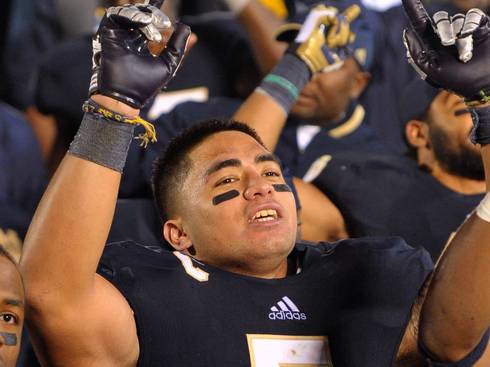

But to hear Te’o speak so candidly with reporters in the weeks following Kekua’s death, you’d have been led to believe they spent time together – and not just in a virtual sense. And no matter what generation you are a part of, that’s hard to square away, that you can feel so much for someone you’ve never met face-to-face.

Just last month I wrote about how we’re slipping away from real and meaningful communication with one another, replacing it with technology and removing true emotion. If this narrative on Te’o is true, and he fell for this woman so hard, without meaningful contact with her, then it’s only further proving this discourse.

Then, there’s the bit of a guy who supposedly created her Twitter account and made this relationship look legit who might have a connection with Te’o prior to all this. Again, that doesn’t solve the mystery of who Te’o was talking to for four hours, every night, for four months – as he told ESPN in an interview in October. 

He either embellished that to make himself sound better, or made it up as a party to this plan.

There are phone records. This can be checked out – and maybe it will be. If there are two people out there who perpetuated this hoax, they can probably be tracked down through IP addresses, GPS, phone records. But what kind of commitment and how evil do you have to be to do this to another human being? Evading Google image searches by stealing, then ever so slightly altering pictures of someone else – that’s not clever, it’s just weird.

Certainly there is more to this option, but in the interest of pulling these threads together, let’s look at option two. It’s much more dastardly and deceitful. Many are hammering Te’o in all media outlets and social networks right now, and many are asking for reservation before making a judgment.

But it is not hard to say that if Te’o was a party to this hoax, it’s one of the more despicable acts I’ve heard of. What it to garner sympathy for Heisman votes? Was it to gain more publicity? He was already a well-regarded linebacker and by all accounts, a man of faith and integrity. Why risk that? Why through that image away? To what point and purpose does that serve?

Perhaps, if this option is true, Te’o is lonely. It’s not a sexy plot line, but plausible all the same. And not quite as sick and twisted.  Yet even still, parts of the story don’t add up from his end.

In a transcript of a press conference from early October, Te’o talks about finding out when they were closing the casket at her service and how emotional that was. He sent roses. To where, exactly? Did he talk to her “family”? How does all that emotion actually work without actually having spent time with her in person?

Te’o got a call in Orlando in early December, from the woman he believed to be Kekua, who told him it was a hoax. Why wait two weeks before telling his coaches? Why let the story and narrative run through the BCS Championship? Even in embarrassment, the longer the hoax runs the worse it gets.

He says he wanted to be there, wanted to see her at the funeral. When he’d not met her? It seems an odd coincidence she told him that if anything happened, not to come, but to play for her.

Outside of just Te’o, the hoax has its own effects on our society, our media. No one vetted this out? Not ESPN, not Sports Illustrated, not writers and editors across the country who published all these “facts”?

As Deadspin reported, when probed on SportsCenter Wednesday night, well regarded ESPN.com senior writer Gene Wojciechowski said he couldn’t find an obituary while researching an article on Te’o and his incredible story. He couldn’t find a record of Kekua’s accident – a seemingly small piece of the account of their tale, from that South Bend Tribune story, yet anyone who’s ever read a local paper knows they publish police reports.

Wojciechowski says he probed Te’o about these missing records, but stopped when Te’o told him to back off. So he did. And in doing so, he committed a journalistic sin: he didn’t follow through on the sources and became too objective and involved with the subject of his writing.

There was a massive failure of many in the media to scratch below the surface of this story. They are culpable in some ways of cultivating this hoax.

No doctors of Kekua’s, who was said to have lost a battle with leukemia, were ever contacted for quotes or interviews. If you’re Te’o, and you’re that close to this girl, wouldn’t you be suspicious? Wouldn’t you want pictures? Wouldn’t you just do a quick search to find out more about her? Like where she went to high school, who she might have dated before you? Wouldn’t you ask to Skype? Why is a leukemia patient, who’s taken a turn for the worse, be on the phone until the late hours every night? Not trying to be glib, but don’t they usually suggest rest in situations like that?

This could go on and on, really. And it very may well. Was he a victim? Possibly. A liar? Maybe.

Thus a legend is born of a hoax.

And where does this leave us, those fans who followed it all and were moved by it? All I can think of is sad and cynical.

My 10-year-old son wore Manti Te’o’s jersey the night of the BCS Championship. We were angry when he didn’t win the Heisman. We were moved by his integrity, his perseverance through all of this tragedy and how hard he worked.

I had to look my son in the eyes Wednesday night and tell him most of the story, because he would hear about it at school. His friends would talk about it at lunch.

He handled it alright, but I didn’t. 

Whether it’s Lance Armstrong, Tiger Woods, Barry Bonds or this weirdness, we’re losing our ability to believe in anyone or anything. And we’re losing all sense of innocence, for our children and whatever sense of it we held ourselves from childhood.

On some level, that’s a good thing. Hero worship is dangerous, as heroes are not perfect and are bound to crumble and fall. This is proven time and again. 

Yet, we still need them. We still want inspiration to cling to. It’s why we believed in Lance. It’s why this hoax was so believable, because we’re so very gullible ourselves.

In the aftermath, the lasting impact of this story will be felt by everyone, from Te’o and his image, to the media and how they report, to how we as a society believe anything that doesn’t quite add up.

Yet here’s where our priorities are: this was the story of the day, perhaps the month. Meanwhile, Congress has yet to pass a budget for over 1,350 days. There’s gun control legislation proposed just today that could change the course of history. We have real issues and real problems facing this nation, yet our unquenchable thirst for gossip and dirt has us entrenched in a story over a college football player’s fake dead girlfriend.

We are losing our way, more and more, each day. From this hoax itself and all its nuanced angles and shades of gray, to the way we – very much including myself – have chosen to respond to it.

Just remember: legends are merely our perceived narrative of what transpired. They don’t have to be real, only occur within the realm of possibility.

We are all both the tellers and the listeners. Of both a legend and a hoax.

Never entirely sure, never entirely and fully doubted.  

Just drifting somewhere in between.

Standard
Bernie Fine, ESPN, Jim Boeheim, Mark Schwarz, New Orleans Saints, Outside the Lines, Syracuse

Truth Has No Agenda

What if I told you that a close friend of ours had cheated on their taxes or used drugs or been involved in any number of salacious acts? Would you believe me? Would you ask for evidence? Would you try to find another source? What if you asked me where I got my information and I could not tell you. What if I told you I swore I would not name my sources? What if you took it at face value and spread the story yourself?
And what if you found out later that none of it was true?
ESPN has a show called “Outside The Lines” where they do some version of a “60 Minutes” investigative journalism thing around sports. They have tried to peel back the layers on hard-hitting stories for years. It has been on the air for over 20 years and won numerous awards.
Last November, the show ran a story by Mark Schwarz about Syracuse University basketball assistant Bernie Fine, who had been accused of molesting two former ball boys during a long period of time as an employee of the school. The show used interviews and statements to support claims that Fine had been following the Jerry Sandusky model of coaching and teaching.
Shortly thereafter, longtime and well respected Syracuse coach Jim Boeheim vigorously came to Fine’s defense. He claimed Fine was a friend and he knew him well enough to know it was not true. ESPN then released a tape, said to be from 2002, where Fine’s wife and one of the ball boy’s spoke about Fine. In the tape she said she knew about Fine and felt powerless to stop it.
Fine was fired. Public opinion, to no surprise, was that Bernie Fine was a disgusting human being and Jim Boeheim should be admonished for defending him, as well as possibly effecting future victims from coming forward.
Fast forward to present.
Two weeks ago, one of Fine’s accusers came forward to say that he had made it all up – in fact, he’d never met Fine. Does it change public opinion? Did ESPN recant their claims? Did Schwarz apologize or recant his story?
Of course not. It is too late. The damage is done.
It has become increasingly clear that in our current culture, all that matters is the moment we are in. We’ve sped up the cycle of digesting news so quickly that before we turn off the TV, we’ve made up our mind. We take whatever we hear as the truth and we go with it. Next story.
Forget for a moment about what this says about us – that we are quick to judge, unforgiving, incapable of admitting a mistake. Think about what this says about our society. The media has become as vicious as any rapid dog or wild animal, so thirsty for headline busting stories that we’ll take whatever we can get.
When did this happen? Was it CNN? Was it “the ticker?
You used to be able to read a story in the paper and it was factual based: Here’s what happened, this is what is known, these are the lingering questions. End of story. When more information became available, there was a follow-up.
Now, well, we live well outside the lines. We do our journalistic work in the dark, in the shadows. We push the limits. We have to break through the 300 stories scrolling on the bottom of your screen, your Facebook updates, your iPhone apps. We have to get your attention. They used to say video killed the radio star. Well what in the name of Joseph Pulitzer is this? Who killed journalism and reporting? Who made us sacrifice the process of moral ethics and integrity?
Case in point: the Trayvon Martin case. The story has been carefully crafted by the media to sway opinion. Why do we need a judge and jury? The guilty are guilty because we say so – and we say so because we’ve been told so.
I honestly have no opinion on this case because I don’t know enough the facts. But take one small sample – the 911 call. What if you found out that the media had altered George Zimmerman’s 911 call? Would it change your opinion or cause you to think differently?
In the altered version, Zimmerman certainly sounds racist, describing Martin only as a race and by the clothing he wore. But if you read the transcript, which you can here: http://www.documentcloud.org/documents/326700-full-transcript-zimmerman.html, it paints a different picture.
NBC apologized for selective editing and fired the producer responsible for making the 911 call by Zimmerman sound racially motivated. They did this a few days before Easter – nearly six weeks after the events occurred and certainly well after public opinion had been formed.
Why did it take so long to do the internal investigation of the editing? The investigation didn’t even begin until March 31, and only after another media outlet essentially called them out on it.
This routinely happens and we are seemingly oblivious. Or we’re just too afraid to say anything for fear that we’ll be labled as something – anything – that makes us look like we support the “wrong side”.
This is scary to me and it should be to you. Because it is very real.
Remember Tom Cruise hammering away on Jack Nicholson in “A Few Good Men”? What if the pivotal moment doesn’t happen? It’s just before, when Nicholson’s character (Colonel Jessup) says something snarky about “pinning the defendants hopes to a foot locker and phone bill.”
Cruise’s lawyer character is shaken. He knows the punishment for falsely accusing a highly decorated officer of a crime. He isn’t sure for a few moments of whether or not to push forward, not because he doesn’t know the truth – remember, another character had confirmed the Code Red was ordered by Jessup – but because he has to get Jessup to say it. Truth has to be corroborated from all angles – multiple sources agreeing on the events.
But life is not like “A Few Good Men.” The guilty rarely crack and usually have their own version of the truth. The truth is hard enough without those who are tasked with covering the news inserting opinion and altering the story to sway public perception.
People don’t win awards and keep jobs in the business if they don’t make headlines themselves. It’s why we have shifted from a world of SportsCenter and The Sports Reporters to “Around the Horn”, where blowhards like Stephen A. Smith and Skip Bayless are able to twist and manipulate their beliefs into what is conveyed as factual opinion.
We stop using the words “I believe” or “I think” and start heavily relying on unnamed sources who were perhaps not really ever there to begin with. They hide behind laws and journalistic axioms of not naming their sources – except they are opinion columnists and talking heads, not real journalists.
Which is why the biggest media machine of all – ESPN – has become so powerful. We let it slide. It’s sports, right? It’s not as important as a death or a murder. But it is within how every situation and event is handled that becomes important. It reveals character – and we are currently severely lacking character as a society.
Take yesterday as another example. It is easier to take a blurb about the New Orleans Saints and general manager Mickey Loomis having a suite that had been re-wired that would enable Loomis to eavesdrop on visiting coaches for three years – on the heels of all the other Saints headlines lately – and let the story run wild and free. Report it, but bury this little nugget about 10 paragraphs into the story: “’Outside the Lines’ could not determine for certain whether Loomis ever made use of the electronic setup.”
They could not determine for certain? Then why is this a story? If you could not determine it, then why are you reporting it? Because it makes headlines. Because most people don’t get that far into the story. Because the damage – and the doubt – are done. You made your headline.
There are ethics and standards in journalism (you can read about them here – and yes, there is an intentional irony in me directing you to a Wikipedia page: http://en.wikipedia.org/wiki/Journalism_ethics_and_standards). Or at least there are supposed to be ethics and standards.
We are only as good as our credibility and reputation.
But how good is your credibility and reputation when your whole modus operandi is to make the news – like exchanging exclusive rights to air LeBron James’ “The Decision” with advertising and air time to him. ESPN gave up editorial independence and were in the business of simultaneously making news while covering it. We’re lucky the universe didn’t explode at that conundrum.
And while I make light of that and ESPN, news reporting is a far deeper issue that goes mostly unobserved in all aspects. We fail to notice it as it’s happening – but we do nothing to stop it, nor does our government, once we wise up and figure it out.
In the absence of factual truth, any substantiated fact or half-truth with do. We want the truth? Forget about not be able to handle the truth, we can’t handle the patience it takes to actually find out the truth. And these are the things we talk about at lunch with co-workers or at dinner parties with family and friends. To think, we seldom have our facts straight, not because of our own misunderstanding, but because of the manipulation of the corporate and global media.
I just wonder if the damage has been done. This is very dangerous and slippery slope. We need to wake up. The truth has no agenda, which is what makes it so hard to find.
How do we recant as a culture? What if it is too late for us to get our integrity back?
Or do we even care anymore?
If you find out the answer, let me know. I swear I’ll believe you – you don’t even need to share your sources.
Standard
Bernie Fine, ESPN, gossip, Jerry Sandusky

The Era of Innuendo

Tomorrow is Thanksgiving, a day of giving thanks for all that we have in remembrance of that very special day long ago when the Pilgrims feasted with the Indians in celebration of the first harvest.
Makes you all warm and fuzzy, to be sure.
Except that day is tomorrow.
Today, I’m not feeling so thankful. In fact, it’s more of a general repulsion.
There’s so much to not be thankful for in the world at this moment. Because we don’t specialize in turkey and stuffing or pumpkin pie. No, sir. We serve up hot and salacious gossip like a master chef. And at this very moment, we’re unfortunately perfecting our craft.
We can’t be thankful for is the sick and perverted folks who’ve enabled Jerry Sandusky and enabled this Penn State scandal. It’s disturbing and we have a long way to go as a society.
Additionally, I’m not thankful for ESPN and their never ending quest to create news. On the flip side of the Sandusky scandal at Penn State, we’ve got the Bernie Fine situation at Syracuse. The following comments are not to exonerate Fine, as I have no idea what happened or what is true.
But something smells fishy.
On the heels of Penn State and a scandal that was a decade in the making, with grand jury investigations and multiple eyewitnesses comes an ESPN report about Fine a week later based on two step-siblings claims. No one has corroborated their story. But now Fine is on leave, the water is boiling hot in Syracuse and all over the nation, people have already passed judgment on Fine based on the raw emotion left in the wake of the Sandusky scandal.
What’s more, many were critical of ESPN being slow to react to the Penn State scandal a few weeks ago. So how do they respond? They crank up their journalistic prowess and go searching for a similar story. Never mind the skeletons in their own closet that have existed on the internet regarding the highly questionable morals of their on-air talents.
Running the Fine story so close to the Sandusky one wreaks of ratings desperation during sweeps month. The facts weren’t in and still aren’t. But public perception is in because of the timing. People are still queasy over Sandusky and Penn State, so the natural reaction is disgust with Fine and Syracuse.
The Worldwide Leader In Sports, along with CNN, MSNBC and Fox News, is at the forefront of an era in which the line between truth and rumor is so blurred, you’d think it had been on a drinking binge for three days.
The sports headlines have been rolling like this for years: Magic has AIDS because he is gay! Jordan is a compulsive gambler whose father was murdered because of gambling debts! Kobe is a rapist! Tiger sleeps with prostitutes! Bob Knight hits his players! Erin Andrews was filmed naked in her hotel room and dated Tim Tebow!
Some turned out to be true, some were vaguely and partially true and some were just downright made up.
But we don’t care about what it turned out to be. We don’t blame whoever first inaccurately reported it. We just want the dirt. The details. We want to know who’s cheating who. We have to find out who’s genitals were sent by text message and what Ashton Kutcher told his one night stand.
There’s a little Hollywood, OK! Magazine, checkout line gossip mag in all of us.
And is this what we strive to be? Both as a country and as journalists? It would appear to be that way. And if it appears that way, then it’s the truth, right?
We’ve turned into a nation of gossip rags. Salacious rumors are the currency of the day and we’re all getting rich in this regard. We may be morally bankrupt, but wealthy in what counts the most, baby: information!
Sometimes, the truth does need to be revealed – when it’s actually true. People need to be unmasked when what’s underneath isn’t the perfect image portrayed by their own doing, to the public.
But what happens if we ruin a person’s life? Do we even care? You can’t get that back. Some things never come back – like faith and trust. If you accuse your spouse of cheating and they are not, it’s over. The trust you have with each other is gone and it probably won’t be coming back, at least never in the same way it was before.  
Again, the facts aren’t all in yet. Bernie Fine could turn out to be just as grotesque as Jerry Sandusky. Or he could be exonerated. Or somewhere in the middle. We don’t know right now. And that’s the point. We shouldn’t be spreading rumors for the sake of screaming, “First! We reported it first!”
The facts and details in these two stories, despite the same fundamental premise, are vastly different. And the sheer reality that those details are being pushed to the side isn’t just bothersome that we do this, it’s blatantly troublesome.  
The underlying theme here is simple: we don’t just report; we tell stories. We don’t just respond, we overreact. We are ruthless savages.
And then we push repeat 1,224 times until it’s been driven so far into our psyche that we believe it to be true.
You hear something enough, it becomes fact. And maybe we’ve been like this since the beginning of time.
For example, as mentioned at the start of this blog, tomorrow is Thanksgiving. We celebrate a historic day when European Pilgrims sat down with Native Americans and ate together to celebrate the first harvest and a growing partnership.
At least that’s what we’ve been told. It’s certainly what we celebrate.
What we know the truth to be is that the Pilgrims in Plymouth didn’t have enough food to feed themselves and relied on the Wampanoag Native Americans to provide them seeds and teach them to fish before that celebration in 1621.
Roughly four months later, hundreds of miles away in Virginia, Indians there massacred nearly 400 settlers.
Wait…what? Why?
Had our news cycle raged on back then, there would have been an massive public outcry. “But we just had Thanksgiving with them! How could they murder our people and treat us like that? Who do they think they are?!
Certainly, our news cycle and current standards would have failed to mention that decades before, natives had be more than happy to trade with the colonists, but by the early 1600s, colonists had earned reputations as, well, savages. 
Without this knowledge, may be we would have isolated Native Americans, burned down their homes and destroyed their food supplies. Perhaps we would have tried to take over their land, put them in colonies and converted them to a different religion.
And by beating the public over the head with the images of the massacre and leaving out the reasons why it happened, we would have easily been able to accomplish this. 
But thank goodness the full truth came out and people we are able to see how early settlers treatment of the Indians had provoked the attack and we didn’t do anything rash in response.
Wait…what’s that you say? Oh, you mean we did do all that stuff anyway without the media to provoke us?
You see, it’s all about perspective and perception. And it’s a battle this country lost long ago. We’re easily manipulated, easily convinced of what is the truth and shamelessly obsessed with controlling perception and turning it into a coalition.
Tomorrow I will gather around the table with family and friends and be thankful that I have food on the table. I will be thankful of our freedom and those who protect it.
But today I remain bothered by what we are and what we’ve become.
And I will remain troubled that gossip will always be the hottest dish we serve – and the one we gorge ourselves on the most.
Standard
Billy Beane, Daryl Morey, ESPN, Houston Rockets, Major League Baseball, Moneyball, Oakland A's, Paul DePodesta

Use Your Illusion: The Truth Behind "Moneyball"

One night this week, my wife and I saw the trailer for Moneyball. We both want to see it, but probably won’t because of two key subplots conspiring to keep us from seeing the film:
1. Our son, and fourth child, is due in less than two weeks, and once that happens, we won’t see a movie in the theaters that doesn’t involve animation until at least 2015.
2.  I can’t stand to pay to see a movie I already know the ending to.
Look, I was intrigued by the idea of a film with Brad Pitt playing Billy Beane, the general manager of the Oakland A’s, who back in 2002, threw himself in the Sabermetrics camp and became a believer in the work of Bill James.
There’s some great lines in the trailer and Pitt is Pitt. As my wife notes, in every film we’ve seen of his, he’s always shoving some sort of food in his mouth and talking while doing so. It’s just funny because we do that, too.
But I know how this ends and so do you [SPOILER ALERT: The A’s win the division!]
Yet beyond knowing the ending, I have a bigger issue with Moneyball, both the movie and the system. Better yet, my issue lies with the notion that it’s solved some great mystery or unearthed this hidden secret that cures disease. The press are fawning all over the movie, which in turn has led to even more glowing reviews of the 2003 book, which in turn has led to some universally agreed notion that Moneyball was brilliant and somehow the work of Einstein-like statistical geniuses.
And that it even really worked to the extent we’re led to believe it did.
Here’s the deal: the whole premise suggests that the Oakland A’s were a down on their luck, cash-strapped Major League Baseball team in the winter of 2001 and that Beane, using Bill James’ Sabermetrics, threw caution to the wind and shocked everyone by building a baseball team around undervalued players who would contribute pieces to a larger puzzle. Michael Lewis then wrote a book about it.
In truth, while the A’s were cash-strapped, they also won 102 games and made the playoffs in 2001.
Every team would have a hard time duplicating a 100-win season, no matter if you are the A’s or the New York Yankees with a payroll four times as large.
Yes, the A’s lost Jason Giambi, Johnny Damon and Jason Isringhausen, all three of whom were critical players to the 2001 team, to free agency that winter. Yes, they didn’t exactly replace those guys or their production but wound up winning 103 games in 2002. In fact, they averaged 95 wins, won four division titles and made the playoffs five times from 2000-06. A tip of the cap is owed, to be sure.
Now, naturally, the film will fabricate or embellish some of the story to make it more entertaining or dramatic. It’s not just the “Hollywood touch” that grinds my gears, but this notion that the Oakland A’s were made up of players from the scrap heap.
Take Jeremy Giambi, Jason’s brother, for example. Jeremy Giambi played in 124 games for the A’s in 2001, with over 400 plate appearances. That’s not the scrap heap.
David Justice, though not as productive as he had been earlier in his career with the Atlanta Braves, wasn’t exactly a slouch. True, Justice hit just .241 in 2001 for the Yankees, but that was his lowest average since he was called up by the Braves in 1989, when he played in just 16 games. The year prior to 2001, Justice hit .286 with 118 RBI and had an OPS of .977. Justice was also injured in 2001, missing 51 games. It’s not totally out of the question to think that Justice just had a bad, injury riddled 2001 season. Again, he wasn’t exactly rescued off the scrap heap or ignored. He was just getting older and broken down and most teams didn’t want to take the risk.
As for replacing Johnny Damon, let’s not get all revisionist that this was the blow to end all blows, some superstar ditching poor Oakland leaving them with a leadoff hitter gap the size of the Bay to fill.
If we’re going to use stats, we can’t just pick and choose which ones work and which ones don’t fit our neat little message of Moneyball.
So try this on: Damon hit just .256, with 9 home runs and 49 RBI in 2001, which according to Baseball-Reference.com’s fun little Wins Above Replacement (bWAR), he was worth a grand total of 2.7 wins more than his replacement that season.
It’s the same for Isringhausen, who was 2.2 wins above his replacement. The two combined for 4.9 wins more than their replacements would have given them in 2001.
But even those stats don’t tell us the complete story. Despite all the moves, the replacements for Damon, Giambi and Isringhausen didn’t fully replace their production in 2002. Justice missed most of May with an injury and played in just 118 games. He didn’t even top Damon at the plate in terms of production, hitting just .266 with 11 home runs and 49 RBIs. Near identical numbers to Damon’s sub-par 2001 season (same number of RBIs, but the downside is, Justice was supposed to be a power hitter, not a leadoff man).
You may be asking what this all means and why the six paragraphs of boring stats that only diehard baseball fans care about?
Because I’m using them to make a point: Moneyball isn’t all that it’s cracked up to be. It helped a team whose owner didn’t want to spend money stay competitive, but really, a majority of any team’s success is luck. The stats say that the 2002 A’s lost 11 wins from their 2001 roster, but somehow ended up with one more win than the previous season. How?
Well, since there must be a logical answer for everything, it has to be this wild, kooky and adventurous Moneyball thing, right?
They outplayed their potential and talent, winning a ton of one-run games. Here’s some more fun facts: in 2001, the A’s went 21-19 in one-run games. In 2002, they went 32-14 in one-run games. What was the difference?
How about sheer luck? One-run games are luck, because according to a team’s projected record based on the number of runs scored and allowed, team records in one-run games most often veer toward .500.
The luck turned a bit in 2003, and the A’s went 25-20 in one-run games, which is still good. But they won 96 games, seven wins fewer than the previous season.
Yet even if you can argue the benefits of Moneyball, did it really win anything for the A’s? They still got beat by the Yankees in 2001, the Twins in 2002 and the Red Sox in 2003. Can you call it a method of winning if you never really win anything other than a few division titles and a wild card?
Maybe more teams should have copied the Florida Marlins system of drafting good players, signing some aging vets, waiting until it all merges for one season, win a title (which they did twice in 1997 and 2003) and then hold a fire sale after because you can’t keep the players or re-sign them?
The truth is, the A’s weren’t just lucky. They had good pitching. The pitching staff was just plain sick during that period. And the majority of their staff was homegrown. Tim Hudson, Barry Zito and Mark Mulder were all drafted by the A’s. So were position players Miguel Tejada and Eric Chavez.
Zito won the Cy Young Award in 2002, and along with Mulder and Hudson, the three combined to win 57 games. All had low ERAs. Tejada won the AL MVP and hit 34 home runs, driving in 131 runs. Chavez won a Gold Glove.
Beane and the “genius” Paul DePodesta, who was really the brainchild behind Moneyball within the organization by imploring James’ work, didn’t come up with these guys off the scrap heap or a computer program that spit out projected stats. These players were already within the A’s farm system.
So maybe the A’s were good because they nailed their draft picks and had good talent already in place. DePodestra joined the team after all those homegrown stars were there and didn’t even get involved in the A’s draft plans until 2002.
Speaking of those post Moneyball drafts, the system and its strategies hasn’t been a total hit, either. Nick Swisher was the only guy targeted in the 2002 draft that has amounted to anything in the major leagues. However, here are the players that Beane dismissed in the 2002 draft: Prince Fielder (whom Beane called too fat to play for the A’s), Jeff Francis and Scott Kazmir. Though Francis and Kazmir haven’t been that successful, in context they were far more so than the A’s other picks. And Fielder? Well, he looks like a future Hall of Famer.
To be fair, this isn’t an attempt to discredit Moneyball, either.
Clearly, Beane and DePodesta came upon something unique by finding talent and maximizing wins where other teams had not yet located it in replacement players or cost effective replacement players who’d get on base, score runs or play good defense. And Beane and DePodesta deserve much credit for accomplishing what the team did during the early to mid-2000s, especially facing two financial goliaths in the American League, Boston and New York – as well as third big spender in the Texas Rangers – who were spending more money than the A’s could dream of on their rosters. By spending just $41 million in that 2002 season, the A’s remained competitive, for sure.
But isn’t the point to win the game, in the words of Herm Edwards?
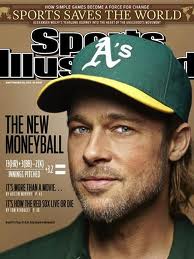
ESPN is running infomercials that point to Moneyball completely changing not only baseball, but others sports, and in some ways, it’s mildly suggested in the ads, the world. Sports Illustrated put Pitt on the cover of this week’s magazine.
Many point to the Houston Rockets and GM Daryl Morey for his work with Moneyball in the NBA. Is it really working? Since Morey took over the Rockets in May of 2007, the team has dropped in total wins in each of his four seasons (55 in 2007-08, 53 in 2008-09, 42 in 2009-10, then up just one game to 43 in 2010-11). Houston has also missed the playoffs the past two seasons.
Changing the world? That’s a bit of a stretch. I’m not even sure if it’s changing professional sports in terms of final outcome.
Considering that the A’s missed the playoffs in 2004 and 2005 and aside from winning the division in 2006, have missed the playoffs for five consecutive seasons, is it working? When you haven’t been winning with the system over a sustained period of time, can it be that much of a success?
Give Moneyball credit for getting baseball people to look beyond just batting average and RBIs and helping teams find new ways of production. But let’s try to restrain ourselves from slobbering all over it as some magical elixir that’s a proven system for winning. Hollywood’s done enough of that embellishment already.
All it does it give new meaning to Moneyball – how we as an audience got played into spending money to believe the system was and is something much more than it is.
Though we won’t ever see a book or movie exposing it as such, that’s a movie I’d get a babysitter to see. 
Standard
BCS, Bill Simmons, College Football, ESPN, Grantland.com, Jim Boeheim, NCAA, Syracuse, Texas Longhorns

The Dash for Cash Era

“A university is a college with a stadium seating over 40,000.” – Leonard Levinson
Not long ago, I wrote this little piece about the state of our priorities and how often sports blur the line between common sense and nonsense.
Turns out, I didn’t dig nearly deep enough.
The unequivocal fact is that it’s all about the money – in everything, everywhere, at all times.
Look at the recent events in college sports – from the scandals at Ohio State, Miami, Oregon and North Carolina to the conference carousel playing out amongst the major football schools.
It’s all about the money. It probably always has been. Just look at out own history, starting with the American Revolution – a bunch of people upset about being taxed, in essence.
Pink Floyd once told us it was about money and so did Gordon Gekko. We’re not listening very well. The only people who tell you money doesn’t buy happiness and that money is the root of all evil are poor people.
You think I’m being glib? You think money doesn’t swallow us up whole and we’re too blind to see it?
The film “Jerry Maguire” was a mega-money maker in 1996, for Cameron Crowe, for Tom Cruise, the studio and for Bruce Springsteen and his little secret garden song.
And when you really look at it, the plot wasn’t a love story or a budding relationship between a forgotten receiver and his agent – it was about money. 
Maguire lost it and got all touchy feely with his manifesto – and then lost his job. Immediately, he regretted this decision and wanted all his clients and Bob Sugar’s. Rod Tidwell was out for more money, the fictional Arizona Cardinals were out to save money. In some ways, Dorothy Boyd was even out for money, in order to protect her son and give him a better life.
That’s sports now and it’s not fictionalized. It’s defined by money.
It’s why Notre Dame is still an independent in football, because they have a ridiculous contract with NBC for all home games worth more than the Rockefeller’s probably gave in philanthropic endeavors.
It’s why Nebraska jumped to the Big Ten, why Colorado went to the Pac-10. And since college football makes the most money, it’s why college basketball has taken a backseat.
Don’t believe me? Then why are Syracuse and Pittsburgh joining the ACC? Hearing Jim Boeheim lament the end of the Big East Tournament and Madison Square Garden is just plain sad.
“We’re going to end up with mega-conferences and 10 years from now, either I’m going to be dead wrong – and I’ll be the first to admit it – or everybody is going to be like, why did we do this again?” Boeheim pondered during a speaking engagement in Alabama, according to the Birmingham News.
“Why is Alabama playing Texas A&M this week…why is Syracuse going to Miami?” he said.
As for Boeheim’s thoughts on why conference expansion is running rampant, he had a simple answer:
“If conference commissioners were the founding fathers of this country, we would have Guatemala, Uruguay and Argentina in the United States,” he said. “This audience knows why we are doing this. There’s two reasons: Money and football.”
Boeheim overstated it – it’s simply about the money. It just so happens that college football produces that money. And just to point this out, I’m wondering if Boeheim was speaking at an engagement that he was paid for.
I get the conferences pining over Texas, I really do. A recruiting hotbed, a traditional power and good at many other sports. The Longhorns are the belle of the conference shuffle ball.
But who on earth would want Texas A&M in any sport other than football? No one even cares about the Aggies until two months ago, suddenly, they put on a little make-up and broke up with their conference and now everyone’s lusting over them like they have Texas’ mega TV deal.
Colorado became a step-child in the Big XII, so they move to the Pac-10, bringing happy-go-lucky mid-major Utah (who’ve complained about the BCS for years) with them. How about an SEC with Texas A&M? How about a Pac-16 with Texas, Oklahoma, Oklahoma State and Texas Tech? Sure, why not.
We can’t get a college football playoff because of money.
Just understand this now: we will not get rid of the bowl system – too many schools make too such coin from bowl games. You will get the Weedeater.com Dip-o-Salsa Bowl and you will like it. Because that’s worth $5 million to the school.
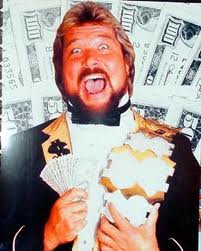
Can we just hire former WWF star Ted DiBiase to run around and throw money at everyone and laugh? Can the Million Dollar Belt be the true championship trophy? Can we stop pretending we care about student-athletes and their educations? 

We can’t bemoan their actions and deride them for taking cash from agents, selling merchandise or getting free tattoos when university presidents are doing this – making a dash for the cash.

Or apparently we can.
Do the schools use their money “earned” from bowl games on other things? Probably. Why do you think the presidents and professors even care about college football? Maybe it’s means to an end for them. They use a payout from a BCS bowl (since every team from an auto-qualifier conference gets a share) and use it to build a new library or academic hall or purchase beakers for science labs.
Then why haven’t we thrown out this question: maybe getting paid from an agent when in college is means to an end for the student-athlete. They have families in need, wants and desires, too.
Just like Texas probably doesn’t need another dorm or a new set of beakers for the science lab, a 19-year-old doesn’t need new rims on his Lincoln Navigator. But in both situations, each party is thinking: “Wouldn’t that be sweet to have, though?”
This is why money rules all: because of what it allows you to do. You have more choices and options. When all you can afford is Boone’s Farm, you don’t know how good the Henri Jayer Cros Parantoux is. Yet the result is still the same with both wines.
Professional sports, which are undeniably businesses and all about money, even make it more obvious it’s about the money.
The NFL’s owners wanted more money in the recent labor negotiations, got it, then got more of it with their recent TV deal with ESPN (conveniently finalized after the lockout).
The NBA owners just want their money back in the current labor negotiations after overspending on mediocre players for the last decade. When Samuel Dalembert is making $58 million over six years, I don’t blame him for signing that contract. I blame you and your moronic general manager.
What is a guy like Dalembert supposed to say, “No, no…that’s too much. I can’t accept. I’ve been less than mediocre and don’t deserve such a large sum of money”? If he didn’t have a pen when they offered that, I’m sure he cut his finger to sign it in his own blood.
And where does the “Dash for Cash” leave us, the fans?
Truth is, I don’t know. We really only have ourselves to blame. We play into it, just as much as anyone. We buy the tickets, the jerseys, the cups, hats and video games.
But we’re the only ones not getting paid in this.
We go to our “normal” jobs, try to earn raises so that we can afford tickets to the Super Bowl or an All-Star Game just to basically say we were there. We buy flatscreens the width of our living room walls so we can see better since we can’t afford the games in person. Yet the more money we feed the system, the more it messes with our traditions.
Rivalries die, uniforms change, winning means everything. And then we pretend to care when we found out you were cheating when you won. And we buy the hype. We’re drones, taking what they give us.
We’re feeding the beast and it’s swallowing us whole.  
Maybe right now, you’re shaking your head in agreement. Maybe you think I’m full of it – and there is still pride in sports, that honor and integrity exist above the checks.
But if I offered you a $100 to come back and read this blog next week, most of you would do it.
If I offered you $1,000 to comment, you’d do it.
And if I offered you $10,000 to write 10 e-mails, tweets or Facebook messages to Bill Simmons begging him to give me a job at Grantland.com, you’d do it. Whether you thought I was a decent writer or not.
All because I showed you the money. 

Now who is being glib?

Standard