College basketball fans, media pundits, NCAA regulatory members, and hoop junkies from sea to shining sea:
A few days ago I had an interesting conversation with a friend. It began with a question: in your opinion, what was the greatest period of college basketball? Our answers aligned: the 1990s to early 2000s.
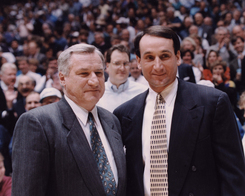
For some time, we recalled some of the great teams and players from that era of amateur roundball, of which there are far too many to name here. We lamented, with that nostalgia in mind, how over the past decade we have become bigger fans and followers of the pro game than of college basketball. And we wondered where the game was headed from here, this point, with no truly great teams.
But to identify the state of college basketball is to essentially begin with why that is so.
On its surface, the college game seems to be maintaining the foundation that was built so long ago. If we were to name some of the top teams and coaches from those glory years of the 1990s and early 2000s, we would find many of them still thriving near the top of the collegiate ranks: Indiana, Michigan, Duke, Kansas and Arizona. And the NCAA Tournament remains as exciting as ever, with surprises coming each year that no one can foresee, lovable underdogs like George Mason, VCU and Butler.
Hereto with, attendance and viewership remains high: the NCAA Tournament commands record crowds and audiences, as well as massive TV contracts, where now you can view every NCAA Tournament game between partners CBS and Turner. And look at the atmosphere created at campus’ all around the country, like Indiana, where Bloomington was bursting with energy and enthusiasm – enough to make Dick Vitale blush – prior to the Hoosiers showdown with then No. 1 Michigan on Feb. 2.
It is a testament to the love and devotion of college basketball around the country. At a time when so much about sports seems to let us down, from performance enhancing drugs and contract disputes to petty personality conflicts and illogical ways of determining a champion in the other big college sport (to be clear, we are talking about you, BCS), college basketball remains a sport filled with unified team ambition. Players and coaches focus on the mission at hand, working together towards a common goal of a tournament bid, a conference title, a Final Four run.
There is something about the one-and-done playoff format of college basketball that will forever hold its grip over the NBA and the institution of the seven game series. Are you good enough to be the best, on one night, in one shining moment? Coaches hold a much greater aura of respect and authority than they ever could in the pro game. In other words, they seem to have a point.
Yet there is still something unsettling about the state of the college game. Something is missing.
While college basketball will go on, its transfixing hold on us might continue to dwindle without proper intervention. Thus, today, we lay out our plans of prosperity for the game.
First, we must no longer dance around the issue of prep-to-pro eligibility. The “One and Done” is a silent killer of the unspoken pull we have to the college game. Imagine if Kentucky returned all their players from last year’s championship team, combined with this current team? Could they threaten Indiana’s 1976 undefeated team? How many schools would be dominant with more players in school than in the NBA? Thusly, how many great games would we have on a week-in, week-out basis?
Part of the reason the 1990s and early 2000s were great is that the teams were deeper. Think of those Duke, Arkansas, Kentucky, Arizona, North Carolina and Kansas teams that were so loaded during that period. And once one of those schools lost a couple seniors and a junior, another loaded, talented team was ready to take the mantle. Kentucky played in three straight championship games between 1996-98, with rosters that overlapped, yet changed completely.

From the Untouchables in 1996, with Antoine Walker, Ron Mercer, Derek Anderson, Walter McCarty, Tony Delk and Jeff Sheppard – and so many more – to the 1997 runner-up team (that lost the title game in OT) featuring Mercer, Anderson, Anthony Epps, Scott Padgett, Wayne Turner and Cameron Mills on to the 1998 team with Sheppard (back from redshirting since the team was loaded), Turner, Padgett, Mills, Allen Edwards and Nazr Mohammed.
Nearly all went pro, but there was just a slew of talent that passed through that program from 1993 to 1999, and even if some only stayed two seasons, like Mercer and Walker, those that stayed three of four were the continuity that bred basically a dynasty.
That’s just one program. Duke seemingly went to every Final Four over a 15-year period, won titles in 1991, 1992 and 2001 – they nearly won the 1994 title as well – with an abundance of talented and memorable players like Grant Hill, Christian Laettner, Bobby Hurley, Shane Battier, Trajan Langdon, Rashawn McLeod, North Carolina featured talent like Eric Montross, Rasheed Wallace, Jerry Stackhouse, Vince Carter, Antwan Jamison and Shammond Williams over a period of 1993-1998. Final Four appearances in 1993, 1995, 1997 and 1998, and the National Championship in 1993.
And here was Arizona’s talent, from about 1994-2003: Damon Stoudamire, Khalid Reeves, Miles Simon, Mike Bibby, Michael Dickerson, Jason Terry, Richard Jefferson, Jason Gardner, Gilbert Arenas, Luke Walton, Salim Stoudamire, Hassan Adams and Andre Igudola. Three Final Fours, two title games, one NCAA Championship (1997).
That’s barely scratching the surface: Michigan’s Fab Five, Indiana’s early 90s reign atop the Big Ten, Purdue’s streak of conference titles, Michigan State’s loaded rosters and Final Four appearances – and we haven’t even mentioned the Big East, with Syracuse, Georgetown, Connecticut (titles in 1999 and 2003). Or Stanford’s rise from 1996-2002 that challenged Arizona in the Pac-10. Or Florida’s budding program that led to back-to-back titles in 2006 and 2007, or Michigan State’s loaded rosters and Final Four appearances, or Maryland taking on the big boys of the ACC and winning the 2002 title.
And I did all that from memory, without looking up a single player – not to prove I could, but because this was the era where even the best of the best went to school, at least for a little while. It’s most likely not even a full or comprehensive list. Undoubtedly, I am missing names and teams.
Now, many will see this as a plea that players stay in school, to which I would argue is a misplaced objective.
No, my fellow basketball fans, we may never see that era of hoops at the collegiate level again. Because the truth is, I can’t name more than 25 current college basketball players, and I feel like I’ve watched my fair share of games over the past three or four years. But we’re doing a great disservice to the game in general by waffling back and forth on this issue of age.
Either pressure the NBA to institute a new rule where players cannot enter the league for two – or even three – years post graduation, or lift the restriction altogether, allow them to go to the NBA directly out of high school, yet adding the caveat that if you choose to enter college, you cannot be drafted for two or three years.
Second, we’re stripping the fabric of college basketball and college sports completely away with conference realignment. It is an abhorred tragedy that the Big East will soon cease to exist. The Big Ten is now the Bloated 14, with the additions of Nebraska, Maryland and Rutgers. Syracuse in the ACC? Utah in the Pac-10, er, 12? Texas A&M in the SEC?
We are losing our rivalries, which are the underbelly of college basketball. No Syracuse vs. Georgetown is like no Indiana vs. Purdue, no North Carolina vs. Duke. Rivalries made college basketball what it was, what drove it to greatness. I remember just as much from our golden era in-conference games and tournaments as I do NCAA Tournaments. Big Monday and Super Tuesday on ESPN, Pac-10 Thursday nights on Fox Sports West, SEC and Big 10 games on Saturday and Sunday afternoons.
These are the ties that bind. Yet everything has a price, and for the right price, we’ll dissolve any institution? That is, except for the institution of the NCAA, right?
Money and the NCAA transition nicely to our next critical item: the student-athlete.
Tell me, dear citizens of Krzyzewskiville, Rock, Chalk Jayhawk and so many college basketball villages coast-to-coast, how much is someone a traditional college student if they practice, travel and play games late at night during the school week? You’ll hear some folks tell you stories that illustrate that this was always the case, but what would be omitted is that due to said conference realignment, teams are crossing multiple states and time zones to play now.
How quickly can Iowa get back from a Tuesday night game in New Jersey? Miami to Syracuse? Nebraska to Maryland? The season lasts from mid-October through March, meaning student-athletes can completely focus on the student part for about six weeks at the start of the year and six weeks at the end of the year.
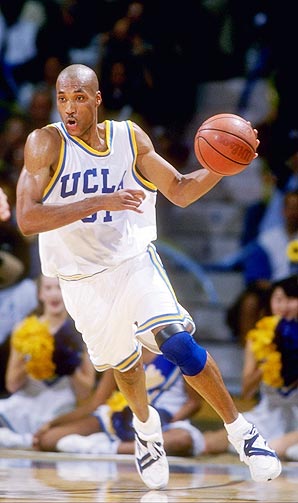
Perhaps – just perhaps – it is time to begin to turn a portion of the proceeds over to the student-athletes. And maybe not during school, but as the case of Ed O’Bannon (former UCLA great who led the Bruins to the 1995 title) vs. the NCAA proved, if you are going to use someone’s name and likeness that long after they were a student-athlete, then perhaps some of the money earned from doing so should be shared.
In 2011, the 31 conferences that received automatic bids received $180.5 million, which is then divided by the number of games each conference played over a six-year period. Each game is worth $240,000. Which meant a conference like the Big East, which played 109 games over the span of 2005-2010, took in $26.1 million. According to Forbes, by 2017, one game in the NCAA Tournament will be worth roughly $377,369 and a single game played in 2012 will have accrued a gross value of $1.9 million.
Quite a deferred play by the NCAA. Now, isn’t that just the way Dr. James Naismith drew it up?
We get confused on the numbers, when really, the battle was technically over whether or not they should receive anything but school expenses? That’s the definition of a full-ride scholarship. The NCAA simply muddied their own waters by introducing the stipend, and upping it to $300 is laughable – not because it’s only $300, but because this is the line, apparently, between heinous evildoers of sports and the kind and gentle NCAA bylaws?
What’s the difference again? Morals and ethics are being defined by the very people who make the rules here. Simply put, if any amount of money changes hands, it’s pay for performance, now we’re just arguing over fair market value.
As crafty as the “most of us go pro in something other than sports” slogan is, it doesn’t mention that most student-athletes name and likeness are used for profit over not just a college or conference, but a sanctioning body. The NCAA is like the bank in monopoly, except no one ever hits Free Parking.
Does this open a can of worms? Maybe, but no more so than continuing to use an outdated term like “student-athlete”.
Which brings us back to the beginning. The very era we hold near and dear began this battle cry and pulled back the curtain.
As Charles Pierce wrote about on Grantland.com last week, it was the Fab Five at Michigan who hand-checked the NCAA on this matter. As the university used Chris Webber, Jalen Rose, Juwan Howard, Jimmy King and Ray Jackson in the ways of advertising that would make Mad Men proud, the players started asking questions.
 Fast-forward to the present the NCAA is dipping it’s pen in company ink: allowing for video games to feature the name and likeness of players, who’s video game counterparts wearing the same jersey numbers additionally feature similar skills to those of the real athletes.
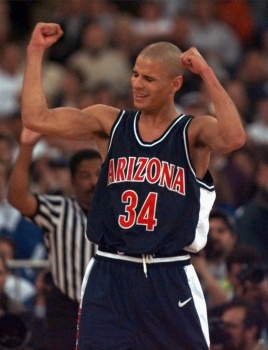
 You’re telling me it’s happenstance that USC’s QB #3 from the 2003 NCAA Football game was right-handed, white and had a similar throwing motion, to, say, Carson Palmer…who wore No. 3, was right-handed and white. It’s one thing to tell the players to keep the amateur in athletics, quite another to use them for profit on merchandise. When I was a kid, I didn’t just want an Arizona jersey – I wanted Miles Simon’s #34 jersey, Jeff Sheppard’s #15 or Steve Wojciechowski’s #12.
There was no coincidence.
It’s not a matter of should that player get a percentage of those jersey sales after their time in school is done, but how. As others have suggested recently, just put it aside and allow the athletes to have it after they leave school. That way, they aren’t getting paid while in school and under scholarship, but it could be a graduation present of sorts, a thank-you for all the money generated by you and your achievements, notoriety and skills while in college.
And so, my fellow basketball fans, the state of the college game is like a double-digit lead: a mirage. All looks fine on the scoreboard, but the momentum has shifted and a sea change is taking place.
We can either embrace this and embark on a new path which will benefit us all in terms of fairness and product, or we can continue to keep our head in the sand as our great sport falls further into the overall sports abyss. But this game will still be pure, still provide joy and opportunity as long as we remain united in common purpose and intent, as long as we maintain our resolve for logic and realize that moving forward can bring us closer to the glory of the past.
The state of college basketball is at the line with a one-and-one opportunity.
Let’s make them both.
 worldbetweenlines.com