American culture, Philosophy, Politics

Revolutions & Evolutions

When John Lennon and The Beatles sang of everyone wanting a revolution and blaming an institution, there was an aura of credibility to the fact it was an era of uprising.

The powerful lyrics about evolution and changing the constitution ended with Lennon telling everyone it would be alright.

beatles revolution

And he was right. The world’s axis has continued to spin for another 40-plus years since that song was recorded in 1968.

The 1960s are often referenced as the preeminent decade when the world was changing, a zero hour for counter-culture, and a revolutionary time when people really wanted to change the world.

In reality, the 1960s were just another decade where a lot of altering and history making events happened at the same time – different and yet much the same as potentially the 1770s, 1860s, 1950s or even the 1990s.

And each time, the message is much the same: We do not like the way things are and believe they can be better.

History, as they say, repeats itself. Sometimes, it just needs to mix up the beat or the chorus or the bridge. But we’ve been playing the same tracks over and over.

Some decades or eras are marked by violence, others by relative peace. But all are marked by men and women who fundamentally are consumed with the idea of seizing power and controlling the masses.

Whether it be a monarchy, a dictator, a president or a parliament, it is not about changing the world – it is about controlling the people in it.

The message is always the same: “I know what is right and what is best for the vast majority of you. Allow me to lead you to an unspecified time in the not too distant future where the world will shine brightly and we will be placed upon top of a hill.”

Be careful, therefore, of mortals who seek to be idolized by man. Ego, vanity, greed. These deadly sins have steered many men and women in the wrong direction, under the false pretense and belief they are part of a positive uprising, a part of the light, a part of truth, that they too shall be a part of history.

If you care to emotionally detach yourself from a political party, from a country, from a religion for a moment, you’ll eventually arrive at the assessment that all the world’s political and ideological dramas come from the same place: we are right and they are wrong.

Now, “we” and “they” could be anyone. It could be the United States, Russia, China, Great Britain, France or Spain. It could be Muslims, Catholics, Protestants, Christians, Jews, Buddhists, or Hindus. It could be Democrats, Republicans, Tea Parties or Green Parties. Perhaps it is Democracies or Communists. It could be Coke or Pepsi. Nike or Adidas. New York Yankees or Boston Red Sox. Gay or straight. Man or woman.

revolution

Each and every affiliation we have and cling to in this world generally has an opposite. We’ve taken ourselves to this generic labels of good and evil, dark and light, when in reality, we do not truly know which is which.

How often to do we look back at our own American history and see we were indeed the bad guys in a situation? At least a couple times, right? But let us move past slavery and our treatment of Native Americans because it was so long ago. Let’s not live in the past, right Mark McGwire?

We pretend to have evolved and changed, but that is all it is – a front which matches our social media pictures and status updates, yet hides the broken infrastructure of our marriages, homes and society.

The violence at home and abroad shifts and varies from year to year, decade to decade. What once took place in the act of war (and difficult to even imagine then) now takes place in our cities, trains, subways, schools and offices worldwide.

We pledge to stop it or solve it, but we’re only saying that to get elected. Seven years ago, we thought we’d turned over some great new chapter of hope and change. We have received roughly the same amount of political jabs, shades of gray and dishonesty as before and some change.

As we prepare to pick another political “leader” in roughly 22 months, we’ll be choosing most likely a new president from an old list. A man attempting for a third time who cannot believe he didn’t win in 2012. A woman doing exactly the same, whose husband was president 20 years ago. Another man whose brother and father were president.

They will all attack each other verbally. The media will attack them. In fact, they already have (at least the New York Times still puts Mr. and Mrs./Ms. in print, so there’s a tad bit of decorum left in the world, I suppose).

These candidates will all claim to be different than their relatives. They will also claim to be different than their records and their previous versions of themselves. We’ll all be left with trying to figure out who is lying and who is telling 40 percent of the truth and who can get five percent of what they say they want to accomplish, accomplished.

This dour message is both meant to depress, educate and invigorate.

Whether we’re discussing terrorism, religion, politics or something else, we do indeed have the power to impact the future.

However, we must first learn to evolve and grow beyond what we are now and what we have been in the past.

It is quite simply how and in what manner we treat each other as human beings. As long as we belittle and disrespect and disparage, all this only continues.

hebdo

Last week it was Paris, next month it may be Rio. In 2007-08, George W. Bush had incredibly low approval ratings. In 2013-14, Barack Obama has had incredibly low approval ratings. We’re using arguments about past wars and past years as some sort of verbal weapon in an attack on something happening now. We’re attempting to repeal and rollback.

These may be valid or necessary – in the eyes of those doing the rolling and repealing and beyond – but we’re simply changing band-aids. Our cuts won’t heal without an ointment to salve our wounds. We just keep cutting the same areas over and over.

Ask those closest to you to describe you in one word. What would their answers be? Love? Faith? Smile? Funny? Caring? Or would it be something else? Depressed? Rude? Angry? Busy?

We’re constantly yearning for change, change, change. But we’re not quite ever sure what that looks like – and we’d most likely need the whole thing explained to us a few times, anyway.

Look at it this way: Ask yourself what you’re doing and what or whom you are doing it for.

No matter who you are, in roughly five or six generations, no one is going to even remember your name. In roughly two generations, they won’t recall what you did for your occupation, what your childhood was like, what your favorite songs or colors were. They won’t know what your favorite hat was, what you got your spouse for their birthday or what it was like when you got married.

It’s quite simple. From the words of Lao Tzu:

“If you are depressed, you are living in the past.

If you are anxious, you are living the future.

If you are at peace, you are living in the present.”

This is not meant to be depressing, either. On the contrary, it is quite freeing. You only need worry about the here and now. The past is over and the future has yet to occur.

Additionally, the world you live in now, the people you surround yourself with and how you treat them, which will be your legacy. Though your name may not last through the infinite time the universe will, your legacy in this world will.

How you treat and interact with your little world will influence those around you – your children, your family, your friends, your colleagues.

Perhaps their actions and behaviors will change as well. And that is something truly revolutionary.

Or maybe, just evolutionary.

Either way, it will indeed be alright.

Standard
American culture, Culture, Media, psychology, Society

Faux Real

Last week, the geniuses at Slate put together an incredible piece about “The Year of Outrage” – tracking what America was so mad about in 2014.

For every day of the year.

Safe to say that based upon this study, it would seem as though our faux anger has created actual, real emotions. This is both sad and slightly scary, meaning that we are having an increasingly difficult time determining what is real, what is fake and how to react to both.

We can get a false sense of just about anything these days. We can generate fear and reaction into someone with a post, an e-mail, a text. We can misrepresent what matters and what does not.

We are less connected physically, but through technology, social media and various work “efficiencies” we are more connected psychologically.

And let’s be honest, our psychological make-up is not always the most stable of places.

41003-Fake-A-Smile

We are flat-out terrified of stuff that just does not matter, yet increasingly numb to that which does.

We do not see things the same way, leading the vast majority of us to react quite differently to the same situation.

For example, an e-mail sent by a co-worker at 10:14pm, over something that could not only be handled tomorrow, but next week, create for some a sense of dread or panic that they have done something wrong to receive said message at said hour of the day. The sender, by contrast, was just knocking out a few “to do” items and not really paying attention to the time of day or the subject matter.

This faux anxiety creates faux stress that feels as real as you can imagine. That stress leads to anger and lashing out at the smallest of things – like perceiving someone cut you off in traffic, leading to a real finger being flashed and real bad words being used.

Thus, often, our perception of reality becomes our reality.

Millions of Americans deal with differing levels of anxiety and to me, there can be no doubt this is contributing factor to our reactions. The best way to describe an anxiety attack is the feeling of being charged by a bear, when there is, in fact, no bear.

It cannot help us out psychologically when we get worked up over something that’s been put out on the line that we have no part in or cannot control. We’re manufacturing our own dramas. We’re desensitized, yet somehow overly worked up at the same time.

A sampling of the topics that made us grab our verbal pitchforks and raise fury like hell hath no in 2014? Just your usual mixed bag: bad jokes by people and companies, how people react and respond to each other in positions of power and authority and of course, race. Typically, it is how we reacted in hindsight that seems most perplexing.

If we’re so outraged all the time, how do we survive? If our not entirely true feelings are coming out in a very real way, how do we know when we’re actually experiencing anything real? How do we know if we’re really angry? How are we not just becoming the slightest bit numb and missing the things that matter?

Do we even know the difference anymore?

Rage is more of a controllable anger. Outrage seems to encompass some sort of moral or ethical fury. As Slate mentions in their piece, it feels showy and a little false. Probably because in America in 2014, the outrage is just that – a faux show.

The-Social-Media-MobWe kind of enjoy putting on the show. For each other, for ourselves.
More people are outraged at Sony for pulling “The Interview” than people who were actually planning to see “The Interview.” If you didn’t plan to see the movie, what do you care that a studio wasted millions on a film and marketing only to pull it? What possible moral or ethical outcry could there be to this? Yet, there it was, headlining the news, trending on social media.

The show must go on.

Of course, there are the topics we were outraged by – like social issues – in a possibly decent and entirely pure way, but of course, both sides of the discussion blew it because we got snide, hateful, over generalized and just looked and sounded insane most of the time.

Most of our stories pass through the life cycle partly on their merit (newsworthiness) and partly – largely – due to how we react to it. “It” only becomes a thing if we let it, allow it or want it to. But who can actually tell what we really care about and what we faux care about anymore.

The general theory goes that in anger, you tend to not listen very well. If we’re so outraged and blinded by vengeful anger at all these topics and sensitive subjects in the world, how on earth are we going to have a proper discourse and actually build a bridge to solving said problems?

Ever argue with your spouse or significant other? The rage and indignation rises to a level that virtually blocks both of you out and all you can hear and see is the anger. The words don’t matter as much as the tone.

No point on earth can be made and accepted through shouting down, demeaning, mocking or condescending the opposing side. Uh, they already oppose you…so…certainly your remarkably smarmy attitude will win friends and influence people over to your side, right?

And after the anger and outrage have subsided, you might have a chance to get somewhere with the person opposite you.

Yet outrage exists as a kind of mental bomb. You cannot see it, but once it goes off, the effects of the outrage last much longer than you think they do. And the next time someone says something, they are gently traipsing through the mental mine field of your outrage, trying to avoid the buzz words or things they believe set you off before.

Or they just don’t even bother, which is kind of worse, because it means we’ve stopped caring.

We’ve all been there. It’s the people in your life that are actually no longer in your life. The ones you stopped seeing and calling – or the family you deal with at major events, but say nothing of relevance to anymore because it just is not worth the hassle of taking another hit of their outrage.

This is my overall fear: That we will stop caring about the stuff that actually matters because we’re too outraged and obsessed with the stuff that doesn’t – or too busy avoiding the social media bullies to realize we’ve become one of them.

We see what the backlash does to people, every day folks like you and me, writers, media types, celebrities. It crushes them like a tidal wave. The vitriol and anger override anything else, swallowing them whole, exacerbating the moment, most of the time making the reaction to a reaction a bigger moment than the moment.

Fake emotional outbursts create real damage.  They create situations where there are none. These have been dubbed “nontroversies.”

nontroversy

By the look of it, we specialize in nontroversies, but what do we do when the indignation and public shaming passes, when the offending party has been branded, fired or both? Then what?

Simple.

On to the next one.

And we leave the trash and damage for someone else to pick-up. It’s not our problem.

This is the faux show.

This is America – where we pretend to care about that which matters little, where we put on our show, where we seek to portray the picture of perfection, of wealth, of happiness.

Except that we are broken inside, broke on the outside and empty all over.

The best gift this holiday season is one you can give both to yourself and help spread to others: be different. Don’t engage in the minutia, the gossip, the social media mobs. Stay positive, do not the negativity eat away your ability to discern the difference between what is real and what is imagined.

Know what is important. Spend some time thinking about that. Live in the present and embrace the unknown. Expect nothing. Calculate little. Just live and be.

Know that the only currency that truly matters in this world is faith, hope and love. Their value is immeasurable, which is why they are a treasure.

And those three – faith, hope and love – are the most real emotions you could ever experience.

Here’s to the hope that 2015 will be the Year of Anything But Anger.

Real or fake.

Standard
American culture, Culture, culture war, Politics, pop culture, psychology, race relations, Society & Culture

As The World Burns

It’s beginning to look a lot like Christmas.

That is not such a good thing.

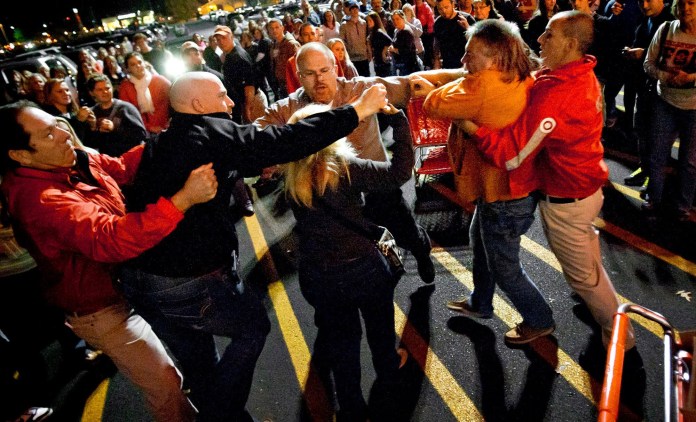
Here we sit, as the world burns around us, and lament the trivial, the inconsequential, the minutia. We fight over saving an extra 20 percent in the Target parking lot. black friday

I have come to the conclusion that we must secretly want it this way. Or we are lazy. Or we do not care. Or it is just easier to ignore it and focus on our first world problems, holiday plans, on the gifts we must buy. We do not really want to talk about it or do anything about it. We just want to complain about it for a hot minute and move on to the next thing.

We put a proverbial Band-Aid over it and hope it goes away?

Oh, you are probably wondering what “it” is. You want to define “it”? Fine, I suppose that is fair.  “It” is undefinable. “It” is everything, anything and nothing at the same time.

“It” is the topic of the day. “It” is immigration, race relations, religion, poverty, politics, international affairs and the economy. “It” is gun control, Hollywood celebrity culture, concussion protocols, domestic violence, locker room language and bullying.

“It” is how families communicate, nuclear and extended. “It” is marriage, divorce, parenting and children. “It” is our increasing reliance on technology. “It” is our jobs, our anxiety, and our fears, our obsessions with the material and immaterial of the world.

“It” is every little thing we deal with on a day-to-day basis.

Perhaps most of all, “it” is you.

Yes, you – the one who thinks I am writing to everyone else and doesn’t think that these (hopefully) thought provoking pieces of less than literary prowess over the past few years are directed at them.

It is directed at you.

It is also meant for me.

When my writing changed a few years ago, it was because the way I think changed and evolved. A funny thing happens as you age, you start paying attention to more than just box scores. You marry, have children and find yourself watching less SportsCenter. Why? Because in the grand scheme of things, it just doesn’t matter as much, while what we are doing to ourselves does as a society matters all that much more.

But a key realization occurred along the way: talking does little. Writing seems to do less. People do not want to hear about the ills of the world, much less so what they can do to improve it. We do quite a bit of talking in our public and private lives. Actually addressing “it” and finding real solutions is a much more difficult proposition.

And this is because we simply do not listen.

We hear, but we don’t listen. We can’t talk about anything that leads to a civilized, give-and-take discussion and solution, because mostly, we’re unwilling to budge on our positions, to meet others halfway. We react, we get angry, we get hostile. To most, an idea of a solution to any problem is agreeing that we are right. It is part ego, part vanity.

Devaluing the ideas, thoughts, and concerns of others while simultaneously self-promoting our own as fact and truth is as dangerous as it is foolish.

To most of us, we might recognize this, so we back-off. It is not worth the argument, the fight. We Band-Aid our lives for the sake of doing the dance. We won’t talk about “it” – whatever “it” happens to be, because all it will end in is hurt feelings, angry words and emotional outbursts.

So we bottle it all up inside, allowing it to take residence in our proverbial mental garbage bin of all the things we’ve ignored, swallowed and tried to forget over the years. These situations become like sticks of unlit dynamite.

And then, at some unknown point in the future, the most meaningless thing sets off the wick and we explode, looking like we need a straight-jacket and some prescription drugs.

We’re all a little crazy.

But that is because we allow ourselves to be. We think we’re saving face. We’re not. Clear and honest communication is a central part, but actually listening and being willing to bend, to meet in the middle on whatever “it” is would most likely serve us all well.

This much is true: if we agreed to disagree from the beginning and worked to a solution that neither feels entirely great about, but comfortable with, we might actually get somewhere in this world.

Our world view is significantly altered by the fact that I am me and you are you. We’re a country and world full of people with specifically engineered lives, with experiences vastly independent from one another.

We share the same period of time and space in this universe, but we experience that time and space in very different ways, which means we do not – and cannot – see the world the same way.

So why are we so surprised when people of opposing viewpoints and political parties, living in different cities, towns and regions, with entirely different life experiences disagree with us?

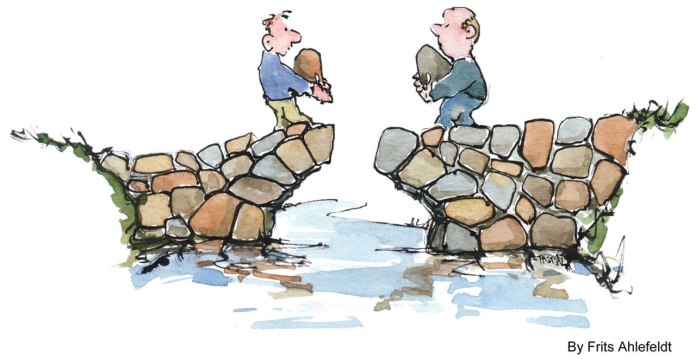
We will never agree on anything because not one of us looks at everything the same way. It is not about forcing someone else to see why they are wrong and you are right.On the contrary, it is an attempt to build a bridge toward the middle where you see where they are coming from.

bridge


That is problem solving. That is relationship management. That is how we were designed to interact. We are not all geniuses in all aspects of life and its infinite mysteries, nor are we complete morons, either. We’re a melting pot of races, religions, ethnicities, social, cultural and economic backgrounds.

We – READ: you and I – would be better off if this were not just a pipe dream, but something we actually exercised ourselves and taught to our children. You – yes, you – will be wrong sometimes. You will be right sometimes.

Sometimes, you might be either, neither or both.

The same goes for me, your parents, in-laws, children, their friends, teachers, your co-workers, the guy working construction and the lawyer on 5th Avenue, the President, Congress, Roger Goodell, Chris Rock and the waiter at your restaurant.

Be in the world, not above it. People are people, their problems are real because they experience them. Don’t shut them down. When we refuse to grow, we refuse to change – and change is largely inevitable. Growth is good. Sticking to your old habits, beliefs and traditions is not necessarily something to be proud of.

So this holiday season, start a new tradition.

Try.

Try to be honest. Try to be kind.

Try to avoid the Social Media tar pits that cannot be one. Try not to take the bait. Try to understand there are people who do not have food, shelter or friends.

Try to not be too swayed – or angry – with those seeking your vote, your money, your donations and your time. Try to give back a little more than you take.

Try to understand the other side, someone else’s perspective as best you can. Try not to shut down or shut out. Try open minded. Try accepting what you can.

I don’t think you should necessarily succumb to the world, give in to all opposing views and beliefs and acknowledge they are somehow right. But the world is not going to fully come your direction, either.

Try to build a bridge.

At least your half of “it,” anyway.

Standard
American culture, belief, Culture

The War on the World

On October 30, 1938 America went into a panic.

We were being invaded by Martians. Or so we thought.

The Mercury Theatre on the Air performed a Halloween radio episode directed and narrated by the great Orson Welles. It was an adaption of the H.G. Well’s novel, The War of the Worlds – which was first published in 1898.

None of this matted when people tuned in and heard the broadcast – missing the intro which stated the show was a dramatization – and believing that an actual alien invasion was occurring.

It caused mass panic and outrage, with the media proclaiming cruel deception against the broadcasters. People immediately called for changes to Federal regulations pertaining to the FCC.

Nearly 80 years later, we’ve come no further, except the roles have reversed.

The media causes the panic now.

Look no further than our current Ebola crises. Now, as a disclaimer, it is clear that the Ebola threat is real and it can/should be a concern, but the manner in which it is purported, you’d think it had taken out half the world’s population, largely due to its by-minute coverage and sensationalized reporting.

There were more Ebola experts on CNN’s split screen the other night than people who currently have Ebola in the United States – or that have been married to Kim Kardashian.

An anchor for NY 1 warned of the dangers of consuming mucus and feces that might come from an Ebola patient. No, really. That happened. Apparently, this was a warning we needed to hear and heed.

Common sense and logic go out the window in these situations. You play with the strings of the puppets long enough, they become tangled.

The media is our machine of mass influence, whether through TV or Twitter. And it must keep the machine running. It has to feed the beast.

This is why you get three weeks of Malaysian Airline coverage in the spring – there was nothing else to cover than moved the needle – what consumes the fear and panic more than a vanished flight, theories and mystery?

We are getting more of this with Ebola. While we never want to make light of a serious illness, some of the coverage has been comical – from sites writing research articles regarding Ebola – and covering themselves with the disclaimer “we don’t know for sure” and “no one should panic.” They are certain you need to quarantine for 21 days – except they need more data to prove that.

If you want to stop making people panic, then stop putting things out there that make people panic. Don’t report what isn’t known.

The New York Times published an article on Sunday about those in quarantine. It cautioned against paranoia, fear and cruelty – only to tell stories of paranoia, fear and cruelty.

The reality is anything can happen to us. Most of the time, the odds are it will not. We could have an Ebola outbreak in the United States. We could also have an asteroid smash into Earth tomorrow. Both are plots from movies (“Outbreak” and “Armageddon”), but the disease outbreak seems more logical to most of us as a thing that could actually happen.

28-outbreak

Or it could only seem that way because we have absolutely no understanding of the universe and the way space works and what’s out there. The asteroid theory is only outside the realm of believability because we do not understand it, we cannot see it.

But both outcomes can be terrifying.

That is, if we let them.

We can blame the media for preying on our fears and perpetuating all the panic, but we’re allowing it to happen to us.

Fear is a very real and human emotion – it’s why we both like and dislike horror movies at the same time. The mind is a very powerful place and goes as far as we would like it to – or let it. Deep within our subconscious is something that triggers us to fear one thing that sparks most all forms of fear: death.

Our fear of death prevents us quite often from living life. We’re afraid to die because of the perceived unknown of what happens after. Even for those who believe in a form of religion or faith, there remains some element of fear for the majority of people. There are no reports from beyond, nothing to be seen, no audio to hear.

You can be at peace with this and live life free of fear – or succumb to its darkness and attempt to do what no one truly can and avoid death. Good luck with the latter.

It’s one thing to be safe, cautious and somewhat guarded with the world. It’s quite another to allow yourself to submit to the panic and fear perpetuating society currently.

And why does this fear play such a pivotal role for the future we’re trying to safeguard?

Because we are freely giving up liberties for the out of convenience; we subjugate control to feel protected, thusly making us less so all the while.

We’d rather give up certain things now to protect a future we want to have – except it might not look anything like what we’ve envisioned. That would be something to fear. The more we give away in our freedoms now, the less we have in the future.

But we’re a short-term society.

We want things now. We want them cheaply. We long for instant gratification and instant satisfaction, unwilling to wait for the natural surprises, for the well-earned payoff. Better yet, we prove unable to show patience or faith.

It is interesting to watch as celebrities have pledged and donated millions of dollars – or in Paul Allen’s case, $100 million – to fight Ebola. While generous and hopefully extremely helpful, it is also fair to say that these outbreaks and situations may have been under better control or even cured had that money been shared long ago. But we only do what we must when pushed or threatened.

You see, fear rules most of our society. It always has. We were afraid of King George and what he might do. We were afraid of the Indians, the Spanish, the French, the Japanese, the Vietnamese, the middle East. We’re not alone in our fear, mind you. Countries and groups the world over are fighting out of fear.

We pretend we’ve changed, that our past has impacted our future through an education. We act like we are smarter. But we’re making the same mistakes. We’re reacting out of fear. We’re easily swayed by propaganda. We panic and overreact, just like we did during numerous past conflicts in the world.

We’re afraid of each other and what we might do to one another. So we put each other in quarantine, in concentration camps. We refuse to give certain rights and liberties – all out of fear. And we give up our personal rights and freedoms for the very same reason. We don’t trust the governments of the world? We don’t trust ourselves.

History repeats itself. And the only winner is fear.

FDR was right: “The only thing we have to fear, is fear itself.”

The war on the world is not conducted with armies, religion and weapons. It is conducted through the mind, through persuasion and fear.

Currently, we are weak and easily swayed.

Of course, based on our past, I’d say we’ve always been this way.

2014 looks an awful lot like 1938 – and many different years before it.

Standard
American culture, money, Uncategorized

The Power of Paper

In America, we are defined by action in virtually everything we do. From how we produce at work to how much we do in our spare time, we attempt to let our actions speak louder than our words.

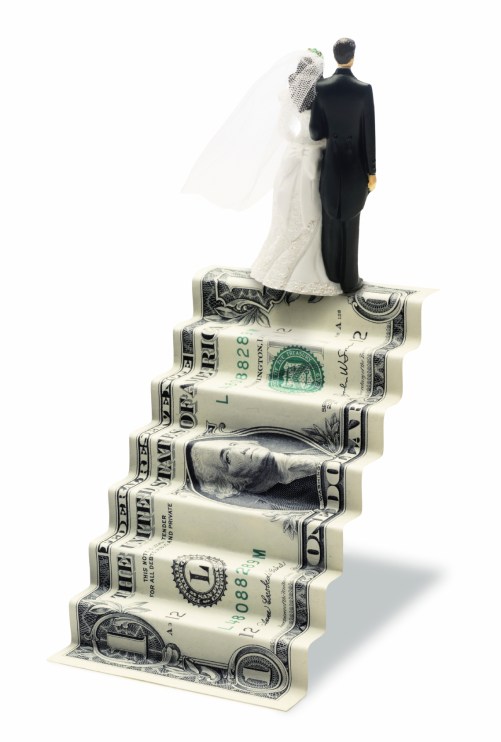
So what does it say about us that a record number of people are choosing to not get married? Further, what does it say about us that the primary reason for this action – or inaction – is due to financial concerns?

It says that while seeking financial windfalls, we have become morally bankrupt in America.

dollar-steps-money-marriage-wedding-bride-groom-bill

This is not a religious soapbox, nor one about the sanctity of marriage. And this certainly is not a statement on who can or should get married.Earlier this week, The Pew Research Center released a report on the decline of marriage in the United States. A record 1 in 5 Americans, aged 25 or older, have never been married – up from 1 in 10 in 1960.

The numbers are further connected by race and gender: men are less likely than women to get married, African-Americans less likely than Hispanics. Education plays in, too, as does employment. A recent survey showed that 78 percent of women polled said it would be “very important” for their prospective spouse to have a steady job.

By 2030, researchers estimate that a 25 percent of 45-t0 54-year olds will never have been married, up from 14 percent right now.

Some may write this off to a weak economy or a recession. Others may reason that because divorce rates are high – and have been for decades – a smarter generation of Americans is emerging that logically wants to make sure all their ducks are in a row and they are safe before they wed. They wish to not make the same mistakes as their ancestors and live a life free of financial stress. In fact, most reports suggest the decision to not marry is in one way or another often tied back to finances.

This fear of financial worry is another ticking time bomb in our current societal and culture implosion.

Our obsession with these numbers, of retirement, of financial freedom, our houses, cars and vacations: do we not understand they are meaningless without someone – or someones – to share it all with?

Humans have written books and produced art for centuries portraying that companionship and love are the true meaning of life. And we are slowly eradicating that by narrowing the human existence down to gross total sums of that sweet paper.

Do we not understand that individually and collectively, we determine all forms of value?

In high school, I had an awesome history teacher who gave an incredible example one day. In explaining how fragile the global economy is, he pulled out a $20 bill.

“All you need to do to completely collapse the infrastructure of any economy is get enough people to agree that this paper in my hand does not actually hold any real value,” he explained. “You see, we’ve all accepted that this is worth twenty dollars, but the paper itself is worthless. It only holds value because we accept the idea that it does. It’s merely a method of exchanging goods and services.”

The teacher went on to explain how we begin this process at a young age, trading a turkey on rye for a PB&J on wheat in the school cafeteria. Each party accepted that the trade was fair and held equal value. Long ago, this trader mentality is how we survived. Furs were traded for grains and so on.

He then ripped the $20 bill up into little pieces, letting it fall like confetti to the ground.

“The moment that any society decides the paper holds no value to them anymore, then the value agreement is broken.”

It could be argued, somewhere along the way, we got lazy and invented a system that would allow others to do the work and we would pay them for services in a standardized, official form.

We perfected this system by then equating time to money, which is really like equating apples to oranges. In essence, we are paid for our time to do and make things others do not in order to purchase things from others that we either don’t do or do not make. One could argue that it is a time saver. But if we’re trading our time anyway, what’s the difference?

While I’m not suggesting ripping up all of your money and proclaiming it has no value (I’m not a barbarian), I am urging us to stop equating apples to oranges. Is money a factor in the world we live in? Of course. Should it be the only one? Never.

We set the market on everything in this world, everything is supply and demand. The minute we stop caring about something, its value drops. We have the power on value, and we’ve had it all along.

We are the ones that buy the gas, the milk, the bread. We’ve deemed these essential to our survival. On the other side of that action, we buy the gossip, the music and movies, the drama of the NFL, the crisis of Apple iPhones bending, politics and the like. Our message is that these things are also essential to us because our actions tell us as much.

The message now, it appears, is that value rules over valuable. Money is more essential than people and relationships, that working together with someone to create a shared profit in the future, one that includes money, but is not of it is just not worth it.

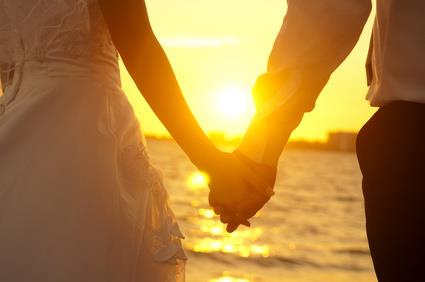
sunset handsMaybe it is just me. From practically the moment I met my wife, I felt a pull that was nearly divine. In a short amount of time, I knew that I needed this woman in my life. I didn’t know exactly what that meant – I couldn’t. I didn’t know how we’d support each other, or a family, in six months, let alone six years – or 60 years.

And that was entirely the point.

I didn’t need to know, because I wanted to try; because all I really needed, was her.

To this writer, at least, marriage isn’t about a solid, well-planned, financial future. It is simply about two people who choose to take on the randomness of the world, its roller coaster ride, as a team – and the emotional, spiritual and physical connection you get from the journey. No amount of monetary value can be placed on that, nor would I accept it if someone tried.

Some do not want to get married, others who do or are already married may not make it ‘til death do them part. It is naïve in America to think that other factors are not at play. It may not always work. I had a conversation with a close, single friend about this very thing, asking him if money would be the primary factor in him choosing to marry someone or not.

“It wouldn’t be the factor, but it would be a factor,” he said.

Fair enough. Money – or lack thereof – can certainly ruin a marriage. But this piece is about the fact we’re increasingly unwilling to even risk getting to the part where we argue with our spouse over money, spending and bills, become bitter and lose the love. This is about the supposedly sweet, gooey part at the beginning. We’re putting the money before that part all together, which means financial planning has replaced the exciting butterflies of falling in love.

It’s a personal decision, but I cannot help but wonder if all that planning for the future will be a future alone, one where we might sacrifice an emotional and physical connection with someone in order to have a larger figure in our bank account. It is a false sense of security in a world where you can never really be financially secure.  The money will come and go. And when you leave, you leave with nothing except what you gave and experienced with others.

Will people remember your bank account figures or how much you paid off in student loans before getting married when your time to go comes? Do we remember that bill from four years ago that had us stressed out? Or who the bill was even from?

It is amazing how much power we’ve given that sweet paper.

I only caution us to find a balance, to be careful. This collective cultural decision to wait for marriage until financially stable means we’re willing to be alone, which ties in closely with the rise of social media.

We’re alone, but we’re pretending to be connected with people. We’re virtually social, we’re virtually getting married. One could argue we’re virtually human. Shakespeare would get laughed out of the room now; Ralph Waldo Emerson, Yeats, Frost, all deemed foolish. Our new poets are Warren Buffett, Suzy Orman and Dave Ramsey.

We have “progressed” to a point in time where we would apparently rather not take the risk of an unhappy, poor future, thus sacrificing the risk of a truly happy, rich future.

I suppose it is all in how a person defines rich and the value equated to that term.

Just try to remember, after all, it’s just paper.

It only holds the value you allow it to.

Standard