Alabama football, BCS National Championship, Bear Bryant, Brian Kelly, Lynard Skynard, NCAA College Football, Nick Saban, Notre Dame

The Song of Saban


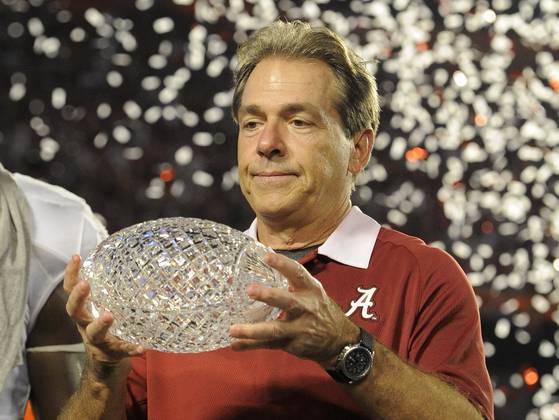
In the aftermath of “The Beating”, as a crystal football was held high into the warm winter air of Miami, the sound of Lynard Skynard’s ode to Alabama oozed out of the speakers in Sun Life Stadium.
“Sweet Home Alabama” was a befitting end to this night, this season.
No. 2 Alabama (13-1) defeated No. 1 Notre Dame (12-1) by a lopsided score of 42-14 to claim the 2012 National Championship and the school’s third national title in four years. It marked the Crimson Tide’s 15th National Championship in football (the school’s count), and for head coach Nick Saban, his fourth, cementing the claim to a dynasty.
By dominating this game in every fashion, it bolstered the crystal-clear notion that the Alabama Crimson Tide are the quintessential historic college football team. Not Notre Dame, not USC, not Texas. Never has a school and a sport meant so much to its fan base, to its state and to a region.
In hindsight, it would appear we all got a little carried away with this one. From breaking down the matchup in ways that gave Notre Dame a puncher’s chance to comparing this historic matchup with each school’s respective counterparts from years gone by.
Let’s just settle this: there will never be another Bear Bryant, another Knute Rockne. Between the Houndsooth Hat and the Galloping Ghosts, this matchup represented history on paper. Forrest Gump versus Rudy. But no hype machine on earth can make this 1973 or 1966. Rudy was an underdog. Forrest was an All-American with blazing speed. Gump was greater than Rudy on this night.
Run, Forrest, run.
But the sequence of plays that lead to “The Beating” proved that aura and mystique only take you so far, for either school. You need speed. You need size. You need precision.
Brian Kelly is a fine football coach, and as a lifelong fan of the Fighting Irish, I’m happy to have him. He’s just what was needed to restore this program to relevancy. And he has. A 12-0 undefeated regular season against a better schedule than people want to give credit for is way more than I expected this season – or frankly any of the next three seasons.
Yet there remains a vast difference between relevancy and relevant. Being in the conversation is not the same as being the center of the conversation. Notre Dame accomplished getting into the former, while Alabama has and is the latter.
When a football team and its fan base remains largely stuck in its past, as Notre Dame has, something has to change. You cannot get young high schoolers who weren’t even born the last time Notre Dame won the national title (1988) to commit based on its tradition and history. You have to show them something. And this is a fine start. This is where Alabama was five or six years ago, on the cusp of relevancy, struggling to maintain consistency.
For whatever it’s worth, Notre Dame deserved to be in this game. The only bowl-eligible undefeated team with wins over Stanford (who beat Oregon at Oregon and won the Rose Bowl) and at Oklahoma, as well as winning at USC (the preseason No. 1 team) was good enough to be selected for this game under this system. The outcome doesn’t prove Notre Dame was overhyped or fraudulent, it just proved Alabama was much, much better.
And therein is the major take away from this unruly affair: Alabama is vastly superior, vastly consistent and properly rated. As we debated over the past two weeks – following Florida’s embarrassing loss to Louisville and the SEC’s less than stellar bowl season showing – if the SEC was down and what that could potentially mean for the BCS title game, we forgot one thing: Alabama is different.
They are coached by Nick Saban, who’s been criticized by many, including me, as being an emotionless coaching droid. But what Saban’s lack of human emotion seems to stir in the rest of us really matters little; his results conjure all the emotional bond he needs with his players and fans. Take away those two lost seasons with the Miami Dolphins and the NFL, Saban’s won four national titles in eight years (he won one with LSU in 2003).
Who cares if Saban resembles the statue of himself outside Bryant-Denny Stadium – in more than just appearance – when he’s off the football field? Who cares if he allows himself and his staff just 48 hours to celebrate championships? And what does it matter if he enjoys a Gatorade bath like a cat enjoys being doused with water?
“Whether I look it or not,” Saban said following the game, “I’m happy as hell.”
Whether it matters or not, we shouldn’t care if he enjoys it. Why would Saban’s enjoyment of his life and accomplishments have any bearing on how we view them? Because we’re human, mostly. And we internalize these things and think, “Oh for pete’s sake, Nick, smile!” We would, right? If we were Saban, we’d be up there begging for more Gatorade to be dumped over our heads, for players to hug us and to sing our praises. We’d soak it all in and smile.
But we’re not Nick Saban.
I watched this game with my 10-year-old son, whom I’ve naturally and carefully crafted into a Notre Dame fan. Unsurprisingly, he went to bed in disgust in the middle of the third quarter. It was painful to watch, but only because – as I told him – the team had come so far and shown so little of what got them there. The hardest thing to do is reach the pinnacle and fall short of actually winning and celebrating.
It’s what we all dream of as kids and as adults, as fans. Those moments of cheering as the clock winds down, basking in the glow of success.
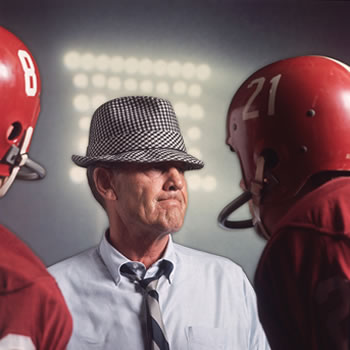
And perhaps that’s why we don’t understand Nick Saban. We’re all vastly different from him. And he’s very different from Bear Bryant. And its not the 1970s.
But maybe that’s why Nick Saban keeps on winning, because he’s different. He may not have the flair for the dramatic. He may not wear a Houndsooth Hat or have the Southern gentleman accent. 
He may not feel the glory of victory or the agony of defeat – which is what allows him to just keep going, keep working, keep pushing.
It’s what might make him the greatest college football coach of all-time, at least statistically, before it’s all said and done.
I just hope, for a moment, as the trophy was held there above his head late on a Monday night in Miami, he could hear the song coming out of the speakers and know that for an awful lot of people, it meant something to them.
Standard
Alabama football, BCS Championship, Brian Kelly, Chip Kelly, LSU, Miami Dolphins, Nick Saban, Notre Dame, Oregon

Prepare to be Prepared


In roughly one month, Nick Saban could win his fourth NCAA college football championship. This is a big deal for a lot of reasons, all mainly to do with sports. He’s well prepared for this moment.
And thus is the Tao of Nick Saban, because nearly everything revolves around football and preparing for football games.
There will be many stories and columns written over the next 30 days, on Alabama’s current dynasty, which is playing for its third national title in four years. There will be stories about the rebirth of Notre Dame, puns about waking up the echoes (I’ve used a few myself), about how Brian Kelly stands become the next in a long line of famous Notre Dame coaches who have won a national title in their third year at the school.
But nothing is more fascinating than the blank, devoid nature of Nicholas Lou Saban.
He’s won 158 games and three national championships (one at LSU in 2003, two at Alabama, in 2009 and again last season). He wins bowl games, conference championships and it could be argued, he started the SEC’s run of dominance with that 2003 LSU team. 
 
Saban is notoriously famous for ducking questions. Any and all questions. Questions about his team, his opponents, his coaching style, recruiting practices and most notably, his emotions.
He rarely smiles, even when hoisting crystal footballs. He doesn’t seem to be enjoying life or football very much.
That’s somewhat troubling for a man who’s at the top of his profession.
Perhaps because he fundamentally believes he can control and manipulate the actions of 19-22 year-old college students, he is obsessed with micromanagement. After the 32-28 victory over Georgia in the SEC Championship that secured the Tide’s bid to the BCS title game, Saban was meticulously breaking down the failure of his players to run the defense called that was designed to stop Georgia from getting out of bounds and ending the game.
Everything Saban does is by design and when it does not go to plan, it’s upsetting to him. He wants to prepare to control. But control is an illusion, especially on a football field with 22 individuals who are reading and calculating in real time. Things don’t always go according to the plan.
And not going according to the plan is exactly how Notre Dame, as an underdog, can beat Alabama. The can prepare to be unprepared. Because it’s the only thing that can beat a calculated robot like Nick Saban.
Surprise him. Create spontaneity.
Miles, aka, the Mad Hatter, drives Saban nuts with his random ideas, fake punts, fake field goals and general zaniness. Only two teams have beaten Alabama over the past two seasons – LSU and Texas A&M. LSU did it by being flat-out crazy, with Miles calling the shots. Texas A&M did it with a quarterback, Johnny Manziel, who largely improvised once plays broke down.
You have to understand how essential preparation is to Saban. And how it’s drilled into his players, how his teams review minute details of every play call, snap count. This is a credit to their obsessive-compulsive head coach. Saban prepares to be prepared.
So when A&M ran their plays, Alabama reacted appropriately, right up to the point of finality. It looked like everyone was covered. It looked like the quarterback was sacked, or had no release valve or fifth option. Then Manziel went off the page and created something.
Same with LSU. It could be 4th-and-30 and Les Miles will run a fake punt option pitch. The least likely play is what Les likes. Especially against Saban, because Miles knows he probably didn’t spend a ton of prep time with his players on the least likely option, therefore it has the best chance to succeed.
And Georgia tried it in the SEC title game. With just seconds remaining and no timeouts, instead of spiking the ball to stop the clock and set something up, Georgia ran a play. They came up short and ran out of time. They didn’t even run the play (a fade to the back of the end zone) the way they wanted to. If they had, they would have won.
“Our players need to learn and execute things,” Saban said. “Like I told them, the most important thing in this game was to execute the plan.”
Had they called the timeout, they might have won, too. But the odds were long. Another 30 seconds for Saban and his assistants to run through the catalog of information in their brains about what Georgia’s top four plays are in that situation. Scanning all information, Alabama would have narrowed it down, ran that right play and most likely, the game would have ended with a sack or an interception or something.
This is why it probably eats at Saban that he failed with the Miami Dolphins. There wasn’t enough stability and too much spontaneity.
In his two years in South Florida, Saban’s teams were 9-7 in 2005 and 6-10 in 2006. It’s important to note how he ran the team as opposed to how they performed. He ran it like he did and would a college program. Except these are grown men. They are professionals.
Saban also elected to pass on signing Drew Brees, because of uncertainty over the torn labrum in his shoulder. He traded for Daunte Culpepper instead. Ironically, Culpepper was the one who never recovered from injury (his knee), leading the Dolphins to start 2006 at 1-6.
It was his only losing season. He couldn’t plan for Culpepper’s failure. He spent weeks assuring fans and Dolphins owner Wayne Huizenga that he was staying. On Jan. 3, 2007, he was gone. For 8 years and $32 million to Alabama.
Saban likes the safety net of college football. He knows what he is and he knows what he’s dealing with. Not many coaches will out prepare him, if any. And he’s got the talent (and their attention, due to their age and the stature of the program).
The only time you really hear him complain is about the BCS (when it’s not going Alabama’s way) because it’s unpredictable. Oh, and that he doesn’t like Chip Kelly’s offense and the speed of games now, because it’s not good for players to go at that speed.
No, Nick. It’s not traditional. It’s hard to completely prepare for. That’s why he doesn’t like it. It makes Saban uncomfortable to be out of his element, to have something out of his realm of control.
There’s nothing wrong with this mind you. It makes for a highly successful college football coach. He produces quality talent, wins, good NFL players. It’s a solid-product in sublime packaging. It works. But it doesn’t emote. It doesn’t inspire. It’s not entirely creative and ground breaking.
And while there’s nothing wrong with it, it’s highly un-entertaining. Saban is bland, boring and frankly, kind of creepy with his obsessive attention to preparation. There’s not a lot of depth there, it would appear. Saban thinks about preparing for football games and little else. He may have charities, he may have a great heart for children and his faith, but he’s not here to change the way we think about football, to invent something new.
Saban’s purpose is to execute the plan that was prepared.
Now, the king of preparation has 40 days to prepare for a bland offensive Notre Dame team and a defense that probably, despite their high ranking, has some holes a great football mind like Saban can find.
For Notre Dame, to win this battle is to not play that game. Notre Dame must do something different, something unpreparable (yes, that’s a new word, for those scoring grammar at home). Something…Miles-esque. Manziel-like.
So for all that you’re about to read, see and hear about Alabama, Notre Dame, traditions, defenses, Brian Kelly and the Irish, national championships and whatever other buzzwords are hard pressed into our subconscious before the BCS National Championship, remember this: Nick Saban will have his team prepared for what is most likely to occur.
Nick Saban won’t go back to the NFL. He can’t be happy. And the pressure of winning at Alabama means there’s no joy to it anymore, not with the expectations so big each week. So his life and his coaching career are intrinsically linked to this feeling of an elevated notion of unhappiness due to expected success. The success isn’t a surprise because it’s so thoroughly prepared for.
But with sports, and life, it’s the unexpected, the roller coaster moments that make us actually feel alive.
If you spend all of your time preparing and things go exactly as planned, it’s a life lived.
But is it living life? 

Either way, it can’t be much fun, which is something you can’t prepare for.


Standard