Andrew Bynum, Dwayne Wade, Indiana Pacers, J.J. Barea, Jermaine O'Neal, Lamar Odom, LeBron James, Los Angeles Lakers, Rajon Rondo, Ron Artest

Something About Stones and Glass Houses

As sports fans, the collective lot of us sure have selective memories. How we define dirty play and label people has become mesmerizing.
It’s really a psycho-analysis of deeper issues. Take this past week in the NBA, for example.
Los Angeles Lakers center Andrew Bynum and forward Lamar Odom are facing somewhat deserved backlash following their actions that resulted in ejections during the Lakers Game 4 loss to the Dallas Mavericks in the Western Conference semifinals.
As the back-to-back defending champions went out with a whimper, Odom and Bynum decided to take their frustrations out physically on their opponents.
First, Odom body blocked Mavericks forward Dirk Nowitzki and was ejected with a flagrant foul – grade 2. Then, less than a minute later, the 285-pound, 7-foot Bynum delivered a nasty forearm shiver in the chest of Dallas guard J.J. Barea – while Barea was in mid-air. Naturally, Bynum was booted for his actions.
The NBA suspended Bynum for five games at the start of next season and fined him $25,000. Odom will likely receive a similar fate, only reduced in the number of games and fine.
Was it wrong? Yes. Was it dirty? Yes, absolutely.
But there is a growing number of people who are outraged by Bynum and Odom, calling them dirty players and the Lakers a classless franchise.
In fact, here’s a quote from a friend of mine:
These guys are classless, embarrassing, and horrible examples to all the kids out there playing ball. I now officially HATE the Lakers.”
Really? Do we really want to go down that path?
Because I think we’re entering a dangerous area as fans when we start generalizing and making disingenuous blanket statements about people.
Bynum and Odom’s actions were certainly in poor taste, they were dirty plays and were uncalled for. They deserved to be fined and suspended. But until that moment, neither had shown anything remotely similar in their on-court behavior.
It’s ironic that the immediate media and fan backlash was nearly the exact opposite when compared to the infamous Indiana Pacers-Detroint Pistons brawl in November 2004.
The “Malice at the Palace” began with about 46 seconds remaining in the game, when Pistons center Ben Wallace was fouled from behind by Pacers forward Ron Artest. Wallace took exception and shoved Artest. As you would expect in the NBA, this led to a lot of pushing and shoving from the players on both teams.
Artest went over and laid down on the scorer’s table and put on a radio headset to speak with Pacers radio broadcaster Mark Boyle and a fan threw a cup of Diet Coke at Artest while he was laying on the table. Artest responded by bulldozing his way into the stands and punching the wrong person. Shortly behind him was teammate Stephen Jackson, who went into the stands, fists flying.
More players – from both teams – headed into the stands, with fans running onto the court to escape the frenzy. Artest was confronted by two fans on the court and teammate Jermaine O’Neal took a running start and decked one of them in the jaw. The game was called off, as the scene was complete chaos, with folding chairs and debris being hurled onto the floor. Nine people were injured.
Shall we reassess what we determine as classless and an embarrassment to an organization?
Not yet? Well, then by all means, let’s keep going.
The Pacers-Pistons post-game commentary was certainly interesting. Studio analysts John Saunders and Tim Legler laid the blame on the Pistons fans, with Saunders calling the fans “a bunch of punks.” Rarely at a loss for words, Stephen A. Smith said that some of the fans should be arrested. He made no mention of the players.
We all lose our cool, the difference is how far do we take it? Is either of these situations, Bynum/Odom or the “Malice at the Palace” acceptable? Of course not. But the point is there are varying degrees here and apparently it only took us seven years to forget that.

Within 48 hours, Bynum had called Barrea several times to apologize. He issued a public apology during his exit interview on Tuesday. 

My actions…don’t represent me, my upbringing, this franchise or any of the Laker fans out there that want to watch us and want us to succeed,” Bynum said. “Furthermore, and more importantly, I want to actually apologize to J.J. Barea for doing that. I’m just glad that he wasn’t seriously injured in the event and all I can say is, I’ve looked at [the replay], it’s terrible and it definitely won’t be happening again.” 

Take that in contrast to this, from Jermaine O’Neal following the Pacers-Pistons brawl in 2004:

“We all knew the league is 80-85 percent black; we all know that,” O’Neal told the Indianapolis Star. “We didn’t talk about the baseball player [Texas Rangers relief pitcher Frank Francisco] just breaking a lady’s nose with a chair because she was talking. They didn’t talk about that for weeks, did they? Every day for six weeks, you see something on TV about it. They didn’t talk about [former St. Louis Blues player Mike Danton] trying to kill his agent. These are people that are not black, and that touched me a little bit because that’s totally unfair for this league to be judged off one incident.”

Race should have little to do with it. 

I said should, because on some level, it might. That brawl in 2004 brought some issues that had been bubbling for years to the surface, most notably, the declining relationships between fans who were (and are) mostly white and a league full of players who were (and are) mostly black. In addition to a league covered by a mostly white media and owners of teams who are white. So I would be remiss if I did not acknowledge that there could be some truth to what O’Neal said at the time. 

But race was used by O’Neal in the wrong way – as a distraction from the point at hand. Maybe the fans shouldn’t be throwing cups and maybe the players shouldn’t go charging into the stands looking to lay a Mike Tyson hook on someone. 

Just a thought.

Dirty plays have always been a lightning rod of conversation. We always want to know how mad the person on the receiving end was. We call the dirty play disher a cheap shot artist and embarrassing. But when it goes too far, it makes us uncomfortable, so we just write it all off as one and the same. 

It is not the same.

We call it dirty and classless when it happens on the court – when everything is at a distance. Remember the Miami Heat and New York Knicks brawls? Jeff Van Gundy wrapped around the legs of players? How about Charles Barkley fighting Shaquille O’Neal, or Kermit Washington decking Rudy Tomjanovich? 

If those situations happened post-Palace brawl, we might have reacted differently. Perhaps the outcry would have been much like it has been this week for the Lakers, Bynum and Odom. 

What can we take away from all of this? That we’re more sensitive now to on and off court physicality?
That may explain why nearly every game, if two players get wrapped up or someone goes down, there’s an overreaction – and then a chain reaction. 

Case in point: Boston Celtics guard Rajon Rondo gets hurt (dislocated elbow) after getting tangled up with Dwayne Wade in Game 3 last Saturday night. The fall is ugly, the injury nearly vomit inducing. Rondo comes back later in the game, is limited, but guts it out. When he returns, many members of the Heat, including Wade, check on him to make sure he’s OK. Game continues, Celtics win.

After the game, someone asks Wade, who’s sitting next to LeBron James, about the play and mentions the word “dirty”. James scoffs and mumbles, “That’s retarded.”

Boom – new controversy: LeBron James is insensitive to those with mental disabilities.

Sure enough, James started off his Game 4 post-game press conference issuing an apology. 

Sure enough, that story will grow. Someone will call it classless and embarrassing. 

The cycle will just continue until we’re all oversensitive to every little thing. 

On second thought…too late.

Standard
Uncategorized

The Cruelty of Time

One of the most underrated TV shows of the past two years has been an NBA production called “The Association”, which chronicles the season from start to finish of one NBA team. Last year, it was the Los Angeles Lakers; this year, it’s the Boston Celtics.
Beginning with training camp, viewers get an all access look at the Celtics as they try to get back to the NBA Finals and win another banner.
But this is the ultimate reality show. Exclusive interviews with players who are sharing their back stories, workout habits and feelings on the team’s performance. For a team that includes NBA stars like Kevin Garnett, Ray Allen, Paul Pierce, Rajon Rondo, Shaquille O’Neal and coach Doc Rivers, it’s truly been must see TV for any basketball fan.
From chronicling Shaquille O’Neal’s re-injury less than five minutes into his comeback against the Detroit Pistons on April 3, to the urgency of the Big Three, it was some of the most compelling scenes of stuff that happens in and around a sport.
The final episode, which aired last week, was jarring to any fan between the ages of 25 and 40.
It was perhaps more reality than I wanted to deal with. It was a window into the reality of what time does to the body, specifically with O’Neal.
At one time, Shaquille O’Neal was one of the most amazing athletes I’d ever seen. From the moment I saw his “Don’t fake the funk on a nasty dunk” commercial as a rookie with the Orlando Magic, both O’Neal’s personality and athleticism were uncontrollable. He really seemed like Superman.
Tell me what you see? I know what I see…memories of my teenage years, watching O’Neal shatter backboards and abuse opposing centers with an absolute force.
For a few years, he was an unstoppable machine in the post. It’s why the Lakers won three rings with him, why he won another with the Heat and made a Finals appearance with the Magic in 1995.
Shaq’s best season had to be 1999-2000. Leading the Lakers to the title, his first, Shaq averaged 29.7 points, 13.6 rebounds, 3.8 assists and 3.0 blocks per game, while shooting nearly 58 percent from the field. Those are simply crazy stats over an 82 game season.
Years from now, we’ll see highlights and briefly remember Shaq that way – an agile 7-footer with so much speed, size and raw force he couldn’t be contained. But time has already altered our memories of him. My 9-year-old son thinks he’s an old, injury-plagued back-up who looks out of shape.
In reality, both are true.
As with most NBA centers and really all players, years of playing 82-plus games a year is not kind on the body. During “The Association: Boston Celtics” finale last week, he admitted as much, saying that getting old was hard because you don’t recover from a tweaked ankle or hamstring like you used to. Shaq alluded to some 39-year-old guy watching right now in his office thinking the same thing.
And he’s right. I’m only in my early 30s, but I’ve already noticed it. Old injuries flare up, new ones emerge. I could hurt my back bending over to tie a shoe and the pain is debilitating.
As fans, when that reality hits us, it changes our perspective on how we view players and teams each year. A Laker fan, I used to despise the Spurs and Celtics. Now, I’m slightly torn and somehow want to see them hang on for a little bit longer, but I know they won’t.
Go back and look at Shaq’s stats again. Notice the games played category? He’s never played a full 82-game season. Since 2004-05, O’Neal has only played in more than 61 games once – with Phoenix in 2008-09, when he played 75.
It just takes longer to recover. It’s a young man’s game and we’re witnessing a changing of the guard. 

The question is, what happens to the old men who were once young men?

A 22-year-old (Derrick Rose of the Chicago Bulls) will be named NBA MVP today. The young Memphis Grizzlies beat the fundamental Spurs in six games in the first round. Other youthful teams, like the Bulls, Heat, Hawks and Thunder are all still alive. The Grizzlies were the Western Conference’s 8-seed, the Spurs were the best NBA team in the regular season. It’s only the second time that kind of upset has occurred in a seven game series.
But the regular season is a veteran’s playground – dealing with the rigors of the road, the bumps and bruises. The regular season encourages sustained excellence and mental toughness.
The playoffs, however, are about much more: how much farther, harder and faster can you push yourself after a five month season? For guys like Shaq, Tim Duncan, Kobe Bryant, Kevin Garnett and so many more, it’s a challenge just to get to the playoffs in one piece. Often they don’t. Kobe’s dealt with a litany of minor injuries the past few years, Garnett missed much of the playoffs in 2009. Duncan just can’t keep up with guys like Zach Randolph every other night for 10 days straight.
We haven’t had a changing of the guard quite like this in the NBA, not since the early 1990s, when Jordan’s Bulls began usurping the Pistons, Lakers and Celtics.
Blake Griffin’s raw skills, along with Howard’s, are breathtaking until you realize that you have seen something similar before. I saw it in Kobe, KG, Shaq…they did it too.
Back then, I was all for seeing guys like Jordan pass Isiah, Magic and Bird. I loved seeing Kobe going toe-to-toe with Michael in ’97 and ’98 – young guns taking over from the old men who should just get out of the game before the embarrass themselves.
And then I hit 30. Now I know there’s more to it than that. It’s not so easy to give up something you love so much, something you’ve poured all your energy into. Even though your body tells you it’s closing time, your mind and heart tell you that you’ve been there before and can do it again.
Maybe that’s why Garnett slaps himself in the head, head-butts the goalpost, and bounces around like a pool of sweat. Maybe it’s why Kobe and Ray Allen shoot hundreds of jumpers – three hours before a playoff game. It’s why Jordan dragged his flu-ridden body around the court in Utah during the legendary Finals and why Willis Reed limped back out in ’70. It’s why Charles Barkley had to literally blow out his knee to the point he couldn’t walk before he could literally walk away.
It can’t be over – I’m not ready for it to be over. I can still do it.”
The same heart of a champion we credit for greatness is the same childlike stubbornness that makes them push on and on in later years.
And that’s what I thought of when I saw Shaq limping down a dark corridor to the Celtics locker room. Head down, a look on his face that was both pained and blank – like he expected it to happen. Juxtaposed with that was young Celtics All-Star point guard Rajon Rondo back on the floor during the game, cutting and stopping on a dime, breaking ankles and displaying a fifth gear of speed.
You have to laugh a little bit then at how excited we get when Kobe dunks on a second-rate center like Emeka Okafor in the Lakers first round match-up with the Hornets. Or when he really turns it up for the All-Star game to prove he still belongs. We know it’s still there, so does he. It just doesn’t come out every day to play.
One day Rondo will be Shaq. One day the torch will be passed unwillingly from one generation to the next. One day we’ll forget how good he was.
They don’t go because they want to. They go because they are made to.
It’s a young man’s game – and youth is fleeting.
Standard
2011 Labor Dispute, Brian Schaefering, NFL, NFL Lockout, Rick Reilly

Where Is The Love?

Text from a friend last night:
Dude, did you hear the lockout’s over! Sounds like football is back and so is our fantasy extravaganza!!!
I still have not responded to the text.

Not because I am mad at my friend. (I actually did reply, I just changed the subject without acknowledging the lockout comment.)

Not because I am suddenly adverse to our fantasy football draft day. On the contrary, I’m always game for a 16-hour day of golf, fantasy draft, pizza, poker and whatever else we come up with.
It’s because, well, frankly, I just don’t care.
Something has either changed in me over the past 45 days since the lockout started, or I have been reading too many articles on our downtrodden economy.
Whatever the case may be, I’m downright furious this is such a big story.
I love football. I love the NFL. I love fall Sundays spent watching games and tracking fantasy stats. I love wearing my Chicago Bears hat like Clark Griswold when I put up my Christmas lights in December. I love playfully bantering with my wife’s family in Wisconsin about the Green Bay Packers, the Bears archrivals.
You know what I don’t love?
Billionaires and millionaires arguing over money for an extended period of time. They are the ones really engaged in a fantasy.
I don’t love media types like Rick Reilly, who makes a high six figures himself, writing about the poor players who made $680,000 last season and might have to get a “real” job supporting their family.
I don’t love the Reilly used Brian Schaefering of the Cleveland Browns as his example of someone we should feel sorry for. 
Schaefering made $200,000 after taxes last season from his $395,000 salary. He says his family is cutting back – watching their cable and cell phone bills, cutting out weekly date nights.
For dates, Schaefering says, “Now, it’s put the kids to bed and slap in a DVD.”
I don’t love how naive, egotistical and self-centered that actually sounds.
My wife and I do that all the time. $200,000 would be like hitting the lottery for us. We’ve watched cell phone bills and cable bills, grocery bills, and every other kind of bill for every year of our marriage. We’ve been crafty and creative at Christmas and haven’t bought a gift for each other in years.
There have been months we wondered if we would make it.
“If this goes into the season, my wife might start panicking a little,” Schaefering said.
Don’t worry, Brian. After six months of keeping your proverbial head above water, you stop panicking and just start doggy-paddling.
It’s called life. We just try to survive and advance to the next day.
At least, it’s life like 85 percent of America knows it.
Then there are those who don’t even have bills to worry about. Because they are homeless or jobless.
I don’t love the revelry that the owners and players treat this whole spectacle with.
We can’t work out at the team facility! We can’t sign players to eight figure salaries!
Meanwhile, the US dollar is falling like a brick from the sky. New estimates show that in 2016, China will surpass America in economic leadership. Gas is hovering near $4 a gallon, higher in some places.
Inflation keeps rising, but salaries for most normal jobs don’t. Unemployment hovers at 9.2 percent of the work force, a figure that has not been that high in nearly 30 years.
We do not really make anything in America anymore.  
I suppose that is not entirely true. We make reality shows and manufacture drama.
Mainly, we just consume. We’re obese and in poor health and then wonder why our medical bills are so high.
I don’t love billionaire owners arguing over more billions with millionaire players and I don’t love billionaire owners who scratch and claw for more money after fleecing cities for years by getting taxpayers to foot the bill for stadiums and arenas.
I don’t love the players pretending that this is the only possible profession in life and they are desperate.
I don’t love players who bemoan their medical care in a violent sport that leaves people seriously debilitated and that statistics show will shorten their lives.
Good sir, you chose to play this sport and are paid a lot of money to do so – even the Brian Schaefering’s of the NFL make more in one year than the President of the United States. Who has the tougher job? Deal with the consequences or get out of the line of work.
Miners and steel mill workers deal with some pretty serious stuff, too. They get probably a tenth of a percentage of the health care benefits an NFL player does. NFL players get treatment on their back, legs, arms, ankles, knees and hamstrings. My father has stood on concrete in a factory for 42 years. There’s no trainer ready with a heat pack at the end of the day.
Pensions are not high enough? Tell that to people who work at an auto factory for 35 years only to see it close and their told they have no pension anymore because it was paid out to some conniving CEO who won’t see any prison time but who was paid a 35 million dollars to go away and stop screwing up by lying and cheating.
I don’t love how our entertainment and sports are masquerading themselves as regular people with regular problems.
You are not us.
We do not understand you because you cannot possibly understand us.
You don’t love us. You just want to argue with yourselves about how to split up our money.
Our money is the money paid to companies when we buy their products at the grocery store, that in turn goes from those companies into advertisements during the long commercial breaks during your games encouraging us to buy more of their products.
Our money is the money paid to cable companies and networks to watch your games, which in turn is shelled out in 10-year contracts from those networks and cable companies for the rights to broadcast your games.
Our money is the money paid to go to games, paid to buy $7 hamburgers, $6 nachos and $10 beers at those games and paid to come home with a $100 jersey that was made in China.
Our money is the money that’s in your bank account, in your $10 million home and your $1,000 suits.
So sorry if right now, I don’t love you, NFL.
Sorry if right now, I don’t even care.
Standard
Charlie Sheen, Dave Anderson, ESPN, Josh Hamilton, Major League Baseball, Major League II, Texas Rangers, Tim Kurkjian

Them’s The Breaks

Sometimes, things just happen and it’s no one’s fault.
While we can blame certain people for certain things – like, say, Charlie Sheen for brining “warlock” and “tiger blood” into the American lexicon – it’s not quite so easy to place responsibility at any one person’s feet.
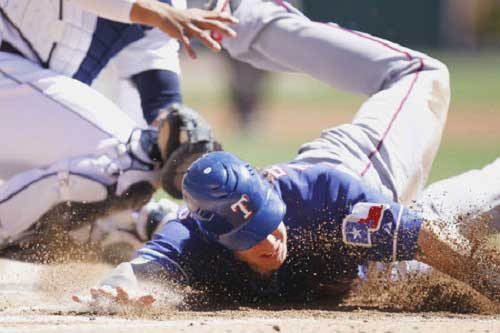
It’s important to remember this when the topic turns to Texas Rangers star outfielder and 2010 MVP Josh Hamilton’s recent injury.
In the first inning of the Rangers Tuesday game against the Detroit Tigers, Rangers third base coach Dave Anderson told Hamilton no one was covering home on a foul-ball pop-up that both the Tigers third baseman Brandon Inge and catcher Victor Martinez moved over to catch.
Detroit pitcher Brad Penny just stood on the mound – never really even moving towards home. That left the base wide open.
Anderson repeated the fact twice. Suddenly, Hamilton tagged up and began making the 90-foot journey to home – which prompted Martinez, who was about 50 feet away, to break towards home as well.
As you might guess, the guy with the 40-foot head start got there first.
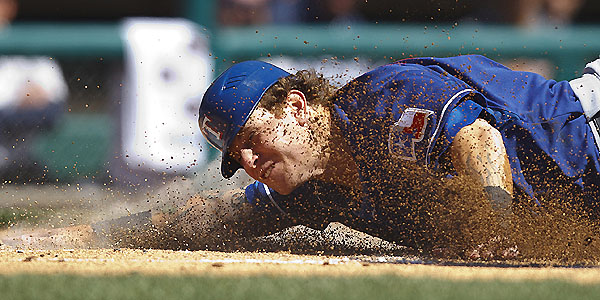
Hamilton went in all Pete Rose-ish (headfirst) and Martinez applied the tag.
And then Hamilton felt a bit of pain. Turns out, he had a small fracture develop in the humerus bone in his upper arm because of the play.
Now, Hamilton’s on the shelf for six to eight weeks. He can’t touch a bat for a month.
Then Hamilton went all crazy ex-girlfriend on Anderson after the game, calling the play “stupid” and “dumb” in the past few days and in not so many words, blaming Anderson for his injury.
He also kinda, sorta implied that he was an innocent bystander just doing his job by listening to his coach.
“I listened to my third-base coach,” Hamilton said at the time. “That’s a little too aggressive. The whole time I was watching the play I was listening. [He said] ‘Nobody’s at home, nobody’s at home.’ I was like, ‘Dude, I don’t want to do this. Something’s going to happen.’ But I listened to my coach. And how do you avoid a tag the best? By going in headfirst and get out of the way and get in there. That’s what I did.”
Come on, Josh. That’s comical in and of itself.
We all know that no one is the pros really listens to their coaches.
Apparently Hamilton is clairvoyant. He just knew that something was going to happen.
Well, if you feel that strongly about something, if you just know you’re going to get hurt, then don’t run.
And maybe don’t go in head first.
How quickly Hamilton forgets that last year he scored from second base on an infield hit. As ESPN’s Tim Kurkjian pointed out, Hamilton called it his proudest moment at the time.
Anderson referenced that as well yesterday.
“You think about in the past what we’ve done,” he said. “He’s scored from second on a groundout to the infield twice. He’s scored from first on a long single. We’ve done double steals with him. That’s a part of our game is being aggressive and taking advantage of situations. The unfortunate part is that he got hurt. But if you go out and play the game and play hard, those things are going to happen.”
So if you are Josh Hamilton, what you can do is show two sides of a coin: you’re either aggressive and hungry enough to want to score on weird plays like that, or you’re more of the cautious type. But you can’t be both.
This whole saga got blown a little out of proportion on Wednesday, with sports radio dials everywhere dissecting the play 30 different ways.
Headfirst or feet first? Was it important to even try in the first inning of a game in mid-April? Was it Anderson’s fault because he kept repeating it like he wanted Hamilton to go? Was Hamilton just a good soldier? What does this say about the future of baseball, in youth ball or the pros – will players start thinking more for themselves on the basepaths?
Seriously, fellas? I know it’s a little slow these days – NFL lockout dragging on, NBA playoffs not yet started, no real attention grabbing headlines – but to spend nearly two hours of your show on subplots in this one play that really don’t exist is a bit much, even for a guy like me.
I shudder to think what the current media would have done with Roger Dorn when he was told to get out there and take one for the team in “Major League II.” We would have heard Dorn was a company line-toeing stooge, or that Jake Taylor’s old-school ways had gone too far this time.
We ruin so many moments in sports and life by over analyzing them.
Just let it be.
Hamilton tried to score – and if he would have, people would be talking about what an amazing, gutsy, heads-up play he made. That plays like that are the difference between great and good.
So he got hurt, so what? Yes, he’s out six-to-eight weeks. Yes, he can’t even swing a bat until mid-May. But let’s look at Hamilton’s track record for injuries:
April 2011         Fractured arm
Sept. 2010        Fractured ribs
June 2010         Hamstring tightness
May 2010          Knee
Sept. 2009        Pinched nerve (neck)
June 2009         Torn abdominal muscle
April 2009         Strained ribs
Face it, the guy was going to miss some games at some point. Since getting into the majors full-time in 2007, Hamilton has played in 133 games or more only once in a season (2008).
“I can understand that if I was pulling things like hamstrings or quads and it was not actual high-intensity things like hitting walls,” Hamilton said. “I’m making plays that the game calls me to make and I’m getting injured that way. That proves to me that I can get hurt anytime doing anything. I’m tired of talking about it, to be honest with you.”
But he said he wouldn’t change the way he plays.
“How else would I play?” Hamilton said. “You can get hurt by doing anything.”
Bingo, kid. Them’s the breaks, as they used to say.
It took him a few days, but at least he understands what most of us already did. You can’t prevent the Sports Gods bringing the pain. Ricky Henderson once got frostbite from falling asleep with an ice bag on. People fall down stairs, throw out their backs bending over to pick up their kids’ toys.
Um, how shall we say, “stuff” happens.
Thankfully, Hamilton did apologize to Anderson publically and privately yesterday.
“I let my emotions get ahead of thinking things through,” Hamilton said. “The more I think about it, the more I understand that I take responsibility for what happened because I had the choice not to go or the choice to go. I just appreciate Dave having confidence in my ability to think I could make that play.”
Hamilton also added, “The object is to score and if you go feet first, that gives them all this up here to tag. It is what it is. It’s over. It sucks it happened, but it happened. We’ll deal with it.”
Exactly.
And hopefully you’ll deal with it better next time.
Standard
BYU, Florida Gators, Jimmer Fredette

Fire Away, Jimmer

Head’s up, Jimmer.
 
The crowd is closing in now and they’ve begun kicking and screaming, now that you went down shooting.
They say you don’t play defense.
They say you shoot too much.
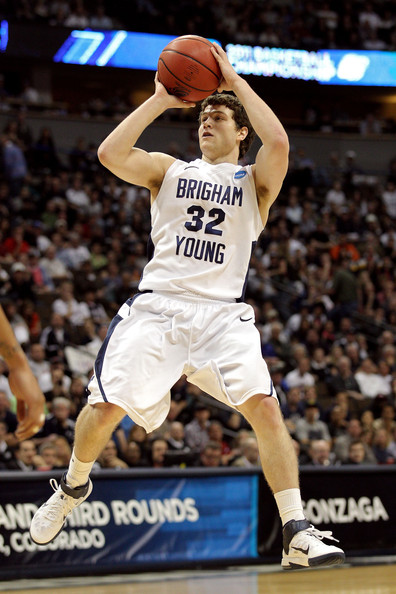
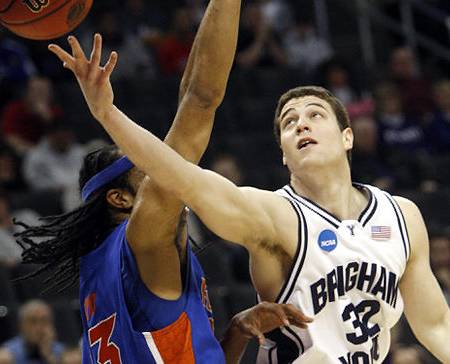
They blame you for the loss to Florida in the Sweet 16.
No handle. No hops.
Tune it out, because, dude, you can shoot.
It’s increasingly rare, really, that someone can shoot like you do. It’s like watching the Jordan versus Bird McDonald’s commercials.
Off the scoreboard, off the floor, nothing but net.”
They can pick holes in your game, that’s fine – frankly, I agree with most of the widely held qualms about your style of play.
But they are missing the point.
This wasn’t ever about defense, or dropping dimes, or a floor-slapping defensive possession.
This was about a kid who once played at the New York State Pen, dropped 40 and got a standing ovation from the prisoners. At the age of 10. With armed guards surrounding the court.
There’s far more wrong with the media than there is with your game. They don’t get it – it’s about the show.  
You’re playing for every has-been gunner, every Y-League and open gym average Joe who thinks he can fill it up. Every guy who’d rather catch a blow on defense as opposed to fighting throw another screen. Just makes you more tired on offense and who needs that, really.
If you played for anyone but BYU, maybe you’d have to play more D. Truth is, you’re the only offense that team had. And they know it.
Sure, I wondered why you didn’t take the Tyus kid to the hole off the ball screen switch late in the Florida game like you had throughout the year when the bigs switched on you at the top of the key, but there was something strangely and perfectly poetic about a gunner going down, well, gunning.
From deep water. From downtown. From where the dust settles on the court.
You emptied your gun, and from a former has-been gunner, I tip my hat.
They want to point to your lack of defense and overall quickness as an NBA sin, something that you’ll pay for down the road.
Maybe.
Or maybe you’ve just solidified the legend of Jimmer Fredette.
We will talk about you for decades, long after Nolan Smith, Kyle Singler and Harrison Barnes have been forgotten, including what team they played for. There’s nothing different or discernible about everyone else’s game – except yours.
The deep ball.
You dropped 40 on teams who double teamed you as effortlessly as a newspaper being dropped off on a doorstep every morning.
So what if you can’t, won’t or haven’t played any defense? What does that matter? Why does your game have to fall into some finely printed stat sheet? Not everyone can be Michael Jordan, Kobe Bryant or Rajon Rondo.
Stat sheets are meant to be filled, right? Who said you had to fill every category?
The media decided it would be nice if you did, I suppose. And now, they’ve recently decided that since you only fill up the points column, there’s a problem with you.
No, no, Jimmer, the problem is with them.
In today’s game, nearly every player can jump and put their head on the rim, every guy is quick. Seven-footers take threes, point guards grab a dozen rebounds. 

But you, you my friend are an old soul – you shoot and shoot and shoot. 

And then, you shoot some more.

What’s ironic is that same 7-footer who can shoot a three can’t make a drop-step power move and shies away from physical contact down low. The point guard who grabs 15 rebounds and dishes out 10 assists? He can’t shoot a pull-up jumper to save his life – or hit a free throw.
So what’s their problem, these haters? They salivate over those guys, but snub their nose at you?
What’s wrong with a 6-foot-2, curly haired, stocky guard filling it up for two straight years and firing from 30-feet?
What’s wrong with a college athlete who is polite, smart and reads the Bible in their hotel room and doesn’t have tattoo sleeves?
Nothing.
There is nothing wrong with you. Don’t let them tell you otherwise, either.

You bring something to the game that no one else can: the wow factor.

Out of all the basketball that’s seen in our house, your 28-foot three-pointer, from just inside the American ribbon on the floor, with about five minutes to go last Thursday is the only play all year that made my 9-year-old son completely freak out.
I mean, laughing, jumping, arms waving, did-you-see-that-dad, freak out.
Who else has a catch phrase (You Got Jimmered!)? Who else would be described as having “Jimmer Range”?
Am I crazy, or isn’t that meant as a compliment?
Apparently, because your team lost, you played little defense and you uncharacteristically shot the ball like every other college player for once, it’s a bad thing to them now.
Maybe they should pay attention to the other factors at play – like the fact that your team’s second best player was booted off the team and, against Florida, a real contender until they hit Butler’s Tournament Magic (someone copyright that, pronto), you were BYU’s only chance.
Did anyone mention that Florida’s team was taller and vastly more athletic at every position? That Florida was filled with Billy Donovan’s five-stars while BYU had one star – you? That you had your chin busted open and were dealing with a calf strain?
Anybody touch on the fact that you played all 44-minutes with said calf strain and busted chin? That you had to put up more trick shots than one would at a Harlem Globetrotters tryout?
Wait, you were supposed to pass to the open man, right? Yeah, the same guys who, when they did get an open look, blew an assortment of layups and 10-footers that most third grade teams would make?
Don’t apologize for that.
Your teammates should be grateful that you dragged their carcasses around for the last two years and for allowing them to be a part of it.
Instead, you get this, from teammate Nick Martineau:
“The weird thing is, [his defense] has gotten progressively worse over the year. From the start, he’s never really been accountable to it, but it’s just gotten looser as the year’s gone on. But he can play defense. He really can. He’ll definitely tighten it up for the NBA.”
Allow me to retort for you, Jimmer.
Hey Nick, your offense has gotten progressively worse and you’ve never been accountable for it. But we’re sure you can play it. You’ll definitely show your game at local Provo Y-Leagues and BYU Alumni games.
See, it’s easy to be critical of others. The point of basketball, aside from outscoring the other team and winning, is to compliment your teammates as best you can.
Looking back, to prove these ungrateful people wrong, they should have taken a couple games and just ran the offense through your teammates, Jimmer. Then, we would see how well the Cougars did. Watch those ESPN headlines roll in, right? Think they still beat a top ranked team twice in conference and secure a 3-seed in the NCAA Tournament?
Please.
Without Jimmer, BYU doesn’t even sniff the tournament. Without Jimmer, they win only a handful of games.
Without Jimmer, we all suffer. We suffer from watching the same mindless ball screens, pick and rolls and motion offenses where every player scores between six and 16 points a game.
No one says “Give me more Wisconsin basketball!
No one’s watching five passes and then a shot from 14-feet. This isn’t 1955 and we’re not wearing nut-huggers anymore. You have to do something different, something special.
You were and are different, Jimmer. Don’t ever change.
When you get your NBA tryouts with various teams over the next few months, give ‘em Jimmer Range. If they ask you about your defense, tell them your offense is your defense. 

Keep living the dream, on behalf of gunners everywhere.

Keep shooting, kid.
Empty your gun, if only because nobody else will.
Standard