Alabama football, BCS National Championship, Bear Bryant, Brian Kelly, Lynard Skynard, NCAA College Football, Nick Saban, Notre Dame

The Song of Saban


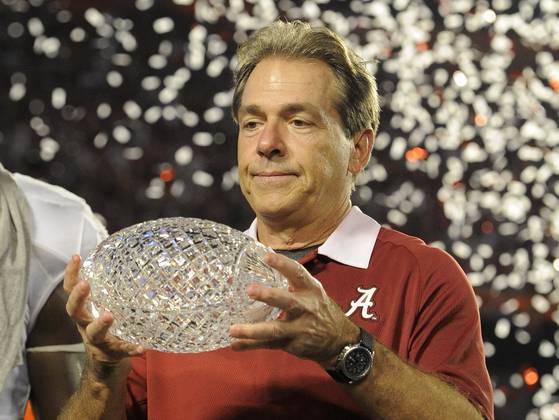
In the aftermath of “The Beating”, as a crystal football was held high into the warm winter air of Miami, the sound of Lynard Skynard’s ode to Alabama oozed out of the speakers in Sun Life Stadium.
“Sweet Home Alabama” was a befitting end to this night, this season.
No. 2 Alabama (13-1) defeated No. 1 Notre Dame (12-1) by a lopsided score of 42-14 to claim the 2012 National Championship and the school’s third national title in four years. It marked the Crimson Tide’s 15th National Championship in football (the school’s count), and for head coach Nick Saban, his fourth, cementing the claim to a dynasty.
By dominating this game in every fashion, it bolstered the crystal-clear notion that the Alabama Crimson Tide are the quintessential historic college football team. Not Notre Dame, not USC, not Texas. Never has a school and a sport meant so much to its fan base, to its state and to a region.
In hindsight, it would appear we all got a little carried away with this one. From breaking down the matchup in ways that gave Notre Dame a puncher’s chance to comparing this historic matchup with each school’s respective counterparts from years gone by.
Let’s just settle this: there will never be another Bear Bryant, another Knute Rockne. Between the Houndsooth Hat and the Galloping Ghosts, this matchup represented history on paper. Forrest Gump versus Rudy. But no hype machine on earth can make this 1973 or 1966. Rudy was an underdog. Forrest was an All-American with blazing speed. Gump was greater than Rudy on this night.
Run, Forrest, run.
But the sequence of plays that lead to “The Beating” proved that aura and mystique only take you so far, for either school. You need speed. You need size. You need precision.
Brian Kelly is a fine football coach, and as a lifelong fan of the Fighting Irish, I’m happy to have him. He’s just what was needed to restore this program to relevancy. And he has. A 12-0 undefeated regular season against a better schedule than people want to give credit for is way more than I expected this season – or frankly any of the next three seasons.
Yet there remains a vast difference between relevancy and relevant. Being in the conversation is not the same as being the center of the conversation. Notre Dame accomplished getting into the former, while Alabama has and is the latter.
When a football team and its fan base remains largely stuck in its past, as Notre Dame has, something has to change. You cannot get young high schoolers who weren’t even born the last time Notre Dame won the national title (1988) to commit based on its tradition and history. You have to show them something. And this is a fine start. This is where Alabama was five or six years ago, on the cusp of relevancy, struggling to maintain consistency.
For whatever it’s worth, Notre Dame deserved to be in this game. The only bowl-eligible undefeated team with wins over Stanford (who beat Oregon at Oregon and won the Rose Bowl) and at Oklahoma, as well as winning at USC (the preseason No. 1 team) was good enough to be selected for this game under this system. The outcome doesn’t prove Notre Dame was overhyped or fraudulent, it just proved Alabama was much, much better.
And therein is the major take away from this unruly affair: Alabama is vastly superior, vastly consistent and properly rated. As we debated over the past two weeks – following Florida’s embarrassing loss to Louisville and the SEC’s less than stellar bowl season showing – if the SEC was down and what that could potentially mean for the BCS title game, we forgot one thing: Alabama is different.
They are coached by Nick Saban, who’s been criticized by many, including me, as being an emotionless coaching droid. But what Saban’s lack of human emotion seems to stir in the rest of us really matters little; his results conjure all the emotional bond he needs with his players and fans. Take away those two lost seasons with the Miami Dolphins and the NFL, Saban’s won four national titles in eight years (he won one with LSU in 2003).
Who cares if Saban resembles the statue of himself outside Bryant-Denny Stadium – in more than just appearance – when he’s off the football field? Who cares if he allows himself and his staff just 48 hours to celebrate championships? And what does it matter if he enjoys a Gatorade bath like a cat enjoys being doused with water?
“Whether I look it or not,” Saban said following the game, “I’m happy as hell.”
Whether it matters or not, we shouldn’t care if he enjoys it. Why would Saban’s enjoyment of his life and accomplishments have any bearing on how we view them? Because we’re human, mostly. And we internalize these things and think, “Oh for pete’s sake, Nick, smile!” We would, right? If we were Saban, we’d be up there begging for more Gatorade to be dumped over our heads, for players to hug us and to sing our praises. We’d soak it all in and smile.
But we’re not Nick Saban.
I watched this game with my 10-year-old son, whom I’ve naturally and carefully crafted into a Notre Dame fan. Unsurprisingly, he went to bed in disgust in the middle of the third quarter. It was painful to watch, but only because – as I told him – the team had come so far and shown so little of what got them there. The hardest thing to do is reach the pinnacle and fall short of actually winning and celebrating.
It’s what we all dream of as kids and as adults, as fans. Those moments of cheering as the clock winds down, basking in the glow of success.
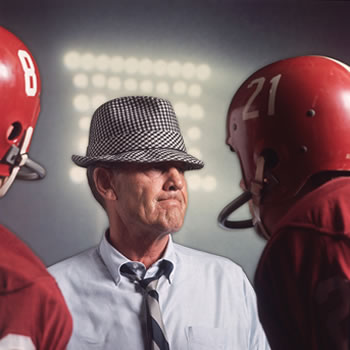
And perhaps that’s why we don’t understand Nick Saban. We’re all vastly different from him. And he’s very different from Bear Bryant. And its not the 1970s.
But maybe that’s why Nick Saban keeps on winning, because he’s different. He may not have the flair for the dramatic. He may not wear a Houndsooth Hat or have the Southern gentleman accent. 
He may not feel the glory of victory or the agony of defeat – which is what allows him to just keep going, keep working, keep pushing.
It’s what might make him the greatest college football coach of all-time, at least statistically, before it’s all said and done.
I just hope, for a moment, as the trophy was held there above his head late on a Monday night in Miami, he could hear the song coming out of the speakers and know that for an awful lot of people, it meant something to them.
Standard
concussions, Dave Duerson, Dr. James Andrews, Matthew Broderick, Mike Shanahan, MLB, NFL, Robert Griffin III, Steven Strasburg, Washington Nationals, Washington Redskins

Sometimes, There Are No Winners


Here’s where we start: 60-year-old men who can’t walk, can’t turn the lights on inside their home and can’t stand the pain to the point that some commit suicide.
If that doesn’t grab your attention, I’m not sure what will. Maybe phrases. Brain damage. Multiple reconstructive surgeries. Cognitive breakdowns. Early onset dementia.
These are the real, live dangers of playing football for a sustained period of time in one’s life. Is it worth it?
How can a schlub like me proclaim to have that answer? I can’t, frankly. But the fundamental fact is that across America, mothers and fathers are struggling with how to take the new information on player safety and mesh it with what is best for our sons.
I have three boys. The oldest plays travel football for a good school system. The coaches are fantastic. The medical staff in our community is top notch. And the same could be said for the NFL. The Washington Redskins have Dr. James Andrews – yes, that Dr. James Andrews, he of renown surgical fame.
And Robert Griffin III is still hurt this morning and we’re still pondering if he should have been playing at all.
Part of this is our fault. As fans and media, we eviscerated Jay Cutler two years ago for not playing in the NFC Championship game against the arch-rival Green Bay Packers with a knee injury. We encourage gritty, tough, manly behavior in sports.
But I have to ask, is it manly to eat through a straw, have recurring headaches and forget your own name by the time your 55? Is it manly to walk with a gimp, hunched over and have knees and hips replaced in your 40s?
It’s an interesting dichotomy, to pair the decision of the Washington Redskins to play Griffin over the past month with the city’s baseball team, the Washington Nationals, polar opposite decision to rest the arm of their prized franchise player, Steven Strasburg. The Nationals faced backlash, including from me, for resting him during the final month of last season, just as the team was in the playoff race. And as the Nationals advanced into the playoffs, they refused to budge: Strasburg would not be pitching until 2013.
Strasburg fought this decision, but ultimately accepted it. Griffin, according to both he and his coach, was asked multiple times about staying in the game Sunday against Seattle. He played.
He got hurt.
As Griffin said in his postgame comments, and as other former players point out all the time, you take the risk of injury any time you step on the field. It is not a variable. It’s there. With baseball and basketball – heck, with walking down the street – the risk of injury is all around us. It’s just significantly less possible to get hurt walking down the street than it is playing baseball. Likewise, the gap is roughly the same between baseball and football.
It doesn’t make Griffin more of a leader or a man to play through pain. Or maybe it does to those other players, because they are doing it, too. Football is a different sport, with its own set of protocols and guiding principles. I enjoy what leadership and experience my son gets from football. But can he find it or learn it in other, less dangerous ways?
If this is where we are as a culture and society of sports fans – that a man is measured solely by pain tolerance and his ability to run around on one leg and fight through injury to lead his team – then we’ve advanced no further than the time of gladiators in ancient Rome.
We should be better than this by now. We’re an advanced race of people, with thousands of years of information at our fingertips. We speak of logic, yet confusingly do not show any on certain things.
Remember the 80s flick, WarGames? Matthew Broderick was caught hacking into a sophisticated computer system that interacted with you (basically, what we have now). At the time, this advanced system learned from itself. Eventually, it learned that Global Thermonuclear War could not be won, under any scenario, and eventually just asked to play chess (after scaring the pants of nearly everyone with security clearance).
I’m not suggesting we all just play chess. To be certain, there’s something endearing about the leadership qualities of Russell Crowe or Russell Wilson, when they keep going. You want to instill perseverance. As a father, I know I do. We love it in America when people keep pushing and going despite the odds, despite the injuries, despite the repercussions.
But you have to look at the culture we – all of us, fans, players, coaches, media – are creating. Is there truly a way to win this game when more and more former players end up not winning at the game of life? Substance abuse, violence, suicides; these are not things I want for my boys. I don’t want them to end up like Jim McMahon, who’s forgotten more about his professional football career than anyone who went by the name “Punky QB” ever should.
Griffin’s injury hasn’t sparked new conversation around head trauma or concussions, because it was his knee.
And this goes beyond giving his team the best chance to win over the backup. Was it best for him? Maybe not. Is it his choice or the teams? Perhaps both, in some way. Yet a friend of mine, who’s had five knee surgeries, three of which were of the reconstructive nature, commented how Griffin’s knee buckling didn’t, uh, look good. He would know – my friend’s injured knee came from football.
How will Griffin’s knee hold up over time? That’s not just the concern of the Washington Redskins or fans of RGIII or the NFL. That’s Griffin’s concern, too. And maybe he’s fine with it. He’s a grown man and has signed a contract to go between those lines each week. If he chooses to play on an injured knee that could lead to major obstacles in the ways he lives life after football is his decision in almost all ways.
And you know what’s ours? What we allow our sons to do, the generation of young boys between the ages of 6-13 who really can’t do anything if we don’t allow them to play.
It’s striking that so many former players have said they weren’t sure if they would allow their boys to play football. Kurt Warner caused a stir when he said he’d prefer his sons not play and nearly retired a year before he actually did when his teammate, Anquan Boldin, suffered a nasty concussion in a mid-air collision going after a ball Warner threw. Tom Brady’s father said he waited until he was 14 until he allowed one of the league’s greatest quarterbacks to play the game. All-pro linebacker Bart Scott said he plays football so his son “won’t have to” and Hall of Famer Terry Bradshaw, who won four Super Bowls with the Pittsburgh Steelers, said if he had a son he wouldn’t allow him to play.
It’s the totality of what we see – it won’t go away. Our gut instinct and reaction tell us that something is off. From former players struggling to cope (like Junior Seau or Dave Duerson) to current ones who struggle, too, we’re getting an all too clear picture of the vast differences between modern football and the game that was once played.
They are not gladiators, and this is not ancient Rome. Commendable, endearing and manly as it may be, it’s brutal and barbaric for us to ignore or subconsciously enjoy their suffering.
Are they well paid? Most certainly. But that money will be gone to prescription drugs and doctor appointments between the ages of 40 to 75. If they make it that long.
It’s one thing to watch it all unfold. It’s another to willingly and openly subject my own children to it. We’re supposed to learn from things. And I frankly can’t decide what I will do with my youngest two boys or how long our 10-year-old will play.
Because football is becoming more and more like a modern sports version of Global Thermonuclear War.
The only way to truly win is not to play. 
Standard
American culture, American People., Fiscal Cliff, Gun Control, Hollywood, Sandy Hook Elementary, Society, United States

The Unused Power of the People


Much has been made of the now-averted “fiscal” cliff, but truthfully, we’ve gone off the selfish cliff.
From almost forgetting the horror of Sandy Hook to our resignation that it’s OK to raise taxes and spending as long as it’s not my taxes, we just don’t seem to care unless we are affected directly.

What will it take for us as a people to act? We have so much more power standing collectively than fighting as individuals.

Should someone come into your home and just grab whatever money you have in your wallet or purse each night? Would that do it? Would you feel violated? Outraged?
I know several friends and family members that are completely fine with the argument that the country’s wealthiest earners should pay more in income and payroll taxes.
“I don’t make over $400,000 a year,” said someone to me recently. “Why should it bother me? And those people should pay more.”
It should bother you, me and everyone because even though it’s not you this time, it will be next time. They’re coming for more money. And they start with the rich and work their way down the line.
See, the conversation and discussion is all wrong – this isn’t just about one economic group in this nation, it’s about all income levels. Whether you pay $150 in taxes or $1.5 million, where is every dollar going and why?
What we should be asking – no, demanding – from our elected officials is this: why is there a need to raise taxes on anyone? Why do you need more of our money? We can’t trust you with what you get from us now!
The package that was passed earlier this week to avert said “fiscal cliff” will add $4 billion in debt. How is that even possible? How do you raise taxes and over time still add that much money to the deficit? What’s worse is the deal made by Congress earlier this week was seen as a compromise – of course it was. Because they created this mess, let’s all congratulate them for averting disaster and putting off the debt ceiling conversation for three months.
Well done, guys and gals.
What if we all agreed to not vote for anyone, any incumbent, who contributes to raising the debt? We might get 100 new elected officials every year for the next four years, but we’d eventually find people who do what we want them to, right? Because as crazy as it sounds, that’s what our elected officials in Congress are there for – to do the will of the people. They represent us.
Except they don’t. They represent themselves and re-elections. And as for the “us”, well, we can’t get out of our own way and get our stuff together in terms of values, guiding principles and general decorum.  
There was an article posted late Monday night about how all the staffers and members of Congress had to order out and get pizza and wings on New Year’s Eve and how depressing that was.
I laughed because I thought it was the punchline of a joke. That’s not sad. Millions of Americans eat like that every New Year’s Eve – and not by choice. Millions of Americans work late into the night on a holiday because they get triple pay for overtime. We need more because now we give more than ever before in our history.
Meanwhile, we spend less time with family, with friends, with spouses.
This vacuum is why Facebook and Twitter exist. They keep us connected to the world when we’re so wrapped up in ours. Except they dehumanize our relationships, take the emotion out and make everything instant and matter of fact.
What do we get when we spend less time with our children? Or better yet, what do they not get from us? How about our spouses? Are marriages stronger? Relationships of any kind, when less time and energy and effort go into them?
And we ask ourselves how we ended up with the massacre of elementary school students? Shootings in a movie theater? High divorce rates? Rising debt? Unmotivated masses, shrinking more each day into their own bubbles.
Wake up! We are the problem. We don’t take the time to fix it. We talk about it on Facebook and Twitter or at our holiday parties and then we move on. Next issue. On to my personal problems, right?
Wake up! Is it going to take your child’s elementary school being unspeakably shaken by tragedy before something is actually done to protect them? I mean, I’m in favor of the Second Amendment, but I’m not sure why anyone needs to be able to buy a Rambo-style machine gun and as much ammo as they can fit in their car trunk.
But Congress can’t talk about that for a few more weeks because they’re “fixing” the “fiscal cliff” they created by mismanaging our money to begin with. So what makes us think these geniuses can fix something like coming up with a logical, modernized second amendment that while protecting the rights of citizens to arm themselves, won’t allow for them to pretend they are preparing for Red Dawn, Part II?
That debate that everyone said we needed to have on gun control lasted in the media for all of 10 days – right up until Christmas and Kim Kardashian announcing she was becoming Kayne West’s baby momma.
We’re running out of time, my friends. What our ancestors and American decendants worked so hard to build in terms of values is being short-sold by our own selfishness, obsession with the material and overall failure to act. We expect others to clean up these messes, but we don’t take action – or build sustained action – ourselves.
There is great power in the people – us, the collective whole that make up our society. If we can set aside these specific arguments, say on faith, tax brackets, marriages, for a brief moment and look at the bigger picture to unite under, we’ll have a greater success at reclaiming and reestablishing our guiding principles that sustain our first world way of life and the freedoms we so take for granted.
Is this the kind of world we want to live in or leave our children with?
Case in point: a recent pollsuggests a majority of Americans don’t feel it’s necessary for Congress to force Hollywood to produce less violence in their products. Yet when every fabric of our vast knowledge suggests that violence begets violence, especially when exposed to the young, why wouldn’t we want that? What if we absolutely forbade anyone under the age of 18 from seeing an R-rated movie, even with a parent?
Our collective selfish nature says we don’t want them to take away what we, as adults, enjoy so much. Do we? Because since Sandy Hook, I can’t watch a violent movie, kudos to you who can. It’s difficult to separate reality from art now. As I said then, everything is different – and it has to be. The very essence and core of our lives is at stake.
What are we doing? What’s it going to take? What will be our breaking point?
Because we are already, quite rapidly, defining our downfall.
Standard
Baltimore Ravens, NFL, Ray Lewis

A Selective Legacy


The man who told us in 2011 that we would be living in a post-apocalyptic society of violence without an NFL season has decided to not continue his NFL career. 
That’s right, after 17 seasons, Baltimore Ravens linebacker Ray Lewis is retiring.
And so now begins the piecing together of his “legacy”, if you are into such things. 
A legacy is basically defined as “what is left” by the person. However, with most professional athletes, especially with Ray Lewis right now, we’re selective on what he leaves behind for us.
Notably, Lewis won a Super Bowl with the Ravens, played his entire career for the franchise and has continually led one of the NFL’s staunchest defensive units. There are the 13 Pro Bowls, the seven first-team All-NFL honors and the two Defensive Player of the Year awards. There is also the compliments being paid by former coaches, who noted how prepared Lewis was, what a model teammate he was and how his passion for the game evoked the same in others.
Ray Lewis might possibly be the greatest middle linebacker to ever play in the NFL to this point, a high honor considering that includes the likes of Mike Singletary and Dick Butkus. He’s a shoe-in, first ballot Hall of Famer.
But let us not write the epitaph of Ray Lewis’ career without mentioning the murder and aggravated assault charges in Atlanta in January 2000. He pled guilty to a misdemeanor charge of obstruction of justice after that original indictment.
The details are still sketchy, thirteen years later. But there were two men stabbed to death and the white suit Lewis’ was wearing that night has never been found. His two friends, that he later testified against, were acquitted in June of 2000. 
No one else has ever been charged with a crime in connection to the murders. 
Then, in April 2004, Lewis paid a settlement with the then four-year-old daughter of one of the men who died, preempting a civil lawsuit. He likewise did the same with the other man’s family.
And as many asked then, why? If innocent, why pay damages preemptively? Why can’t he tell anyone where his clothes are from that night? Why can’t he tell us where he was at the time of the deaths?
For those that say this is drudging up the past, it very well may be – but when an NFL legend retires and everyone else wants to do nothing but pay homage to him, it’s at least worth mentioning. This happened. And we don’t really know what exactly it is that happened. He says he didn’t see anything and was involved in earlier confrontations as a peacemaker.
In the years since, Lewis has greatly rehabbed his image. 
He’s been deeply involved with the Baltimore and Miami communities. The Ray Lewis 52 Foundation, a non-profit entity, provides personal and economic assistance to disadvantaged youth. He’s been a big proponent of disabled sports in the U.S. and in developing countries abroad.
But no one who followed the NFL during the 2000 season and subsequent playoffs can forget how awkward it was when Trent Dilfer was given the “I’m going to Disney World” commercial following the Ravens Super Bowl win, despite Lewis being the game’s MVP. No one who remembers that off-season of 2000 can forget how weird it felt to see him touting religion on the cover of Sports Illustrated in 2006.
And thus we’re left with the quandary of how to handle athletes like this. This isn’t someone who was involved in drugs and became clean, like say Josh Hamilton, who’s dealt with the awkwardness and tension for longer than Lewis dealt with his accusation of murder.
As a society, aren’t we doing ourselves a disservice by not covering all of a person equally? Just because the last decade happened, doesn’t mean it didn’t occur. I get that we live in a very forgiving society, where second chances are not only afforded, but extended rather easily, depending on what occurred.
But I find our failure over the past 24 hours to cover the entirety of the man’s legacy as quite a shame.
This is not how history should be written, with one lens. 
It began before he retired, with the “Football Life” video, and media personalities gushing about what a fine person he was. We must be careful to imply that he isn’t a fine person, based on this incident 13 years ago, yet we must be tactful and forthright by mentioning the charges were filed and he plead guilty to obstruction of justice. Those are facts.
We don’t need to go to a re-trail. Debating his innocence, guilt or connection is irrelevant. He’s not being charged with a new crime or on trial for it now. But you would think that in the hours following his retirement announcement, it would be mentioned. It’s relevant to discuss when considering the entirety of his “legacy”.
And thus his legacy will not be defined by all of his actions, but rather who covers and writes about his actions and which ones they select. And that incompleteness actually says more about us and our media hero worship of professional athletes than it does about Ray Lewis.
I can only hope that others, including myself, will be so lucky as to have our legacy defined by others in a selective fashion that picks the good parts. I’d be a Hall of Famer in something, too.
Standard
Andy Reid, Chicago Bears, Chip Kelly, Cleveland Browns, Dallas Cowboys, fired NFL coaches, Lovie Smith, NFL, Norv Turner, Oregon Ducks, Pat Shurmur, Philadelphia Eagles, Rex Ryan, Tony Romo

The Firing Squad


Round and round we go.
The yearly – and highly predictable – coaching carousel in the NFL made it’s big return.
Of the 20 NFL teams that began their off-season Monday, half of them made at least one firing of a head coach or front office personnel.
The names and faces change, but not really. They go from place to place. One man’s trash is another man’s treasure, so they say. If you were an NFL coach or general manager fired on Pink Slip Monday, fret not, you’ll most likely have a new job, in many cases the same as your old one, very soon.
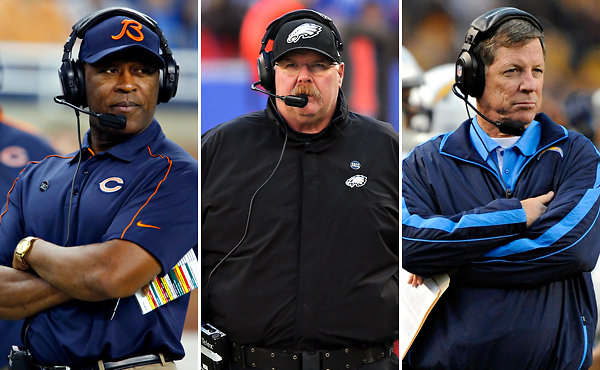
Five NFL coaches were fired Monday, including Lovie Smith of the Bears and Andy Reid of the Philadelphia Eagles, two long-tenured coaches with overall winning records. The list also included Norv Turner of the Chargers, Pat Shurmur of the Browns and Ken Whisenhunt of the Cardinals.
Why did these coaches get fired, but not, say Jason Garrett of the Dallas Cowboys? Or Rex Ryan of the Jets? I mean that inquisitively as to the bigger question, not actually why. I get why – most of these coaches failed to do something, like reach the playoffs, win a Super Bowl, change the culture of the locker room – something. So the “why” is there, but not the “why” of “to what point and purpose”?
A friend texted me after Tony Romo turned into Tony “Oh-No!” again Sunday night, asking if the Cowboys would finally do something about Romo and move on. My response was that though it may be better for all sides, why? Romo isn’t a Top 10 quarterback in the NFL, but he is in the top half of the league, right? So if you’re going to “improve” or “upgrade” the position, it better be for someone, well, better, right? Otherwise, what’s the point? And are we sure Romo is entirely the problem?
The point is the same with coaches. Is Lovie Smith one of the top five or 10 coaches in the NFL? No, probably not. Is he better than half? Probably. Was Lovie the problem? How do we even know? He’s the same coach who guided them to a 7-1 start this season. But what has never improved and been a recurring source of problems is the offensive line. It’s downright gross. I don’t like Jay Cutler, but I fear for his future health all the same with the brutality of the hits he takes each year.
Yet it’s easier to fire a coach than it is to suddenly get a brand new offensive line that works. It may be a severely flawed theory, but it’s one all the same: the coach will make these less than mediocre lineman better, either through film, motivation or some other intangible. Basically, he’ll cover the scouts mistakes on draft day.
That’s like arguing that you bought bad fish at the market, but expect the chef to fork over the greatest tilapia you’ve ever tasted. It’s backwards logic.
But, as we’ve covered, it’s just easier. It gives the illusion and appearance that changes are being made and things are going to be different.  
New coaches! New era! Same players!
The culprit in many of these cases tends to be poor quarterback play or a bad offensive line that can’t produce a good ground game or protect said quarterback. But how much of that has to do with the coach? Generally, it seems as though bad coaches can win with good players (see Jim Caldwell’s Super Bowl appearance with Indianapolis), but good coaches have a hard time winning with bad players. There’s only so much a coach, good or bad, can do. I can diagram a terrific play, but if the players don’t execute it, it’s not a terrific play anymore.
Only 12 of 32 teams make the NFL playoffs, that means roughly 60 percent of the league is done now. If the requirements for coaching in the NFL include making the playoffs every year or two, then good luck with any semblance of job security. Some years you just don’t have it. We’ve rapidly increased our intolerance for meeting fan and front office expectations.
Just because something seems like it should be working or winning doesn’t mean it does for a variety of factors. And what about if you’ve been terrible for a long period of time? For example, when I saw the Browns, they just looked different this year. They were competitive, they were going in the right direction. They ended up 5-11, but they feel like a team that could turns the corner next season. They, too, fired their coach.
So it’s been decreed: you must go to the playoffs to keep your job, no matter who you are. In some situations, you must go to the playoffs more than a certain number of times in a certain number of years, but we just can’t tell you exactly what that looks like. And we’d really like you to win the Super Bowl, even though only 7 franchises have won the Super Bowl in the last 11 seasons.
If we aren’t setting realistic expectations, then we’re expecting unrealistic results.
It’s not to say that some shouldn’t be fired. It’s necessary or just time in some cases. But 5-7 coaches every year? What have you done for me lately, Tom Coughlin? Welcome to the 2013 Hot Seat.
After being fired Monday, many of these coaches were rumored for other gigs on Tuesday – like Reid in Arizona or Kansas City. Lovie Smith might end up as a defensive coordinator for some team on the cusp.
And there’s our punch-line to this bad joke: these guys keep finding six and seven figure jobs in other places, within weeks of being let go for failure to accomplish nearly the same tasks in their old employment. If they were CEOs, they won’t sniff another job like that unless they built something else from the ground up, and never for a rival company.
From this perspective, it’s apparent professional sports still can’t decide if it’s a business or not. Less risk, less innovation. Coaches get hired and immediately get conservative. Take Shurmur with the Browns, again. Though I just partially defended his two years in Cleveland as not being long enough, there wasn’t anything revolutionary about his tenure.
Known for his offensive mind after grooming Sam Bradford’s solid rookie season in St. Louis, his players in Cleveland complained last month at how stale and predictable the offense was.
Predictably, Shurmur got the head gig and wanted to keep it and feared that veering too far from the norm as a head coach and trying radically new things would make for a more volatile fan base and negative media coverage. So he reverted to what everybody else did or does as a head coach. His results: much like everybody else.  
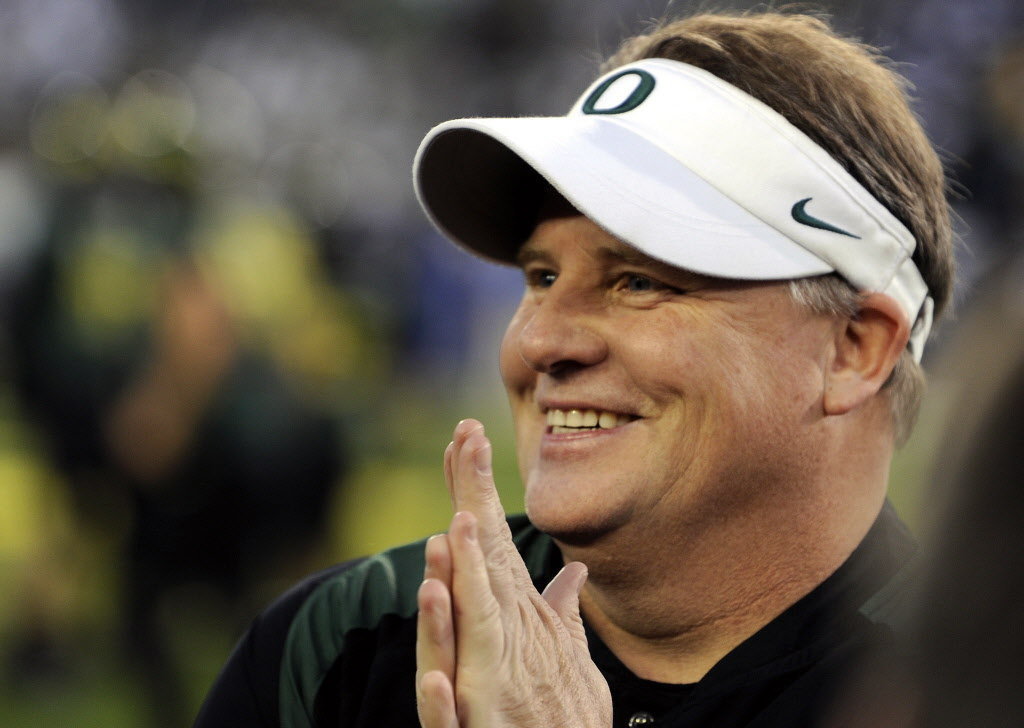
So who’s the hot coaching name this off-season? Chip Kelly of Oregon, who’s revolutionized the college game with his speedy offense. Why would Chip Kelly want to do go to the NFL and become like everybody else? Right now, the odds are long that Kelly will take a job. He turned down the Tampa Bay Buccaneers last year, who had a better team than many of this year’s suitors.
Thus without innovation in the NFL, since there’s so much coverage of doing anything “different”, it basically ensures we get the same old candidates popping up, ensuring that the merry-go-round will just continue.
The same thing will happen next year, another 5-7 coaches will be fired, finding similar jobs in different cities. Maybe it’s a reflection of the times – we’re too impatient to build anything anymore. We’re not patient enough to completely innovate something new and give it time to grow. Coaches don’t stay in the same place very long, to the point where 5-8 seasons is considered a lifetime, either by choice or by force.
Are we fans that demanding, that our power sways those in the decision making positions of our favorite teams feel compelled to make swift change for the sake of showing that they care about what we want? If so, why doesn’t this work with our elected officials in government? They are put there by us, unlike professional sports. Shouldn’t it be the other way around?
Regardless, another post-holiday blues begins to settle in as the NFL winds down, once again with the stark realization that the more things change, the more they stay the same.
Someone break the cycle – make real changes to who your workers are, invest in innovation, give it time to grow.
Maybe whoever does won’t be looking for a new coach in two or three years.
Standard