Baltimore Ravens, Bill Belichick, Chuck Klosterman, Code of Conduct, Los Angeles Lakers, Manti Te'o, Morals, New England Patriots, Ray Lewis, Tom Brady

These Lines in the Sand


These lines in the sand,
they keep hurting my hand,
because I redraw them all the time
And covering my tracks
shows me what lacks
’cause life is more than just a climb…
Perspective and introspection are a funny thing.
It’s easy to admit when you are right, and often times hard to accept that you’re wrong. Somewhere between those two places lies our own rationalization, a vague area where we’ve justified our thoughts, our reactions and our perspectives. It’s here, in this place, where we identify what we stand for.
What do I stand for? I’d like to think I know, but truthfully, I’m all over the place. Frankly, we all are.
Last night, following the Baltimore Ravens 28-13 victory over the New England Patriots in the AFC Championship, I commented on Twitter how much I was not looking forward to the next two weeks of The Ray Lewis Farewell Tour. It makes my skin crawl every time we hear another gushing commentary about what a warrior, what a competitor and what an inspiration Ray Lewis is.
And as I wrote a few weeks ago, my visceral reaction is in large part due to the fact I’m uncomfortable with the elephant in the room regarding Lewis’ legacy. I was blown away by a couple of good friends saying 1) they didn’t care as much as I did, and, 2) they’d rather hear about Lewis than Tom Brady and Bill Belichick.
As one of my friends said, we’re not the Moral Police, so whether the story lines revolve around Lewis or Brady, it was a toss up to him. I knew they were partly needling me, as a Patriots fan and someone who loves Brady, over the team’s defeat. Yet another part of me couldn’t comprehend the comparison: Brady is disliked because he wins, because his coach is unlikable and because the Patriots are always good. Ray Lewis’ story is a little more sordid and scandalous, revolving around the night of the Super Bowl in 2001, when two men were stabbed to death after getting into it with Lewis and some of his crew.
How are these things even comparable?
In short, to me, they are not. But I’m not the Moral Police either, so just because I find something gross, distasteful or just plain wrong doesn’t mean others have to. Not everyone thinks the same way I do – and I shouldn’t expect them to. Further, even you could find 49 other people out of 100 to agree with you exactly on something, you’d easily find another 50 who didn’t.
And that’s where we are, really, as sports fans and as a society: split. We justify and rationalize things all the time depending on our own perceptions and values, calling some things wrong and other things right when really, that’s just our own justification for holding some ground on an ever moving target.
Our codes of conduct, our moral lines, are drawn in the sand.
As another friend pointed out, I had no problem with Kobe Bryant’s rape accusations, but I’m getting high and mighty over murder charges? Well, clearly I did have a problem with it – but the point remains, I continued to, and have continued, to root for the Los Angeles Lakers despite Kobe Bryant’s 2004 rape charges.
In my head came the rationalization, where I moved the line in the sand. The Lakers have been my team since childhood. Do you stop rooting for your favorite team because its star franchise player doesn’t seem like a very good dude? Do you allow yourself to call him one of the greats and celebrate the championships he helped guide that team to? In my case, the answers were no and yes.
So I just basically took my hand and made a new line in the sand.
Likewise, the reason I’m a Patriots fan is Tom Brady. New England isn’t my childhood team. And Bill Belichick, despite being decorated with rings and trophies, isn’t the fairest coach around (I get that’s an understatement). Between Spygate and his constant unsportsmanlike behavior, he’s, well, a jerk. But I like Tom Brady, so I neither agree with his actions or defend them; I just ignore and pretend it’s not there.
Many revel in the Patriots losing and often refer to Belichick and “Belicheat” – which is clever, and most likely true. Yet other teams have been accused of pumping in sound to their stadiums. From high school to the pros, coaches will leave the grass longer or shorter to gain a slight advantage. Is there a difference between taping your opponent to gain an advantage and using all the tools in the stadium to slow them down, break their communication and so forth? Probably so, and the former is certainly a more aggressive form of cheating, but it still feels like we’re justifying one over the other, when in reality, they’re all probably some form of wrong.
Is it all or nothing? Does it have to be?
Additionally, I’ve got no problem rooting for Brady, someone who left his pregnant actress girlfriend for a Victoria’s Secret model, but for years I held local rumors of infidelity against Peyton Manning. Rumors which were never confirmed or exposed in the media, just friend of a friend stories and word on the street type stuff. Nevertheless, I drew my line in the sand: I liked Brady better, so naturally, I looked for the flaws in Manning and ignored character traits of Brady that didn’t jive with my own personal Moral Police.
And really, that’s what we all do. It makes it easier to root for the laundry, since, as I’ve said many times, we don’t know these athletes at all.
We look up to them, but we shouldn’t. We should always be our kids role models. And even when we are, athletes provide some sort of third party credibility to the narrative when you’re coaching your child through a tough defeat or a loss, to say, hey, look at Player X on our favorite team – he fought through that, so good things can happen. Meanwhile, Player X fought through it by taking PEDs, and hasn’t paid child support in six years.
Time to redraw the line in the sand, again.
As I am sure my friend would remark at this point, who cares? Stop with the morality play and just be entertained. What does it matter, anyway? But I can’t.
At the height of the Manti Te’o story last week, Chuck Klosterman wrote on Grantland, in a piece with Malcolm Gladwell, that in essence, our reaction to Te’o shouldn’t necessarily change all that much because some of the story was omitted or embellished or a hoax. He compared it to a best friend of telling you that 10 years ago, he had murdered someone and never been caught. He was sorry now and a changed person. Would you still be his friend?
Klosterman argued that you’d put aside your own moral code and disdain for this action because you knew your friend as someone completely different than the person he was describing and you would remain his friend – unless you were a self-righteous individual. A self-righteous person would say they could never be friends with a murderer because actions have to have consequences.
Basically, you’d move your line in the sand to accommodate your friend.
I guess you can call me a hypocrite for all of my rationalizing on which teams and athletes I root for, and I will be the first to do so, frankly. Because it is hypocritical to blast Ray Lewis, but not turn my moral guns on Kobe Bryant. And I guess according to Chuck Klosterman, I’m self-righteous, because I don’t think I could be friends with someone who committed a murder and got away with it.
We do this justification and line drawing all the time, in normal life, too. The clerk forgot to scan a 24-pack of water bottles, did we go back and tell them? No, because they charged me more for hamburger than the store down the street. Your co-worker comes in an hour late every day and it makes you mad that the boss never says anything, but you’ll take that extra 15 minutes at lunch for a few days a week for six straight months and justify it as a wash.
Let’s say I finally got the break I was looking for in writing, that all my dreams could come true, but all I had to do to get there was write a scathing lie that everyone would believe about an athlete or coach. I’d never be exposed and it would propel me to the top of the sports writing genre.
Would I do it?
I say no. I couldn’t allow myself. Just like I would not have taken a pill to get to the pros. My best friend thinks I’m saying that in retrospect, that I’m standing on a moral high ground by proclaiming that. And there’s really no way for me to confirm that I would have turned it down. And there’s only one way for me to confirm I wouldn’t write the column to break my career open (that’s a hint for someone out there to field me an offer).
But I have to believe that I wouldn’t, otherwise, what do I stand for?
I presuppose that many others are like me, but perhaps there are not, who want to know that you can reach your goals without lying and cheating, and that when you do, you won’t become an insufferable jerk.
It seems more logical to stay true to what I say I believe, based on my own personal Moral Police than to continue to stay loyal to a team or an athlete. When the information we have changes, so too does our opinion or allegiance, right? It’s been confirmed the world is round, so just because, let’s say, I was a World is Flat guy for 20 years doesn’t mean I keep my head in the sand, right?
I suppose what’s left is this: perhaps it is time for a break from the morality writing I’ve been doing for the past month or so, because I’m no more qualified than anyone else to tell you what’s right or wrong for all of us. It’s quite possible that I am self-righteous and a hypocrite. In fact, I think I’ve learned that I’m as human and guilty as the next person when it comes to who I root for and what I justify in my head.
But can I change it – and should I – now that I realize it? Should I put away the Lakers gear? Stop rooting so hard for Touchdown Tom? Maybe it’s time to start living out what I believe, instead of just writing it – maybe I should watch sports with a sort of distant attachment, because it’s getting more difficult the older I get.
As I heard someone say recently, life is not the way it’s supposed to be, it’s the way it is. The way you deal with it makes all the difference.
We can’t make these athletes and coaches do what we want, behave like we want or do what we expect. We can only barely do that with ourselves most days. We’re all just human, prone to fall short and incapable of perfection. Yet in between, we have to decide, what will we stand for.
Or at least I will. So until Kobe retires, I’m renouncing my Lakers fandom.
And next time, I’m going back in the store to pay for the water bottles.

Standard
Deadspin, ESPN, Gene Wojciechowski, Girlfriend Hoax, Lennay Kekua, Manti Te'o, Notre Dame

The Legend of the Hoax

What do we know of legends?

They are narratives of human actions that are perceived, by both the teller and the listener, to take place within history and to possess certain qualities that give the tale some sense of probability. Basically, the legend has to feel real to both the teller and the listener.

And most legends we hear of tend to fall into a realm of both believability and uncertainty, never being entirely believed by all involved, but also never completely doubted, either.

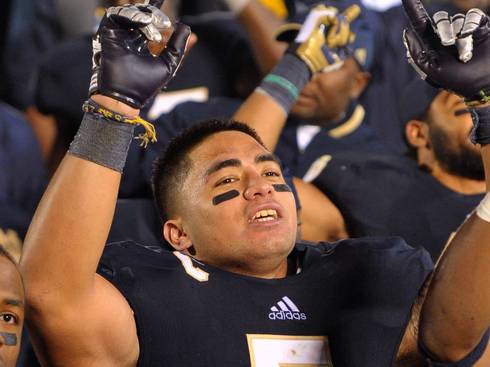
This seems like a good time to mention that it was revealed Wednesday afternoon that Notre Dame All-American and Heisman runner-up Manti Te’o has either been a victim of a massive hoax or a party to it.

According to Deadspin.com, the story that captured a nation last fall, where Te’o’s grandmother and girlfriend both passed away within hours of each other on September 12, spurring Te’o to emotionally guide Notre Dame to an undefeated regular season, was not entirely, well, true.

This is the stuff of legend. And not the kind we’re happy to pass on through the generations.

The details are still emerging. With each passing hour Wednesday afternoon, new – and exceedingly weird – details came to light.

A hoax. A dead girlfriend who wasn’t really dead, who furthermore wasn’t really real. Rumors of either plotted connections to Te’o or from people he seems to be acquainted with. Videotape evidence and published articles and columns which contradict each other. Conspirators almost begging to get caught through Twitter feeds in December.

There isn’t enough room to dive through all of it here, but you can read the Deadspin.com article and the follow-up on ESPN.com to get caught up or review.

What this blog does is look at the angles, the shades of gray and searches for reasoned answers through all the nuance of a story, trying to draw a narrative.

Yet this is difficult.

There’s really only two outcomes: either Te’o is a gullible victim of an odd and well-executed hoax that rocked him to his core or he was a disgraceful and participating piece of a hoax that in the worst possible way garnered sympathy and publicity.

Either way, there are so many questions, it is hard to determine which version is the truth. If Te’o was a victim in all this, our first option, then why did he feed information to the media that seems to contradict his latest comments?

In his statement, Te’o said he had a phone and online relationship with Lennay Kekua. Yet in published articles and interviews, there’s a narrative of Te’o having met her years earlier after a game at Stanford, where Kekua attended. How can she be the most beautiful person you’ve ever met, if you’ve, well, in fact, never met? (And yes, the above is a link to a page from the South Bend Tribune where that story has now been removed.)

How can you develop such an emotional bond with someone on the phone and through social media? Perhaps it’s fair to assume that the generation behind me, a technology inclined generation, can believe they feel these things because in many ways they do.

All I know is that, I too, spent two or three hours per night talking to the woman who is now my wife throughout the early part of our courtship. But I also saw her, in person, nearly every day. I met her family,  she met mine. The things we told each other about the other checked out because they were visible to all our senses: I could see and touch and feel her life, her history. Pictures, real relatives, etc. This deepens any relationship.


But to hear Te’o speak so candidly with reporters in the weeks following Kekua’s death, you’d have been led to believe they spent time together – and not just in a virtual sense. And no matter what generation you are a part of, that’s hard to square away, that you can feel so much for someone you’ve never met face-to-face.

Just last month I wrote about how we’re slipping away from real and meaningful communication with one another, replacing it with technology and removing true emotion. If this narrative on Te’o is true, and he fell for this woman so hard, without meaningful contact with her, then it’s only further proving this discourse.

Then, there’s the bit of a guy who supposedly created her Twitter account and made this relationship look legit who might have a connection with Te’o prior to all this. Again, that doesn’t solve the mystery of who Te’o was talking to for four hours, every night, for four months – as he told ESPN in an interview in October. 

He either embellished that to make himself sound better, or made it up as a party to this plan.

There are phone records. This can be checked out – and maybe it will be. If there are two people out there who perpetuated this hoax, they can probably be tracked down through IP addresses, GPS, phone records. But what kind of commitment and how evil do you have to be to do this to another human being? Evading Google image searches by stealing, then ever so slightly altering pictures of someone else – that’s not clever, it’s just weird.

Certainly there is more to this option, but in the interest of pulling these threads together, let’s look at option two. It’s much more dastardly and deceitful. Many are hammering Te’o in all media outlets and social networks right now, and many are asking for reservation before making a judgment.

But it is not hard to say that if Te’o was a party to this hoax, it’s one of the more despicable acts I’ve heard of. What it to garner sympathy for Heisman votes? Was it to gain more publicity? He was already a well-regarded linebacker and by all accounts, a man of faith and integrity. Why risk that? Why through that image away? To what point and purpose does that serve?

Perhaps, if this option is true, Te’o is lonely. It’s not a sexy plot line, but plausible all the same. And not quite as sick and twisted.  Yet even still, parts of the story don’t add up from his end.

In a transcript of a press conference from early October, Te’o talks about finding out when they were closing the casket at her service and how emotional that was. He sent roses. To where, exactly? Did he talk to her “family”? How does all that emotion actually work without actually having spent time with her in person?

Te’o got a call in Orlando in early December, from the woman he believed to be Kekua, who told him it was a hoax. Why wait two weeks before telling his coaches? Why let the story and narrative run through the BCS Championship? Even in embarrassment, the longer the hoax runs the worse it gets.

He says he wanted to be there, wanted to see her at the funeral. When he’d not met her? It seems an odd coincidence she told him that if anything happened, not to come, but to play for her.

Outside of just Te’o, the hoax has its own effects on our society, our media. No one vetted this out? Not ESPN, not Sports Illustrated, not writers and editors across the country who published all these “facts”?

As Deadspin reported, when probed on SportsCenter Wednesday night, well regarded ESPN.com senior writer Gene Wojciechowski said he couldn’t find an obituary while researching an article on Te’o and his incredible story. He couldn’t find a record of Kekua’s accident – a seemingly small piece of the account of their tale, from that South Bend Tribune story, yet anyone who’s ever read a local paper knows they publish police reports.

Wojciechowski says he probed Te’o about these missing records, but stopped when Te’o told him to back off. So he did. And in doing so, he committed a journalistic sin: he didn’t follow through on the sources and became too objective and involved with the subject of his writing.

There was a massive failure of many in the media to scratch below the surface of this story. They are culpable in some ways of cultivating this hoax.

No doctors of Kekua’s, who was said to have lost a battle with leukemia, were ever contacted for quotes or interviews. If you’re Te’o, and you’re that close to this girl, wouldn’t you be suspicious? Wouldn’t you want pictures? Wouldn’t you just do a quick search to find out more about her? Like where she went to high school, who she might have dated before you? Wouldn’t you ask to Skype? Why is a leukemia patient, who’s taken a turn for the worse, be on the phone until the late hours every night? Not trying to be glib, but don’t they usually suggest rest in situations like that?

This could go on and on, really. And it very may well. Was he a victim? Possibly. A liar? Maybe.

Thus a legend is born of a hoax.

And where does this leave us, those fans who followed it all and were moved by it? All I can think of is sad and cynical.

My 10-year-old son wore Manti Te’o’s jersey the night of the BCS Championship. We were angry when he didn’t win the Heisman. We were moved by his integrity, his perseverance through all of this tragedy and how hard he worked.

I had to look my son in the eyes Wednesday night and tell him most of the story, because he would hear about it at school. His friends would talk about it at lunch.

He handled it alright, but I didn’t. 

Whether it’s Lance Armstrong, Tiger Woods, Barry Bonds or this weirdness, we’re losing our ability to believe in anyone or anything. And we’re losing all sense of innocence, for our children and whatever sense of it we held ourselves from childhood.

On some level, that’s a good thing. Hero worship is dangerous, as heroes are not perfect and are bound to crumble and fall. This is proven time and again. 

Yet, we still need them. We still want inspiration to cling to. It’s why we believed in Lance. It’s why this hoax was so believable, because we’re so very gullible ourselves.

In the aftermath, the lasting impact of this story will be felt by everyone, from Te’o and his image, to the media and how they report, to how we as a society believe anything that doesn’t quite add up.

Yet here’s where our priorities are: this was the story of the day, perhaps the month. Meanwhile, Congress has yet to pass a budget for over 1,350 days. There’s gun control legislation proposed just today that could change the course of history. We have real issues and real problems facing this nation, yet our unquenchable thirst for gossip and dirt has us entrenched in a story over a college football player’s fake dead girlfriend.

We are losing our way, more and more, each day. From this hoax itself and all its nuanced angles and shades of gray, to the way we – very much including myself – have chosen to respond to it.

Just remember: legends are merely our perceived narrative of what transpired. They don’t have to be real, only occur within the realm of possibility.

We are all both the tellers and the listeners. Of both a legend and a hoax.

Never entirely sure, never entirely and fully doubted.  

Just drifting somewhere in between.

Standard
blood doping, cycling, Lance Armstrong, Livestrong Foundation, Mark McGwire, PEDs, Sammy Sosa, Tour de France

Living Not So Strong


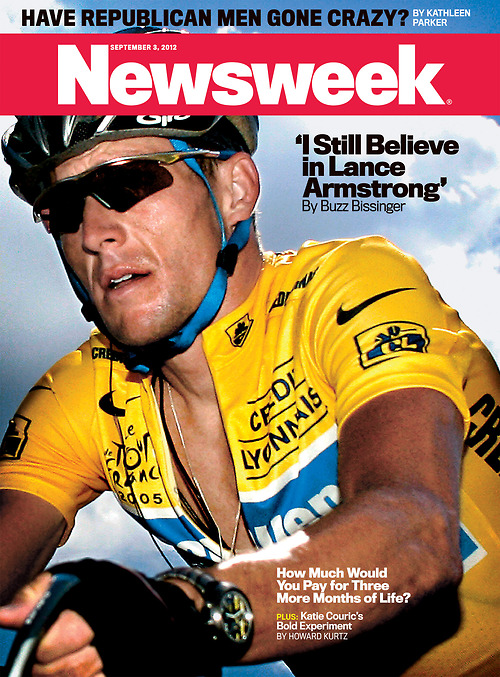
On its Web site, the Livestrong Foundation states that its mission is to “inspire and empower” cancer survivors and their families. The foundation has provided numerous people and families with the tools and resources to help overcome the emotional and physical damage of cancer. 

This country now needs a foundation to help us overcome the emotional damage of Lance Armstrong.

The foundation of the, well, his foundation, is built on the secrets and lies of the now disgraced hero and cyclist.
And the fallout from Armstrong’s doping admission to Oprah Winfrey this week leaves many of us feeling sick to our stomachs. We feel duped, cheated and lied to. The entire country spent the better part of a decade rooting for this man and fell victim to his charm – and his yellow bracelets.
No one cared about cycling before Lance Armstrong unless you were into cycling. No one cared all that much after he left, either. But you give football and baseball loving folks the story of a man who survived cancer, who sweats his way through France against all those cheating European bikers and overcomes all of it to capture every Tour de France from 1999-2005 and you’ve got an All-American Legend.
We can deal with flaws. Most of our heroes have them, even the fictional tales of Superman, Spider-Man and Batman showcase men who have their own secrets, weaknesses and fears to overcome. In some cases, they have strength, ability and powers not obtained through natural means. 

But Batman never blood-doped. Spider-Man doesn’t stick a needle in his butt.

Some, as I mentioned last week, just don’t care. One of my best friends has told me that my morality writing is some of my worst. This is due in part to his lack of regard for sports performance enhancing drugs. There are so many in the same state of mind: either it just doesn’t move the needle (no pun intended) and they don’t care what athletes do to entertain us and succeed, or it’s just a tired, drawn out storyline.
Essentially, why do we care anymore? If they all do it – and so many of our sports heroes appear to fall from grace nowadays in this very manner – then why do we bother with it anymore? We should just accept it as a new normal and move on.
But some of us can’t. I can’t. It does matter. And it’s bigger than just being a morality play or holier than thou attitude from the self-righteous.
The simple fact is, we all make mistakes. Ninety-five percent of Americans are just normal, average, every day people. And it’s inspiring to those of us in that 95 percent to hear and see others doing extraordinary things. It pushes us through our cold January mornings, slogging through traffic to an office. It inspires us to coach our children and instill a never-give-up attitude, a sense of hard work paying off and knowing that if you do, good things can happen.
When we find out our inspirational stories were missing some seedy chapters, it’s cheapened. We are cheated because they cheated. And it’s a feeling that doesn’t go away, no matter what is accomplished.
As many people have pointed out, what does it matter how Armstrong came to fame, but how he used that fame – to push for more cancer research and support the families afflicted by this terrible disease. There is truth to that, no doubt. But when the face and inspiration of the cause is found to have doped his own blood, and much of his success is now credited to gaining an edge on the competition not through determination, preparation and hard work, but through downright cheating – and then denying it for 10 years – it’s not so inspiring anymore.
In the summer of 1998, the home run chase between Mark McGwire and Sammy Sosa captured many fans, fathers and sons throughout the nation. My dad and I were no different. And at 18, I was in a strange transition time in my life. My father and I, always on good terms and already having a good relationship, bonded even more. We weren’t even fans of the Cardinals and Cubs, but watching these guys chase history, embrace each other and thrive under the spotlight was something we shared. We were watching history, together. And it brought us closer together, as sports so often has.
And then it became clear that something fishy had happened. All Dad and I could think about was McGwire talking about touching Roger Maris’ bat and touching with his heart.
“And a steroid needle,” I joked.
Suddenly, while Dad and I still had a deep bond and do to this day, our memories of it are tainted. It feels like it happened under false pretenses. And perhaps that’s where we get that sick feeling from.
That 95 percent of us want good things to happen. We want love, we want money, we want happiness. But many of us won’t allow ourselves to cross these moral lines and reach these things under false pretenses. If that makes me a righteous hypocrite that lives in a fantasy world of ethics that no longer exist, even to my closest friends, then fine. I don’t care.
Because for me, and for so many out there, I’d rather fail horribly by natural means and by my own weaknesses and failures than succeed through unnatural ways. I don’t want to win by doing what others aren’t, maybe because it means we know we went toe-to-toe with the other guy and were just better on that day.
This is precisely why it is so difficult for us to have heroes anymore. We don’t know who’s best is beefed up. What’s real and what’s a mirage?
Like Armstrong, we find out too many were not at all heroic in their means, but only their deeds. In Armstrong’s case, his end result as a record-shattering cycling champion, who’s own story of cancer survivor wove a heroic tale that all Americans could root for, was largely in part only accomplished because he manipulated his own blood in order to perform better.
No matter where we all collective reside in the discussion on PEDs, let’s all agree on one thing: that we’re not going to praise Armstrong for finally coming clean and admitting something he vehemently denied for years and years, legally and in the court of public opinion. Would a husband or wife call their cheating spouse of a decade direct, honest and candid when they finally admit to it only after everyone proved what a liar they were? I doubt it. Thou doth protest too much, eh?
I don’t care that he choked up when apologizing to members of the Livestrong charity. He didn’t Livestrong. He lived rather poorly in how he conducted himself – not just with the doping. And he’s only crying because he got caught, not because he’s sorry. That’s not regret or remorse. That’s self-pity for wishing he had not been exposed. Huge difference.
Heartfelt and sincere? Please. Colonel Jessup showed more accountability and remorse in A Few Good Men than Armstrong can fake at this point.
We’re partly to blame. We’re so thirsty for heroes that we’ll gobble down any story and trust anyone. And now we’re cynical as the years pass with our heroes. We’ve got to start standing for something more, or we’ll keep falling for anything.
After all, the U.S. Postal Service sponsored most of the those tour teams that Armstrong rode to victory seven times. I wonder where a government entity got their sponsorship money? Taxpayers perhaps?
See, no matter which way you look at it, in the end, really we all pay a price for “inspiration and empowerment.” Live strong, indeed.

Standard
Dwight Howard, Kobe Bryant, Los Angeles Lakers, Mike D'Antoni, NBA, Pau Gasol, Rasheed Wallace, Steve Nash

Ball Don’t Lie


Ready for an understatement?
This isn’t Showtime. And this isn’t fun.
This isn’t even the 2007-10 Los Angeles Lakers that made three straight trips to the finals and captured two NBA titles.
It’s a Hodge-podge group of veterans, past primes and no names. The Lakers have an egocentric star, and his name is not Kobe Bryant. Another player’s psyche is highly susceptible to breakdowns. Their coach has a warped sense of reality and apparently doesn’t see the roster like the rest of us does.
If this weren’t the Lakers, we’d ignore them, tell them to blow it up and check back in a year or two to see if they’ve made any progress.
But this is Los Angeles and these are the Lakers. The Yankees of the NBA. And drama and theater go hand-in-hand with the purple and gold.
The media will keep talking about them, but even Jack Nicholson’s waved the white flag.
The Los Angeles Lakers are a 16-21 team.
Can we stop talking about them now? If not, just let me know when, because it’s at that moment I’d love to talk about the NBA with you.
The most interesting, dynamic and contending team in Los Angeles is the Clippers. There’s a better story in terms of collapse in Boston with the Celtics. New York finally has a decent Knicks team. The Thunder are rolling in Oklahoma City, the Pacers have saved their season in Indiana, the Heat are bored in Miami and the Spurs keep fighting off father time in San Antonio.
But everywhere you turn it’s the Lakers, who frankly, just don’t matter. Lack of depth on the bench, old age on the court, chaos in the front office. Jim Buss is calling the shots, more and more frequently, if that tells you anything.
You already knew most of this. It’s nothing new. But for some odd reason, they won’t go away.
The players keep talking. Everyone involved is trying to stay relevant and pretend the Lakers matter right now. But it’s just an act.
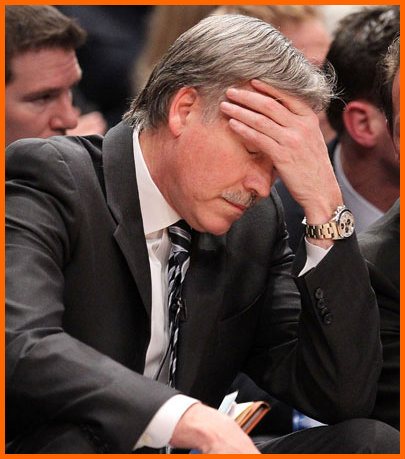
Maybe it’s their coach, Mike D’Antoni, who continues to say outlandish things on a nearly daily basis. The man touted the return of Showtime when he took the job in November, promised things would get better when Steve Nash returned and just yesterday said the Lakers season was just starting.
D’Antoni has turned into a walking, mustachioed cliché. One game at a time? Season just starting? You’re 16-22! There’s just 45 games left in the season and it’s reasonable to suspect that in a difficult Western Conference, the Lakers need to go around 30-15 the rest of the way to make the playoffs.
Can this team win 30 of it’s remaining 45 games?
It can. But it won’t.
Which means all of this is just a sideshow. It’s window dressing on an embarrassing season. To preach to the masses to not give up hope is an affront to the masses. We all might not have made it to the NBA, but we can tell when we see a train wreck on the court and in the locker room.
We were asked to give it time, to exercise patience while this group figured it out. Many pointed to the way the Miami Heat started two years ago with Chris Bosh and LeBron James. By this point in the 2010-11 season, the Heat were winning games, not losing six straight. The Heat struggled with things like who’ll take the last shot. The Lakers struggle to get their shot at the end of games.
This isn’t a team that’s close, on the cusp and showing potential signs of greatness.
It’s a mediocre team. Kobe Bryant wants it, Dwight Howard just wants his. Steve Nash wants it, but can’t use it the way he used to. And Pau Gasol just wants to be wanted. There’s too much noise in Lakerland.  
Now, for all the poking and prodding on D’Antoni, what is it that I expect him to do? Hold pressers with a drink in his hand and say things like the uncle in Home Alone: “Horrible, just horrible.”
No, Mike D is doing just what anyone would, trying to paint a face of hope and optimism on a dire situation. And Kobe can tweet staged photos that make light of reports he and Dwight are sparring behind the scenes. And the Lakers can claim a 10-point home win over a 9-29 Cavs team is righting the ship.
They can do all those things. It doesn’t mean they shouldn’t. But it doesn’t mean we have to watch.
What do we typically do when we see a proverbial sports train wreck? We watch until it’s over. Well, this is over. We pay attention to things only as long as they are interesting. Most people pay attention to politics the six weeks to two months before an election. Within days of the election being over, we’re not watching Hardball, Morning Joe or CNN as much.
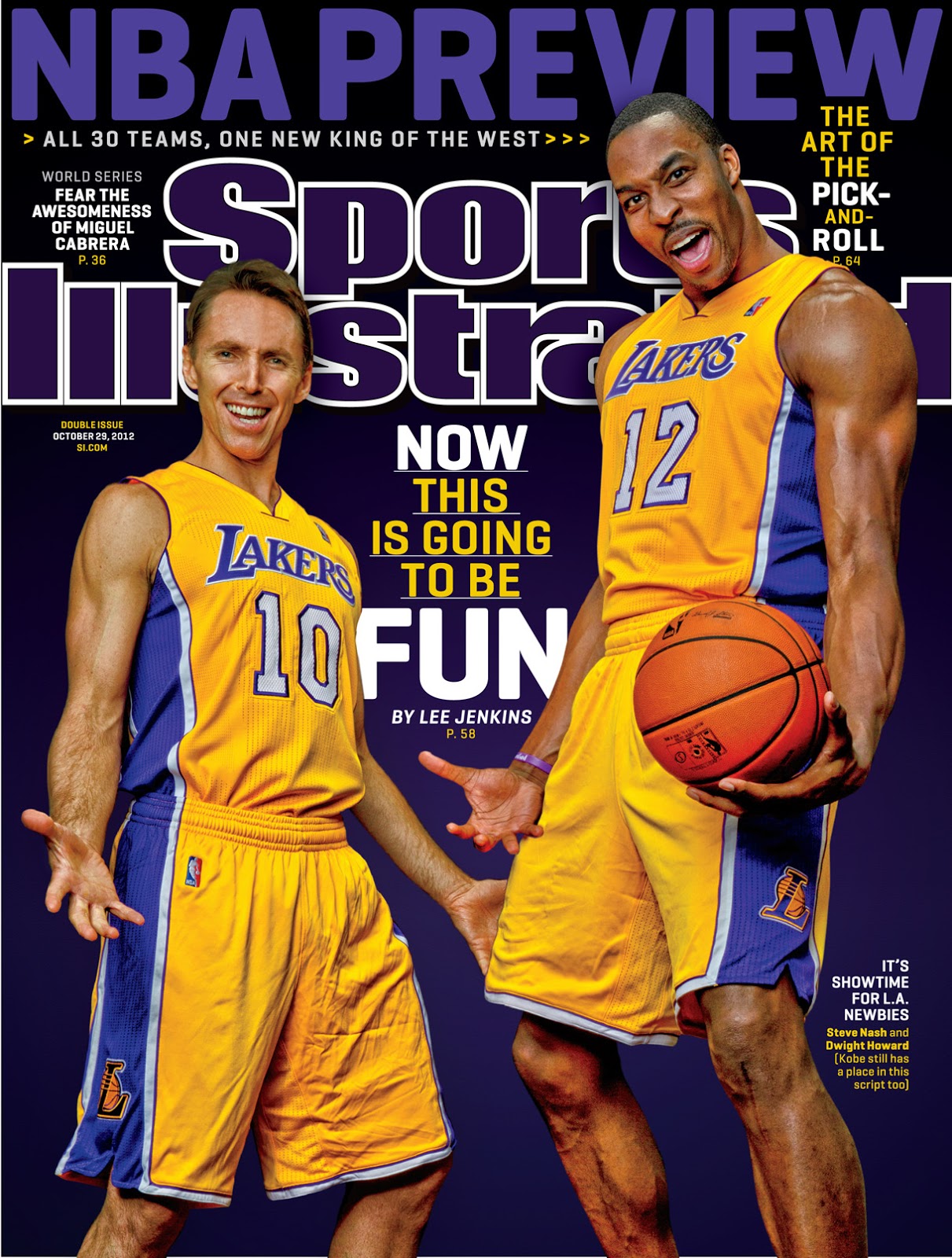
We needed to see how this would play out: Kobe, Nash and Howard on the same team. How it would go, what egos would get in the way, how they would run D’Antoni’s offense, if they complemented one another (both with their play and their words in the media).
We wanted to see if this was as fun as everyone said it would be (like on the NBA preview issue of SI, above).
It’s not.
And that’s the thing with sports, you watch until you’re spinning your wheels and wasting your time. We know what’s going to happen from here on out. Is success possible? Well, as Mike D and many of the Lakers players will try and tell you, anything’s possible.
Our eyes see a different story. And it’s just not one worth paying attention to. Let’s just close the curtain on this season and focus on other things, other storylines and teams that are worth our time.
Remember Rasheed Wallace’s famous line about how the “ball don’t lie”? Meaning, if you’re given the ball and you shouldn’t have been, the story will be told with the next shot. If it doesn’t go in, the ball told the truth. 
The ball isn’t lying on the Lakers season. Whether it’s turned over, bouncing off the rim and careening into the stands from a bad pass, the ball don’t lie.
And there’s no talking around that.
Standard
Barry Bonds, Baseball Hall of Fame, Major League Baseball, Mark McGwire, MLB, Performance Enhancing Drugs, Roger Clemens, Sammy Sosa, Steroid Era

No Hall Pass


Here are your 2013 Major League Baseball Hall of Fame inductees, those who had careers that catapulted them to Cooperstown:
(Insert sound of wind, crickets or picture tumbleweed drifting through the Old West).
That’s right, no one was elected to the Baseball Hall of Fame this year, the first time since 1996 that’s happened. The lack of inductees – technically, there were three, but they all died in the 1930s and were elected by the veteran’s committee – means that it’s the first time since 1960 that the induction ceremony will include no new or living honorees.
If this isn’t a condemnation of performance enhancing drugs and the era of 1990s and early 2000s, I don’t know what is. The names are there: Mark McGwire,
Barry Bonds, Roger Clemens, Sammy Sosa. 
They are all floating out there, names as big as their arms and thighs and heads in the baseball world. 
The stats are there, too. Home runs, strikeouts, hits – record shattering accomplishments litter their resumes.
But something else is there, too.
The asterisk, the black mark, the whispers. The performance enhancing drugs.
I had a friend tell me recently that he didn’t care about the steroids. He wanted the juice dripping off the ball. If someone wanted to ‘roid out for his entertainment and smash the ball 500 feet to provide good theater, even if it wrecked the man’s body or health, then so be it.
And really, I’m not sure I care about that, either. Granted, health is an issue – but it’s their bodies, it’s their decision, it’s their long-term health. Who am I to tell them what they can and cannot do?
I’m much more concerned about how we view this as fans and mothers and fathers. We spend all of our time telling our children to work hard, then we allow others to cut-corners in life on the path to success and riches? If that’s a jealous comment, then fine, though it’s not intended to be.
Someone once asked me if I could have taken a few pills or injections back in high school that would have turned me into a D-1 college basketball player and future NBA star, would I take it. My answer was and remains: no. I want to always know what I did or didn’t get was solely based on my own merits. We’re already fighting advantages in sports and in life. Some people are smarter in general, others more methodical. Some are fast, some are slow. Short, tall, strong, lean. These can all be used as advantages and disadvantages.
The best are the ones that maximize what they have, they rise to the top. If you have a Hall of Fame, it does imply these are the best, the ones to strive for and mimic and be like. They are the standard.
Who wants that standard mixed with performance enchancers? Many would argue that why wouldn’t you want to improve your performance, in whatever realm you do it? I’ve got no problem with supplements and vitamins and flu shots – things that prevent and fill in gaps I can’t get from food. Optimal nutrition. New ideas in the realm of sleep, rehab, surgery and nutrition are all good.
But if you’re in a controlled group where 50-60 percent of the people are doing one thing and 40-50 percent are doing another, that taints your sample and your results. How can you compare the two? How do you know, specifically, who was doing what?
Steroids don’t allow you to hit the ball, that still takes practice. But it does allow you quicker bat speed – not in a natural way. HGH doesn’t make you better, it just helps you recover from injury faster than the other guy.
But we’re not even really debating all that today, are we?
The question is, what to do with those that we know or suspect did use these drugs and enhancers? Do we place them among the other baseball legends who accomplished their now broken records without those items? What does it say about us – and more importantly – to our young athletes if we do?
The criticism of the writers for failure to elect anyone is so misguided. Attacking the system and who votes and elects members is diverting attention away from the real conversation.
Which, essentially, is simple. You can keep the money you made entertaining us, the fame given by us and all the trophies you were awarded, but you will not be permitted to be forever remembered and represented as a standard-bearer of what we want our athletes to achieve. 
Forget separate wings of the Hall, the conversation about the character clause. I don’t care if half the players in the Hall of Fame were jerks, they didn’t disrespect the game itself. You did. If Pete Rose doesn’t get in for gambling on baseball, you don’t get in for cheating your peers in baseball.
Barry Bonds wants us to turn the page, to stop being angry. OK, we have. Now what? Well, we just sent you the message: Go away.
It’s that simple, we’ll move on when you move on. You’re not getting in.
We won’t forget you, but you won’t be remembered with a bust, either. 
Standard