NFL

Pink Slip Promotions

Several years ago, I wrote a column about the massive layoff that occurs each year the day after the final game of the NFL regular season. Several years later, nothing has changed except this: it has gotten worse.

Across the NFL, across the landscape of professional sports in general, coaching is not just an uneasy profession, it is nearly brimming on insanity.

Before noon on Monday, four NFL coaches no longer had the positions they’d held 24 hours prior. Fewer people probably lost their seasonal jobs at your local Wal-Mart Friday.

Then again, it’s not just football that hires and fires the same way we change our undergarments – nor is this a new phenomenon.

In late 2008, six NBA coaches were fired before the season was 25 games old. Think about that: six teams decided that the wrong person was coaching their franchise that season when the season was barely 25 percent complete.

All this begs the question of why? Why are we terminating head coaches so fast? Is it the culture? Is it the rabid fan bases? Is it the expectations?

Coaches are paid, shall we say, rather well these days. The fact that Jim Harbaugh was offered a rumored $48 million dollars to coach a collegiate football team who have not been elite for nearly a decade (or longer) is the easiest example of this.

But it appears that it takes that kind of money to lure someone into the coaching pit of hell that is “big-time” football.

san-francisco-49ers-head-coach-jim-harbaugh

Harbaugh seems to have preferred to stay in the NFL, but he looked at the mess in Oakland (something like 400 coaches in the last 15 seasons) and Chicago (brimming with angry teens at skill positions) and then glanced at his alma mater’s boosters whipping out their checkbooks (and adding something like 14 zeroes) and had an actual decision to make.

But beware of the obligation that comes with that money. It’s win and win now. Like right now. Like the recruiting war, the season opener, the Ohio State, Michigan State and all the B1G games. Oh, and win the B1G title game. Restore the greatness, win the playoff and Hail to the Victors. Do this! Do it now!

Or find another job.

And find them, fired coaches do.

Why? Because the coaches that are being fired are pretty much all the same. They do the same stuff. Run the same plays. Talk the same speak. Wear the same clothes. Some are stronger in some areas, but the vast majority of coaches’ fall into needing some luck, some key buy-in from the players and/or the organization, some early success and fans who’ll at least give them two or three seasons.

Marc Trestman didn’t get the multiple seasons. Rex Ryan didn’t get the players. Jim Harbaugh had the early success, but the organization did not seem to like him (and vice versa) no matter how much success they had.

Mike Smith, well, he joins the list of guys who deserved to be fired appropriately: multiple seasons, underachieving teams, poor decisions, lack of success. His time was up and that’s just the way it goes…for about one or two coaches a decade.

Production takes a little bit of time. Perhaps there is no sweet spot, yet logic would preclude that a season is not long enough – at any level – to determine future success. Unless that season is winless or a significant drop-off from before.

How many of us would have lost our jobs after 60 or 90 days under these conditions? What if your boss told you that you had exactly one year to win all the major awards you could win or hit a threshold the company had never seen or you would be fired?

Would you take the job? What if every job was like that? We’d be so busy undoing or understanding where we were that we’d never get anything done. Think of all the people who would have been fired for lack of production in history?

In 2006, Tom Coughlin was nearly fired by the New York Giants. Like “as close as you can be to fired without being fired” fired. He went on to win the Super Bowl the following season, got a contract extension, won another Super Bowl and now, eight years later, the rumors are the Giants will never fire him. Coughlin will have to step down to not be the coach of the Giants.
20131202jets00jz

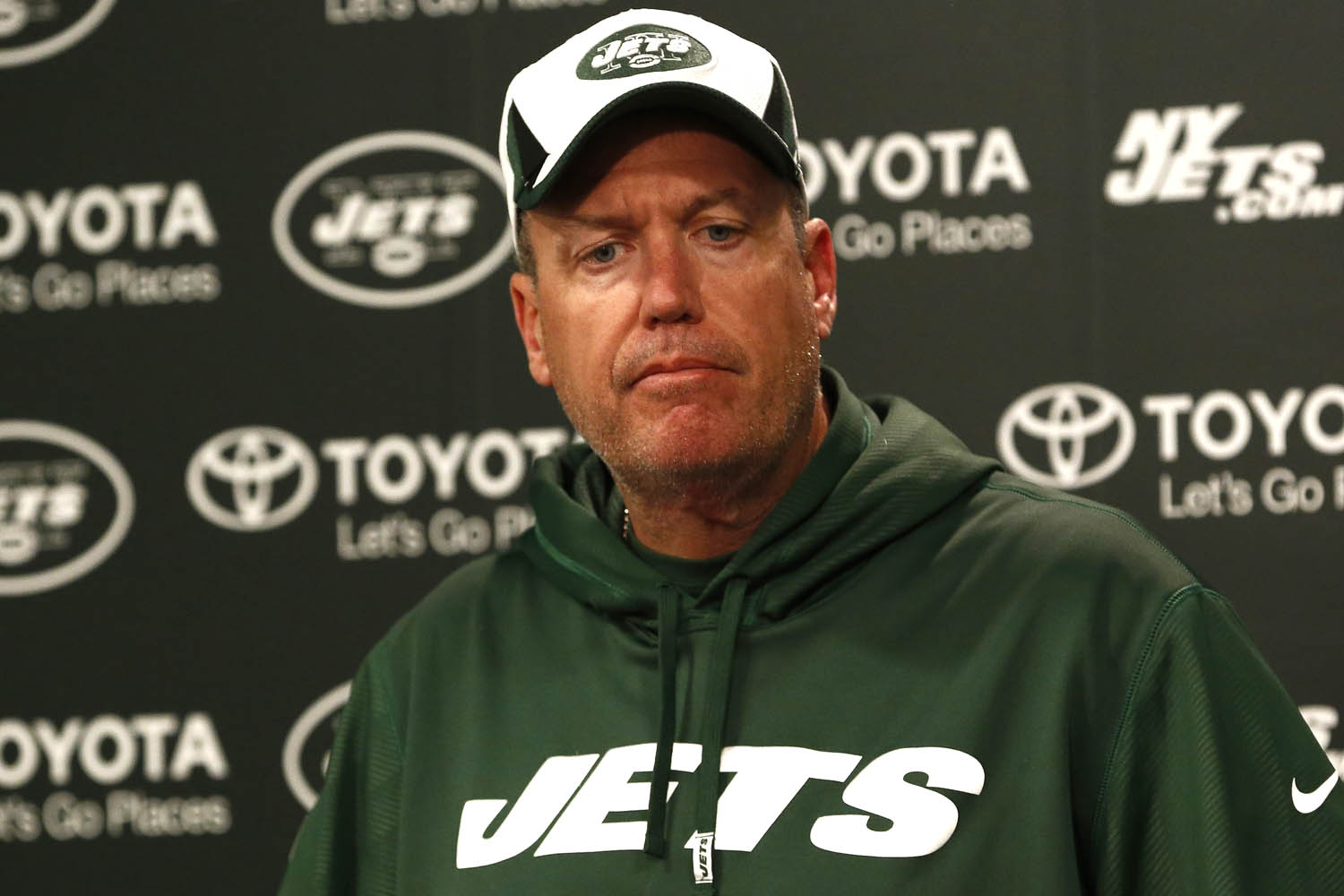
Rex Ryan took over the listless Jets and made them contenders against the likes of the New England Patriots and Indianapolis Colts, without much of a quarterback (or knowledge of the offensive side of the ball in general). Ryan made it to AFC Championship Games and seemed perfect for the tabloid headlines in New York, but ultimately, he failed.

Or did he? The players never quit and they all seem to love playing for Ryan.

The role of coach has become blurred. Is it a coach who gets the most out of his players? If so, Ryan and Harbaugh are widely successful. Is it someone who acts like a PR mouthpiece for the team? Or a calm, rational person who deals well with the media and fans? If so, they failed.

We cannot seem to make our minds up. We mock Harbaugh for his intensity, we belittled Jon Gruden’s famous 3:17am wake-up call, but then that’s the guy we want when the other guys fail. The grass is always just a little greener, no?

Is this a call for the use of a little patience? Of course, but we’re to blame. As fans, when we see another team turn it around, we get envious and demand the same thing.

There are mitigating factors to these teams and seasons, but we don’t care – give us the goods! Make something happen, owners and general managers! Create the illusion we’re moving in the right direction!

There’s a reason the Pittsburgh Steelers have been an overall successful organization for the better part of the past two decades. They’ve had two head coaches in that time span: Bill Cowher and Mike Tomlin. Go back even further, add in Chuck Noll’s legendary career, and the Steelers have had three head coaches since 1968.

The Raiders, by contrast, have had 13 head coaches since Tom Flores left after the 1987 season. Only Jon Gruden coached the Raiders for more than three seasons. In a totally related note, the Raiders have been one of the NFL’s worst teams since Gruden left.

It is increasingly unlikely we’re going to see another Jerry Sloan or Bill Belichick. We’re lucky if we will see another coach like Coughlin. We used to be surrounded by continuity. Coaches used to be able to have the chance to pull their teams out of a funk or improve on a losing or unsuccessful season.

This actually helped keep the players in line, knowing that they couldn’t whine to the media and work to have the coach canned, they’d have to work with the coach to make the team better and right the ship.

We live on a merry-go-round of professional coaching. I forgot that Tony Sparano, who coached the Miami Dolphins, was in fact the coach of the Raiders this season – and I pay attention to the NFL. Actually, without looking, I’m not sure I could name more than 20 of the 32 NFL coaches – and would be mildly surprised at who is coaching the team’s I cannot remember.

Yet we’re astonished when these coaches fail all over again. We want new coaches and new ideas, then read articles criticizing teams like the Philadelphia Eagles and Chip Kelly.

There’s only so many of these guys to go around. It’s what I call the “Pink Slip Promotion.” Get fired? No worries, just wait, there’s another job offer coming.

For our part as fans, we somehow operate under the premise that every team should be good or make the playoffs in every sport. They can’t.

No, really, they can’t.

Some teams are just bad and will remain that way until a coach has enough time to put his practices and methodologies in place and the players respond accordingly. Or they won’t, in which case, time to start over.

Look, I’m all for change if something’s not working.

Mike Smith should have been fired by the Atlanta Falcons – his team’s consistently underperformed, his consistently made poor decisions and he’d had more than sufficient time (seven seasons) to win division titles, playoff games and potentially, a Super Bowl.

But in the end, all we’re left with is pink slip promotions. Smith, Ryan, Trestman and the others who will follow will all end up back on your TVs soon enough.

So enjoy the next round of new hires in the NFL.

The names might ring a bell.

So might the results.

Standard
American culture, Culture, Media, psychology, Society

Faux Real

Last week, the geniuses at Slate put together an incredible piece about “The Year of Outrage” – tracking what America was so mad about in 2014.

For every day of the year.

Safe to say that based upon this study, it would seem as though our faux anger has created actual, real emotions. This is both sad and slightly scary, meaning that we are having an increasingly difficult time determining what is real, what is fake and how to react to both.

We can get a false sense of just about anything these days. We can generate fear and reaction into someone with a post, an e-mail, a text. We can misrepresent what matters and what does not.

We are less connected physically, but through technology, social media and various work “efficiencies” we are more connected psychologically.

And let’s be honest, our psychological make-up is not always the most stable of places.

41003-Fake-A-Smile

We are flat-out terrified of stuff that just does not matter, yet increasingly numb to that which does.

We do not see things the same way, leading the vast majority of us to react quite differently to the same situation.

For example, an e-mail sent by a co-worker at 10:14pm, over something that could not only be handled tomorrow, but next week, create for some a sense of dread or panic that they have done something wrong to receive said message at said hour of the day. The sender, by contrast, was just knocking out a few “to do” items and not really paying attention to the time of day or the subject matter.

This faux anxiety creates faux stress that feels as real as you can imagine. That stress leads to anger and lashing out at the smallest of things – like perceiving someone cut you off in traffic, leading to a real finger being flashed and real bad words being used.

Thus, often, our perception of reality becomes our reality.

Millions of Americans deal with differing levels of anxiety and to me, there can be no doubt this is contributing factor to our reactions. The best way to describe an anxiety attack is the feeling of being charged by a bear, when there is, in fact, no bear.

It cannot help us out psychologically when we get worked up over something that’s been put out on the line that we have no part in or cannot control. We’re manufacturing our own dramas. We’re desensitized, yet somehow overly worked up at the same time.

A sampling of the topics that made us grab our verbal pitchforks and raise fury like hell hath no in 2014? Just your usual mixed bag: bad jokes by people and companies, how people react and respond to each other in positions of power and authority and of course, race. Typically, it is how we reacted in hindsight that seems most perplexing.

If we’re so outraged all the time, how do we survive? If our not entirely true feelings are coming out in a very real way, how do we know when we’re actually experiencing anything real? How do we know if we’re really angry? How are we not just becoming the slightest bit numb and missing the things that matter?

Do we even know the difference anymore?

Rage is more of a controllable anger. Outrage seems to encompass some sort of moral or ethical fury. As Slate mentions in their piece, it feels showy and a little false. Probably because in America in 2014, the outrage is just that – a faux show.

The-Social-Media-MobWe kind of enjoy putting on the show. For each other, for ourselves.

More people are outraged at Sony for pulling “The Interview” than people who were actually planning to see “The Interview.” If you didn’t plan to see the movie, what do you care that a studio wasted millions on a film and marketing only to pull it? What possible moral or ethical outcry could there be to this? Yet, there it was, headlining the news, trending on social media.

The show must go on.

Of course, there are the topics we were outraged by – like social issues – in a possibly decent and entirely pure way, but of course, both sides of the discussion blew it because we got snide, hateful, over generalized and just looked and sounded insane most of the time.

Most of our stories pass through the life cycle partly on their merit (newsworthiness) and partly – largely – due to how we react to it. “It” only becomes a thing if we let it, allow it or want it to. But who can actually tell what we really care about and what we faux care about anymore.

The general theory goes that in anger, you tend to not listen very well. If we’re so outraged and blinded by vengeful anger at all these topics and sensitive subjects in the world, how on earth are we going to have a proper discourse and actually build a bridge to solving said problems?

Ever argue with your spouse or significant other? The rage and indignation rises to a level that virtually blocks both of you out and all you can hear and see is the anger. The words don’t matter as much as the tone.

No point on earth can be made and accepted through shouting down, demeaning, mocking or condescending the opposing side. Uh, they already oppose you…so…certainly your remarkably smarmy attitude will win friends and influence people over to your side, right?

And after the anger and outrage have subsided, you might have a chance to get somewhere with the person opposite you.

Yet outrage exists as a kind of mental bomb. You cannot see it, but once it goes off, the effects of the outrage last much longer than you think they do. And the next time someone says something, they are gently traipsing through the mental mine field of your outrage, trying to avoid the buzz words or things they believe set you off before.

Or they just don’t even bother, which is kind of worse, because it means we’ve stopped caring.

We’ve all been there. It’s the people in your life that are actually no longer in your life. The ones you stopped seeing and calling – or the family you deal with at major events, but say nothing of relevance to anymore because it just is not worth the hassle of taking another hit of their outrage.

This is my overall fear: That we will stop caring about the stuff that actually matters because we’re too outraged and obsessed with the stuff that doesn’t – or too busy avoiding the social media bullies to realize we’ve become one of them.

We see what the backlash does to people, every day folks like you and me, writers, media types, celebrities. It crushes them like a tidal wave. The vitriol and anger override anything else, swallowing them whole, exacerbating the moment, most of the time making the reaction to a reaction a bigger moment than the moment.

Fake emotional outbursts create real damage.  They create situations where there are none. These have been dubbed “nontroversies.”

nontroversy

By the look of it, we specialize in nontroversies, but what do we do when the indignation and public shaming passes, when the offending party has been branded, fired or both? Then what?

Simple.

On to the next one.

And we leave the trash and damage for someone else to pick-up. It’s not our problem.

This is the faux show.

This is America – where we pretend to care about that which matters little, where we put on our show, where we seek to portray the picture of perfection, of wealth, of happiness.

Except that we are broken inside, broke on the outside and empty all over.

The best gift this holiday season is one you can give both to yourself and help spread to others: be different. Don’t engage in the minutia, the gossip, the social media mobs. Stay positive, do not the negativity eat away your ability to discern the difference between what is real and what is imagined.

Know what is important. Spend some time thinking about that. Live in the present and embrace the unknown. Expect nothing. Calculate little. Just live and be.

Know that the only currency that truly matters in this world is faith, hope and love. Their value is immeasurable, which is why they are a treasure.

And those three – faith, hope and love – are the most real emotions you could ever experience.

Here’s to the hope that 2015 will be the Year of Anything But Anger.

Real or fake.

Standard
American culture, Culture, culture war, Politics, pop culture, psychology, race relations, Society & Culture

As The World Burns

It’s beginning to look a lot like Christmas.

That is not such a good thing.

Here we sit, as the world burns around us, and lament the trivial, the inconsequential, the minutia. We fight over saving an extra 20 percent in the Target parking lot. black friday

I have come to the conclusion that we must secretly want it this way. Or we are lazy. Or we do not care. Or it is just easier to ignore it and focus on our first world problems, holiday plans, on the gifts we must buy. We do not really want to talk about it or do anything about it. We just want to complain about it for a hot minute and move on to the next thing.

We put a proverbial Band-Aid over it and hope it goes away?

Oh, you are probably wondering what “it” is. You want to define “it”? Fine, I suppose that is fair.  “It” is undefinable. “It” is everything, anything and nothing at the same time.

“It” is the topic of the day. “It” is immigration, race relations, religion, poverty, politics, international affairs and the economy. “It” is gun control, Hollywood celebrity culture, concussion protocols, domestic violence, locker room language and bullying.

“It” is how families communicate, nuclear and extended. “It” is marriage, divorce, parenting and children. “It” is our increasing reliance on technology. “It” is our jobs, our anxiety, and our fears, our obsessions with the material and immaterial of the world.

“It” is every little thing we deal with on a day-to-day basis.

Perhaps most of all, “it” is you.

Yes, you – the one who thinks I am writing to everyone else and doesn’t think that these (hopefully) thought provoking pieces of less than literary prowess over the past few years are directed at them.

It is directed at you.

It is also meant for me.

When my writing changed a few years ago, it was because the way I think changed and evolved. A funny thing happens as you age, you start paying attention to more than just box scores. You marry, have children and find yourself watching less SportsCenter. Why? Because in the grand scheme of things, it just doesn’t matter as much, while what we are doing to ourselves does as a society matters all that much more.

But a key realization occurred along the way: talking does little. Writing seems to do less. People do not want to hear about the ills of the world, much less so what they can do to improve it. We do quite a bit of talking in our public and private lives. Actually addressing “it” and finding real solutions is a much more difficult proposition.

And this is because we simply do not listen.

We hear, but we don’t listen. We can’t talk about anything that leads to a civilized, give-and-take discussion and solution, because mostly, we’re unwilling to budge on our positions, to meet others halfway. We react, we get angry, we get hostile. To most, an idea of a solution to any problem is agreeing that we are right. It is part ego, part vanity.

Devaluing the ideas, thoughts, and concerns of others while simultaneously self-promoting our own as fact and truth is as dangerous as it is foolish.

To most of us, we might recognize this, so we back-off. It is not worth the argument, the fight. We Band-Aid our lives for the sake of doing the dance. We won’t talk about “it” – whatever “it” happens to be, because all it will end in is hurt feelings, angry words and emotional outbursts.

So we bottle it all up inside, allowing it to take residence in our proverbial mental garbage bin of all the things we’ve ignored, swallowed and tried to forget over the years. These situations become like sticks of unlit dynamite.

And then, at some unknown point in the future, the most meaningless thing sets off the wick and we explode, looking like we need a straight-jacket and some prescription drugs.

We’re all a little crazy.

But that is because we allow ourselves to be. We think we’re saving face. We’re not. Clear and honest communication is a central part, but actually listening and being willing to bend, to meet in the middle on whatever “it” is would most likely serve us all well.

This much is true: if we agreed to disagree from the beginning and worked to a solution that neither feels entirely great about, but comfortable with, we might actually get somewhere in this world.

Our world view is significantly altered by the fact that I am me and you are you. We’re a country and world full of people with specifically engineered lives, with experiences vastly independent from one another.

We share the same period of time and space in this universe, but we experience that time and space in very different ways, which means we do not – and cannot – see the world the same way.

So why are we so surprised when people of opposing viewpoints and political parties, living in different cities, towns and regions, with entirely different life experiences disagree with us?

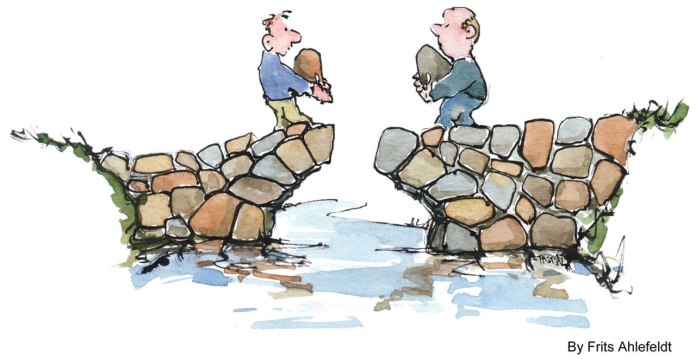
We will never agree on anything because not one of us looks at everything the same way. It is not about forcing someone else to see why they are wrong and you are right.On the contrary, it is an attempt to build a bridge toward the middle where you see where they are coming from.

bridge


That is problem solving. That is relationship management. That is how we were designed to interact. We are not all geniuses in all aspects of life and its infinite mysteries, nor are we complete morons, either. We’re a melting pot of races, religions, ethnicities, social, cultural and economic backgrounds.

We – READ: you and I – would be better off if this were not just a pipe dream, but something we actually exercised ourselves and taught to our children. You – yes, you – will be wrong sometimes. You will be right sometimes.

Sometimes, you might be either, neither or both.

The same goes for me, your parents, in-laws, children, their friends, teachers, your co-workers, the guy working construction and the lawyer on 5th Avenue, the President, Congress, Roger Goodell, Chris Rock and the waiter at your restaurant.

Be in the world, not above it. People are people, their problems are real because they experience them. Don’t shut them down. When we refuse to grow, we refuse to change – and change is largely inevitable. Growth is good. Sticking to your old habits, beliefs and traditions is not necessarily something to be proud of.

So this holiday season, start a new tradition.

Try.

Try to be honest. Try to be kind.

Try to avoid the Social Media tar pits that cannot be one. Try not to take the bait. Try to understand there are people who do not have food, shelter or friends.

Try to not be too swayed – or angry – with those seeking your vote, your money, your donations and your time. Try to give back a little more than you take.

Try to understand the other side, someone else’s perspective as best you can. Try not to shut down or shut out. Try open minded. Try accepting what you can.

I don’t think you should necessarily succumb to the world, give in to all opposing views and beliefs and acknowledge they are somehow right. But the world is not going to fully come your direction, either.

Try to build a bridge.

At least your half of “it,” anyway.

Standard