Another calendar year has nearly come and gone.
We’re facing “The Holidays” again, left wondering where 2013 went and feeling like spring or summer was just last week when it was months ago.
The reminders of the passage of time are all around us, constant notifications that the world continues to press on, whether we want it to or not. And we’re constantly battling the notion we may be missing the good stuff.
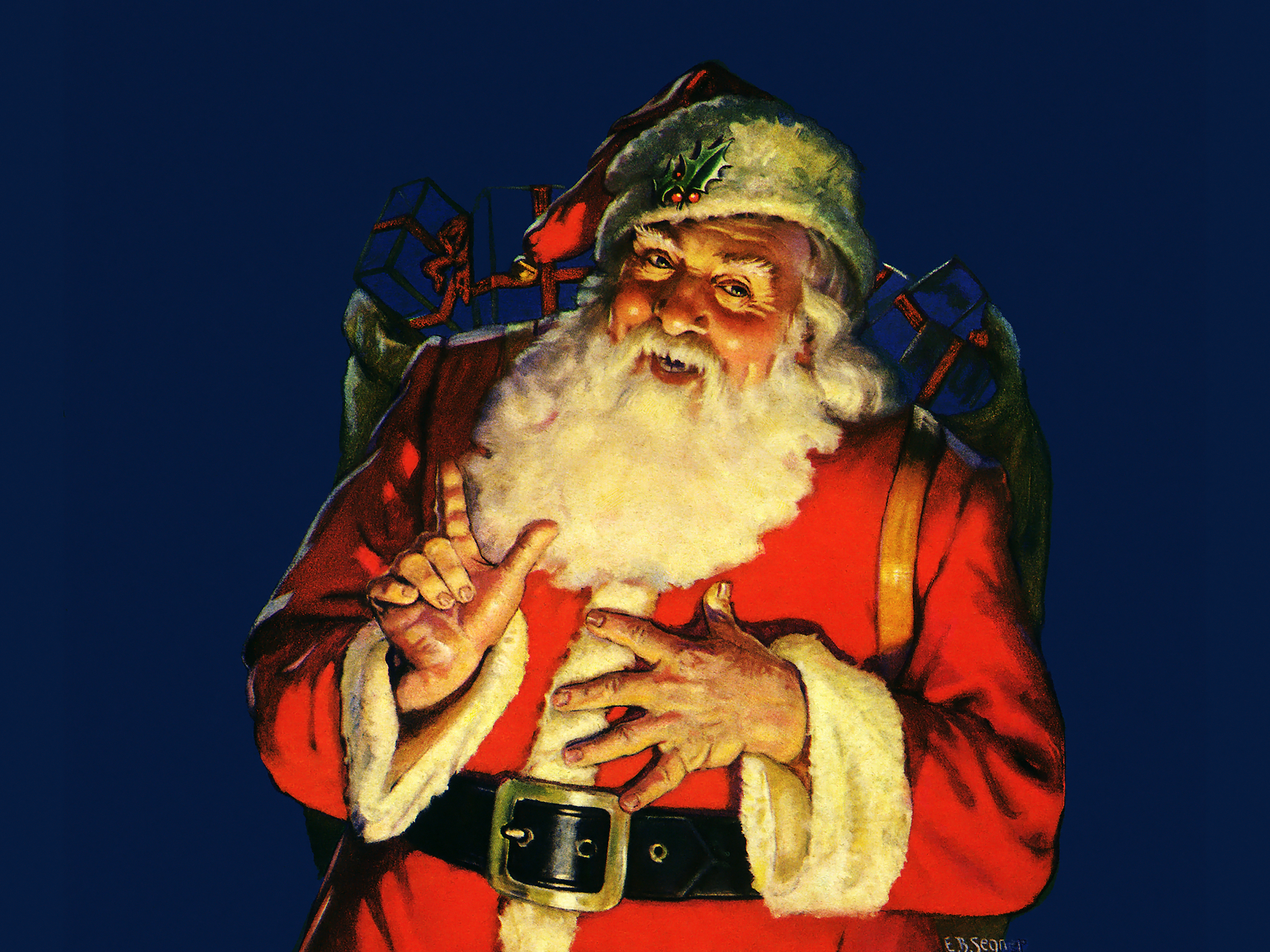
My most recent encounter with this came earlier this week, when my family renewed a family tradition of watching Christmas movies, like “The Santa Clause.”
And as my seven-year-old daughter climbed into my lap, the scene near the beginning that is the crux of this enjoyable farce hit home: the conversation about whether Santa Claus is real between Charlie and, and…Tim Taylor, er, Tim Allen – wait, I’ve got it – Scott Calvin.
Our children haven’t asked us about Santa being real yet, really, just like they haven’t asked about Jesus or heaven being real.
That is not meant to combine the two onto some equal ground, mind you, but to merely point out the association of belief in something you cannot see.
So many logical, rational and data-driven people will tell you it is dangerous to foster notions of a fat man in a suit taking presents to every child in the world that’s been good in one night, just the same as many non-Christians or atheists question the legitimacy of Jesus – from conception to birth to death.
Now I’m not looking to turn this into a religious forum, it is not my job to judge beliefs one way or the other against my own. Everyone is entitled to an opinion.
But belief is simply an opinion with conviction, and some choose to back up their beliefs, convictions and opinions with facts. Others with emotion. Belief is just an acceptance of something as truth or factual – with a heavy dose of perception of what we allow ourselves to emotionally accept as true or fact.
We use facts, pictures, models, graphs and statistics to prove what we want others to believe, but in our world, belief is an emotion, a feeling.
You can show me all kinds of numbers on why Android is better than Apple, or vice versa. All it comes down to is what I like, what I think once I use both products. We can argue over politics, but that’s as much belief and emotion as anything else. We try to use facts and figures there as well. We even break down human relationships to statistics and figures, qualities, advantages and disadvantages.
But what about what we cannot explain? Why someone lives or dies through an ordeal? How certain events have inexpiable outcomes, how they defy logic and science and physics? What makes you happy and sad?
Research has found that the brain is sensitive to any form of belief that improves the chances of survival. Just like that, we have our answer for why we love, why we believe in God – or do not – and for the purposes of this prose, why we choose to allow our children to believe in Santa.
It’s an idea, more than an actual person. Does Santa exist? I don’t know.
But neither do you.
Perhaps he did hundreds of years ago, like any legend, and simply delivered toys one year to the children of some small village.
We often say that when people pass on, they are in a better place. We do this for a variety of reasons. Perhaps we believe it, perhaps we’re saying it to someone for comfort. Is that true? I don’t know. But it brings us some sense of peace all the same.
So is allowing your children to believe in such an idea detrimental? I don’t know.
But neither do you.
It can foster vivid creativity, as the pure imagination of what happens in the early hours of December 25 runs wild. If at any time you believed in Santa as a child, just think of the mental images and scenarios your mind envisioned.
Again, this is not endorsing Santa Claus the person, more explaining the idea that allowing belief is a good thing.
We truly don’t know what happens when we die. There is no absolute fact because no statistics, figures or images can support it for us. But the belief or lack of belief in religion, in mythical holiday figures, is more or less a coping mechanism in our brains for just how big and unknown the world is. It would be quite difficult to deal with the vastness or mystery of it all if we did not cope through belief.
For some, enjoyment and peace in life can be found in believing in a reason, a higher power. For others, not believing explains a chaotic theory of life. Either way, the person has chosen that path as a way to believe in the purpose of their own existence.
Life is an emotion, a sensation, really – that has no explanation. There may be all kinds of statistics, but those statistics are just numbers really, not people.
For the logical, Santa Claus is as much a farce as creation, as believing in miracles. For this group, for example, saw the end of the Auburn-Alabama game last week as merely the end of a sequence of statistics that led to a low probability that occurred given the right set of circumstances. In fact, the probability was .007%.
For the emotive, it was a game won out of belief, out of some special moment that occurred because of want, need, desire. And belief.
It really comes down to choice: what you choose to believe – but believing in something, all the same.
As a man, built on gut reactions, emotions and feelings, I see the creativity, the vivid imagination of my children, who currently believe in Santa Claus, who can see heaven in their minds and think Disney World exists in the sky (because we take off on an airplane and land there) and I believe that these are the kinds of children who might grow up to do something really cool.
I don’t know if that means cool as in changing the world cool.
But neither do you.
At the very least, if allowing the perception or the belief that such a figure exists fosters special neurons in their brains to fire that spark imagination and creativity, then I am personally fine with that. Even after they stop believing in that figure, those neurons and synapses will still continue firing, still dreaming, still creating. Because they believe such things could exist.
This is how you create. And creating is good.
It’s the step that happens before all those statistics showing how effective or ineffective the creation was. And when you create something, it has to be believed before it’s seen.
Funny how that works.
Seeing isn’t believing.
Believing is seeing.
And perfectly fine for you and your kids if it happens to be a large old man in a red velvet suit who squeezes down chimneys, eats cookies, never finishes the milk and reverse burglarizes your overly decorated home on a secular holiday.
Just go with it.
Before another year passes and you miss out on all the good stuff.
 worldbetweenlines.com