Life, passage of time, Philosophy

In the Here & Now

Except the ticking of the clock, there are constant reminders that life is ever-constant, always changing, moving. 
As time marches on, I become more evident of it, more appreciative, more selective. 
There was the conversation where my wife and I realized our oldest son is now the same age her youngest brother was when we met and started dating. It was a discussion about Halloween costumes and how he might not dress up this year. 
That didn’t seem right, not because a sixth grader might not want to dress up – but just that we were at a point of time in his life where it was even a discussion. 
Our youngest son, and youngest child, is a precocious two-year-old and loves Scooby-Doo. So did his five-year-old brother and his seven-year-old sister. And by the end of next Thursday night, all will have worn the same Scooby-Doo costume for Halloween. 
Moments like this present themselves numerous times a day or week, specific and unique to all of us, but somehow still shared. That radio station playing a “classic” song that you remember as a new release. Ever look down at your phone and just get amazed that you’re even holding such a device?
Maybe it is just me. 
It is within our shared recollections where we probably notice it the most. Next month marks the 50th anniversary of the death of JFK. Bob Knight just turned 72. Michael Jordan is 50. 
That is when you find yourself looking around a bit more. You see the lines on your parents faces. You hear your son’s voice deepening, seemingly by day. You feel it when you first wake up in the morning, with every joint popping as you slowly get out of bed.
And you wonder, where is the time going? Like a dream, memories mount over time, but jumble together into a haze. When your five-year-old puts on a pair of cowboy boots, you recall the ones you donned in 1985. You think of the grandfather who gave them to you and how long it’s been since his passing. Memories take form in Instagram-like filters. I can see my childhood house, but the color looks like an old, not fully developed Polaroid. 

So we shake our heads, and simply ponder life for a bit. Where did the time go?
The answer is simple. 

Where it’s always gone, at the same exact pace it’s always moved. 
And you realize: this is life. Just let it sink in for a fleeting moment.

Life is watching your wife play a superhero, building a business out of motivation and passion, while multitasking 402 everyday things like homework, practice, laundry, groceries and random tasks that each day bring. Life is finding the time to steal a kiss hello or goodbye. Life is off to the races, happening in one hundred different places. 
It’s hearing your mother cry as she struggles with the toll that Alzheimer’s has taken on your grandmother. Life is being speechless, because there are no words. It is fear that you won’t know what to say the next time you see her. Or if she’ll remember you at all.
Life is seeing your child learn to read, your entire family bow their heads in prayer and read a passage from the Bible each night. It’s hearing a teacher tell you your son has been kind and compassionate, taking time at recess and in class to spend it with children who have autism and being overcome with busting pride to the point of tears. 

It’s the crisp air of fall, of picking pumpkins and baking seeds. It’s wrapping presents for your kids and playing Santa. Life is everything happening to you and around you. And it can be overwhelming trying to figure out a place in it, or how everything is effected and affected by every decision, no matter how small, that you make.

Life will go on, as it always has, at the same speed it always does. 
As the popular quote goes, when it’s over, it isn’t the dates and years of birth and death that matter. It’s that little dash in between.
That dash is life for not just you, but for everyone else in your particular life.
That dash is every Sunday morning making pancakes, every night one or all of your children end up in your bed. It’s late nights watching baseball games and sitting in traffic for 45 minutes to get to work. It’s summer vacations as a kid, break-ups and make-ups. It’s bad decisions and a clean slate. 

That dash represents every breakthrough, every smile, every tear. Every moment of anxiety, of dread, of panic, of laughter you’ll ever have.  The good and the bad, the friends you have and the ones who’ve fallen out of touch. 
Because when everyone sees that dash, it will inevitably invoke some memory or meaning. And we are remembered not for the hours worked or the production of our days, but considerably more for how we made everyone in our life feel.

Life is emotion – and in some cases, lack thereof. And that dash represents every time you smiled at someone who frowned. Every time you called and just left a quick “thinking of you” message for a friend. 

The dash is flowers for no reason, an extra hug and kiss goodbye, every “great job, I’m proud of you” spoken to eyes searching for approval. It’s held doors, holding hands, making time when you really believed there wasn’t. It’s leaving a little extra tip at dinner, going ahead and having the ice cream. It’s the extra mile you ran to get rid of the ice cream so you could be around longer. 
Time stops for no one. But the truth is that realization should bring some sense of comfort, make it easier, not harder. We can’t get any of this moment back. So worrying about what cannot be controlled, which is everything that happened to this point, is fruitless. It cannot be changed. 

And it means that the future, which hasn’t happened yet, cannot really be controlled. So that deadline at work, while important, in proper perspective, is just a blip. There will be another. And another. 
Thus, your life, your dash, becomes more about how you choose to spend it and the manner in which you spend it. Because it will be spent. This moment right now is the only thing that matters. 
Life is fickle, and it doesn’t promise answers or reasons. The more tightly we squeeze it, the less grip we have. 
So ease up. Take the time to take your time. Laugh, smile, cry, learn, love. Live your dash and make sure your dash holds as much meaning as it possibly can. 
If there were ever a time to embrace, engage and just be you, well, the here and now is better than never. Everything is both starting and ending simultaneously. 

Find that little dash in between the beginning and end of everything, because in that moment, that is where life happens.
Time can do everything but turn back, meaning we never get another chance to be in this moment. Don’t trap yourself in the past or engage solely in planning for the future. 
Because now is where you are, and if you waste it in the before and after, you miss what is. 

Life.
Standard
Bill Polian, Denver Broncos, Indianapolis Colts, Jim Irsay, NFL, Peyton Manning

The Book on Manning

On Sunday night, Peyton Manning returns to Indianapolis to play professional football in a state-of-the-art football stadium he played a large role in getting built.
Perhaps you have heard of this little fact. If not, let me know once you’re out from underneath that rock and I’ll fill you in on government shutdowns, Miley Cyrus and this new thing called the iPhone.
In all seriousness, Peyton’s return to Indy as the quarterback of the Denver Broncos continues to grow in significance with each passing day. This is due largely to the fact that the Broncos are undefeated, that Peyton Manning is doing Peyton Manning like things, you know, generally embarrassing defenses with an offense so cutting and precise, it would make a slew of surgeons, architects and engineers jealous.
But Peyton has always done this, or at least it has felt like he has. Now there’s that undertone flowing into this Sunday’s game with the Colts, that imagine what he could do if he were still there and that the Colts might have given up on him.
So of course, the normally quiet and reserved owner of the Colts, Jim Irsay, spoke up about this after a litany of questions this week.
Actually, again, unless you living Patrick Starfish-style under a rock, you know that it was the exact opposite – Irsay talks constantly, about anything and everything under the sun, without prompting. His comments about wishing the Colts would have won more Super Bowls weren’t really controversial; it was the truth.
The media has latched on to the story this week, but that’s what the media does.
If you’ve seen the “Book of Manning” documentary, then you can get the background needed to write the book on Peyton Manning. He’s prepared, flawless, exceptional, born to play quarterback and thrives by knowing every possible situation and outcome – like a mathematical genius that sees every possible outcome before it happens.
But being built in such a way does not leave room for randomness, spontaneity, surprise. What happens when things go wrong and something does not go as planned. This is where, as we learned from that documentary, where Peyton’s father, Archie thrived.
And by watching old footage of Archie – even that crazy scrimmage game in the late 1980s at Ole Miss – you can see it: Archie just kind of made things up.
You know which one of Archie’s sons does that now? Eli – not Peyton. Just look at the New York Giants Super Bowl wins, the playoff runs, the regular season games where they look out of it. Eli scrambles, chucks and pulls rabbits out of his hat.
Peyton’s act is no magician; he’s a professional quarterback. As such, the book on Peyton has always been that he’s exceptional in the regular season, but come playoff time, he’s not very good. It happened at Tennessee and it definitely happened with the Colts.
Now, that’s not meant to place the blame of first-round exits and humiliating defeats in the playoffs at the hands of Peyton Manning. Football is more nuanced than that. But just look at the key interception of the Super Bowl loss to the Saints. Is Reggie Wayne to blame for that costly pick? Or, could it be that Peyton is such a tactician, he threw it to the pre-programmed spot on the field where Reggie was supposed to be? Who’s actually at fault, Wayne for not being there, for a variety of reasons – or Peyton for not adjusting his read and throwing it anyway?
This could obviously spiral off into a multi-layered conversation if we actually rehashed even just that one play.
The overall point: nothing Irsay said about Peyton was inaccurate, and frankly, not that controversial. How can you not have wished to have won more than one ring with perhaps the greatest quarterback of all-time taking you to the playoffs 11 years? The same has been said about the Atlanta Braves of the 1990s with their incredible pitching staff of Glavine, Smoltz and Maddux.
As I heard earlier this week, the real and hidden swipe might have been at Bill Polian, with Irsay essentially saying Polian could bring the horse to the water, but couldn’t make it drink. While slightly unfair – and kind of uncalled for, considering what Polian did, it also might be just inaccurate.
Polian had a tough task of building an entire franchise around Peyton, and accordingly, he put together a team that could play from ahead defensively, since that was the goal: Peyton gets you a lead, pin your ears back and go after the other team aggressively on the defensive front.
It did work. Polian cannot perform on the field, any more than any other sports executive. He assembled the team and accomplished a great deal during his tenure, the likes of which had not been seen either in the NFL or in Indianapolis from a consistency standpoint.
If it was indeed a swipe, it was unfair and needless.
But let the good fans in Indy not waste any time thinking about what could be currently. It was time to change direction, switch things up and try a new approach. And clearly, we didn’t know if Peyton would return to form like this. We still don’t know if it will last for more than a year or two.
The Broncos were simply a better fit last season. They looked a lot like Manning’s 2000s Colts. Still do, just more dangerous weapons and a better overall defense. We shall see if this translates to another 13-3 season and a bitter playoff failure, or, perhaps a Super Bowl.
For the Colts, Andrew Luck couldn’t be a better fit. It could not have worked out better.
Is it going to be awkward Sunday night? Of course. These things always are. Without Manning, the city may not even have a pro football team, let alone a new stadium. It certainly wouldn’t have the Super Bowl banner it has.
But every legend leaves with a little gas left in the tank. The Colts just didn’t want to be left holding the keys when it went empty. They saw a chance for another once-in-a-generation quarterback who fit their city and style perfectly and they took it.
Its sports. It is how these things work. Would the Colts be better off with Peyton right now? There’s no real way to know for sure. We’re not in an alternate world where he is with the Colts, we just have what we see.
And for all that he did accomplish, for basically saving football in Indiana, the fans will give him a standing ovation, Peyton will be humble, gracious and appreciative. The game will start and aside from the crowd not giving him the benefit of pin-drop quiet he’s used to in Lucas Oil Stadium, it will be fine.
While it will be easy to look back at the end of the season or in five years and point out what happened as evidence either way, just remember this: it seemed right and natural at the time. Because as crazy as Jim Irsay is, he was not necessarily incorrect (this time).
The book on this Manning may not be complete, but the preceding chapters to this one have told a story, and not every page was perfect.
We did want more.

Standard
Los Angeles Dodgers, Los Angeles Lakers, Major League Baseball, NBA, NFL, Yasiel Puig

Rules Meant to be Broken?

Most likely, it is as old as the law of the jungle.
Someone probably scribbled it on ancient papaya with one of those really official feather ink pens.
And it could be encased in glass in some national museum that you cannot probably get into at the moment (cough, cough).
They are the official, unwritten Rules of Baseball.
And I say official and unwritten with the same intent as I used ‘most likely,’ ‘probably’ and ‘could be’ – because the unwritten Rules of Baseball just don’t exist. Like Captain Barbossa says in “Pirates of the Caribbean,” their more what you would call guidelines.
As such, there is no punishment or fine for breaking them, except for those called for the in unwritten Rules of Baseball guidebook, which no one has ever seen, but referred to often.
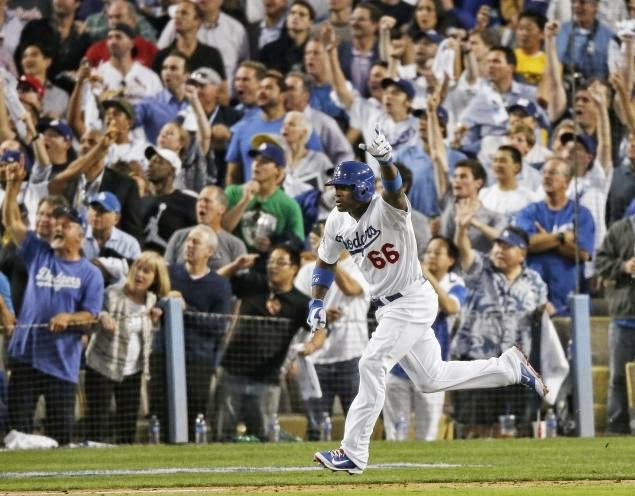
And based on his latest actions, Los Angeles Dodgers rookie sensation Yasiel Puig is apparently getting dangerously close to setting off the unsounding alarm. The elders may be gathering and the keeper of the code will be looking up just how to deal with him.
Because you just can’t show boat like that. You can’t hit a deep ball, flip your bat, throw up your hands like you’re in a club and watch it like a firework on Independence Day.
Well, you can if you’re Puig and you can make up the time and stretch what you thought was a home run but hit the fence into a triple. And then you can celebrate that like someone who just drove in the go-ahead run in Game 7 of the World Series.
Except it was Game 3 of the NLCS and the Dodgers were down 0-2. And Puig didn’t have a hit in the series.
Then again, there was more energy in that moment than any other so far in the postseason, outside perhaps of David Ortiz’ grand slam on Sunday night that gave the Boston Red Sox new life in their ALCS matchup with the Detroit Tigers.
And if there is something that is and has been sorely lacking in baseball, compared to so many other sports, it’s the massive star power, that excitement, that ability that brings oohs and aahs each game.
As I had said before, we’ve spent way too much time talking about a relief pitcher in his early 40s this summer. Mariano Rivera has been great, and was one of the greatest players of the past couple decades. Notice the has and was in that last sentence? Because it’s in the past, which is the point: the game is stuck in the past.
Everything good and bad about baseball is intrinsically connected to the past. Past players, historic numbers and legends born long ago, grainy images giving us a link to our fathers heroes.
Case in point: one of the main stories on SportsCenter and ESPN today? The 25thanniversary of the Kirk Gibson Home Run in the 1988 World Series. While no doubt a legendary moment in the game, with an incredible call from another legend, Vin Scully, it’s a lead story? Baseball is having some trouble here finding a modern narrative.
While other sports, like the NFL and NBA honor the past, they put great emphasis on the present and future. And because baseball prides itself so much on history, when something like PEDs comes along, it causes such a tremendous uproar because it would create a space-time continuum shift the likes of which would make Doc Brown squirm in his lab coat.
How can we possibly compare all of these numbers we’ve pointed to and prided ourselves on if we don’t know which ones are legitimate? Do we go back and asterisk the books? Do we have eras? What do we do? It’s been a decade long headache.
Meanwhile, the NFL and NBA, which have similar, yet not as publicized issues with PEDs, escape relatively unscathed, partly due to the fact they have not propped up their historical numbers as a thread. The games evolved. The three-point line was invented. It moved back. New rules came into play that increased or decreased scoring. The field goal posts moved to the back of the end zone and headshots were addressed. They are dealing with player safety.
But in baseball, they’ve always been slower to adopt the game to the changing of times. It’s grand ties to history remain both its greatest asset and curse.
Which is why it was strange to hear so much today on TV and radio about Puig and how he carried on last night – and how he carries himself. Many of the old guard talk about doing things the right way, they brought up his struggles with the Dodgers and giving maximum effort, and partying with LeBron James and hanging out with Jay-Z.
They don’t want that, not from a rookie. It messes with those unwritten rules of baseball. But the game might need that if it wants to grow and gain new fans or earn lost fans back.
Did Puig look foolish last night? Oh, most definitely. He embarrassed himself by watching his hit and then over-celebrating on third base. It tends to ruffle less feathers when our athletes act a bit more professional, possibly because in our daily lives, we have to act a bit more professional.
Can you imagine sprinting around the office celebrating every time you closed a deal, or came in early on a timeline? Our frame of reference dictates a lot of that discussion.
Yet I can’t forget what I heard my Dad say when I was a little boy, watching the Lakers with him in the mid-1980s, as Magic Johnson led Showtime. It was fast, up-tempo and exciting. You never knew what was going to happen.
“I work hard all day, every day, doing the same things,” he said. “And that’s fine. But I’d like to get a little excited watching basketball and not know what they’re going to do.”
And some people hated that style of play. They didn’t like all the flash, just wanted the classic substance they grew up with and were used to. Totally a matter of opinion. But Magic wasn’t breaking any unwritten rules with no-look passes and a faster tempo. Just speaking to a different crowd.
There’s room for both.
Which is why baseball needs Yasiel Puig just as much as they do retaliation plunking and a hundred players who, as Carlos Beltran said, pretend like it was an accident when they hit a home run so to not give the pitcher motivation. It can all work in baseball – there’s room for everyone.

Just have to see if those unwritten rules have room for a section on it.
Because it might be just as much fun to talk about Puig’s antics as it is for someone else to watch Puig do it so dramatically, so recklessly.
Now, who keeps the code, anyway? 
Standard
American culture, Jimmy Fallon, Miley Cyrus, music, Society, We Can't Stop

We Can’t Stop – But We Should

Last night, I was faced with a most troubling decision.

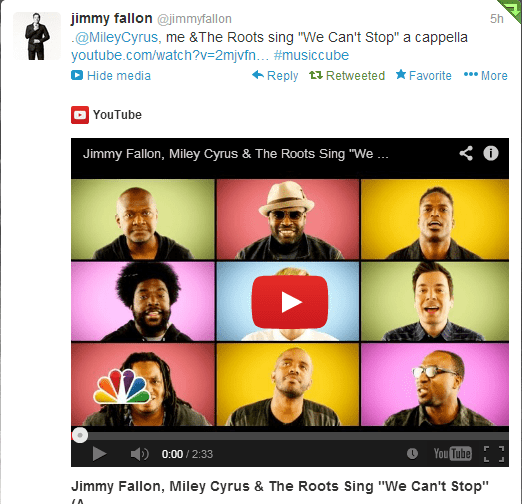
As I thumbed through my Twitter feed, I came across a tweet from one of my favorite entertainers, Jimmy Fallon.

But it was a video featuring Miley Cyrus. For reasons that should be obvious, I cringed.

Oh, the dilemma.

07aab-jimmytweet

See, on the one hand, everything that Jimmy Fallon does is amazing. But on the other, pretty much everything that Miley does make me want to lock my daughter in our house until she’s 30.

Convinced Fallon is the next Johnny Carson, I finally clicked on the link to his A capella version of “We Can’t Stop” with Miley Cyrus and The Roots, despite an aforementioned aversion to Cyrus and her recent antics.

I loved it.

I think (and desperately hope) this probably speaks more to Fallon being great at everything than this does the song or artist itself. Yet it was so well done, I couldn’t stop listening to it. I hit replay probably 10 times. There was harmony, tenderness and sadness – you forget that in between the music video weirdness, tongue sticking out weirdness and a variety of other weirdities, Miley Cyrus can indeed sing.

I was moved by the little video – and that was without really listening to the words.

And then I did listen to the words.

The more I listened to the song – then Googled the original version of the song and listened to it, too – I noticed that the lyrics were not just completely out of my realm, but wondered what segment of society they were relatable to? A much segmented part of our youth population I am guessing.

Hey, I get it; the song is catchy, has a good beat and sounds fun. It could be every major pop hit we’ve had for the past few years. Lyrics do matter, regardless of what anyone tells you. What a song says is as important and influential as its sound.

Yet I am not that old. I’ve listened to tons of pop, rock and alternate music and grew up in a pretty good era for it.

That said, what the recent stream of young artists say in these tunes has a whole lot more to do with us than it does them, since we buy it, play it on repeat and call it “my jam.”

I think we get the message: Miley Cyrus has matured from that little Hanna Montana girl she used to be. But it is a farce, from the outsider perspective, to say Miley knows who she is right now. She’s 20. She has no clue who she is. Most everyone I’ve ever known would agree. “Twenty?” they answer. “Oh, I was a disaster.”

And everyone between the ages of roughly 28 and 100 is nodding in agreement. You just can’t know, but the problem is you think you do. At that age, you are stuck between adolescence and adult, emerging rebellion and responsibility.

Is Miley Cyrus tormented and struggling? Maybe. Certainly to her, she is. To the vast majority of 20, 21, 22-year-olds, what they see as a struggle varies greatly from what Miley Cyrus sees as a struggle.

They can’t afford to dance with “Molly” and wave their arms in clubs like they don’t have a care. They can on weekends, I suppose, between jobs and/or classes, then reality hits on Monday morning when they wake up in a dorm with a presentation due that afternoon, or they are late for their job.

For Miley, she’s missing a key component to this dichotomy: the earlier you begin entertaining the rest of us, the less you are like us. Likewise, we can’t relate to you, even if we grew up with you. You live in your own box long enough, when you speak, the words that come out won’t make sense to us. Just ask Britney Spears.

The conventional vanity of our pop-culture driven world cannot be afforded – monetarily or morally – by really anyone outside the very circle that creates it in the first place.

Us “normal folk” watch it all and are either horrified or entertained – and sometimes both. But we watch. We watch because it’s there, and because 25 percent of it looks fun, and because we’re pretty sure the singers, actors and athletes we watch are going to implode in a variety of sadly predictable ways: drugs, bankruptcy or because they are actually just bad people.

Yet it remains a cycle we have been unable to stop for at least the past 40-50 years: we gorge ourselves on what they do, their accomplishments and products, which makes them rich and bored, in turn causing them to gorge on things like drugs, mansions or any number of material items that the rest of us aren’t addicted to, in part because we can’t afford them and our version of reality kept the need for self-control.

In this song, “We Can’t Stop”, Miley sings of not stopping and doing what she wants. This is both an idea that we can totally relate to, yet at the same time have no concept of the specific meaning she has in her mind when the lyrics pass her lips. Because we haven’t experienced what it is Miley won’t stop.

And this is exactly the point where our worlds differ: she means what she sings, while we’re listening to it and enjoying it in a generalized, passive sort of way. It’s not necessarily the lyrics don’t have meaning, but they don’t really mean anything to her audience.

Where she can’t stop (though I do wonder if even Miley knows what exactly she won’t stop or if it’s just the idea of being a rebellious figure that’s so appealing to her), the rest of us must. We must stop because we have wages to earn, classes to attend and families to start.

Simultaneously, I’d like to believe there is a majority of us between the ages of 16 to 35 (assuming that’s her new demographic) that would prefer to not disrespect everyone that cares about us.

In some ways, it’s true; you can say and do whatever you want. It’s called free will and it’s a beautiful gift. But it’s what you do with that gift, or the others given to you that define who you are. And when you live in a world that most exclusively defines people by who you are, then it matters.

You can’t say you won’t stop and will do whatever you want, and then bemoan the media attention paid to your every breakdown, break-up and drug bust. Or, as Miley said earlier this week, that you don’t have a plan and just want to be popular. Talk about vanity.

It’s the same as saying you don’t like drama – but then you fill your life, your newsfeed and timeline with it and then actively seek ways to confirm that, again, you don’t like drama. In reality, you are a drama addict. We get it: important things are happening to you and it’s a bummer sometimes. But it’s only important to you because it’s happening to you.

To be fair, we’re all a little self-centered; naturally, this is because we are us. I inherently care way more about what’s going on in my life than you do because it’s, well, my life. But our society is shifting that line of demarcation – the line that holds the balance in order. We’re losing our civility on these matters.

Now, we’re mostly just self-involved. The only reason everyone else usually cares to listen is because they care about you. Fail to return the favor and ask about them or listen to them, and they will most definitely start checking out on your life and all its drama.

As Mr. Miyagi once said, we must learn balance.

Self-control is not lame, it does not say anything about you other than that you have it and respect yourself and others enough to show it. But too many are taking Miley’s approach, where expressing one’s desires or partying habits is a way of showing individual freedom. This is a free country, so by all means, enjoy.

Just know that not being able to stop yourself is a sure sign of gluttony and greed. Doing whatever you want, no matter the consequences or repercussions, for yourself or others is the epitome of being not just self-involved, but a full-fledged megalomaniac. Needing credit, needing constant attention, demanding your voice be heard for no reason other than hearing yourself talk.

It’s ours, we constantly say. This country is now ours, this generation, this time. But we really mean that it’s mine. And we want everyone else to know it.

However, I’m reminded of a great passage I read recently, that speaks of how every precious thing in the world is hidden. From pearls, gold and metal to corn and nuts – all hidden somewhere. The same can be said of kindness, knowledge, self-awareness, perseverance and love. They are not easy to find in the world, or within others. But if you work hard enough to find them or cultivate them yourself, you will be rewarded.

What does all that have to do with Miley Cyrus, popular culture, and Jimmy Fallon?

I honestly don’t know, but repeatedly watching that video they made caused me to pull this narrative together and come to this conclusion: I am disappointed in the laziness of a culture that demands they can’t stop doing all the things that speak of greed and gluttony, while refusing to do anything redeeming, good or kind.

If we’re going to grab the mic and demand to be heard, we better have a message worth hearing.

Maybe Miley is right about something grander than what she sings, because she is actually spot on: we can’t stop. As a nation, we like to “par-dy”, do whatever we want. Our Molly is what it’s been for many years and decades: unquenchable, unrelenting, power – at home and abroad.

And chasing that power had led us to this point, where a former cute and cuddly child-star is now a wannabe grown-up at 20, being provocative solely for the sake of attention and being famous – not even because she’s actually provocative.

We can’t even be sincere anymore about being insincere.

But hey, at least I know my decision to click on the video was worth it.

Jimmy Fallon never disappoints.

Standard
American culture, American People., Breaking Bad finale, Government shutdown, positive thinking, Society

Badly Broken

My fellow Americans, at this point, all I can do is urge you to sweat.
That’s right, sweat.
It’s the greatest fertilizer in the history of the world, a surefire way to make anything grow – and something that is severely lacking right now in our country that would, more than likely, fix a lot of our issues.
And there are many issues, most all of which, start with us.
We’ve got it all wrong. We want to blame Washington for our problems. We want to blame politicians, presidents and the pundits who fan the flames in the media.
We should be blaming ourselves – or better yet, stop blaming – and start sweating again. We need to get to work on us, because we are morally, socially and physically broken.
And broken badly.
Don’t like Obamacare? Well, don’t blame Obama. Don’t like the Republicans who shut down the government? Well, don’t blame the Republicans. Because we shut down long before they did.
Think of why this debate exists in the first place? Because we have an inverted pyramid of a population, sucking the economy dry with the need for more doctors and drugs, which raises the costs of care. And we have begged for the politicians to fix it. So this is the solution they came up with. And now we’re angry?
You’d think 90 percent of our population is upset as much as we’ve heard about it this week. But not even – or barely even  50 percent of eligible voters voted in the last election. Seems like we like to complain, whine and moan, but not actually, you know, get our hands dirty and do anything to change it.
We cannot sit back and just wait for others to fix problems we the people created.
Frankly speaking, we’re obese, we’re lazy and we are just waiting for others to do it for us. We ask for more from our government, it in turn gets bigger, thus taxes us more. Then, we get upset at those taxes, and the solutions offered, by the people we didn’t care enough to vote for – or against.
Yet I fear we are incapable or up to the task of changing it ourselves. Our efforts are lacking, our resolve is weak, our morals eroding.
More people cared about the finale of a show about a teacher-turned-amateur druggist than do the government shutdown or impending debt ceiling debate. Breaking Bad, no matter how well acted, directed and reviewed, represents a vast portion of what’s happening to us.
We used to watch finales involving friends (Friends, Seinfeld), people who frequented a bar (Cheers), or a middle-class family learning life together (pick one of many).
Now, our most popular shows are violent, obscene and worst of all, try to paint a face of empathy on the characters who are the worst. Mobsters (The Sopranos), murderers (Dexter), drug-makers (Breaking Bad) or drug-peddlers (The Wire). We’ve turned these characters into sympathetic figures and call it real TV progress because of all the nuance and character conflict.
The story of a teacher who had cancer, didn’t have insurance and turned to making meth is not just a television fantasy, it is a fantasy that consumed 10 million people last weekend into sitting on pins and needles to see how it would end. I’ve seen more media attention and stories about what it all meant, what was Walt’s legacy and the lasting effect of the show than I have just about anything else – including what’s going on in Congress.
And we wonder what’s wrong with us?
Our priorities are skewed, as we sit in our own bathwater and call others dirty and corrupt.
Have we learned nothing from history? We’re following every other great civilization in world history…right to the depths of demise. And none – not even Rome – were taken down from marching armies, but from within, by its own moral, social and economic declines.
Too bold? Too apocalyptic? I beg to differ.
To heal, to fix what ails us, we must first fix ourselves.
We too gladly hand off our liberties. We spend more than we make, then we want to blame someone else for our failure to plan. We don’t hold doors open. We don’t say thank you when someone does it for us.
We dress like slackers. We hold an aura of disdain and contempt in the general way in which we carry ourselves. We expect, but we don’t respect. We’re so engrossed with what is going on in our own little bubble, that we can see past our little walls.
The sooner we learn it’s not about us, the better off we become, the more we live our lives with a greater good in mind. We worry about our younger generations, but that focus should be on us. If we are better people, better parents, better spouses, we produce better children.
We prance around staring at our phones, but wonder why we’re losing contact and that feeling of closeness with family and friends. Because there is no connection. We impose our will on others, yet wonder why no one else is more understanding, forgiving or sincere.
And we’re easy targets for the current medium of the media. Information fed to us 24/7, over Twitter, scrolling footers on TV and with outrage and a false sense of urgency on everything has numbed us to anything. And when we are paying attention, misinformation is used as a scare tactic to paint a picture in a color by numbers sort of way.
We are what’s wrong with America. We don’t vote, but we complain about who we didn’t vote for. We are shocked by the violence in the world today – from mass shootings at schools and public places, to acts of terrorism. Yet in the next breath, we’re lauding the latest incomprehensibly violent movie or video game. We’d rather read 50 Shades of Gray, The Da Vinci Code and other fiction, then pretend it is real and that it somehow represents our struggles in life.
The variable in anything and everything is us. Always.
We lack any sense of discipline to change our course and our situation. We give in too easily. We medicate with drink, food, money and bright shiny objects, mostly because the very heart of our being is crying out from the inside and telling us how wrong it all is.
Something is working on us, something despicable, something dark, something sinister.
And every hour we stay late at work, every skipped family event, every day we say our little lies, gossip about friends, family and those we barely know or don’t even know, the deeper we let it work into our culture.
We are apathetic and it is becoming pathetic.
Lack of concern, lack of care, lack of passion and compassion. We have stopped caring enough to fight for or against anything that truly matters in the end. Instead, we get more worked up over the latest software updates than we do the pursuit of liberty and the laws surrounding it.
We have become lazy with our lives, our jobs, our friendships, our marriages, our parental duties. We don’t protect what we have, making it easier for it to be taken.
Think we’re fine? Fine. Keep waiting for something else to happen or someone else to fix it.
It’s called a decline for a reason. It’s slow and not obvious.
The opposite – literally in spelling – of “live” is “evil.” The less we live, truly and energetically live, the further we fall into the faceless, nameless evil that exists. If we’re not willing to protect ourselves, who will? We are the problem. We are badly broken, not just breaking bad.
But we can be the solution.
How do you avoid a complete moral bankruptcy and shutdown in our society? Go back to the roots. De-weed them, clean them off, make them whole, feed and water them with the right nourishment so that they will grow strong once more.
That nourishment is good, old-fashioned, sweat.
We must get to work on ourselves, sweating through the pain and growth of fixing us. From our bodies to our minds. Build things. Engage in our relationships. Cultivate our friendships. Plant positive thoughts and ideas in our children so that they may spread to the world. Pray more, text less. Stop letting others define us, instead refining ourselves into who you want to be.
Pick up the proverbial shovel and start digging, in the very same fashion we built this empire and became envy of the world.
If everything around us is falling apart, if we don’t like the current ways of the world, then our only real choice is to break away and invest in what we can control: ourselves.
And it starts with a little sweat.
We are the people. We are the beacon of freedom, of hope, of opportunity.
Time to start acting like it.


Standard