Ever listened to the clock, like one of those old grandfather clocks with the chimes that would wake you from a dead sleep in the middle of the night?
Tick, tock. Tick, tock.
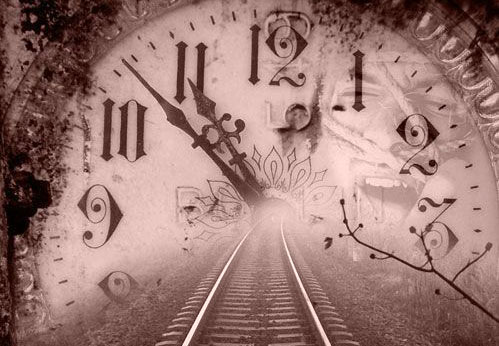
You can actually hear time passing. What’s interesting that you pick up from observing this is that there is really no such thing as right now, even though Val Halen had a popular song about it. In fact, Sammy Hagar’s lyrics were outdated before the ink probably dried on the notepad he wrote the lyrics.
Even saying the phrase right now takes a second, which inevitably creates a paradox in which you are both speaking of something from the past in the current and calling it the present.
Good and confused? Well, you should be. The passage of time has and will remain one of the great mysteries of our world.
Men and women have used it and abused it, wasted it and made the most of it for as long as we’ve inhabited the planet. While we’d probably think of the way we once lived as nomadic hunter and gatherers as naively barbaric , it could be argued that we are still barbarians, just a different kind.
We’re still hunting and gathering, only now, it’s consumption of things.
If you really want to see how fast the world moves, just go here, to the worldometers, a site that measure statistics on a variety of things.
In some areas, it is difficult to even comprehend “right now”. Just watch the birth rate. Or scroll down to the social aspects of the world. Look at how many Tweets are sent every second. The only thing that keeps up with both those categories is the number of CO2emissions this year – measured in tons, of course – and money spent on obesity related diseases. Or cigarettes smoked or world spending on illegal drugs.
Want to know about how fast – and what exactly moves quickest – here in the good ole United States? Then head over here, to usarightnow.com. Watch how fast these categories move: cans of coca-cola consumed, debt, revenue, spending on plastic surgery, text messages sent, energy consumed.
So we’ve never really figured out this whole “what to do with ourselves” quandary. How is our time best spent, and according to whom? I suppose it’s up to the individual. Some live for family, some for faith. Some for vacations, gadgets, objects. Others live for love – of person, of food, of money. Some live for their work and the task manager mentality of accomplishing something, even if that something isn’t all that well defined or, frankly, important.
Not everything holds the same value when measured by people or, perhaps even more intriguing, by time. It cannot, frankly, otherwise, we wouldn’t know what to appreciate. But that doesn’t mean what we value most is what we spend the most of our time on. Some argue because we can’t afford to.
I’d say based on things are going, we can’t afford not to.
According to most of the statistics, how we literally “spend” our time says all we need to know about us, as individuals and as a society. How we do our now will ultimately determine our later.
We want it all and we want it now.
We want quick fixes and short-term solutions to long-term problems. We want to feel good, so we buy whatever our drug of choice is: movies, music, food. And yet another minute, another hour, another day, month or year will pass and nothing actually changed. The feeling we get from all these things, is, like time itself, momentary and brief. And at the end of it, you have to wonder: what did I actually do?
We’re all about me. Then again, we always have been. There’s just more of us now.
Time just ran yet another story about another generation of young people who are all about themselves and how many people in older generations worry that they won’t be productive members of society.
Oh, but they will.
This story has been told and re-written many times, about Baby Boomers, Generation X, Y, Z and Millennials. As Elspeth Reeve so eloquently pointed out in The Atlantic Wire last week, this same argument has been pushed as a talking point for over a hundred years, with nearly every generation. And every time, eventually, the vast majority settle down and do what they are supposed to: get jobs, acquire debt, pay taxes and die.
It seems no matter where you look, you find people who are not content or happy with something. And that’s not a knock, we’re all human and we all want and desire and need. But based on what we spend the majority of our time on, none of it is worthwhile to us. Actions speak louder than words, as they say, right?
Who are “they” anyway? Who actually does instead of merely speak? If action is the greatest indicator of doing there is, if so many are sick and tired of so many things, why do we spend so much time talking about it all? Perhaps because, at a young age, we’re told to share our emotions and our feelings as a coping mechanism. “You’ll feel better if you talk about it.”
And so we are a society of talkers.
This runs contradictory to all that we, in societal terms, believe ourselves to be. Our collective and individual self-image and worth is higher than what we actually are, or how we are viewed by others. Basically, we think we’re great, but we’re not all that great.
Yet inherent within the fabric of our very being is the need and the desire for something more. This could be due to the fact that we’re not fulfilled in how we spend the majority of our time. With over 80 percent of the American population reporting they do not enjoy what they do, this can certainly be a large contributing factor to our sense of uneasiness.
It’s the constant pull between the benefits of the here and now versus the hazy, distant outlook of the future. It’s hard to picture the future and see anything but an older reflection of today, or better yet, yesterday.
Do we have the wherewithal and the focus to get past the right now, which we’ve already established doesn’t exist? There’s always another horizon, another horizon – until there isn’t and we’ve ran out of time.
The promise of someday is nothing more than an illusion that makes us feel our mediocrity is acceptable. To actually make someday today, to make our tomorrow, our vision for the future a reality does, in fact, require action. It requires care, focus and a formidable resolve to see it through.
Society has taught us – or impressed upon us through marketing and consumerism, that all things must occur fast. That speed equals good, that the quicker you get it, the happier you are. We should be mindful of wanting it all to happen now.
There’s good in the journey. There’s quality over a duration of time, a reminder that sometimes – often times – the best things happen over a period of time. Change typically occurs, for good or bad, slowly. Instead of just some picturesque idea or vision of what we dream and hope for, the journey and the determination to do it and actually see it through is the actual change.
Time is ever-fleeting. Not much is ever done or resolved right now, but rather in the moments long before and after it.
So what you do with your time only says and writes the history of you.
The world, as we know, will keep on moving – a grand machine where the numbers are ever changing. But even though they are measured the same – by the rate of time – they are not and do not have to be connected.
An individual’s life is theirs and theirs alone. So to what do we owe ourselves, as opposed to the world in general? Is what we do who were are, and if it is, are we happy with it?
Action speak louder than words.
So the next time you want to talk about how you feel, remember that’s fine. It’s good to get it out. In the end, however, the action you take determines what you truly mean (or don’t) what you say.
The hope and promise of the future will exist tomorrow as it did today and yesterday.
What are we doing right now that will make our dreams and goals of tomorrow a reality?
Tick, tock.
 worldbetweenlines.com