Today, many see Walt Disney World in Orlando, Florida as a vacation hotspot for the young and young at heart. And while this is most certainly true, it was going to be so much more.
Walt Disney had a vision when he purchased the roughly 47 square miles in Central Florida that would become Disney World. And it was an idea he simply had to try, simply because that’s what the man did.
 My family and I frequently travel to the “Vacation Kingdom” and every time a trip nears, I get caught up in researching what could have been, because there was something much more to the original plans than most realize: ideas that would completely revolutionize our world.
 It all began when Walt Disney grew disenchanted with what was taking place around Disneyland in Anaheim, California in the years following its 1955 opening. Really, you could go back further: Walt was inspired to do something different than what was because when he took his daughters to amusement parks, he found them to be unclean, unfriendly and solely built for short-term entertainment of children. Adults were basically relegated to the sidelines and the experience lacked a uniqueness to it.
And so he created Disneyland.
Yet soon after, the area around the park – which he couldn’t control – was seized by corporations looking to get their piece of the monetary pie. Hotels, fast –food chains, all searching to pull profits away from Disney. Completely fair in a fair market economy.
But that didn’t mean Walt had to like it. Believe it or not, Disney (the man) didn’t care all that much for profit. He’s the same man, who, during World War II, had his studios do nothing but American propaganda films at his expense, not the governments. He was nearly broke following the war. It’s a situation that happened time and time again during his life. He’d sink everything into an idea or a vision he truly believed in.
So Disney wanted more area mainly to control the environment around his ideas, and with Disney World, those ideas were so much bigger than fairytale castles and character-themed rides. Ever heard of the Experimental Prototype Community of Tomorrow? No doubt you would recognize Epcot (the current park in Florida), originally named EPCOT Center when it opened in the early 1980s.
It resembles nothing of what Walt had planned right up to his death in December of 1966. The purpose of Disney World was to create this experimental prototype city, this EPCOT.
Walt noticed what had happened around Disneyland in California was something happening everywhere, on a grander scale: hectic, disorganized and dirty cities riddled with crime, obsessed with materialism and not with improving humanity. He became obsessed himself, with community based planning, cutting edge ideas on cityscape and design.
So he used dummy corporations to buy up all the land he could in Central Florida to keep the media unaware. In phases, he would build what in hindsight was his means to an end. Maybe the world would think his World was crazy if it was simply about improving society, so he would first build a larger version of Disneyland (aka, The Magic Kingdom), some hotels and golf courses in order to make the money to do what he really wanted to do: essentially, the small ambition of changing the world.
The purpose of this Florida Project was to entice American corporations to come up with new ideas for urban living. Instead of having to battle them for profits, why not use the profits to better humanity. Walt described much of it in a film made shortly before his death.
“EPCOT will take its cues from the new ideas and technologies emerging from the forefront of American industry,” Disney said. “It will be a community of tomorrow that will never be completed. It will always be showcasing and testing and demonstrating new materials and new systems.”
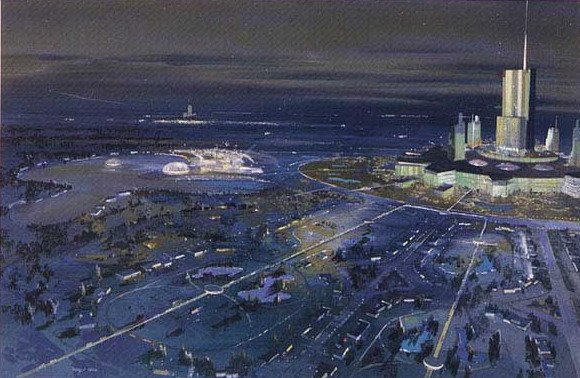
At the heart of it all was Progress City – a wholly new community with ideas that even 60 years later look futuristic and, frankly, downright amazing. Featuring a radial design (not a grid), an urban center with a green belt and an industrial park, it focused on people, not industry. Transportation would not include cars, instead there would be Monorails, PeopleMovers, and of course, walking. The industrial park would house the major corporations who would use the facilities and the city’s inhabitants to develop new technology for use of EPCOT and eventually, the world.
EPCOT was going to be so much more than what it became, and you can certainly find out more than is included in this space to satisfy your curiosity regarding its original plans. But what happened?
Well, essentially, Walt Disney died and the world went crazy.
After Walt passed away, the already skeptical board of directors slightly altered the plans for EPCOT, though the essence remained intact. The area that is now Downtown Disney was set aside to become the city of Lake Buena Vista, an essential arm of housing development for EPCOT and part of the outer core of Progress City. As late as 1972, six years after Disney died, his company was still moving forward with the majority of his original plans.
And then came the Oil Embargo of 1973.
The gas crisis meant a financial crisis, which permanently damaged those plans. Having opened to huge crowds in October of 1971, Walt Disney World was in its infancy when the Oil Embargo began. Suddenly, people couldn’t travel to Orlando to see Mickey Mouse. And if fewer people could travel, that meant less money spent at the park. Less money coming in means less money going out, less construction and completion of plans. Additionally, it meant fewer corporations willing to get involved with a project like EPCOT that would not be producing a financial windfall, even during strong economic times.

Lake Buena Vista was to be the starting point of EPCOT, but it would be nothing more than creative artwork. Coinciding with the embargo, with Walt and his financial wizard brother Roy both dead, the board began using outside influences, studies and research to look at feasibility, profit and loss and other mitigating factors.
Which is how, in October 1982, EPCOT Center opened with a giant geodesic sphere as its landmark – it had completely changed. Futuristic and a sight to behold, but mainly eye candy to those who connected tomorrow with future. Behind it laid greatly watered-down versions of some of the innovation and technology Disney had hoped for. Beyond that, a tribute to countries around the world. EPCOT Center became, in time, a cool and unique theme park, filled with great food, education and attractions.
But it wasn’t Progress City or an experimental prototype community of tomorrow.
You may find it strange to think of the man who invented Mickey Mouse and a theme park to, near the end of his life, be one of the last great idealists and innovators of the modern era, but it’s true that when Walt Disney died, part of our future did as well. The Walt Disney Company is still a leader in American corporate culture, and that itself is a tribute.
Innovation and ideas are worthwhile endeavors. We get so little of that now, which is even worse because maybe we had so little of it for so long.
As I have stated in this space before, we’re unknowingly focused on keeping the status quo in this country, and we should be embarrassed of ourselves. Building future generations to become employees and not entrepreneurs is a grave disservice. How do we know what we can do when we continue to do the same things we always have?
We’re taking away the ability and want of children to dream. We say it out of habit, that they can be anything they want or do whatever they want, but we don’t truly mean it because we then train them to be just like the rest of us – little mice nibbling at the cheese of corporate America, chasing small pay increases for material items that get us through the day.
And the Disney World that could have been inspires me to continue to try and forge a new path with my wife for our children, that they may carve a different path, a road less traveled, filled with possibility and unique vision.
Being different means taking on the biggest risks imaginable. It includes a little less logic and a little more emotion and passion. It requires unwavering belief, no matter how many family, friends or colleagues tell you it is crazy, who use their apathy and negativity to tell you what cannot be done.
It is easy to become influenced by these things. It is easy to listen to the research that tells you what won’t work – how do you know something cannot be done, if it’s never been done? How are we going to cultivate our next bunch of Edisons, Picassos, Disneys and Jobs by telling our children what we tell ourselves everyday: what cannot be done instead of what can?
The hope was that Progress City might break that cycle. Despite the odds, it came close to fruition. But it’s not enough to just plan, get halfway and then give up. That’s not any more American than the seedy underbelly of the area around Disneyland in the late 1950s. The best of intentions mean little without clarity and conviction.
We’re not just mice on a wheel chasing the cheese; we can get out of that cycle by forging new paths. However, someone has to follow through on these promises, these ideas, these plans. We can’t have people blinded by the power of money or the power of power. We can’t have elected officials who are afraid to lose office and just keep the status quo. We can’t just keep running for re-election, the same as we average Americans can’t just keep doing enough to pay our bills and slowly grow our debt.
Our mice wheels are the daily commute to the jobs we never dreamed of in our youth. We stuck in a rut, we Americans. A collective rut of dreary drabness devoid of dreams.
We must stop thinking of what cannot be. We must take the road less traveled in order to discover new things and cultivate innovation. We got here, to this point in history by sailing beyond the map, challenging held notions of time, space and location, traveling into the unknown, asking what could happen if I combine these elements, try this paint or draw this building this way?
It’s how, for thousands of years, we made a world that never was before a world that could be.
And ultimately, that’s progress. Pushing ourselves and our boundaries are dreams realized, but never fulfilled, always evolving, but never complete. Sound familiar?
You see, we were always an experimental prototype community of tomorrow. We can be again.
(Source material found at great sites like Progress City, USA and The Original EPCOT Project. These sites show great data, video, graphics and in-depth look at Walt Disney and his original plans. This post was intended to provide personal opinion on what occurred and how it came to be, as well as speculate on overall American innovation deterioration, using EPCOT’s original plans as a guide for future hope of continuing progress in this area.)
 worldbetweenlines.com