American culture, EPCOT, humanity, innovation, Progress City, The Florida Project, Walt Disney, Walt Disney World

The “World” That Almost Was


Today, many see Walt Disney World in Orlando, Florida as a vacation hotspot for the young and young at heart. And while this is most certainly true, it was going to be so much more.
Walt Disney had a vision when he purchased the roughly 47 square miles in Central Florida that would become Disney World. And it was an idea he simply had to try, simply because that’s what the man did. 
My family and I frequently travel to the “Vacation Kingdom” and every time a trip nears, I get caught up in researching what could have been, because there was something much more to the original plans than most realize: ideas that would completely revolutionize our world.
It all began when Walt Disney grew disenchanted with what was taking place around Disneyland in Anaheim, California in the years following its 1955 opening. Really, you could go back further: Walt was inspired to do something different than what was because when he took his daughters to amusement parks, he found them to be unclean, unfriendly and solely built for short-term entertainment of children. Adults were basically relegated to the sidelines and the experience lacked a uniqueness to it.
And so he created Disneyland.
Yet soon after, the area around the park – which he couldn’t control – was seized by corporations looking to get their piece of the monetary pie. Hotels, fast –food chains, all searching to pull profits away from Disney. Completely fair in a fair market economy.
But that didn’t mean Walt had to like it. Believe it or not, Disney (the man) didn’t care all that much for profit. He’s the same man, who, during World War II, had his studios do nothing but American propaganda films at his expense, not the governments. He was nearly broke following the war. It’s a situation that happened time and time again during his life. He’d sink everything into an idea or a vision he truly believed in.
So Disney wanted more area mainly to control the environment around his ideas, and with Disney World, those ideas were so much bigger than fairytale castles and character-themed rides. Ever heard of the Experimental Prototype Community of Tomorrow? No doubt you would recognize Epcot (the current park in Florida), originally named EPCOT Center when it opened in the early 1980s.
It resembles nothing of what Walt had planned right up to his death in December of 1966. The purpose of Disney World was to create this experimental prototype city, this EPCOT.
Walt noticed what had happened around Disneyland in California was something happening everywhere, on a grander scale: hectic, disorganized and dirty cities riddled with crime, obsessed with materialism and not with improving humanity. He became obsessed himself, with community based planning, cutting edge ideas on cityscape and design.
So he used dummy corporations to buy up all the land he could in Central Florida to keep the media unaware. In phases, he would build what in hindsight was his means to an end. Maybe the world would think his World was crazy if it was simply about improving society, so he would first build a larger version of Disneyland (aka, The Magic Kingdom), some hotels and golf courses in order to make the money to do what he really wanted to do: essentially, the small ambition of changing the world.
The purpose of this Florida Project was to entice American corporations to come up with new ideas for urban living. Instead of having to battle them for profits, why not use the profits to better humanity. Walt described much of it in a film made shortly before his death.
“EPCOT will take its cues from the new ideas and technologies emerging from the forefront of American industry,” Disney said. “It will be a community of tomorrow that will never be completed. It will always be showcasing and testing and demonstrating new materials and new systems.”

At the heart of it all was Progress City – a wholly new community with ideas that even 60 years later look futuristic and, frankly, downright amazing. Featuring a radial design (not a grid), an urban center with a green belt and an industrial park, it focused on people, not industry. Transportation would not include cars, instead there would be Monorails, PeopleMovers, and of course, walking. The industrial park would house the major corporations who would use the facilities and the city’s inhabitants to develop new technology for use of EPCOT and eventually, the world.
EPCOT was going to be so much more than what it became, and you can certainly find out more than is included in this space to satisfy your curiosity regarding its original plans. But what happened?
Well, essentially, Walt Disney died and the world went crazy.
After Walt passed away, the already skeptical board of directors slightly altered the plans for EPCOT, though the essence remained intact. The area that is now Downtown Disney was set aside to become the city of Lake Buena Vista, an essential arm of housing development for EPCOT and part of the outer core of Progress City. As late as 1972, six years after Disney died, his company was still moving forward with the majority of his original plans.
And then came the Oil Embargo of 1973.
The gas crisis meant a financial crisis, which permanently damaged those plans. Having opened to huge crowds in October of 1971, Walt Disney World was in its infancy when the Oil Embargo began. Suddenly, people couldn’t travel to Orlando to see Mickey Mouse. And if fewer people could travel, that meant less money spent at the park. Less money coming in means less money going out, less construction and completion of plans. Additionally, it meant fewer corporations willing to get involved with a project like EPCOT that would not be producing a financial windfall, even during strong economic times.
Lake Buena Vista was to be the starting point of EPCOT, but it would be nothing more than creative artwork. Coinciding with the embargo, with Walt and his financial wizard brother Roy both dead, the board began using outside influences, studies and research to look at feasibility, profit and loss and other mitigating factors.
Which is how, in October 1982, EPCOT Center opened with a giant geodesic sphere as its landmark – it had completely changed. Futuristic and a sight to behold, but mainly eye candy to those who connected tomorrow with future. Behind it laid greatly watered-down versions of some of the innovation and technology Disney had hoped for. Beyond that, a tribute to countries around the world. EPCOT Center became, in time, a cool and unique theme park, filled with great food, education and attractions.
But it wasn’t Progress City or an experimental prototype community of tomorrow.
You may find it strange to think of the man who invented Mickey Mouse and a theme park to, near the end of his life, be one of the last great idealists and innovators of the modern era, but it’s true that when Walt Disney died, part of our future did as well. The Walt Disney Company is still a leader in American corporate culture, and that itself is a tribute.
Innovation and ideas are worthwhile endeavors. We get so little of that now, which is even worse because maybe we had so little of it for so long.
As I have stated in this space before, we’re unknowingly focused on keeping the status quo in this country, and we should be embarrassed of ourselves. Building future generations to become employees and not entrepreneurs is a grave disservice. How do we know what we can do when we continue to do the same things we always have?
We’re taking away the ability and want of children to dream. We say it out of habit, that they can be anything they want or do whatever they want, but we don’t truly mean it because we then train them to be just like the rest of us – little mice nibbling at the cheese of corporate America, chasing small pay increases for material items that get us through the day.
And the Disney World that could have been inspires me to continue to try and forge a new path with my wife for our children, that they may carve a different path, a road less traveled, filled with possibility and unique vision.
Being different means taking on the biggest risks imaginable. It includes a little less logic and a little more emotion and passion. It requires unwavering belief, no matter how many family, friends or colleagues tell you it is crazy, who use their apathy and negativity to tell you what cannot be done.
It is easy to become influenced by these things. It is easy to listen to the research that tells you what won’t work – how do you know something cannot be done, if it’s never been done? How are we going to cultivate our next bunch of Edisons, Picassos, Disneys and Jobs by telling our children what we tell ourselves everyday: what cannot be done instead of what can?
The hope was that Progress City might break that cycle. Despite the odds, it came close to fruition. But it’s not enough to just plan, get halfway and then give up. That’s not any more American than the seedy underbelly of the area around Disneyland in the late 1950s. The best of intentions mean little without clarity and conviction.
We’re not just mice on a wheel chasing the cheese; we can get out of that cycle by forging new paths. However, someone has to follow through on these promises, these ideas, these plans. We can’t have people blinded by the power of money or the power of power. We can’t have elected officials who are afraid to lose office and just keep the status quo. We can’t just keep running for re-election, the same as we average Americans can’t just keep doing enough to pay our bills and slowly grow our debt.
Our mice wheels are the daily commute to the jobs we never dreamed of in our youth. We stuck in a rut, we Americans. A collective rut of dreary drabness devoid of dreams.
We must stop thinking of what cannot be. We must take the road less traveled in order to discover new things and cultivate innovation. We got here, to this point in history by sailing beyond the map, challenging held notions of time, space and location, traveling into the unknown, asking what could happen if I combine these elements, try this paint or draw this building this way?
It’s how, for thousands of years, we made a world that never was before a world that could be.
And ultimately, that’s progress. Pushing ourselves and our boundaries are dreams realized, but never fulfilled, always evolving, but never complete. Sound familiar?
You see, we were always an experimental prototype community of tomorrow. We can be again. 

(Source material found at great sites like Progress City, USA and The Original EPCOT Project. These sites show great data, video, graphics and in-depth look at Walt Disney and his original plans. This post was intended to provide personal opinion on what occurred and how it came to be, as well as speculate on overall American innovation deterioration, using EPCOT’s original plans as a guide for future hope of continuing progress in this area.)
Standard
Bob Woodward, Congress, President Barack Obama, Sequestration, United States, US government

The Real Sequestration


Let’s play a game of word association.
Sequestration.
Diversion. Mirage. Trickery. Congressional. Presidential. Needed. Unnecessary.
All are true, depending on your point of view.
But better yet, perhaps we start with this: do you even know what sequestration is? Chances are, you’ve heard of it, incessantly so, the past several days. You can get a quick synopsis of sequestration here.
Basically, a deal was made 18 months ago to withhold federal funding programs of domestic and military nature. They put a clock on it, drew a finish line well past election day and then decided to deal with it later. They thought it would draw action.
Yet once again, our elected officials are in office to bicker with each other back and forth in the media. It’s Armageddon in nation’s capital again. And all we see is finger pointing. The White House blames the Congressional Republicans, the GOP blames the White House. Meanwhile, the people who put them all there sit and watch as our so-called leaders squabble like six-year-olds on a playground.
Actually, that’s probably not fair to six-year-olds.
We deserve more. We deserve better. We deserve, well, anything.
This is not a call to arms for the conservatives or an endorsement of the left. This is simply a plea from the American people. You have to know it’s bad when a famed journalist calls out the President in The Washington Post.
That’s what happened Sunday, when Bob Woodward – yes, that Woodward – did the journalistic duty of reporting fact. He pulled back the curtain and showed how this particular issue of sequestration was the brainchild of the White House. Yet he also did the journalistic duty of showing how Congressional Republicans had played a large role in this issue as well.
In a different time, this would be a good thing. But it’s not a different time. It’s America, present day, and we’re a bunch of self-righteous jerks. The left is shaming Woodward for basically outing President Obama following the POTUS outlandish claims that the Republicans were taking a meat clever to America. The same Bob Woodward who broke Watergate wide open and helped bring down President Nixon. He ought to have a lifelong pass from Democrats.
Apparently not.
Meanwhile, conservatives didn’t just point to Woodward’s column and use it as simple leverage to gain a political advantage behind closed door negotiations. No, no…that would be too old school, too classically political. The right used Woodward as ammo for the war – overused it in fact – and then mocked Woodward even in praising him for telling the truth.
Who could survive in a town like this? Better yet, who would want to?
Many of us were inspired in our own way growing up by our presidents and national leaders. Their speeches weren’t just rhetoric, they were a tactical plan wrapped in poetic text. Now, they are just speeches.
We’re not that dumb. We’re disinterested. We’re tired of the bickering and frankly, it’s confusing us.
A recent poll suggests….I don’t know what it suggests because it’s all over the map. 56 percent of the country thinks Republicans are out of touch, 46 percent think the Democrats are, 52 percent think Republicans are extreme, 39 percent think Democrats are. So one party is more or less crazy than another? Based on phone calls to 1,500 people over a three day span?
Politicians love polls. It allows them to continue to blame others, spin the data and distort facts, except when it’s obvious they are also viewed poorly or just plain wrong – then they paint themselves as Washington outsiders and just blame Washington.
It’s diversion. Trickery. Fiscal cliffs and sequestrations.
What are they doing? What are we doing? You know why the military industrial complex is upset over sequestration? Because it takes massive piles of increasingly worthless American money to build its equipment.
Democrats care about federal program cuts because the majority of the people who elect them receive money from those cuts. And it’s base is a wide conglomeration of groups with varying interests.
Republicans care about tax rates because they are elected by small business owners and others who’ve made incomes they don’t want to see even more taken out of. So when the White House demands programs to satisfy their base, the Republicans push back because they are defending their base.
And so no one does anything truly for the good of the people, but merely to hold on to what they have or gain more. In the end, it’s always about the money.
Folks, it’s just paper.
It only has value because somewhere, sometime ago, it was determined it held value. We could all agree to use buttons and M&Ms as our currency, it just has to be backed by something. I suppose this is human nature, but at some point, we’re going to break the ties that bind us.
As I have stated before, this must be how Rome fell – from within. From greed. From power derided by consent but without consent.
Befallen by diversion. By trickery. Needed, but unnecessary.
Destruction is happening to our formerly strong foundation. It won’t happen in a day, yet it is ever-occurring due to our insatiable thirst for conquest. We’ve defeated our enemies, so let us defeat each other.  
Our great sequester began long ago and only the American people as a united whole, willing to agree to disagree – clearly – can be the ones to set us right again.
Standard
Dwight Howard, Kobe Bryant, Los Angeles Lakers, Mike D'Antoni, NBA, Orlando Magic, Phil Jackson, Shaquille O'Neal, Stan Van Gundy

Howard’s Hotel California


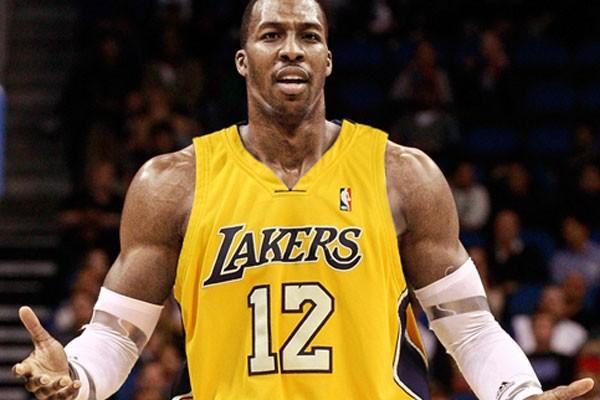
Dwight Howard never wanted the Los Angeles Lakers. 
He knew he would never match up to the expectations, the history, the legacy. Yet true to his personality, Howard smiled on the outside in the preseason following his trade from the Orlando Magic to the Lakers. He said mostly all the right things, mostly because there’s no way he’d say the wrong things.
Howard told us he wanted to win a championship. As opposed to telling everyone he doesn’t? And that’s the thing with Howard: his actions have always spoken louder than words.
From arriving as such a fresh-faced teenager who spoke about his Christian faith and all that he hoped to accomplish until this moment, wearing the famed Lakers purple and gold nearly a decade later, Howard’s hopeful words have never changed.
He always says what you want to hear, you just can’t tell if he believes it or only says it because he longs to be liked.
Howard had it all in Orlando: a small-market team that embraced him as Shaq The Second, willing to let him run the roost and act like a kid, because, that’s what he was. 
The Magic had a coach in Stan Van Gundy who exhausted all options in making Dwight’s strengths obvious, while hiding his weaknesses. Van Gundy protected Howard, both on and off the court. He defended him in the media. He surrounded him with shooters.
In Orlando, it was all about Dwight – and mainly only the good parts. Taking cues from Disney World just down the street, it truly was Dwight’s Magic Kingdom.
Just four short seasons ago, it looked like it couldn’t get much better: there was Howard, strong, agile and dominant in his own way, the centerpiece of a team that reached the NBA Finals. 
In retrospect, Stan Van Gundy did more for Dwight Howard that even Dwight Howard. 
Van Gundy put Howard at the rim, drawing defenders and creating a defensive scramble that forced help and freed up shooters like J.J. Redick, Courtney Lee, Hedo Turkoglu and Rashard Lewis to fire away or attack the rim themselves. Throw in Jameer Nelson and Mickael Pietrus, the Magic had athleticism, shooters and tons of ball movement.
It was perfect for Howard, who was allowed to control his environment, in the middle of the paint, and took the spotlight off his offensive weaknesses, like creating his own shot, developing a mid-range jump shot or a series of post-moves.
But nothing lasts forever. And everything ends badly or it wouldn’t end. Yet it’s still perplexing why exactly Howard grew so sour on Orlando. Or on Stan van Gundy.
Howard got SVG canned and himself traded out of town. He was indeed the second coming of Shaq in that regard, but nothing like him on the court. Which is why following Shaq’s path to L.A. is a big problem.
The Lakers are the complete opposite of the Magic, and it shouldn’t take much knowledge of professional sports or the NBA to know that. The Lakers are the Yankees of pro basketball, and therefore, everything is magnified. Every comment, every missed free throw, every loss and win. Howard’s worn out on the drama already – and we’re barely 50 games into his stay in L.A.
This could be Heaven or this could be Hell for Howard. If he committed himself to the Lakers, it would end part of the merry-go-round and media circus. But he only perpetuates it with his non-committal attitude. He thinks he’s being coy; he’s just being annoying to Laker fans and the media.
Likewise, it could be heavenly if Howard would develop the parts of his game that were masked by the Magic and Van Gundy. But he hasn’t shown signs of improvement and remains very limited offensively. You still have to have Howard close to the rim to be effective. You can’t just toss him the ball in the post and let him go to work. He’s not Shaq. He’s not Ewing, Mourning or Olajuwon, gifted big men who could score in a variety of ways.
Howard doesn’t need to shoot threes, even though he likes to joke about it. None of those guys did. But he’s got fewer offensive capabilities than Dikembe Mutombo. Howard’s also missing something else nearly all of the great and dominant centers have had: a mean streak. All of the best go into beast mode, where they physically take over games, snear and mean mug it down the floor, their presence known and felt. Howard just smiles, afraid that someone won’t like him.
So instead of being the awesome match everyone assumes it will be, it’s been Hell so far for the Lakers and for Howard. It’s exacerbating all of his flaws: his need to feel wanted and loved, his limited offensive ability, his cloak-and-dagger comments about the future.
Yet truthfully, the Lakers didn’t lose out on this trade, even if Howard doesn’t stay. The guy they traded, Andrew Bynum, has lost his knees and his mind (seriously, check out his hair). Bynum hasn’t played this season for the Philadelphia 76ers, and might not ever be what he once was – which was the No. 2 big man in the NBA.
And there’s the point: the Lakers needed to find someone to transition the face of the franchise to once Kobe Bryant retires. Howard could be that guy. And they didn’t really give up much to get him. If it doesn’t work out and he bolts town, then at the very least they have cap space to spend in 2014 on some other big name free agent.
Trust me, someone will want to play in L.A. and take over after Kobe is gone. The Lakers biggest mistake was in choosing Mike D’Antoni over Phil Jackson (which is still too weird to talk about). Jackson certainly would have made this work better and Howard would be more apt to stay. Then again, Jackson wouldn’t have stayed as long as Dwight, so you’d be right back here in a few years anyway.
Howard is an enigma, perhaps even to himself. He doesn’t know what he wants, and perhaps when he does, he’ll be too old to use it. He’s looking for what he already had and in the process of doing so, he’s created a beast, fed daily by the overactive L.A. media. But just like the Eagles sang, you just can’t kill the beast. This thing has spun out of control now.
Mitch Kupcheck says he’ll stand firm, that he won’t trade Howard today and that Howard will be another in a line of legendary Lakers.
At least someone believes that. At least someone wants that.
Problem is, it’s not the guy the Lakers need wanting and believing it.
Problem is, Howard can’t get out so easy now. There’s too much money on the table. Too much damage to Howard’s rep should he leave another team when times got tough. And that, for many reasons, matters to Howard. He may want things a certain way, but it goes hand in hand with being liked. You’re not well liked when you bail on the league’s marquee franchise, not when nearly everything for your future and the team’s is set on you. And he’ll have about $30 million extra reasons to make it work.
Howard just really hoped he would be able to recreate the magic he had with the Magic in some nondescript, less pressure-packed place like Dallas, Brooklyn or Atlanta, where he’d be revered as a much as he was for his first eight years in Orlando. But this is the Lakers. They focus on winning banners, not the happy pursuit of them.
In a way, he really did find the Hotel California.
Howard is caught looking for a passage back to the place he was before, and while he can check-out, he can’t really ever leave.
Standard
Arizona, Duke, Ed O'Bannon, Indiana, Jeff Sheppard, Mike Krzyzewski, Miles Simon, NCAA College Basketball, North Carolina, Rick Pitino, UCLA

The State of College Basketball


College basketball fans, media pundits, NCAA regulatory members, and hoop junkies from sea to shining sea:
A few days ago I had an interesting conversation with a friend. It began with a question: in your opinion, what was the greatest period of college basketball? Our answers aligned: the 1990s to early 2000s.
For some time, we recalled some of the great teams and players from that era of amateur roundball, of which there are far too many to name here. We lamented, with that nostalgia in mind, how over the past decade we have become bigger fans and followers of the pro game than of college basketball. And we wondered where the game was headed from here, this point, with no truly great teams.
But to identify the state of college basketball is to essentially begin with why that is so.
On its surface, the college game seems to be maintaining the foundation that was built so long ago. If we were to name some of the top teams and coaches from those glory years of the 1990s and early 2000s, we would find many of them still thriving near the top of the collegiate ranks: Indiana, Michigan, Duke, Kansas and Arizona. And the NCAA Tournament remains as exciting as ever, with surprises coming each year that no one can foresee, lovable underdogs like George Mason, VCU and Butler.
Hereto with, attendance and viewership remains high: the NCAA Tournament commands record crowds and audiences, as well as massive TV contracts, where now you can view every NCAA Tournament game between partners CBS and Turner. And look at the atmosphere created at campus’ all around the country, like Indiana, where Bloomington was bursting with energy and enthusiasm – enough to make Dick Vitale blush – prior to the Hoosiers showdown with then No. 1 Michigan on Feb. 2.
It is a testament to the love and devotion of college basketball around the country. At a time when so much about sports seems to let us down, from performance enhancing drugs and contract disputes to petty personality conflicts and illogical ways of determining a champion in the other big college sport (to be clear, we are talking about you, BCS), college basketball remains a sport filled with unified team ambition. Players and coaches focus on the mission at hand, working together towards a common goal of a tournament bid, a conference title, a Final Four run. 
There is something about the one-and-done playoff format of college basketball that will forever hold its grip over the NBA and the institution of the seven game series. Are you good enough to be the best, on one night, in one shining moment? Coaches hold a much greater aura of respect and authority than they ever could in the pro game. In other words, they seem to have a point.
Yet there is still something unsettling about the state of the college game. Something is missing.
While college basketball will go on, its transfixing hold on us might continue to dwindle without proper intervention. Thus, today, we lay out our plans of prosperity for the game.
First, we must no longer dance around the issue of prep-to-pro eligibility. The “One and Done” is a silent killer of the unspoken pull we have to the college game. Imagine if Kentucky returned all their players from last year’s championship team, combined with this current team? Could they threaten Indiana’s 1976 undefeated team? How many schools would be dominant with more players in school than in the NBA? Thusly, how many great games would we have on a week-in, week-out basis?
Part of the reason the 1990s and early 2000s were great is that the teams were deeper. Think of those Duke, Arkansas, Kentucky, Arizona, North Carolina and Kansas teams that were so loaded during that period. And once one of those schools lost a couple seniors and a junior, another loaded, talented team was ready to take the mantle. Kentucky played in three straight championship games between 1996-98, with rosters that overlapped, yet changed completely.
From the Untouchables in 1996, with Antoine Walker, Ron Mercer, Derek Anderson, Walter McCarty, Tony Delk and Jeff Sheppard – and so many more – to the 1997 runner-up team (that lost the title game in OT) featuring Mercer, Anderson, Anthony Epps, Scott Padgett, Wayne Turner and Cameron Mills on to the 1998 team with Sheppard (back from redshirting since the team was loaded), Turner, Padgett, Mills, Allen Edwards and Nazr Mohammed.
Nearly all went pro, but there was just a slew of talent that passed through that program from 1993 to 1999, and even if some only stayed two seasons, like Mercer and Walker, those that stayed three of four were the continuity that bred basically a dynasty.
That’s just one program. Duke seemingly went to every Final Four over a 15-year period, won titles in 1991, 1992 and 2001 – they nearly won the 1994 title as well – with an abundance of talented and memorable players like Grant Hill, Christian Laettner, Bobby Hurley, Shane Battier, Trajan Langdon, Rashawn McLeod, North Carolina featured talent like Eric Montross, Rasheed Wallace, Jerry Stackhouse, Vince Carter, Antwan Jamison and Shammond Williams over a period of 1993-1998. Final Four appearances in 1993, 1995, 1997 and 1998, and the National Championship in 1993.
And here was Arizona’s talent, from about 1994-2003: Damon Stoudamire, Khalid Reeves, Miles Simon, Mike Bibby, Michael Dickerson, Jason Terry, Richard Jefferson, Jason Gardner, Gilbert Arenas, Luke Walton, Salim Stoudamire, Hassan Adams and Andre Igudola. Three Final Fours, two title games, one NCAA Championship (1997).
That’s barely scratching the surface: Michigan’s Fab Five, Indiana’s early 90s reign atop the Big Ten, Purdue’s streak of conference titles, Michigan State’s loaded rosters and Final Four appearances – and we haven’t even mentioned the Big East, with Syracuse, Georgetown, Connecticut (titles in 1999 and 2003). Or Stanford’s rise from 1996-2002 that challenged Arizona in the Pac-10. Or Florida’s budding program that led to back-to-back titles in 2006 and 2007, or Michigan State’s loaded rosters and Final Four appearances, or Maryland taking on the big boys of the ACC and winning the 2002 title.
And I did all that from memory, without looking up a single player – not to prove I could, but because this was the era where even the best of the best went to school, at least for a little while. It’s most likely not even a full or comprehensive list. Undoubtedly, I am missing names and teams.
Now, many will see this as a plea that players stay in school, to which I would argue is a misplaced objective.
No, my fellow basketball fans, we may never see that era of hoops at the collegiate level again. Because the truth is, I can’t name more than 25 current college basketball players, and I feel like I’ve watched my fair share of games over the past three or four years. But we’re doing a great disservice to the game in general by waffling back and forth on this issue of age.
Either pressure the NBA to institute a new rule where players cannot enter the league for two – or even three – years post graduation, or lift the restriction altogether, allow them to go to the NBA directly out of high school, yet adding the caveat that if you choose to enter college, you cannot be drafted for two or three years.
Second, we’re stripping the fabric of college basketball and college sports completely away with conference realignment. It is an abhorred tragedy that the Big East will soon cease to exist. The Big Ten is now the Bloated 14, with the additions of Nebraska, Maryland and Rutgers. Syracuse in the ACC? Utah in the Pac-10, er, 12? Texas A&M in the SEC?
We are losing our rivalries, which are the underbelly of college basketball. No Syracuse vs. Georgetown is like no Indiana vs. Purdue, no North Carolina vs. Duke. Rivalries made college basketball what it was, what drove it to greatness. I remember just as much from our golden era in-conference games and tournaments as I do NCAA Tournaments. Big Monday and Super Tuesday on ESPN, Pac-10 Thursday nights on Fox Sports West, SEC and Big 10 games on Saturday and Sunday afternoons.
These are the ties that bind. Yet everything has a price, and for the right price, we’ll dissolve any institution? That is, except for the institution of the NCAA, right?
Money and the NCAA transition nicely to our next critical item: the student-athlete.
Tell me, dear citizens of Krzyzewskiville, Rock, Chalk Jayhawk and so many college basketball villages coast-to-coast, how much is someone a traditional college student if they practice, travel and play games late at night during the school week? You’ll hear some folks tell you stories that illustrate that this was always the case, but what would be omitted is that due to said conference realignment, teams are crossing multiple states and time zones to play now.
How quickly can Iowa get back from a Tuesday night game in New Jersey? Miami to Syracuse? Nebraska to Maryland? The season lasts from mid-October through March, meaning student-athletes can completely focus on the student part for about six weeks at the start of the year and six weeks at the end of the year.
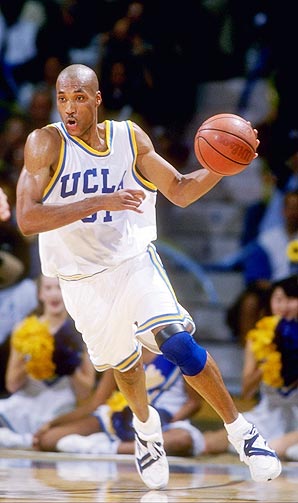
Perhaps – just perhaps – it is time to begin to turn a portion of the proceeds over to the student-athletes. And maybe not during school, but as the case of Ed O’Bannon (former UCLA great who led the Bruins to the 1995 title) vs. the NCAA proved, if you are going to use someone’s name and likeness that long after they were a student-athlete, then perhaps some of the money earned from doing so should be shared.
In 2011, the 31 conferences that received automatic bids received $180.5 million, which is then divided by the number of games each conference played over a six-year period. Each game is worth $240,000. Which meant a conference like the Big East, which played 109 games over the span of 2005-2010, took in $26.1 million. According to Forbes, by 2017, one game in the NCAA Tournament will be worth roughly $377,369 and a single game played in 2012 will have accrued a gross value of $1.9 million.
Quite a deferred play by the NCAA. Now, isn’t that just the way Dr. James Naismith drew it up?
We get confused on the numbers, when really, the battle was technically over whether or not they should receive anything but school expenses? That’s the definition of a full-ride scholarship. The NCAA simply muddied their own waters by introducing the stipend, and upping it to $300 is laughable – not because it’s only $300, but because this is the line, apparently, between heinous evildoers of sports and the kind and gentle NCAA bylaws?
What’s the difference again? Morals and ethics are being defined by the very people who make the rules here. Simply put, if any amount of money changes hands, it’s pay for performance, now we’re just arguing over fair market value.
As crafty as the “most of us go pro in something other than sports” slogan is, it doesn’t mention that most student-athletes name and likeness are used for profit over not just a college or conference, but a sanctioning body. The NCAA is like the bank in monopoly, except no one ever hits Free Parking.
Does this open a can of worms? Maybe, but no more so than continuing to use an outdated term like “student-athlete”.
Which brings us back to the beginning. The very era we hold near and dear began this battle cry and pulled back the curtain.
As Charles Pierce wrote about on Grantland.com last week, it was the Fab Five at Michigan who hand-checked the NCAA on this matter. As the university used Chris Webber, Jalen Rose, Juwan Howard, Jimmy King and Ray Jackson in the ways of advertising that would make Mad Men proud, the players started asking questions.
Fast-forward to the present the NCAA is dipping it’s pen in company ink: allowing for video games to feature the name and likeness of players, who’s video game counterparts wearing the same jersey numbers additionally feature similar skills to those of the real athletes.
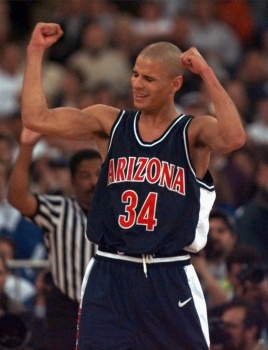
You’re telling me it’s happenstance that USC’s QB #3 from the 2003 NCAA Football game was right-handed, white and had a similar throwing motion, to, say, Carson Palmer…who wore No. 3, was right-handed and white. It’s one thing to tell the players to keep the amateur in athletics, quite another to use them for profit on merchandise. When I was a kid, I didn’t just want an Arizona jersey – I wanted Miles Simon’s #34 jersey, Jeff Sheppard’s #15 or Steve Wojciechowski’s #12.
There was no coincidence.
It’s not a matter of should that player get a percentage of those jersey sales after their time in school is done, but how. As others have suggested recently, just put it aside and allow the athletes to have it after they leave school. That way, they aren’t getting paid while in school and under scholarship, but it could be a graduation present of sorts, a thank-you for all the money generated by you and your achievements, notoriety and skills while in college.
And so, my fellow basketball fans, the state of the college game is like a double-digit lead: a mirage. All looks fine on the scoreboard, but the momentum has shifted and a sea change is taking place.
We can either embrace this and embark on a new path which will benefit us all in terms of fairness and product, or we can continue to keep our head in the sand as our great sport falls further into the overall sports abyss. But this game will still be pure, still provide joy and opportunity as long as we remain united in common purpose and intent, as long as we maintain our resolve for logic and realize that moving forward can bring us closer to the glory of the past.
The state of college basketball is at the line with a one-and-one opportunity.
Let’s make them both.
Standard
Dwight Howard, Kobe Bryant, LeBron James, Los Angeles Lakers, Miami Heat, Mike D'Antoni, NBA, Pau Gasol, Phil Jackson

Showcase Showdown?


Now that football has entered hibernation period, and just before baseball begins its long warm-up to a long season, there is basketball of the college and professional variety to help us pass our weekend time.
And while the amateur ranks of college have produced a wildly entertaining and wholly unpredictable state of affairs, with the nation’s No. 1 ranked team losing each of the past five weeks, the NBA hums along toward its mid-way point with little surprise in its pecking order. As usual, you will find the San Antonio Spurs, Oklahoma City Thunder, Miami Heat, and of course, traditional powers like the Los Angeles Clippers and Indiana Pacers.
Wait, what’s that you say? The Pacers and Clipper aren’t traditional powers? You wouldn’t know the Pacers had won 15 straight at home until Friday night’s loss to the plucky Toronto Raptors. Hell, you may not remember Canada still has a team. Or that the New York Knicks – yes, the Knicks – have the second best record in the Eastern Conference, or that the Chicago Bulls are hanging around and doing pretty good without former MVP Derrick Rose, still out because of his knee injury suffered last year.
You might not know the aging Spurs are 40-12, and have only lost two home games all year or that the Golden State Warriors are an emerging young team out West.
But as a casual fan coming out of a football coma wouldn’t know these things because no one is talking about them.
It’s all Los Angeles Lakers, all Dwight Howard, all Kobe Bryant and all the time.
The Lakers are a 24-28 team – good enough for 10th place in the Western Conference. They are old, injured and plagued by infighting. As I highlighted a few weeks ago, they aren’t really worth watching. Yet I couldn’t turn down the chance to watch at least a little of the ABC “Sunday Showcase” game featuring the Lakers at the Miami Heat.
For three-and-a-half quarters, the game was competitive and close. And then the Heat blew the Lakers doors off in the final six minutes before winning 107-97. Eric Spoelstra out-coached Mike D’Antoni, LeBron James continued to outplay everyone and Kobe Bryant tried to will his team back in the game, even as a five or six-point lead felt insurmountable.
You could glean several things by just watching the second half, where the Lakers couldn’t keep pace and allowed the Heat to score 29 in the final stanza. Even more telling – the Heat outscored L.A. 25-16 the final nine minutes.
First, LeBron James has no peers right now. It’s all come together and he’s at the peak of his prime. Google “LeBron James” and “shooting streak” and you’ll get a good idea of why. Efficient doesn’t even really begin to describe what James is doing, shooting 75 percent on his last 65 shots. He just broke the franchise record with five-straight 30-point games as well.
It’s a reminder of when Michael Jordan was in the midst of his reign of awesomeness: the only way James won’t win another MVP is if, much like Jordan, the voters get tired of it. No one else should win. He’s just that good.
The second thing you’d notice from yesterday’s game is just how dysfunctional the Lakers truly are. Steve Nash looks like a broken man who regrets agreeing to this trade. When they showed a close-up of his face, I pictured him with a thought bubble over his head: “I really think losing in Phoenix might be better than this.”
And for as great as Kobe is, as he himself has admitted recently, he is a difficult player to play with. He clogged up the offense good and gross down the stretch Sunday, using an array of back-to-the-basket moves, faders and leaners, appearing to me like a guy who’s legs were fading. This is understandable considering the Lakers were completing their long annual Grammy/Eastern road trip with the game in Miami.
Maybe Kobe was just tired. But he looked like a guy who was old, the one who’s shots at the end of the open gym are bouncing around the rim four or five times and falling out. And with each passing possession, his teammates are less and less interested in watching the same show. Keep in mind, Kobe’s heroics were half the reason the Lakers were even in the game midway through the fourth quarter, but the outcome was all too familiar: another loss.
We haven’t even touched on Dwight Howard (frankly because everyone else spends too much time on him). But Howard’s either not right physically, disengaged with all the drama mentally or most likely, a little bit of both. This week alone featured another round of media clips of Kobe calling out Dwight, Dwight responding and even Dwight’s dad getting involved to take a shot at Mike D’Antoni for not stopping it all.
But forgetting all that drama, the Lakers lack scorers, speed and aggression. They have no bench. There’s relatively little that’s likable about this team on our off the floor.
The Heat play, as do many of the aforementioned teams, with a sense of aggression and attitude. The Lakers have only Bryant with that mindset. Pau Gasol, currently out 6-8 weeks with a foot injury, attacks once every three weeks. Dwight Howard shows more aggression in trying to make his teammates laugh than he does on the court. Howard has one of the most forgettable 15-point, 9-rebound games I can remember. Howard ought to be getting 20 and 10, every night.
The Heat have let our out their inner beasts, the Lakers their inner child.
It’s clear the Lakers made a mistake in not bringing back Phil Jackson, who’s perhaps the best there ever was in the professional ranks at bringing massive egos like Howard and Bryant together under a common goal, while nurturing bruised ego’s like Pau Gasol’s and crazy-in-the-head egos like Metta World Peace/Ron Artest.
What does it say about Mike D’Antoni that the Knicks were a mess during his time in New York, yet a year later, they have the second best record in the Eastern Conference and seem to be playing quite well together? All you need to know about D’Antoni is what he said following the game yesterday: “We’re making strides. We can still do this. [Miami] set the bar and this is where we got to get to.”
I suppose I don’t know what I expect D’Antoni to say. I really don’t expect that truth, which would be: “We’re horrible and we really aren’t getting better. We should be left alone to become an afterthought on what has been a compelling and entertaining NBA season.”
He can’t and won’t say that, I know. But it’s outlandish to think the Lakers are making strides. Or that they are close. Not only can this team not win a championship, it shouldn’t out of sheer principle.
But sadly, this won’t go away. They are the Lakers. It’s 2013. The media cannot not hammer this story, this team, even though there is more going on in the NBA than this mess. So I beg of you, turn on NBA TV, check out some other games this week and then All-Star Weekend. You’ll find so much more going on in the NBA than what you might have seen Sunday from the team in purple and gold.
Otherwise, March Madness won’t just be reserved for the college ranks, as I’m not sure how much more of this ongoing soap opera in L.A. we can take.
It certainly was a Showcase Sunday for both James and the Heat and Kobe and the Lakers.
Yet only LeBron and Miami can feel good about what’s on display.
Standard