 What do we know of legends?
They are narratives of human actions that are perceived, by both the teller and the listener, to take place within history and to possess certain qualities that give the tale some sense of probability. Basically, the legend has to feel real to both the teller and the listener.
And most legends we hear of tend to fall into a realm of both believability and uncertainty, never being entirely believed by all involved, but also never completely doubted, either.
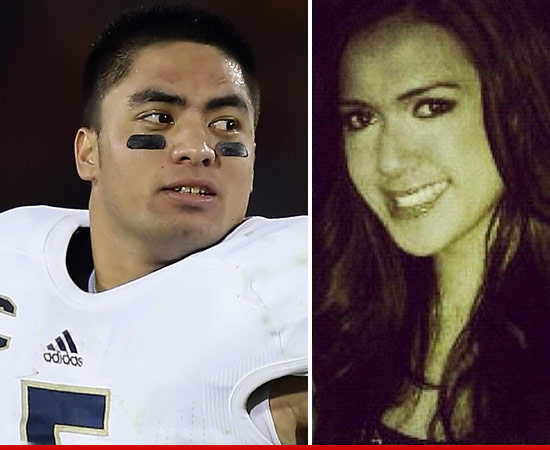
This seems like a good time to mention that it was revealed Wednesday afternoon that Notre Dame All-American and Heisman runner-up Manti Te’o has either been a victim of a massive hoax or a party to it.
According to Deadspin.com, the story that captured a nation last fall, where Te’o’s grandmother and girlfriend both passed away within hours of each other on September 12, spurring Te’o to emotionally guide Notre Dame to an undefeated regular season, was not entirely, well, true.
This is the stuff of legend. And not the kind we’re happy to pass on through the generations.
The details are still emerging. With each passing hour Wednesday afternoon, new – and exceedingly weird – details came to light.
A hoax. A dead girlfriend who wasn’t really dead, who furthermore wasn’t really real. Rumors of either plotted connections to Te’o or from people he seems to be acquainted with. Videotape evidence and published articles and columns which contradict each other. Conspirators almost begging to get caught through Twitter feeds in December.
There isn’t enough room to dive through all of it here, but you can read the Deadspin.com article and the follow-up on ESPN.com to get caught up or review.
What this blog does is look at the angles, the shades of gray and searches for reasoned answers through all the nuance of a story, trying to draw a narrative.
Yet this is difficult.
There’s really only two outcomes: either Te’o is a gullible victim of an odd and well-executed hoax that rocked him to his core or he was a disgraceful and participating piece of a hoax that in the worst possible way garnered sympathy and publicity.
Either way, there are so many questions, it is hard to determine which version is the truth. If Te’o was a victim in all this, our first option, then why did he feed information to the media that seems to contradict his latest comments?
In his statement, Te’o said he had a phone and online relationship with Lennay Kekua. Yet in published articles and interviews, there’s a narrative of Te’o having met her years earlier after a game at Stanford, where Kekua attended. How can she be the most beautiful person you’ve ever met, if you’ve, well, in fact, never met? (And yes, the above is a link to a page from the South Bend Tribune where that story has now been removed.)
How can you develop such an emotional bond with someone on the phone and through social media? Perhaps it’s fair to assume that the generation behind me, a technology inclined generation, can believe they feel these things because in many ways they do.
All I know is that, I too, spent two or three hours per night talking to the woman who is now my wife throughout the early part of our courtship. But I also saw her, in person, nearly every day. I met her family, she met mine. The things we told each other about the other checked out because they were visible to all our senses: I could see and touch and feel her life, her history. Pictures, real relatives, etc. This deepens any relationship.
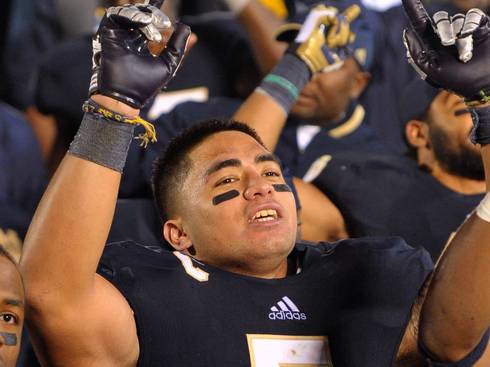
But to hear Te’o speak so candidly with reporters in the weeks following Kekua’s death, you’d have been led to believe they spent time together – and not just in a virtual sense. And no matter what generation you are a part of, that’s hard to square away, that you can feel so much for someone you’ve never met face-to-face.
Just last month I wrote about how we’re slipping away from real and meaningful communication with one another, replacing it with technology and removing true emotion. If this narrative on Te’o is true, and he fell for this woman so hard, without meaningful contact with her, then it’s only further proving this discourse.
Then, there’s the bit of a guy who supposedly created her Twitter account and made this relationship look legit who might have a connection with Te’o prior to all this. Again, that doesn’t solve the mystery of who Te’o was talking to for four hours, every night, for four months – as he told ESPN in an interview in October.
He either embellished that to make himself sound better, or made it up as a party to this plan.
There are phone records. This can be checked out – and maybe it will be. If there are two people out there who perpetuated this hoax, they can probably be tracked down through IP addresses, GPS, phone records. But what kind of commitment and how evil do you have to be to do this to another human being? Evading Google image searches by stealing, then ever so slightly altering pictures of someone else – that’s not clever, it’s just weird.
Certainly there is more to this option, but in the interest of pulling these threads together, let’s look at option two. It’s much more dastardly and deceitful. Many are hammering Te’o in all media outlets and social networks right now, and many are asking for reservation before making a judgment.
But it is not hard to say that if Te’o was a party to this hoax, it’s one of the more despicable acts I’ve heard of. What it to garner sympathy for Heisman votes? Was it to gain more publicity? He was already a well-regarded linebacker and by all accounts, a man of faith and integrity. Why risk that? Why through that image away? To what point and purpose does that serve?
Perhaps, if this option is true, Te’o is lonely. It’s not a sexy plot line, but plausible all the same. And not quite as sick and twisted. Yet even still, parts of the story don’t add up from his end.
In a transcript of a press conference from early October, Te’o talks about finding out when they were closing the casket at her service and how emotional that was. He sent roses. To where, exactly? Did he talk to her “family”? How does all that emotion actually work without actually having spent time with her in person?
Te’o got a call in Orlando in early December, from the woman he believed to be Kekua, who told him it was a hoax. Why wait two weeks before telling his coaches? Why let the story and narrative run through the BCS Championship? Even in embarrassment, the longer the hoax runs the worse it gets.
He says he wanted to be there, wanted to see her at the funeral. When he’d not met her? It seems an odd coincidence she told him that if anything happened, not to come, but to play for her.
Outside of just Te’o, the hoax has its own effects on our society, our media. No one vetted this out? Not ESPN, not Sports Illustrated, not writers and editors across the country who published all these “facts”?
As Deadspin reported, when probed on SportsCenter Wednesday night, well regarded ESPN.com senior writer Gene Wojciechowski said he couldn’t find an obituary while researching an article on Te’o and his incredible story. He couldn’t find a record of Kekua’s accident – a seemingly small piece of the account of their tale, from that South Bend Tribune story, yet anyone who’s ever read a local paper knows they publish police reports.
Wojciechowski says he probed Te’o about these missing records, but stopped when Te’o told him to back off. So he did. And in doing so, he committed a journalistic sin: he didn’t follow through on the sources and became too objective and involved with the subject of his writing.
There was a massive failure of many in the media to scratch below the surface of this story. They are culpable in some ways of cultivating this hoax.
No doctors of Kekua’s, who was said to have lost a battle with leukemia, were ever contacted for quotes or interviews. If you’re Te’o, and you’re that close to this girl, wouldn’t you be suspicious? Wouldn’t you want pictures? Wouldn’t you just do a quick search to find out more about her? Like where she went to high school, who she might have dated before you? Wouldn’t you ask to Skype? Why is a leukemia patient, who’s taken a turn for the worse, be on the phone until the late hours every night? Not trying to be glib, but don’t they usually suggest rest in situations like that?
This could go on and on, really. And it very may well. Was he a victim? Possibly. A liar? Maybe.
Thus a legend is born of a hoax.
And where does this leave us, those fans who followed it all and were moved by it? All I can think of is sad and cynical.
My 10-year-old son wore Manti Te’o’s jersey the night of the BCS Championship. We were angry when he didn’t win the Heisman. We were moved by his integrity, his perseverance through all of this tragedy and how hard he worked.
I had to look my son in the eyes Wednesday night and tell him most of the story, because he would hear about it at school. His friends would talk about it at lunch.
He handled it alright, but I didn’t.
Whether it’s Lance Armstrong, Tiger Woods, Barry Bonds or this weirdness, we’re losing our ability to believe in anyone or anything. And we’re losing all sense of innocence, for our children and whatever sense of it we held ourselves from childhood.
On some level, that’s a good thing. Hero worship is dangerous, as heroes are not perfect and are bound to crumble and fall. This is proven time and again.
Yet, we still need them. We still want inspiration to cling to. It’s why we believed in Lance. It’s why this hoax was so believable, because we’re so very gullible ourselves.
In the aftermath, the lasting impact of this story will be felt by everyone, from Te’o and his image, to the media and how they report, to how we as a society believe anything that doesn’t quite add up.
Yet here’s where our priorities are: this was the story of the day, perhaps the month. Meanwhile, Congress has yet to pass a budget for over 1,350 days. There’s gun control legislation proposed just today that could change the course of history. We have real issues and real problems facing this nation, yet our unquenchable thirst for gossip and dirt has us entrenched in a story over a college football player’s fake dead girlfriend.
We are losing our way, more and more, each day. From this hoax itself and all its nuanced angles and shades of gray, to the way we – very much including myself – have chosen to respond to it.
Just remember: legends are merely our perceived narrative of what transpired. They don’t have to be real, only occur within the realm of possibility.
We are all both the tellers and the listeners. Of both a legend and a hoax.
Never entirely sure, never entirely and fully doubted.
Just drifting somewhere in between.
 worldbetweenlines.com