Following the horrific shootings in Aurora, Colorado this past summer, when a man who believed he was the Joker busted into a movie theater during The Dark Knight Rises and killed 12 people while injuring 59 others, there was an open call for more gun control.
Then last weekend, after Kansas City Chiefs linebacker Jovan Belcher killed his girlfriend, then himself, NBC sports anchor Bob Costas spoke out on needing more gun control, following respected sportswriter Jason Whitlock’s column regarding the need for more restrictions and getting the guns off the street.
I respect these points of view and their merit. And I don’t entirely disagree with any of the statements.
But they don’t go deep enough.
We don’t go deep enough. We’re not a very reflective bunch.
The truth is, as we’ve heard before, is that guns don’t kill people – people kill people.
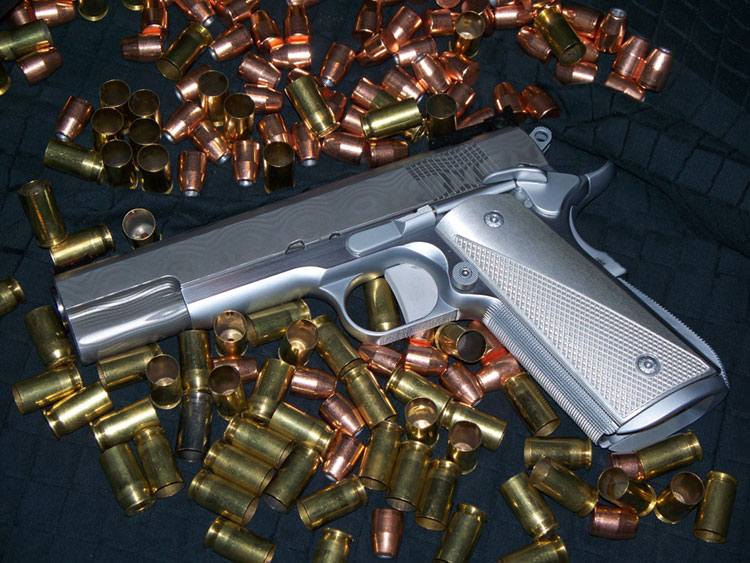
Guns may be a tool, the same as a knife, or bare hands. People are often horrified because of the damage guns inflict. They are loud. It is messy. It’s sudden and powerful. But the end result of shooting a gun is the same as using a bow and arrow, a knife, or one’s own hands.
So we do ourselves a great disservice when we break down these tragedies to simply espousing the need for more gun control, more regulation and restrictions. The Second Amendment isn’t the problem. It may be something that needs addressed, but it is not the problem.
People are the problem.
To be fair, what we very may well need is more analysis on people before they are allowed to purchase and possess handguns, automatic weapons and shotguns. But again, even that is short sighted. The simple fact is that people can and will fake their way through these tests. We may call a murderer crazy, but they aren’t necessarily all stupid. Masking and hiding tendencies is generally how we get to the point of the interview with a neighbor where so-and-so “was the last person they would suspect” of doing something like this.
Did you know that Americans are 40 percent more likely to be killed by guns as citizens of other countries like England and Canada? 40 percent! The easy response is that’s because of all the readily available handguns. Get rid of the guns altogether and you fix the problem.
No. No. No. You can do that all you want and all you are doing is duct taping the problem. You can take away the weapon or the tool, but you cannot remove the intent and the penchant for violence.
This is America’s biggest fault – we’re too rapid with our responses. It’s a fast-food society, too quick to determine actual and effective cause and solution. Massive deficit? Tax the rich! People shooting each other? Take away the guns!
We don’t research, we don’t think and process information or theorize. We’re too busy to critically think through our issues. Band-aid solutions are abound. We want the best outcome with the fastest response. In the absence of genuine, well-thought solutions, any old idea will do.
How often at work are you in meetings? I know a lot of people that spend most of their day meeting with co-workers about action items and to do lists and then go on to the next meeting. In a variety of different industries. And there is less time to do the actual work, to think, to devise creative solutions.
We’ve removed thinking and pontificating from our daily lives. And we apply this logic – or lack thereof – to other problems in our culture all the time.
And that is exactly what we’re doing when we speak so vaguely about guns and gun control. We turn to the violent nature of guns instead of examining the violent nature of people.
It’s easy to blame the weapon – it cannot defend itself or rationalize an argument. You cannot arrest a gun, or put it on trial or declare it insane. You cannot interview it, you cannot assess its logic. It’s a static tool – it’s used. It doesn’t think, have feeling, emotion, practice a religion or process outcomes. But it can be blamed because it’s there.
Simply put, I urge us to look deeper if we want to know why we’re a more murderous culture and society than the rest of this planet.
Not everyone is prepared, or sane, or cares – about the outcome when they use guns. They are carrying a weapon to defend themselves, so they think and say, and often turn to the device when most angry, challenged or upset.
This isn’t a new thing for Americans. And while this could be a racial or class issue, it’s really an American issue to a far greater extent than other places in the world.

Remember the duel between Alexander Hamilton and Aaron Burr? We fought a revolution with muskets when we didn’t like the King’s taxes. We didn’t use guns to throw tea into the Boston Harbor – an act of violence. But that was OK, because it was justified, right?
We turned to violence in 1776. Less than a hundred years later, we got violent with each other over a Northern industrial economy and a Southern farming economy. Brother versus brother. We turned guns on each other because we were offended and threatened.
We still do so today.
We are a violent society and, frankly, always have been. We can justify which actions require the use of weapons, automatic rifles and handguns. We can openly question why someone needs a machine gun, a glock or an AK-47 if they aren’t serving in the military and stationed somewhere. That’s all fine. But we will always fail to get to the root of the problem.
The problem is us. We are the ones who pull the trigger. We are the ones who turn to guns and violence in fits of rage and anger.
We’re also not strict enough with the laws currently in place. It’s illegal for convicted felons to carry handguns, yet many still find a way to get them. Why? Guns weren’t used on 9/11, violence and terror and fear were.
As I wrote earlier this week, to discuss these topics after the fact is too late. When someone’s already pulled the trigger or has a gun to their head is the wrong time to debate whether or not the gun control laws are strong enough.
The presence of a gun increases chances of violence that already exists in the first place, but doesn’t remove the chance altogether. But that still misses the larger point: the existence of violence is more detrimental than the existence of the gun.
Many argue that guns exacerbate the situation; they remove time for thought, regret, reaction. There can be no denying that. The rate of deaths, drive-bys, domestic violence ending in fatality would probably lower if we removed guns completely – but you’re not digging up the weed by the root. You’re not fixing it by masking it. Domestic violence exists with or without handguns. Lack of a gun may prevent death, but the violence is still there.
You see, this has to be a societal change. Is America ready for that? Are we ready for that discussion?
Because we can’t have massive gun control reform and then have 10 million people sit down and enjoy an MMA fight, The Sopranos, The Wire or buy the latest edition of Hitman. We cannot celebrate the values depicted in The Patriot, then argue that guns shouldn’t be in our midst. It’s counter-intuitive.
On Sunday, Costas said, “If Jovan Belcher didn’t posses a gun, he and Kasandra Perkins would both be alive today.”
We simply do not know that to be true. We can assume that, since the statistics show it would (obviously) greatly enhance their chances of being alive. But that’s just not deep enough analysis. It doesn’t remove the intent to do harm to one another.
Certainly, the guns made it quicker, deadlier, more violent and definitive. So let’s just band-aid it, wrap a bow around it and proclaim that guns and gun control are the crux of the issue.
No – guns are part of the issue. Guns may be big part of the problem because of their impersonal nature, availability and quick finality.
But they are not the problem.
We are.
 worldbetweenlines.com