There’s something about life in the age of technology, something dark and sinister, that you can’t see in the glare of a computer screen or an iPhone.
There, off in the shadows of our lives, what’s not showing in all our posts, Tweets and feeds, is what we don’t do or say.
We’re alone together.
In our interactions, in our relationships and friendships. And the average, every day American isn’t the only one who deals with this.
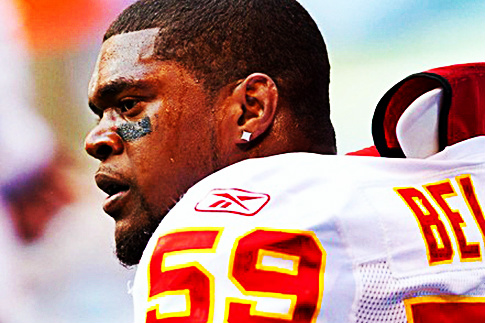
Yet another reminder of this came Saturday, when Kansas City Chiefs linebacker Jovan Belcher killed his girlfriend, then drove to practice in his Bentley, thanked head coach Romeo Crennel and GM Scott Paioli and then pointed a gun at his head and pulled the trigger, committing suicide right in front of them.
The latest reports have said Belcher and his girlfriend, Kasandra Perkins, were arguing before he shot her. He had been out partying all night and the police had woke him up and determined him fit to drive home. The Cheifs were aware of the arguments and had gotten the couple counseling.
It’s another football player who’s life has ended in sudden death this year. The most stunning of 2012 remains Junior Seau’s suicide earlier this year.
We can question the logic of a young man who’s driving a Bentley arguing over finances with his girlfriend and say he wasn’t prepared for the lavish lifestyle modern professional sports yields. We can blame Seau’s suicide on brain damage or the loss of oneself after a lifetime of playing football and say that Junior just didn’t know what to do with himself. We can blame both on gun control or lack thereof, but that’s too easy.
There’s a big difference between the two. Belcher is a murderer who’s grizzly actions cannot be condemned. Seau had grown despondent. Both may have ended tragically, but only one is truly a tragedy.
But taking away the guns doesn’t change the situation or possibly the outcomes. With Belcher, taking away the gun doesn’t stop him from being crazy. With Seau, he might have found another way to end his life.
Getting rid of the guns doesn’t get rid of the emptiness inside someone’s mind or heart.
The truth is that these things happen every day in America. Race doesn’t matter. Financial situations don’t matter. Profession doesn’t matter. A white father in a suit and tie can (and has) come home and killed his wife in their mansion after arguing about money. Wall Street professionals have drug addictions. That’s because loneliness and craziness, two different types of mental illness, pay no mind to what do or who you are.
The only comparison we can make between Belcher and Seau is that perhaps those around had turned a deaf ear. No one on the Chiefs, no one in Belcher’s family or circle of friends can comprehend it. Likewise with Junior Seau, too. Maybe football related damage helped, but perhaps Seau was just depressed and car dealerships and golf weren’t enough to fulfill a man for the next 30 years.
You often hear those closest to the one responsible in a tragedy like this to say they had no idea. And this is what we refuse to discuss as a society, as a culture. Maybe we all have no idea because, well, we have literally no idea what’s going on with the people we think we really know best.
As Chiefs quarterback Brady Quinn said following Sunday’s game, we ask people how they are doing, and we care – but do we mean it?
I know I’m guilty in my own life of getting so wrapped up in my little world, a lot of my contact with friends and family consists of text messages, Facebook posts and fewer phone calls and in person communication. I know I also have occasionally thought that some friends and family care less about my family and I because they do the same thing.
“We live in a society of social networks, with Twitter pages and Facebook, and that’s fine, but we have contact with our work associates, our family, our friends, and it seems like half the time we are more preoccupied with our phone and others things going on instead of the actual relationships that we have right in front of us,” Quinn said.

We can joke about it – but this is our national addiction. We don’t necessarily have to flush it or get rid of it, but does it do anything for our relationships with family, friends, spouses and children when we check our feeds and our e-mail? Why don’t we pick up the phone more? Why don’t we spend more time showing we care?
This Belcher situation has nothing and everything to do with this. We’re more concerned about the image and the appearance of we what we project than what we actually are.
Take the NFL for example. How can you read the grizzly details of Saturday morning and think that the Chiefs staff and players were fine to play a game on Sunday? This is where Roger Goodell could have postponed the game until Monday night. Give it time to breathe, let the air settle.
Instead, the NFL shrugged their proverbial shoulders and moved on. It’s only Tuesday and it’s already become nothing more than a news story that has legs because the “why” is still so unknown. The fact that his teammates didn’t know, that the Chiefs knew but just addressed it with couples counseling proves how far we’ve fall.
We have the illusion of companionship now.
My best relationships are with my wife and children, whom I see every day and engage in conversation with. We turn off the TV. We talk. We read. We laugh. We play. My wife and I built our relationships with hours upon hours of conversation – spending time every single day together, in person.
My worst relationships are with the people outside my nuclear family that I should know – or once knew – best. Childhood friends. Current buddies. People so close, they are family. I know they might be building a house, or their kids are in sports, or they took a vacation last week, or their birthday is next Tuesday.
But I only know that because I saw it on Facebook.
We’re short-changing ourselves and hurting others with how we interact with one another. Emoticons aren’t actual emotions.
My parents aren’t on Facebook. They barely use e-mail. This has forced me to communicate with them over the phone every few days or see them on the weekends. Same thing with my in-laws. My wife and I are close to both sets of parents because the lack of technology has put us right back in the stone age of talking to them, you know, like human beings.
My sister-in-law lives halfway across the country, but we’ve seen her and her significant other a lot over the past year. It’s one of our strongest friendships right now. And when we write something on their wall or send a text, the joke has actual meaning behind it. It’s not just a check-in that we kind of mean but have no real emotion behind. There is a difference. I can mean it when I write how much I care to an old friend, but is there truth behind it?
While this may have little to do with why a young middle linebacker killed his girlfriend, then himself, in the middle of the country, it has, as Quinn said, more to do with it than we can to admit to ourselves.
We’re growing further apart as people, as a society. We’d rather care from afar. We add and delete the relationships in our lives. But the rich, emotional undertones of real relationships cannot be replaced.
I get it, our cup runneth over. We only have so much time in a day. But too soon, a day becomes a week, a week a month, a month turns into a year. In moderation, texts, Tweets and Facebook are quite handy tools. Yet they can never replace the emotional and physical connection of shared time.
We need to be more present in our own lives so we can be present in others. Our full attention is needed. We text in meetings. We text when hanging out on dates. We check our newsfeed at the dinner table. We want to be in two places at once, but by doing so, we’re never fully in one place.
We don’t know what happened to Jovan Belcher. And we can only speculate on Junior Seau. We don’t know how troubled he was, how depressed or how mentally ill. We didn’t really know him at all, as fans or media types. We don’t know what he was feeling, and neither do many around him.
It does little good to examine his brain after the fact. It does little good to try and talk someone out of shooting themselves with a gun to their head. It’s too late by that point.
But there is a difference between crazy and despondent.
It’s the failure to see either that is a bigger problem.
 worldbetweenlines.com