
One night this week, my wife and I saw the trailer for Moneyball. We both want to see it, but probably won’t because of two key subplots conspiring to keep us from seeing the film:
1. Our son, and fourth child, is due in less than two weeks, and once that happens, we won’t see a movie in the theaters that doesn’t involve animation until at least 2015.
2. I can’t stand to pay to see a movie I already know the ending to.

Look, I was intrigued by the idea of a film with Brad Pitt playing Billy Beane, the general manager of the Oakland A’s, who back in 2002, threw himself in the Sabermetrics camp and became a believer in the work of Bill James.
There’s some great lines in the trailer and Pitt is Pitt. As my wife notes, in every film we’ve seen of his, he’s always shoving some sort of food in his mouth and talking while doing so. It’s just funny because we do that, too.
But I know how this ends and so do you [SPOILER ALERT: The A’s win the division!]
Yet beyond knowing the ending, I have a bigger issue with Moneyball, both the movie and the system. Better yet, my issue lies with the notion that it’s solved some great mystery or unearthed this hidden secret that cures disease. The press are fawning all over the movie, which in turn has led to even more glowing reviews of the 2003 book, which in turn has led to some universally agreed notion that Moneyball was brilliant and somehow the work of Einstein-like statistical geniuses.
And that it even really worked to the extent we’re led to believe it did.
Here’s the deal: the whole premise suggests that the Oakland A’s were a down on their luck, cash-strapped Major League Baseball team in the winter of 2001 and that Beane, using Bill James’ Sabermetrics, threw caution to the wind and shocked everyone by building a baseball team around undervalued players who would contribute pieces to a larger puzzle. Michael Lewis then wrote a book about it.
In truth, while the A’s were cash-strapped, they also won 102 games and made the playoffs in 2001.
Every team would have a hard time duplicating a 100-win season, no matter if you are the A’s or the New York Yankees with a payroll four times as large.
Yes, the A’s lost Jason Giambi, Johnny Damon and Jason Isringhausen, all three of whom were critical players to the 2001 team, to free agency that winter. Yes, they didn’t exactly replace those guys or their production but wound up winning 103 games in 2002. In fact, they averaged 95 wins, won four division titles and made the playoffs five times from 2000-06. A tip of the cap is owed, to be sure.
Now, naturally, the film will fabricate or embellish some of the story to make it more entertaining or dramatic. It’s not just the “Hollywood touch” that grinds my gears, but this notion that the Oakland A’s were made up of players from the scrap heap.
Take Jeremy Giambi, Jason’s brother, for example. Jeremy Giambi played in 124 games for the A’s in 2001, with over 400 plate appearances. That’s not the scrap heap.
David Justice, though not as productive as he had been earlier in his career with the Atlanta Braves, wasn’t exactly a slouch. True, Justice hit just .241 in 2001 for the Yankees, but that was his lowest average since he was called up by the Braves in 1989, when he played in just 16 games. The year prior to 2001, Justice hit .286 with 118 RBI and had an OPS of .977. Justice was also injured in 2001, missing 51 games. It’s not totally out of the question to think that Justice just had a bad, injury riddled 2001 season. Again, he wasn’t exactly rescued off the scrap heap or ignored. He was just getting older and broken down and most teams didn’t want to take the risk.
As for replacing Johnny Damon, let’s not get all revisionist that this was the blow to end all blows, some superstar ditching poor Oakland leaving them with a leadoff hitter gap the size of the Bay to fill.
If we’re going to use stats, we can’t just pick and choose which ones work and which ones don’t fit our neat little message of Moneyball.
So try this on: Damon hit just .256, with 9 home runs and 49 RBI in 2001, which according to Baseball-Reference.com’s fun little Wins Above Replacement (bWAR), he was worth a grand total of 2.7 wins more than his replacement that season.
It’s the same for Isringhausen, who was 2.2 wins above his replacement. The two combined for 4.9 wins more than their replacements would have given them in 2001.

But even those stats don’t tell us the complete story. Despite all the moves, the replacements for Damon, Giambi and Isringhausen didn’t fully replace their production in 2002. Justice missed most of May with an injury and played in just 118 games. He didn’t even top Damon at the plate in terms of production, hitting just .266 with 11 home runs and 49 RBIs. Near identical numbers to Damon’s sub-par 2001 season (same number of RBIs, but the downside is, Justice was supposed to be a power hitter, not a leadoff man).
You may be asking what this all means and why the six paragraphs of boring stats that only diehard baseball fans care about?
Because I’m using them to make a point: Moneyball isn’t all that it’s cracked up to be. It helped a team whose owner didn’t want to spend money stay competitive, but really, a majority of any team’s success is luck. The stats say that the 2002 A’s lost 11 wins from their 2001 roster, but somehow ended up with one more win than the previous season. How?
Well, since there must be a logical answer for everything, it has to be this wild, kooky and adventurous Moneyball thing, right?
They outplayed their potential and talent, winning a ton of one-run games. Here’s some more fun facts: in 2001, the A’s went 21-19 in one-run games. In 2002, they went 32-14 in one-run games. What was the difference?
How about sheer luck? One-run games are luck, because according to a team’s projected record based on the number of runs scored and allowed, team records in one-run games most often veer toward .500.
The luck turned a bit in 2003, and the A’s went 25-20 in one-run games, which is still good. But they won 96 games, seven wins fewer than the previous season.
Yet even if you can argue the benefits of Moneyball, did it really win anything for the A’s? They still got beat by the Yankees in 2001, the Twins in 2002 and the Red Sox in 2003. Can you call it a method of winning if you never really win anything other than a few division titles and a wild card?
Maybe more teams should have copied the Florida Marlins system of drafting good players, signing some aging vets, waiting until it all merges for one season, win a title (which they did twice in 1997 and 2003) and then hold a fire sale after because you can’t keep the players or re-sign them?
The truth is, the A’s weren’t just lucky. They had good pitching. The pitching staff was just plain sick during that period. And the majority of their staff was homegrown. Tim Hudson, Barry Zito and Mark Mulder were all drafted by the A’s. So were position players Miguel Tejada and Eric Chavez.
Zito won the Cy Young Award in 2002, and along with Mulder and Hudson, the three combined to win 57 games. All had low ERAs. Tejada won the AL MVP and hit 34 home runs, driving in 131 runs. Chavez won a Gold Glove.
Beane and the “genius” Paul DePodesta, who was really the brainchild behind Moneyball within the organization by imploring James’ work, didn’t come up with these guys off the scrap heap or a computer program that spit out projected stats. These players were already within the A’s farm system.
So maybe the A’s were good because they nailed their draft picks and had good talent already in place. DePodestra joined the team after all those homegrown stars were there and didn’t even get involved in the A’s draft plans until 2002.
Speaking of those post Moneyball drafts, the system and its strategies hasn’t been a total hit, either. Nick Swisher was the only guy targeted in the 2002 draft that has amounted to anything in the major leagues. However, here are the players that Beane dismissed in the 2002 draft: Prince Fielder (whom Beane called too fat to play for the A’s), Jeff Francis and Scott Kazmir. Though Francis and Kazmir haven’t been that successful, in context they were far more so than the A’s other picks. And Fielder? Well, he looks like a future Hall of Famer.
To be fair, this isn’t an attempt to discredit Moneyball, either.
Clearly, Beane and DePodesta came upon something unique by finding talent and maximizing wins where other teams had not yet located it in replacement players or cost effective replacement players who’d get on base, score runs or play good defense. And Beane and DePodesta deserve much credit for accomplishing what the team did during the early to mid-2000s, especially facing two financial goliaths in the American League, Boston and New York – as well as third big spender in the Texas Rangers – who were spending more money than the A’s could dream of on their rosters. By spending just $41 million in that 2002 season, the A’s remained competitive, for sure.
But isn’t the point to win the game, in the words of Herm Edwards?
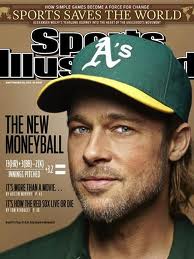
ESPN is running infomercials that point to Moneyball completely changing not only baseball, but others sports, and in some ways, it’s mildly suggested in the ads, the world. Sports Illustrated put Pitt on the cover of this week’s magazine.
Many point to the Houston Rockets and GM Daryl Morey for his work with Moneyball in the NBA. Is it really working? Since Morey took over the Rockets in May of 2007, the team has dropped in total wins in each of his four seasons (55 in 2007-08, 53 in 2008-09, 42 in 2009-10, then up just one game to 43 in 2010-11). Houston has also missed the playoffs the past two seasons.
Changing the world? That’s a bit of a stretch. I’m not even sure if it’s changing professional sports in terms of final outcome.
Considering that the A’s missed the playoffs in 2004 and 2005 and aside from winning the division in 2006, have missed the playoffs for five consecutive seasons, is it working? When you haven’t been winning with the system over a sustained period of time, can it be that much of a success?
Give Moneyball credit for getting baseball people to look beyond just batting average and RBIs and helping teams find new ways of production. But let’s try to restrain ourselves from slobbering all over it as some magical elixir that’s a proven system for winning. Hollywood’s done enough of that embellishment already.
All it does it give new meaning to Moneyball – how we as an audience got played into spending money to believe the system was and is something much more than it is.
Though we won’t ever see a book or movie exposing it as such, that’s a movie I’d get a babysitter to see.
 worldbetweenlines.com