Billy Beane, Daryl Morey, ESPN, Houston Rockets, Major League Baseball, Moneyball, Oakland A's, Paul DePodesta

Use Your Illusion: The Truth Behind "Moneyball"

One night this week, my wife and I saw the trailer for Moneyball. We both want to see it, but probably won’t because of two key subplots conspiring to keep us from seeing the film:
1. Our son, and fourth child, is due in less than two weeks, and once that happens, we won’t see a movie in the theaters that doesn’t involve animation until at least 2015.
2.  I can’t stand to pay to see a movie I already know the ending to.
Look, I was intrigued by the idea of a film with Brad Pitt playing Billy Beane, the general manager of the Oakland A’s, who back in 2002, threw himself in the Sabermetrics camp and became a believer in the work of Bill James.
There’s some great lines in the trailer and Pitt is Pitt. As my wife notes, in every film we’ve seen of his, he’s always shoving some sort of food in his mouth and talking while doing so. It’s just funny because we do that, too.
But I know how this ends and so do you [SPOILER ALERT: The A’s win the division!]
Yet beyond knowing the ending, I have a bigger issue with Moneyball, both the movie and the system. Better yet, my issue lies with the notion that it’s solved some great mystery or unearthed this hidden secret that cures disease. The press are fawning all over the movie, which in turn has led to even more glowing reviews of the 2003 book, which in turn has led to some universally agreed notion that Moneyball was brilliant and somehow the work of Einstein-like statistical geniuses.
And that it even really worked to the extent we’re led to believe it did.
Here’s the deal: the whole premise suggests that the Oakland A’s were a down on their luck, cash-strapped Major League Baseball team in the winter of 2001 and that Beane, using Bill James’ Sabermetrics, threw caution to the wind and shocked everyone by building a baseball team around undervalued players who would contribute pieces to a larger puzzle. Michael Lewis then wrote a book about it.
In truth, while the A’s were cash-strapped, they also won 102 games and made the playoffs in 2001.
Every team would have a hard time duplicating a 100-win season, no matter if you are the A’s or the New York Yankees with a payroll four times as large.
Yes, the A’s lost Jason Giambi, Johnny Damon and Jason Isringhausen, all three of whom were critical players to the 2001 team, to free agency that winter. Yes, they didn’t exactly replace those guys or their production but wound up winning 103 games in 2002. In fact, they averaged 95 wins, won four division titles and made the playoffs five times from 2000-06. A tip of the cap is owed, to be sure.
Now, naturally, the film will fabricate or embellish some of the story to make it more entertaining or dramatic. It’s not just the “Hollywood touch” that grinds my gears, but this notion that the Oakland A’s were made up of players from the scrap heap.
Take Jeremy Giambi, Jason’s brother, for example. Jeremy Giambi played in 124 games for the A’s in 2001, with over 400 plate appearances. That’s not the scrap heap.
David Justice, though not as productive as he had been earlier in his career with the Atlanta Braves, wasn’t exactly a slouch. True, Justice hit just .241 in 2001 for the Yankees, but that was his lowest average since he was called up by the Braves in 1989, when he played in just 16 games. The year prior to 2001, Justice hit .286 with 118 RBI and had an OPS of .977. Justice was also injured in 2001, missing 51 games. It’s not totally out of the question to think that Justice just had a bad, injury riddled 2001 season. Again, he wasn’t exactly rescued off the scrap heap or ignored. He was just getting older and broken down and most teams didn’t want to take the risk.
As for replacing Johnny Damon, let’s not get all revisionist that this was the blow to end all blows, some superstar ditching poor Oakland leaving them with a leadoff hitter gap the size of the Bay to fill.
If we’re going to use stats, we can’t just pick and choose which ones work and which ones don’t fit our neat little message of Moneyball.
So try this on: Damon hit just .256, with 9 home runs and 49 RBI in 2001, which according to Baseball-Reference.com’s fun little Wins Above Replacement (bWAR), he was worth a grand total of 2.7 wins more than his replacement that season.
It’s the same for Isringhausen, who was 2.2 wins above his replacement. The two combined for 4.9 wins more than their replacements would have given them in 2001.
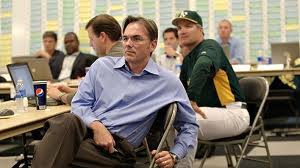
But even those stats don’t tell us the complete story. Despite all the moves, the replacements for Damon, Giambi and Isringhausen didn’t fully replace their production in 2002. Justice missed most of May with an injury and played in just 118 games. He didn’t even top Damon at the plate in terms of production, hitting just .266 with 11 home runs and 49 RBIs. Near identical numbers to Damon’s sub-par 2001 season (same number of RBIs, but the downside is, Justice was supposed to be a power hitter, not a leadoff man).
You may be asking what this all means and why the six paragraphs of boring stats that only diehard baseball fans care about?
Because I’m using them to make a point: Moneyball isn’t all that it’s cracked up to be. It helped a team whose owner didn’t want to spend money stay competitive, but really, a majority of any team’s success is luck. The stats say that the 2002 A’s lost 11 wins from their 2001 roster, but somehow ended up with one more win than the previous season. How?
Well, since there must be a logical answer for everything, it has to be this wild, kooky and adventurous Moneyball thing, right?
They outplayed their potential and talent, winning a ton of one-run games. Here’s some more fun facts: in 2001, the A’s went 21-19 in one-run games. In 2002, they went 32-14 in one-run games. What was the difference?
How about sheer luck? One-run games are luck, because according to a team’s projected record based on the number of runs scored and allowed, team records in one-run games most often veer toward .500.
The luck turned a bit in 2003, and the A’s went 25-20 in one-run games, which is still good. But they won 96 games, seven wins fewer than the previous season.
Yet even if you can argue the benefits of Moneyball, did it really win anything for the A’s? They still got beat by the Yankees in 2001, the Twins in 2002 and the Red Sox in 2003. Can you call it a method of winning if you never really win anything other than a few division titles and a wild card?
Maybe more teams should have copied the Florida Marlins system of drafting good players, signing some aging vets, waiting until it all merges for one season, win a title (which they did twice in 1997 and 2003) and then hold a fire sale after because you can’t keep the players or re-sign them?
The truth is, the A’s weren’t just lucky. They had good pitching. The pitching staff was just plain sick during that period. And the majority of their staff was homegrown. Tim Hudson, Barry Zito and Mark Mulder were all drafted by the A’s. So were position players Miguel Tejada and Eric Chavez.
Zito won the Cy Young Award in 2002, and along with Mulder and Hudson, the three combined to win 57 games. All had low ERAs. Tejada won the AL MVP and hit 34 home runs, driving in 131 runs. Chavez won a Gold Glove.
Beane and the “genius” Paul DePodesta, who was really the brainchild behind Moneyball within the organization by imploring James’ work, didn’t come up with these guys off the scrap heap or a computer program that spit out projected stats. These players were already within the A’s farm system.
So maybe the A’s were good because they nailed their draft picks and had good talent already in place. DePodestra joined the team after all those homegrown stars were there and didn’t even get involved in the A’s draft plans until 2002.
Speaking of those post Moneyball drafts, the system and its strategies hasn’t been a total hit, either. Nick Swisher was the only guy targeted in the 2002 draft that has amounted to anything in the major leagues. However, here are the players that Beane dismissed in the 2002 draft: Prince Fielder (whom Beane called too fat to play for the A’s), Jeff Francis and Scott Kazmir. Though Francis and Kazmir haven’t been that successful, in context they were far more so than the A’s other picks. And Fielder? Well, he looks like a future Hall of Famer.
To be fair, this isn’t an attempt to discredit Moneyball, either.
Clearly, Beane and DePodesta came upon something unique by finding talent and maximizing wins where other teams had not yet located it in replacement players or cost effective replacement players who’d get on base, score runs or play good defense. And Beane and DePodesta deserve much credit for accomplishing what the team did during the early to mid-2000s, especially facing two financial goliaths in the American League, Boston and New York – as well as third big spender in the Texas Rangers – who were spending more money than the A’s could dream of on their rosters. By spending just $41 million in that 2002 season, the A’s remained competitive, for sure.
But isn’t the point to win the game, in the words of Herm Edwards?
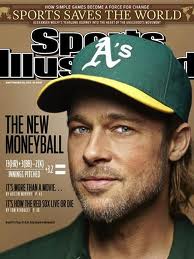
ESPN is running infomercials that point to Moneyball completely changing not only baseball, but others sports, and in some ways, it’s mildly suggested in the ads, the world. Sports Illustrated put Pitt on the cover of this week’s magazine.
Many point to the Houston Rockets and GM Daryl Morey for his work with Moneyball in the NBA. Is it really working? Since Morey took over the Rockets in May of 2007, the team has dropped in total wins in each of his four seasons (55 in 2007-08, 53 in 2008-09, 42 in 2009-10, then up just one game to 43 in 2010-11). Houston has also missed the playoffs the past two seasons.
Changing the world? That’s a bit of a stretch. I’m not even sure if it’s changing professional sports in terms of final outcome.
Considering that the A’s missed the playoffs in 2004 and 2005 and aside from winning the division in 2006, have missed the playoffs for five consecutive seasons, is it working? When you haven’t been winning with the system over a sustained period of time, can it be that much of a success?
Give Moneyball credit for getting baseball people to look beyond just batting average and RBIs and helping teams find new ways of production. But let’s try to restrain ourselves from slobbering all over it as some magical elixir that’s a proven system for winning. Hollywood’s done enough of that embellishment already.
All it does it give new meaning to Moneyball – how we as an audience got played into spending money to believe the system was and is something much more than it is.
Though we won’t ever see a book or movie exposing it as such, that’s a movie I’d get a babysitter to see. 
Standard
BCS, Bill Simmons, College Football, ESPN, Grantland.com, Jim Boeheim, NCAA, Syracuse, Texas Longhorns

The Dash for Cash Era

“A university is a college with a stadium seating over 40,000.” – Leonard Levinson
Not long ago, I wrote this little piece about the state of our priorities and how often sports blur the line between common sense and nonsense.
Turns out, I didn’t dig nearly deep enough.
The unequivocal fact is that it’s all about the money – in everything, everywhere, at all times.
Look at the recent events in college sports – from the scandals at Ohio State, Miami, Oregon and North Carolina to the conference carousel playing out amongst the major football schools.
It’s all about the money. It probably always has been. Just look at out own history, starting with the American Revolution – a bunch of people upset about being taxed, in essence.
Pink Floyd once told us it was about money and so did Gordon Gekko. We’re not listening very well. The only people who tell you money doesn’t buy happiness and that money is the root of all evil are poor people.
You think I’m being glib? You think money doesn’t swallow us up whole and we’re too blind to see it?
The film “Jerry Maguire” was a mega-money maker in 1996, for Cameron Crowe, for Tom Cruise, the studio and for Bruce Springsteen and his little secret garden song.
And when you really look at it, the plot wasn’t a love story or a budding relationship between a forgotten receiver and his agent – it was about money. 
Maguire lost it and got all touchy feely with his manifesto – and then lost his job. Immediately, he regretted this decision and wanted all his clients and Bob Sugar’s. Rod Tidwell was out for more money, the fictional Arizona Cardinals were out to save money. In some ways, Dorothy Boyd was even out for money, in order to protect her son and give him a better life.
That’s sports now and it’s not fictionalized. It’s defined by money.
It’s why Notre Dame is still an independent in football, because they have a ridiculous contract with NBC for all home games worth more than the Rockefeller’s probably gave in philanthropic endeavors.
It’s why Nebraska jumped to the Big Ten, why Colorado went to the Pac-10. And since college football makes the most money, it’s why college basketball has taken a backseat.
Don’t believe me? Then why are Syracuse and Pittsburgh joining the ACC? Hearing Jim Boeheim lament the end of the Big East Tournament and Madison Square Garden is just plain sad.
“We’re going to end up with mega-conferences and 10 years from now, either I’m going to be dead wrong – and I’ll be the first to admit it – or everybody is going to be like, why did we do this again?” Boeheim pondered during a speaking engagement in Alabama, according to the Birmingham News.
“Why is Alabama playing Texas A&M this week…why is Syracuse going to Miami?” he said.
As for Boeheim’s thoughts on why conference expansion is running rampant, he had a simple answer:
“If conference commissioners were the founding fathers of this country, we would have Guatemala, Uruguay and Argentina in the United States,” he said. “This audience knows why we are doing this. There’s two reasons: Money and football.”
Boeheim overstated it – it’s simply about the money. It just so happens that college football produces that money. And just to point this out, I’m wondering if Boeheim was speaking at an engagement that he was paid for.
I get the conferences pining over Texas, I really do. A recruiting hotbed, a traditional power and good at many other sports. The Longhorns are the belle of the conference shuffle ball.
But who on earth would want Texas A&M in any sport other than football? No one even cares about the Aggies until two months ago, suddenly, they put on a little make-up and broke up with their conference and now everyone’s lusting over them like they have Texas’ mega TV deal.
Colorado became a step-child in the Big XII, so they move to the Pac-10, bringing happy-go-lucky mid-major Utah (who’ve complained about the BCS for years) with them. How about an SEC with Texas A&M? How about a Pac-16 with Texas, Oklahoma, Oklahoma State and Texas Tech? Sure, why not.
We can’t get a college football playoff because of money.
Just understand this now: we will not get rid of the bowl system – too many schools make too such coin from bowl games. You will get the Weedeater.com Dip-o-Salsa Bowl and you will like it. Because that’s worth $5 million to the school.
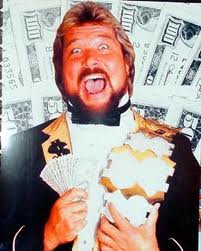
Can we just hire former WWF star Ted DiBiase to run around and throw money at everyone and laugh? Can the Million Dollar Belt be the true championship trophy? Can we stop pretending we care about student-athletes and their educations? 

We can’t bemoan their actions and deride them for taking cash from agents, selling merchandise or getting free tattoos when university presidents are doing this – making a dash for the cash.

Or apparently we can.
Do the schools use their money “earned” from bowl games on other things? Probably. Why do you think the presidents and professors even care about college football? Maybe it’s means to an end for them. They use a payout from a BCS bowl (since every team from an auto-qualifier conference gets a share) and use it to build a new library or academic hall or purchase beakers for science labs.
Then why haven’t we thrown out this question: maybe getting paid from an agent when in college is means to an end for the student-athlete. They have families in need, wants and desires, too.
Just like Texas probably doesn’t need another dorm or a new set of beakers for the science lab, a 19-year-old doesn’t need new rims on his Lincoln Navigator. But in both situations, each party is thinking: “Wouldn’t that be sweet to have, though?”
This is why money rules all: because of what it allows you to do. You have more choices and options. When all you can afford is Boone’s Farm, you don’t know how good the Henri Jayer Cros Parantoux is. Yet the result is still the same with both wines.
Professional sports, which are undeniably businesses and all about money, even make it more obvious it’s about the money.
The NFL’s owners wanted more money in the recent labor negotiations, got it, then got more of it with their recent TV deal with ESPN (conveniently finalized after the lockout).
The NBA owners just want their money back in the current labor negotiations after overspending on mediocre players for the last decade. When Samuel Dalembert is making $58 million over six years, I don’t blame him for signing that contract. I blame you and your moronic general manager.
What is a guy like Dalembert supposed to say, “No, no…that’s too much. I can’t accept. I’ve been less than mediocre and don’t deserve such a large sum of money”? If he didn’t have a pen when they offered that, I’m sure he cut his finger to sign it in his own blood.
And where does the “Dash for Cash” leave us, the fans?
Truth is, I don’t know. We really only have ourselves to blame. We play into it, just as much as anyone. We buy the tickets, the jerseys, the cups, hats and video games.
But we’re the only ones not getting paid in this.
We go to our “normal” jobs, try to earn raises so that we can afford tickets to the Super Bowl or an All-Star Game just to basically say we were there. We buy flatscreens the width of our living room walls so we can see better since we can’t afford the games in person. Yet the more money we feed the system, the more it messes with our traditions.
Rivalries die, uniforms change, winning means everything. And then we pretend to care when we found out you were cheating when you won. And we buy the hype. We’re drones, taking what they give us.
We’re feeding the beast and it’s swallowing us whole.  
Maybe right now, you’re shaking your head in agreement. Maybe you think I’m full of it – and there is still pride in sports, that honor and integrity exist above the checks.
But if I offered you a $100 to come back and read this blog next week, most of you would do it.
If I offered you $1,000 to comment, you’d do it.
And if I offered you $10,000 to write 10 e-mails, tweets or Facebook messages to Bill Simmons begging him to give me a job at Grantland.com, you’d do it. Whether you thought I was a decent writer or not.
All because I showed you the money. 

Now who is being glib?

Standard
Duane Bickett, Indianapolis Colts, Jim Irsay, NFL, Peyton Manning

What Goes Around…

Like any good football fan, around 1:00PM yesterday, I was all set: Fantasy football league StatTracker loaded on the computer, beer in hand and scrolling through NFL Sunday Ticket to see which game I wanted to watch, I settled on the Atlanta Falcons vs. Chicago Bears tilt.
Being a Bears fan, this was a natural selection for me. But living around Central Indiana all these years, as the Indianapolis Colts bandwagon grew, part of me reveled in checking in on the Colts trip to Houston to play the Texans. So I did, around 1:20PM.

The Colts were already down.

I had a hunch – just a sneaking suspicion really – that the Colts would sorely miss Peyton Manning, out for “awhile” (in the words of owner Jim Irsay) due to a second surgery on his neck.
And wouldn’t you know it, I was right.
After the Texans 34-7 throttling of the Colts, I couldn’t help but chuckle. Scrolling through my Facebook updates, I saw friends trashing the team, talking about how horrible they were, how it could have been 68-0.
Right on all accounts.
And then I saw this: “This is going to be such a long season…I won’t be able to watch!
Bingo. 

The money line I’d been waiting for. You could almost hear Colts fans across the state hitting the sauce, opening their fourth beer of the day in the early second quarter.

See, a few years ago, I wrote about how the Colts fans were spoiled brats, the whole bandwagon lot of them. Nearly 10 straight playoff seasons, seven straight 12-win campaigns, nine straight 10-win seasons, fans didn’t know how good they had it – or had forgotten had bad it had been.
The last time the Colts were under .500 was 2001 and Manning was in his fourth season, just 25-years old. In fact, 2001 was the only other season other than Manning’s rookie year in 1998 that the Colts were below .500. The last time the Colts won 10 or more games in a season before 1999, when Manning led the Colts to a 13-3 mark? Try 1977, when they were in Baltimore.
Since arriving in Indianapolis in 1984, the Colts had 7 losing seasons in 13 years. They had a few fun years with Jim Harbaugh and Marshall Faulk, but they always felt like punchy underdogs in the playoffs.
But since Peyton Manning came to town, the Colts have been the heavyweight favorites in the regular season. I’ve often argued that most fans just want a team that always has a shot and contends. But the Colts are proving my theory wrong, really.
Perennial contenders, the Colts fan base forgot how bad it sucked to be Colts fans. And I can say this because I’m unattached, unemotionally watching it happen from the sidelines as a fan of another team who doesn’t rival the Colts like the New England Patriots or Pittsburgh Steelers.

The fan base has swollen to include people who can’t name anyone on the team before 1998. They don’t know who Ron Stark is, Billy Brooks or Duane Bickett. The majority of these fans didn’t watch the team in the 1980s and 1990s – I know because the games were often blacked out. They got excited when Eric Dickerson came to town, but when the Colts didn’t win games, they stopped coming.

If you were looking for something to do in downtown Naptown in the late 80s or early 90s, it would have been a Pacers game. Or, wait for Indiana and Kentucky to play college basketball in the RCA Dome (or, as most should remember it, “The Hoosier Dome”). 

I can’t remember a single friend from the age of 8-16 who told me, at any point, they were a Colts fan. No one wore their jersey to school, no one went to the games.

And then, in 1999, it happened – they went 13-3 and had a franchise quarterback. Over the last 12 years, the Colts have used their success with Manning to build a new stadium and host the upcoming Super Bowl, bringing in millions of revenue in one form or another. Yeah, he’s worth the money and the roster bonus he earned even if he doesn’t play a down in 2011.
But Manning has masked a flawed franchise for years. Poor draft selections (just see everything from 2007-2011), bad hires (is Jim Caldwell even alive?) and an owner who seems to be going slightly insane (check out his hilarious Twitter feed).

This is what ancient Rome must have been like just before the end. Romans just ticked off at the lackluster leadership and star power: “Well, he’s no Caesar!

Maybe Manning never plays another game or maybe he plays five more highly productive years and wins another Super Bowl. Honestly, both options are on the table. But that’s not what is at play here.
It’s the city and its fans at stake. This isn’t just an abnormal season or set of six games in which the Colts won’t have Peyton Manning at quarterback. No, Indy, it’s the future.
Take a look around – poor special teams, lackluster and unimaginative offense with a bumbling, aging quarterback and an incompetent coach? 

Welcome to how the other half of the NFL lives every week.

The problem is the fan base is built upon guys who’ve started rooting for the Colts in the Manning era and subsequently convinced their wives and girlfriends to watch, to go to games, to tailgate and host Colts parties.  At least 30 percent of the fan base is women under 50 – and I have no real way to back that up other than the fact I live here and see it with my eyes.

As a friend told me today, “My girlfriend didn’t want to watch the entire game because it was getting out of hand and she said, ‘I think I’m just a Peyton Manning fan, not a Colts fan.’”

And there you have it – the bulk of the Colts fan base is centered around Peyton Manning and wearing cute No. 18 jerseys.
Take a look at fans in other cities and you’ll see Gale Sayers and Walter Payton throwbacks in Chicago, Dan Fouts in San Diego, Montana and Rice in San Francisco, Bart Starr in Green Bay, Randall Cunningham and Seth Joyner in Philadelphia. 

No one’s wearing Earl Morrall throwbacks in Indianapolis. It’s a young fan base that hasn’t aged through time.

Being a fan of a team means you support that team no matter what. Want to curse at their ineptitude? Fine. Hate the GM? By all means, question the draft strategy. Criticize the players for not caring like you do? Well, only if you can back that up. You still have to tune in. You have to take your lumps, otherwise, the big wins and the championships don’t mean as much.
Most (again, not all, but most) Colts fans would tell you the lean years were during Peyton’s career, losses to the Dolphins, Jets, Patriots and Chargers, when the team had a good regular season and blew an opportunity in the playoffs.
Wrong.
The hard times were 1-15 in 1991, 4-12 in 1993, 3-13 in 1997. Those were the bad times, the bumbling times you looked away in horror, wondering desperately if it would ever get better, if they would ever contend. But there weren’t enough fans of the team now to remember that kind of pain because they bought their first jersey or ticket in 1999, 2001 or 2002.
Once Peyton’s done, this franchise will move forward and find a new quarterback. It might take five or six rough years, but they will eventually find a new guy that will be a good player for a decade or so and put the team in position to contend. It happened in Dallas, Green Bay and Pittsburgh. It’s the circle of NFL life.
There was only one Roger Staubach, but there was also only one Troy Aikman. He had a couple bad years early on too. Dallas fans stuck around for the whole thing.
No team can remain that good forever. And there will never be another Peyton Manning.
But there will be Colts football.
Question is for the fair-weathered fans of Indy, will anyone care enough to be around for the truly hard times?
Standard