1984, George Orwell, Michael Jordan, Muhammad Ali, PGA, Rory McIlroy, Tiger Woods

The Doublethink on Tiger Woods

Am I missing something?
Did Tiger Woods senselessly pass away at the tragic age of 35? Did Woods retire to take up his other passions, like professional sweet pickle canning? Was he named in a hacking of all the Citi bank and Sony accounts?

If not, then I cannot figure out why we have collectively tossed him to the side in favor of Rory McIlroy.
Many in the media are doing a little bit of revisionist history right now. This is different than kicking a man when he is down, as was the case when his sex scandal broke 18 months ago. No, this is just poking an injured bear.
With Tiger gone, golf is thirsty for a new topic, something to keep it in the limelight. With Rory McIlroy’s destruction of the field at the U.S. Open 10 days ago, it got one.
By all accounts, McIlroy is a nice young man who signs autographs and smiles. Nearly everyone on the PGA Tour gushes over the kid. They praise his work ethic and his game.
Remind of you of anyone? When Tiger broke into professional golf’s big leagues in 1997 and won the Masters, I vaguely remember hearing similar things about him.
Now everyone is taking their shots, taking Tiger to task for spitting on the course, for cursing on the course, for not signing autographs, for throwing his clubs.
Honestly, that always endeared him to me more than anything else. The fact that the most talented golfer in the world did the exact same stuff I did, that my friends did, made him all that more likeable. And if you can tell me with a straight face you’ve never cursed on the golf course or tried to snap a club over your knee, well, you’re either a liar or a much better person than 99.9 percent of golfers out there.
I am a hacker. And golf is a frustrating game, period. The nod, the tip of the cap, that’s great and all, but it isn’t the reality that most casual golfers face. We fist pump, we do the bull dance from Happy Gilmore, we generally act like fools.
Golf is a 19th century game trying to make a name for itself in the 21st century. It’s expensive, time consuming and difficult to play. And the general public needs to have a reason to watch. Tiger gave us a reason to watch, as does McIlroy currently, like Nicklaus and Palmer before them.
But I do not see a reason to disparage Woods. Or to take a mulligan on how we viewed him until Thanksgiving 2009.
He wasn’t as reviled as everyone now likes to believe. In fact, he was often voted the most popular athlete in any given year. To take what makes him Tiger and use it as evidence of an egocentric athlete gone bad is a bit revisionist.
At one point, we viewed his fist pump as raw elation, not showmanship. We thought he was focused on the course, not some jerk who wouldn’t wave to the gallery or acknowledge their autograph requests.
Really, Tiger was and is no different than any other recent “greats” in their sport. As I’ve said many times, Michael Jordan berated teammates and punched one in the face, yet this was seen as Jordan the ultimate competitor who would not tolerate anything less than his team’s best effort. Jordan had a messy divorce and a gambling problem, it was just a little better hidden from the public eye.
Maybe we really did only love Tiger for his dominance, but isn’t that true of all the greats? We don’t really know any of them. Remember Don Johnson’s character in “Tin Cup”? He’s a jerk out of the public eye, a smarmy smoker who calls women “darlin’” and makes snide remarks about nearly every person he meets. To the cameras though, he’s a gentleman and a scholar.
How do we know McIlroy isn’t like that behind closed doors? The truth is we don’t, just like we didn’t with Jordan or Tiger. Muhammad Ali verbally abused his opponents and we revere him for it. Could Ali even survive today’s media onslaught? Would we even praise Wilt Chamberlain for his play had it been widely known that he carelessly slept with so many women?
The point is, we love all athletes for their dominance and little else. And we love the dominance because they are doing things we can only dream of doing.
Why does an athlete have to be endearing or embraceable? Because it makes us feel better about ourselves? Where is there a requirement that you have to sign autographs? To give something of yourself to the same media who will berate you, shred you and belittle you at the first sign of imperfection?
At some point, our beloved Rory will stumble, either on or off the golf course, and the media will question his passion, his dedication, his true skill or his morals. And we’ll move on to the next big thing.
This isn’t meant to be an endorsement of Woods, either. Yet at the same time, do you really want to poke a guy named Tiger? Something tells me Woods isn’t done yet and we may be just fueling the fire building inside him.
In which case, if Tiger does come back and win more majors and breaks Nicklaus’ all-time record, the media will once again embrace him, do a rewrite on this latest rewrite and pretend they always loved Tiger’s will to win.
George Orwell had it right in his book, 1984. Our media is a dystopian society, coercing and eliciting our reactions. We’re rewriting history constantly, engaging in doublethink, where we tamper with reality and manipulate how we once thought and felt about someone or something. We’re losing our curiosity and our ability to enjoy the natural process of life.
Right now, Big Brother has its bulls-eye on Tiger Woods.
Frankly, I’m excited to see how Woods responds to all this, if McIlroy really is the real deal.
Unlike Winston Smith, I refuse to sell out. The media can’t make me think I always disliked Tiger Woods and that McIlroy is the next Tiger, but with a better attitude and a winning smile. The truth is I loved watching Tiger Woods golf for over a decade and I can’t deny that what people now tell you is bad about him, I thought was fascinating.
And I can tell you that Rory McIlroy has a long way to go before he becomes Tiger Woods.
But for once, can we just all hang back and see how it plays out, instead of trying to compartmentalize the moment? That just might be the most fascinating development of all.
And if it happens, well, just pass me the Victory Gin.
Standard
Chris Berman, ESPN, NBA Draft, Stuart Scott

The Pretentious Ballad of Stuart Scott

While watching the NBA Draft last night, it became apparent that the biggest question wasn’t about what Cleveland would do with the first pick or how many times Minnesota fans would scream “KKKKKKKKKAAAAAAAAAAAAAAAAHHHHHHHHHHHHHNNNNNNNNNNNNNNN!” There wasn’t much trepidation around who would select Jimmer Fredette and where.
No, it became obvious our biggest concern should have been how uncomfortable Stuart Scott was going to make it to watch the coverage of the draft itself.
I twisted and squirmed uncomfortably for most of the broadcast each time Scott opened his mouth. The absolute worst was the wide shot of the crew: Jay Bilas, Jeff Van Gundy and Jon Barry sitting next to Scott as he cracked an absolutely horrendous joke about the Chicago Bulls drafting “a certain Bobcats owner from North Carolina.”
Nobody on the set moved. No one made eye contact. No one laughed.
After at least a good four or five seconds of dead-air (which feesl like an eternity when there’s no music, no one speaking and no one even blinking), Scott said with a wry smile, “So we’re pretty sure the Bulls aren’t going to take Michael Jordan with this next pick.”
Again, no one moved a muscle. No one spoke.
And no one laughed.
Yeah, Stu, we’re pretty certain Jordan won’t be drafted by the Bulls. It also marked the 957th consecutive time he’s referenced either Jordan or North Carolina when on-air.
It was yet another example of Stuart Scott showing what a caricature of himself he’s become. It’s like he sat down with Chris Berman one day and they shared career notes. All that’s left is the YouTube clip of Scott completely losing his mind on set during a commercialbreak because someone walked in front of a camera.
Scott’s biggest problem is he puts too much of himself into every situation to the point that you are readily aware of his presence before he even opens his mouth. As with too many studio hosts these days, he sees himself as a personality, instead of the guy steering the ship.
Scott forgets we already have personalities like Magic Johnson and Jon Barry on the set. Often, during the pre and post-game, Michael Wilbon is there to provide context – which he can, because, you know, he’s one of the most respected journalists and opinion givers in sports media. Scott’s job is supposed to be that of a classic point guard – throw a bone to each of them in each segment, let the analysts do their thing and reign it back in when it starts to drift off topic.
Every “Boo-yah” is grating, like nails on a chalkboard or my beagle’s howl in the middle of the night because she saw a leaf blow across the yard four houses down. In other words, much like I yell at my beagle in those moments, when I hear Scott my first reaction is “Shut up!
As viewers, it’s difficult to watch the mind-numbing absurdity of the questions Scott poses during a broadcast. A few examples:

  • “If Carlos Boozer stays healthy, how much does that help the Chicago Bulls?”
  • “If Kobe Bryant doesn’t score points, does this make the Lakers a worse team offensively?”
  • “Was Michael Jordan a big reason the Bulls won the 1991 Finals, Magic?”
It’s mind-numbing, really. I can’t tell which is worse, the pretentious, semi-loaded questions (and the fact that even the people he’s asking the questions to don’t know if he’s being serious) – or the forced jargon that he works into the highlights. This play was sick, that play was “phat with a capital P”, someone’s “as cool as the other side of the pillow.” Or, the classic, “holla” – which was what they named his recurring column in ESPN The Magazine.
Of course they did.
The man uses “boo-yah” as a verb, noun, adjective, period and an exclamation point. Apparently, it’s the most versatile word in the English language that’s not even technically a word.
Scott often just lacks awareness, which makes him come off as a sideshow. Case in point, during the 2008 NBA Draft, he asked Indiana Pacers president Larry Bird about drafting Jerryd Bayless and his strengths as a player – except the Pacers had traded him to Portland about five minutes earlier.
People can respect a shtick, but they can’t respect clueless hyperbole.
It’s difficult to criticize a man who has cancer and has valiantly fought that battle. But this isn’t even meant to be criticism – it’s just annoyance. Annoyance with an overwhelming number of people in media who’ve become characters and caricatures, who search wildly for a catchy phrase and try to inject more and more of themselves into the broadcast.
Scott often tries to appear hip and smart, all while trying to drop words that give him street cred. It’s a recipe for disaster. What he and so many others do not get is that we tune in to watch the game or event, not them.
The self-aggrandizing nature in which Scott, Berman and so many others conduct themselves takes me down a path where I have to question their motives, their intent and purpose for becoming the show instead of part of it. And just by making me do that, I resent them for it.
By approaching their profession this way, folks like Scott take away what I’m looking for when I sit down for the first time after working all day, playing with my kids, cleaning up from dinner, giving baths and doing laundry. I need entertainment in the form of a game. If I wanted jokes, I’d watch Colbert, Jon Stewart or throw in a Will Ferrell film on DVD. Same as if I want news, I’ll put on the news.
And by not staying out of the way, these personalities are robbing me of “me time” by forcing me to think about if the latest “boo-yah” was used as an exclamation point or a period. Everything we get now, in the form of pretentious hyperbole, is delivered in a self-promotional fit of megalomania.
Sports has become like too many other things in life that are fluffed up and given the works. Now all steaks are marinated in eight different spices. Drinks are all combos of four liquors and juices. TV shows are a weird mix of comedy, drama and reality. Cars have rear-view cameras, GPS, talk to you and plug into an outlet. It’s not enough to have an open bar and a good DJ at a wedding, we have photo booths with crazy outfits and paper mâché stations.
You know what? Just give me a steak with nothing on it, served medium to medium rare. Give me a beer. Give me a 1968 Camaro or a 1977 Silverado pick-up truck.
And for crying out loud, just give me a ball game with Vin Scully.
Standard
Allen Iverson, Brett Favre, Major League Baseball, NBA, NFL, Sports, Tiger Woods, Yankee Stadium

From the Vault: A Few Good Fans

(Note: The following was originally written a little over two years ago, but some portions have been updated to fit the current times. It is being re-posted on this blog at the request of a Cube follower)
Dear Sports,
I hope this letter finds you well.
Oh, who are we kidding? We both know where this letter finds you – and it’s a hell of a long way from well.  
We need to talk, sports. We need to create a dialogue, an open line of communication – something you have a hard time doing amongst your owners and players in nearly even major damn sport America has.
If we don’t start communicating and conducting some much needed group therapy, I fear that we’ll drift further apart until our relationship is irrevocably damaged.
And the truth is, a divorce would hurt you much more than me or the rest of us fans.
You need fans, you really do. You think we just follow you in droves? We survived for hundreds of years without you, frankly. We made things in this country. We can get obsessed over muscle cars again, if we have to. We can play Angry Birds, we can all get into music and films. We don’t need you to survive.
We love you, but we’re not feeling the love from you right now.
Sure, you secretly despise us for our irrational behavior, our lofty expectations and our demands. And granted, it’s embarrassing for you when we wear paper bags during a bad decade or two. Or when we drink ourselves into a stupor and throw empty cups onto your players. Or when we confront them in the parking lot after the games.
We can take responsibility for our actions. Can you?
You haven’t exactly been treating us like royalty as of late.
Some of your guys (we’re looking at you, Charlie Villanueva) are Twittering, er, Tweeting (whatever bird sound it is) – at halftime, no less – to stay in touch with us. Sweet, really. But, um, maybe they should take it just a tad more serious?
See, we think that our favorite teams paying triple what a doctor or president makes (or roughly about 300 times what we make in our profession) brings on expectations that for six months during the season, they should, you know, try really, really hard and stuff.
And yes, Allen Iverson, I’m talkin’ about practice too, man.
Speaking of taking things serious, that’s part of the problem. Most of the time, when we fight, you accuse us of taking things too seriously and we don’t think you take it quite serious enough.
Different worlds, I suppose. You are not the one who has to clumsily explain the Tiger Woods sex scandal or baseball’s steroid era to their impressionable, inquisitive and sports obsessed nine-year-old.
Thanks for that, and all the naked athlete cell phone pics, by the way. It’s been a real treat spraining my thumbs trying to change channels when a new story breaks. And I’m fairly certain my children think I have a stutter because of my stumbling and baffled responses to their questions. But I digress.
As fans, we lack the resources, the guilty pleasures, the comfort of the payday you provide your players and coaches. In fairness, the vast majority of us don’t have the inherit skill to break down film, the athleticism, the stamina required or the knowledge of a particular sport. Then again, neither do many of the “gifted” people who announce the games for you, but that’s another story.
The one place we seem to outnumber you is in the passion department. We care about you a heck of a lot more than you care about us.
As professional leagues, you lack the passion that got you there – you forgot what it was like to be where we are. Remember empty stadiums? Remember when very few people wanted your autograph or thought your sport was a tad stupid?
Yet the passion of the athletes, owners and league offices pushed you to new heights from the 1950s-1990s. And the growing fan bases of your various sports helped a little bit, don’t you think?
So we ask, where’s the passion?
And that passion has little to do with work ethic. Most athletes are workout fanatics, busting their humps to chase a variety of things: respect, pride, trophies and, of course, a little coin.
Generally, though, pleasing the fans comes last. That’s cool, we’ve dealt with it and that simple fact explains so much.
It’s apparently why roughly 1,100 seats at the new Yankee Stadium are obstructed view. We’re not smart enough, apparently, to figure out why, in this day and age, any stadium – let alone Yankee Stadium – would be built with obstructed views. To us, that’s so 1920s.
The seats in new Yankee Stadium certainly don’t cost 1920s prices, though, do they? Even though we’re living an economy that reminds us of December 1929.
And yet, you still want $1,500 for ticket. For a single game.    
I gotta tell ya, Sports, the vast majority of us don’t make $1,500 every two weeks. And those that do are pulling into gas stations and watching it float away in a river of oil. 
So cut us some slack, will you? We’re looking for a little latitude, the same as you were with the steroid era, the NBA referee scandal and the BCS.
Now, we’re not dumb. We don’t expect $10 tickets to the Super Bowl. But work with us a little.We’d at least like to have seats that we paid for at the Super Bowl. Don’t shuffle us under the bowels of the stadium to watch it on TV because your people couldn’t get the stands together in time.
This is why we’re asking, and here’s the juicy part, where we hold all the power in this relationship – the part where you need us, but we don’t need you.
Oh, we want you, all right. Like a fat kid wants a cupcake. We lust after you, but if we can’t afford you – if you come between us and the mortgage, our kid’s college tuition, our groceries or potential family vacation…well, you’re gone.
This means that eventually, you’re really gone.
Oh sure, we don’t directly pay your salaries. These days ticket sales are just a small piece of the cash pie. But we fans find it more than ironic that your leagues are all arguing over pieces of that pie – a pie that’s adding up to $9 billion in revenue for football.
But if we stop coming to games, due to the economy or just being plain pissed off, well, who buys your $7 hot dogs and $8 beers? Who buys a t-shirt or jersey? Still think you’ll have $9 billion to argue over?
If concessions and novelties aren’t moving in the arena or the stadium – does the provider wish to continue leasing its services to you? If you have no place to play because no one is coming to your games, what are your franchises worth to rich Russians then?
Seriously, if it gets that bad in other aspects of life, if we’re just scratching for crumbs and we’re all shopping at Goodwill – if it’s a depression…well, you can think that far ahead can’t you?
If we can’t afford TiVO, cable TV, DirecTV, DISH, whatever…well, forget about live attendance – who’s watching from home? And if we’re not watching, how do the advertisers’ spots get noticed? And if the sponsors aren’t selling any products or finding any value, their money comes off the billboards, pregame shows…you get the point.
Or maybe you don’t. Maybe, for once, we need to explain it for you.
As an individual, what I spend on you over the course of a year is probably equal to what Frank McCourt spends in an hour of divorce attorney fees. If you lose me, or better yet, pieces of my wallet, you could care less because there are millions more just like me that will shell out the cash.
But what if a large portion of us fell by the wayside? What if 30 percent suddenly stopped spending our greenbacks on you? What about 50 percent? What about 60 percent?
Working up a sweat just thinking about it, aren’t you, Sports?
If this recession affects 95 percent of Americans, which has been indicated, isn’t it reasonable to think that a large percentage of that group might be cutting back on those things deemed unnecessary?
Sports, in times like these, your prices become unnecessary.
So, again, you need us.
In the spirit of Jack Nicholson and “A Few Good Men“, let me paraphrase:
You need us in your stands. You need us in your seats, holding beers, brats, gloves and banners. You need us on that wall – you want us on that wall. And our absence is the very thing your athletes and coaches don’t talk about in locker rooms.
You survive under the very blanket of security that we provide and we’re starting to question the manner in which we provide it. We’d rather you just said thank you by slashing prices and making things more affordable. 
We’d appreciate it if you built stadiums in the 21st Century that you can actually see the entire field from any seat, instead of giving us another worthless bobblehead night. Either way, we don’t give a damn if the economy has affected your bottom line – we are your bottom line!
And the bottom is about to fall out of this relationship.
Sincerely,
One of a Few Good Fans
Standard
Big League Tours, Mickey Mantle, New York Yankees, Old Yankee Stadium

Fans of our Fathers

[Note: In honor of Father’s Day, I am re-posting a column I wrote for the Daily Journal in September 2008 in honor of my dad – and sons of fathers everywhere.]
There are a litany of reasons why baseball is no longer America’s favorite pastime, but an argument could be made that it is still America’s go-to sport in times of bonding, stress and leisure.
We watch football now for its fast-paced, violent nature – it keeps our attention span because of the shortness of each season. (And because we need 22 points from our starting running back in order to beat a friend in our Fantasy Football league.)
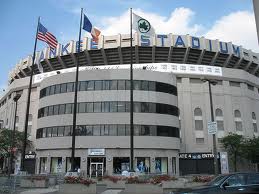
But I have a newly concocted theory about why baseball has fallen off our list of great loves. I formed this theory from Box 215, Seat C2 in Yankee Stadium last weekend with my dad.
Now for anyone who’s read this space more than once, many of you know I’m a card-carrying member of Red Sox Nation.  And dear old dad is a Yankee fan.
That last paragraph is in some respects what’s wrong with baseball. It couldn’t – and can’t – keep fans of teams. It keeps fans of players.
Allow me to explain.
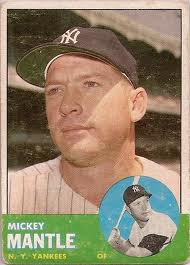
My father became a fan of the New York Yankees during his youth in the 1950s. I say that, and many of you immediately think of Mickey Mantle, Yogi Berra and Whitey Ford.
When my old man went off to serve his country in the late 1960s, he had a shoebox collection of baseball cards of these players and many others. They were a treasured part of his youth, his favorite team and his favorite sport.
While he was away for 18 months, my grandmother trashed the box while cleaning out his room, unaware of its contents. My father was devastated by this news upon returning home from South Korea.
People do not collect baseball cards like that anymore, and certainly are not affected at that level by the loss of them.
Cards or no cards, the passion continued. He’s loved watching and rooting for the New York Yankees all his life. Once a Yankee, always a Yankee.
Until free agency came along, that is, and basically everyone’s been a Yankee over the last 20 years. If you had a decent year, George Steinbrenner would Godfather you into a Yankee uniform (in other words, make you an offer you couldn’t refuse). Never a big fan of the Yankees anyway, it was easy for me to hate them when they gulped up free agents and bought titles.
And then the Red Sox started doing that in the last 10 years, so perhaps it is all the same.
The hard truth is that all we’re rooting for is laundry. The players are gone from year to year. If Mantle played today, he would never have played his whole career in Yankee Stadium. Once his Sabermetrics dropped, he’d be traded to another team, with the Yankees still paying his salary five years later. Furthermore, if this were 40 years ago, Pedro Martinez would have never left Boston. It just wouldn’t happen.
Nevertheless, my dad remains true to the Bronx Bombers. And in all his life, he’d never seen the pinstripes play in the hollowed and fabled grounds at 161st Street in the Bronx.
I thought this was a travesty that needed to be corrected. So, for his 60th birthday, with the help of my wife, my mother and of course, Glenn Dunlap and the great folks at Big League Tours in Greenwood, we set off last weekend for the Big Apple and a big weekend of baseball.
You see, I may not be a fan of the Yankees, but I’m a fan of my father.
It was the trip of a lifetime, for him and for me.
A rainout forced a Saturday doubleheader – we spent 11 hours in Yankee Stadium and we were truly in awe for every minute.  We didn’t want to leave, because as soon as we stepped off the Subway, you could feel it.
History.
Alive – and nearly speaking to us, with its ghosts and the roar of the crowd. It’s almost as if there were horns and trumpets playing every so softly, like something straight out of a movie.
Here we were, inside “The House That Ruth Built” – a place where the Great Bambino smashed so many home runs and teamed with Lou Gehrig to form the 1927 Murderer’s Row lineup. In fact, it was Ruth that hit the first home run in the stadium, a three-run shot to defeat – you guessed it – the Boston Red Sox – in the first game played in Yankee Stadium during the 1923 season.
Sitting there, roughly 25 rows behind home plate, you could almost hear the speeches given on those hallowed grounds, ones that are as revered in sports and life as any made by a president or politician.  Namely, Gehrig’s “Luckiest Man” speech and Knute Rockne’s “Win one for the Gipper” speech.
Then, your head starts spinning when you realize Yankee Stadium has been host to 37 World Series. Wrap your mind around the fact that Gene Tunney, Joe Louis and Muhammad Ali all fought here in some of the greatest boxing matches ever. Remember that the New York Giants and Baltimore Colts played here in one of the NFL’s greatest games in 1958.
Three Popes have celebrated Mass inside the stadium; a memorial service for 9/11 victims was held here on Sept. 23, 2001.
There’s the Frieze (the white architectural work that runs all around the stadium’s outfield walls). There’s the Big Bat (as shown on several episodes of “Seinfeld”) and of course, Monument Park.
I don’t think I’ve ever had goose bumps and the hair stand on the back of my neck for a longer period of time in my life. And that was before the games even started.
When they played a video commemorating New York and the 9/11 victims, showing the tattered and torn American flag, you could have heard a pin drop. When “God Bless America” finished, the cheering at the end by the crowd was so loud your ears rang. 
It was quite emotional, sharing that moment of silence surrounded by New Yorkers who would never forget and reminding us that we shouldn’t either. But it was also a reminder of how baseball soothed the pain that fall of 2001, providing us with a memorable World Series between the Arizona Diamondbacks and of course, the New York Yankees.
Once the games began, delightfully, I watched my father’s eyes beam with joy as we witnessed the 10th and ninth final games to ever be played in Yankee Stadium. In a way, we had become a part of its history as well.
Dad can forget about those lost baseball cards now. He has something much more special.
Just like so many, my dad and I played catch when I was a kid. He coached my Little League teams and came to every game in high school. In the summer of 1998, we glued ourselves to the McGwire and Sosa home run chase. In 2004, my mother wouldn’t let us speak to each other during the ALCS between the Yankees and Red Sox, in large part because a year earlier the playful banter between he and I got so carried away she couldn’t take hearing about it.
Our trip to an 85-year old stadium meant far more than a trip to a football game ever could.
That’s something that the NFL can’t ever get its hands on: the history of the sport, the bonds formed between millions of fathers and sons playing catch. Where else, in what other sport, can you step into a field or a stadium and feel its history so vividly?
And it will soon be gone.
The way sports should be is to not necessarily make us fans of a particular multi-million dollar player or a specific play – but of history and of the bonds formed through time spent together.
Because at the heart of all sports experiences, is a love of the game. Many of us developed our love of baseball or basketball or football or field hockey or swimming from our experiences as youths and in part because of the passion of our parents.
We’re fans of our fathers and fans of our mothers and what they loved. That’s how sports are passed down, generation to generation – not because of David Ortiz or Derek Jeter, but because of how we remember with fondness watching the exploits of Jeter and Ortiz, the same way our parents did Mantle and Ted Williams. And sports are passed down fondly because we share them – together.
And that’s why dad and I had to go, because it was Yankee Stadium.
Because it was my father.
I may not ever be a fan of the New York Yankees, but I’ll always be a fan of my father.
Standard
Derek Jeter, Don Henley, Eminem, LeBron James, New York Yankees

After The Boys of Summer Are Gone

Don Henley wrote nostalgically once about “The Boys of Summer.” A huge hit in 1984, years later Henley told Rolling Stone that the song represented a questioning the past and was about aging. A key line in the song that represents much of this sentiment and self-reflection: “Out on the road today, I saw a Deadhead sticker on a Cadillac. A little voice inside my head said don’t look back, you can never look back.”

It’s an ironic image for the 1980s: once counter-culture, fans of the Grateful Dead  driving around Cadillacs – a status symbol both of maturity and a touch of wealth. 

And whenever I hear it – and you still hear that song this time of year – I think of Derek Jeter. 

Didn’t expect that, did you?

For much of his career, I have held quiet and unassuming hatred for Derek Jeter. He represents the New York Yankees, and as a Boston Red Sox fan, he is the face of the arch-rival’s franchise. Therefore, if you are like me, you are just simply predisposed to disliking the guy.

At least that’s what I thought from 1995-2004. Then, on July 1, 2004, it became a genuine, sports hatred.
The Red Sox and Yankees – nearing the height of their rivalry, were battling tooth and nail in an extra innings game. With the score tied at 3 in the 12th inning, with runners at second and third and two outs, Sox outfielder Trot Nixon hits a pop-up down the third base line. Watching the game, you were certain the ball was heading foul into the stands.

Suddenly, there’s Jeter, screaming into the picture and making an over-the-shoulder catch. He is at the wall, so the force of his momentum launches him over the railing and into the stands. He makes the catch and cuts his chin, but the play ends the inning. Jeter leaves the game, but the Yankees win – and naturally, the announcers are drooling over him like the kid in that “Stacy’s Mom” video fawning over Rachel Hunter.

The announcers go on and on about what a leader “Jete” is, what a gamer, what a captain. It’s nauseating. It’s get-a-room-uncomfortable. It’s nails on a chalkboard to Red Sox fans. Remember, there were wounds still not healed from the previous October, so Sox fans hated everything Yankees even more so than normal. 

In hindsight, it was an amazing play. But I could never see it as such at the time. I was too young to appreciate it.

Fast-forward to the present.

Derek Jeter sits on the cusp of 3,000 hits and suddenly, I am nostalgic. 

After a contentious contract negotiation with the Yankees last winter, and with age becoming a factor, Jeter’s on the tail end of his career. And despite being a Yankee, I cannot help but feel sad that we’re losing something here. 

Jeter reminds you of the old boys of baseball. The Mantle’s, the Ryan’s – and some combination of both. He is a pretty tough cat, but he’s got this high amount of celebrity cache. The man has been with nearly every attractive celebrity female on the planet. 

Somehow, with all that happens in the current media age (Twitter, Facebook and 24/7 scrolling tickers) Jeter has managed to be in the public eye without anyone really knowing anything. It is like old Hollywood, really. People say they saw Jeter out doing this or that, hanging with this woman or that woman, but there’s no pictures, no proof – just stories. It’s mysterious, but not in a bad way since it leaves something to the imagination.

With Tiger Woods, once it all came out, there was literally nothing left to the imagination. In fact, your imagination died painfully as you scrubbed your eyes with Clorox. Either Jeter’s really, really good and doesn’t text people or he’s paid off everyone in Manhattan to keep quiet. And either way, that is pretty freakin’ cool.

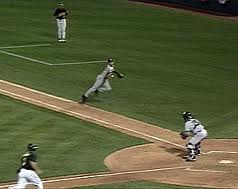
Despite advancing in age and putting tons of miles on the tires with all the Yankees postseason runs, Jeter just went on the disabled list for the first time since 2003. He has really been a model of efficiency offensively and defensively. He is the only guy who could pull off forcing Alex Rodriguez to move to third base and then have people say that A-Rod was a better shortstop. And Jeter holds so many memories of iconic plays – mainly the flip play, where he tossed the ball to Jorge Posada to tag out Jason Giambi while running the opposite direction after cutting off a throw from right in 2001. 

I still don’t like Derek Jeter, yet I cannot help but feel odd (and old) that his time left in baseball is short.

We forget that athletes age too. Oh, we see it. We can see the gray hair and the loss of physique. We watch them stumble and get burned because they have lost a step – but we are not really comprehending it. At first, they get by on raw talent and athleticism. But in the end, it is all about being a cagey veteran who knows how a situation on the field or on the court will play out because they have been there, done that. 

This is where Jeter is at, like so many before him – getting by on what he knows and how the movie plays out. He has the script, he’s just executing the lines with more nuance. But the time is coming where he will not be able to get by on his wits anymore. 

And what does he do then? Naturally, he retires and becomes a manger or a TV analyst and becomes something entirely different. The better question is, what do we do next? 

It is always odd watching guys like Charles Barkley, Dan Marino and Troy Aikman in the studio or calling games. To anyone under the age of 30, that is all these guys are – old dudes referencing a game they once used to play. People view them with a sort of “Sure, I bet, old man” reverence, which is to say, “I hear you, but it’s just words.”

To anyone over 30, we remember how good these guys were. We were there, we saw their prime and we still hold them in high regard. 

And that difference in how people view athletes from one generation to the next is a striking similarity to Don Henley’s song and how we operate day-to-day in our own lives. It is why someone who enjoys Eminem does not get why people think NWA was controversial. It is why LeBron James can never be Michael Jordan. It is why I cannot begin to tell my kid how cool “Tecmo Bowl” was, because he has an X-Box and can run his own franchise, create himself as a player and set the price of popcorn in the concession stand. 

Perhaps that is why we can’t look back. We can never look back because only you understand the intrinsic value of what you’re looking back at if you were actually there to witness it.

In other words, for both Jeter and for me, getting older sucks.

Standard